Chicago
Aimee Marcereau DeGalan, Editor, French Paintings and Pastels, 1600–1945: The Collections of the Nelson-Atkins Museum of Art (Kansas City: The Nelson-Atkins Museum of Art, 2021–2025), https://doi.org/10.37764/78973.
MLA
Marcereau DeGalan, Aimee. Editor. French Paintings and Pastels, 1600–1945: The Collections of the Nelson-Atkins Museum of Art. The Nelson-Atkins Museum of Art, 2021–2025. doi: 10.37764/78973.
Pierre Puvis de Chavannes, Return from the Hunt or The Boar Hunt, ca. 1859–62, oil on panel, 18 1/8 x 14 3/4 in. (46.1 x 37.5 cm), Purchase: William Rockhill Nelson Trust, 33-149
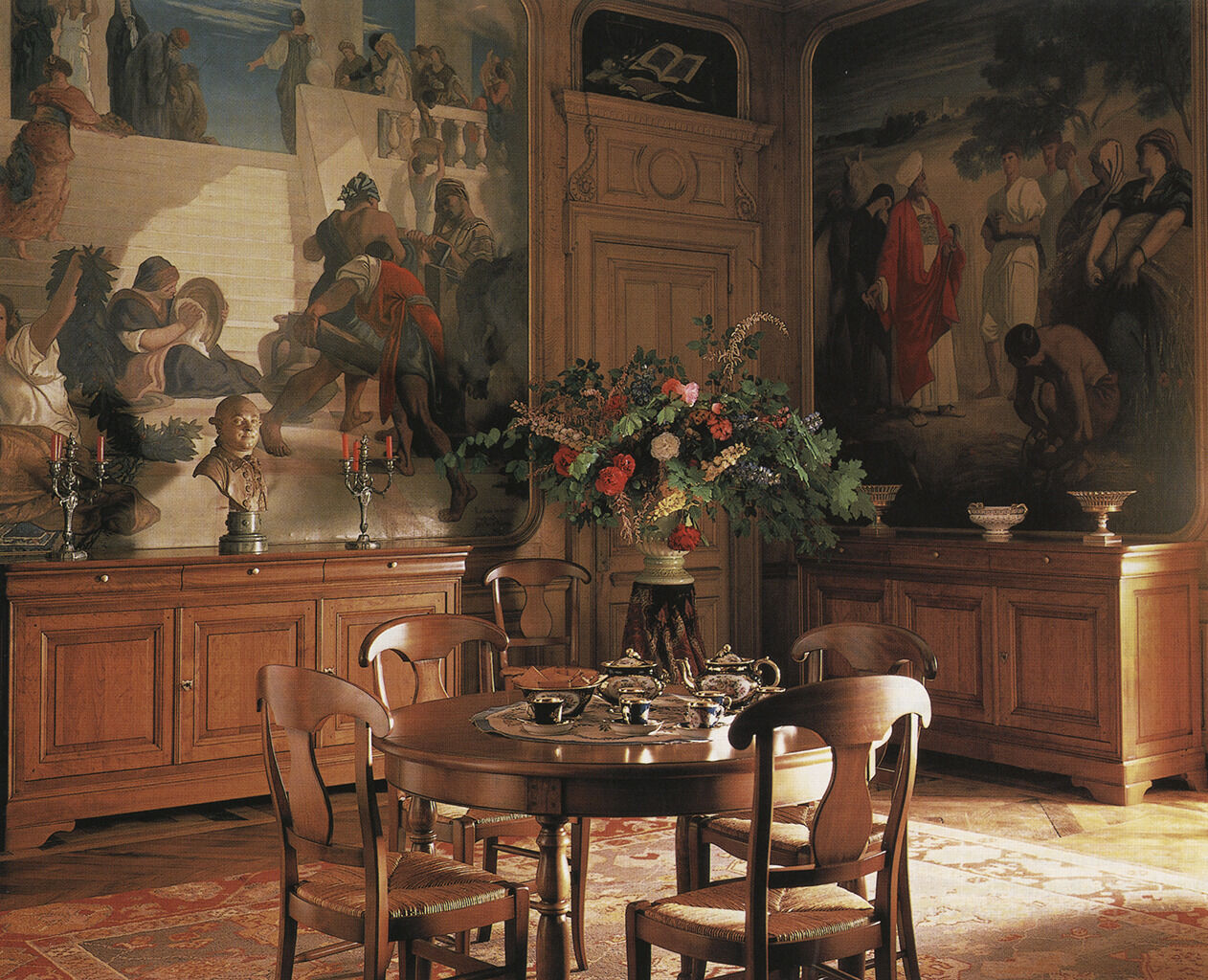
Fig. 1. Pierre Puvis de Chavannes, The Four Seasons, 1854–55, oil on canvas, decoration of the dining room at Le Château du Brouchy
Toggle Caption
Toggle Dual View
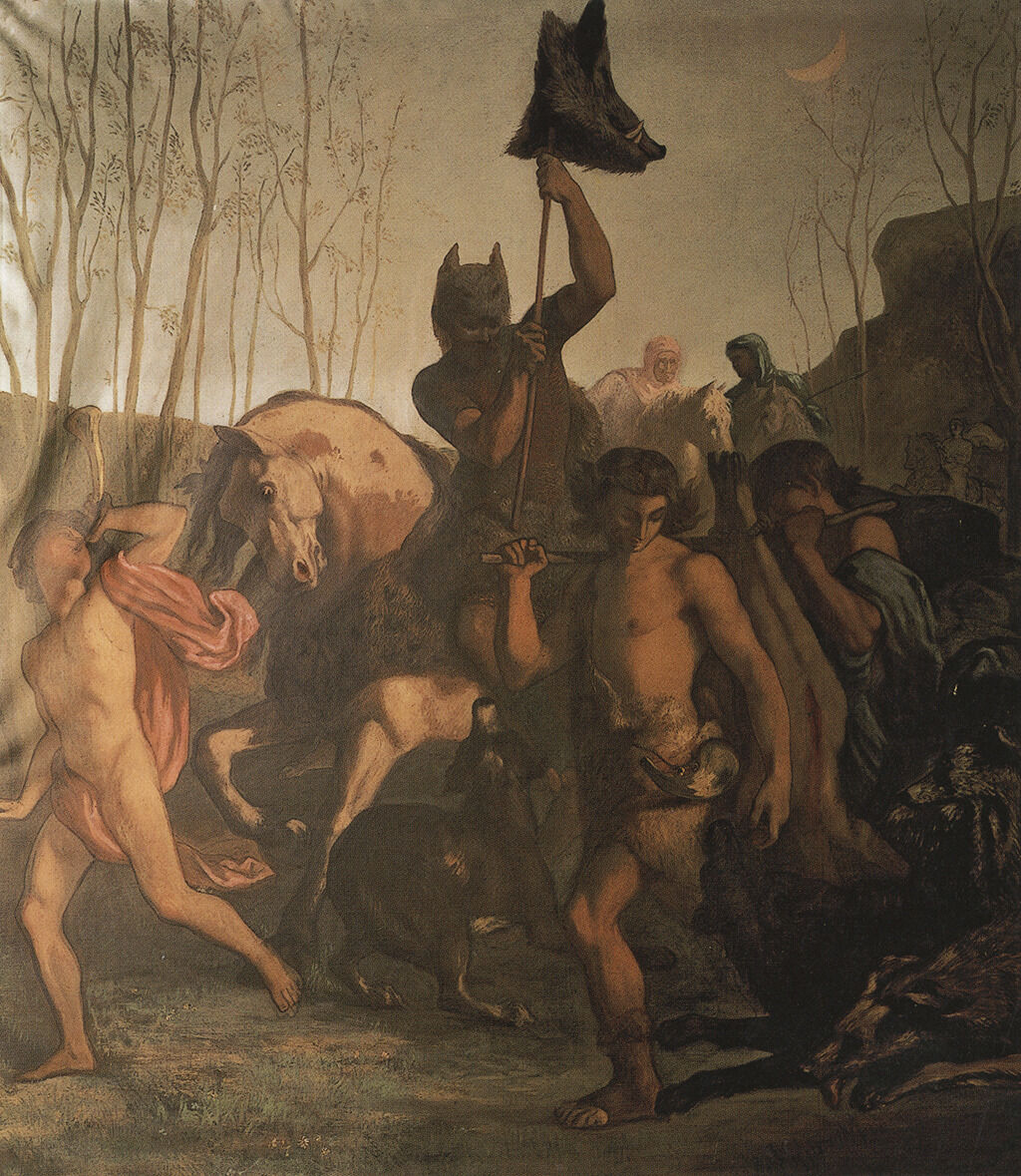
Fig. 2. Pierre Puvis de Chavannes, Esau’s Return from the Hunt or Winter, 1854–55, oil on canvas, 98 x 87 1/2 in. (249 x 222.3 xm), private collection, Le Brouchy, France
Toggle Caption
Toggle Dual View
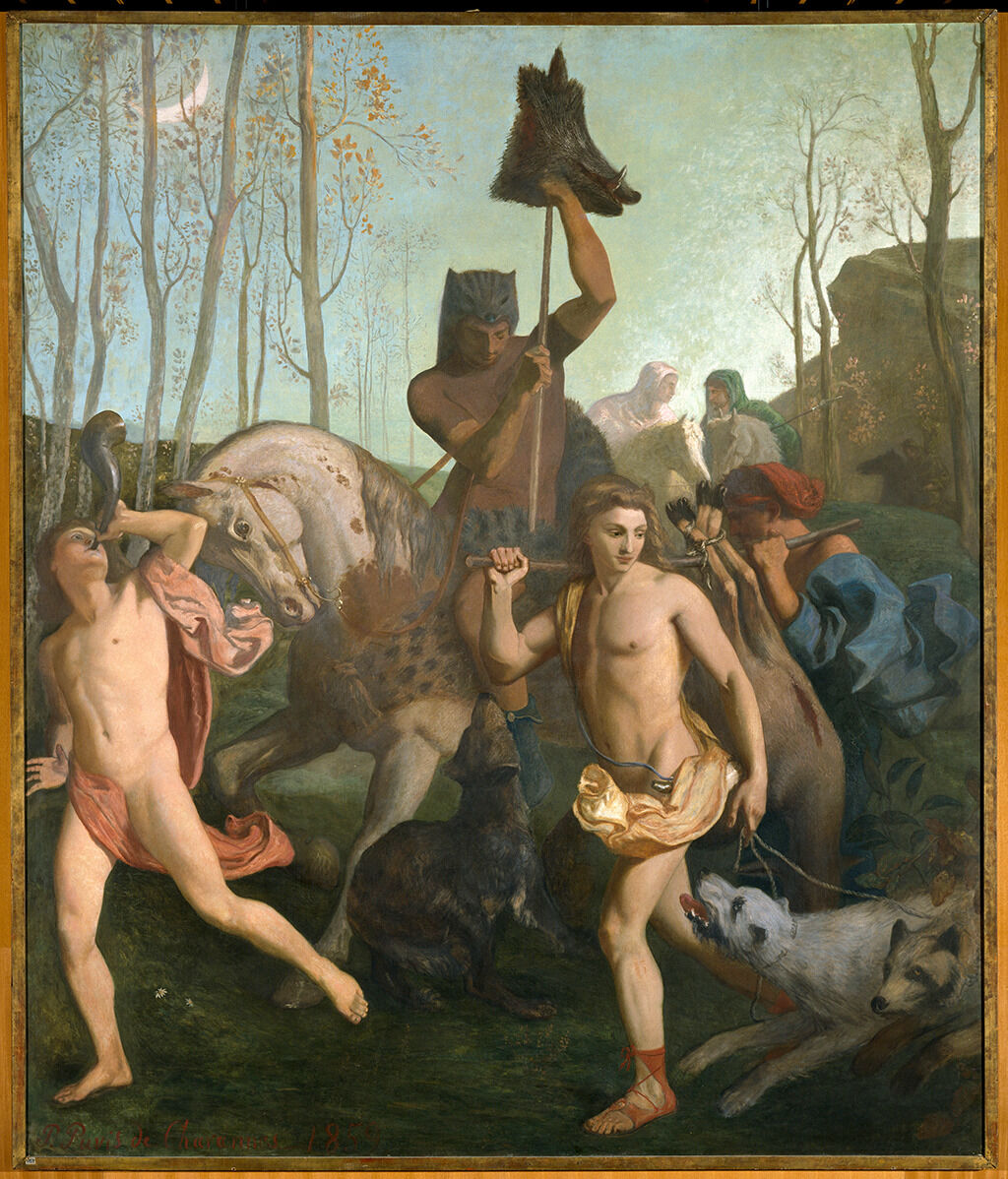
Fig. 3. Pierre Puvis de Chavannes, Return from the Hunt, 1859, oil on canvas, 155 1/2 x 116 1/8 in. (395 x 295 cm), Musée des Beaux-Arts, Marseille, inv. 214
Toggle Caption
Toggle Dual View
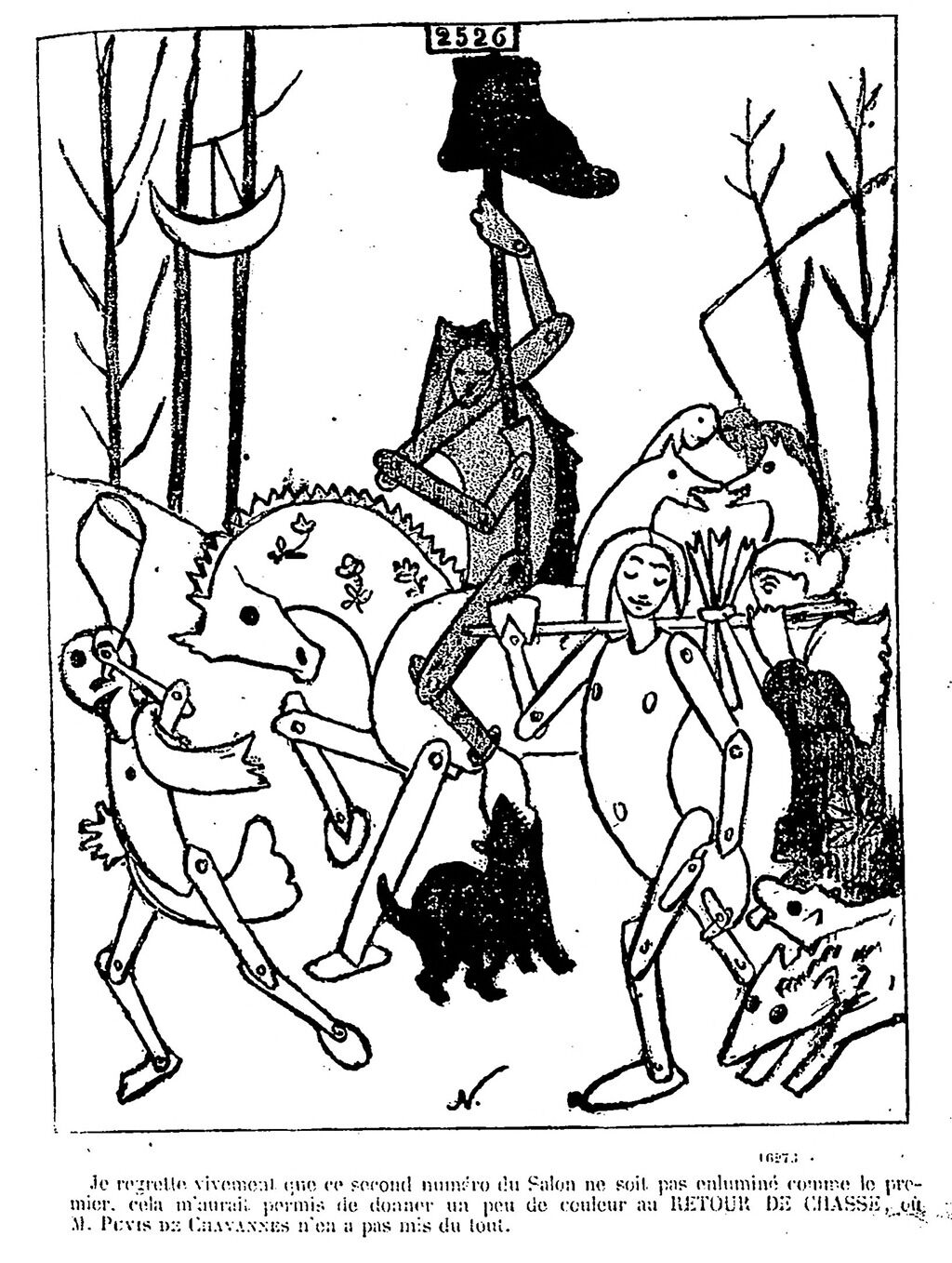
Fig. 4. Attributed to Félix Nadar (Gaspard Félix Tournachon, 1820–1910), after Pierre Puvis de Chavannes, caricature of Return from the Hunt, 1859, reproduced in Journal pour Rire: Le Journal Amusant, no. 185 (July 16, 1859): 5, Bibliothèque nationale de France, Paris
Toggle Caption
Toggle Dual View
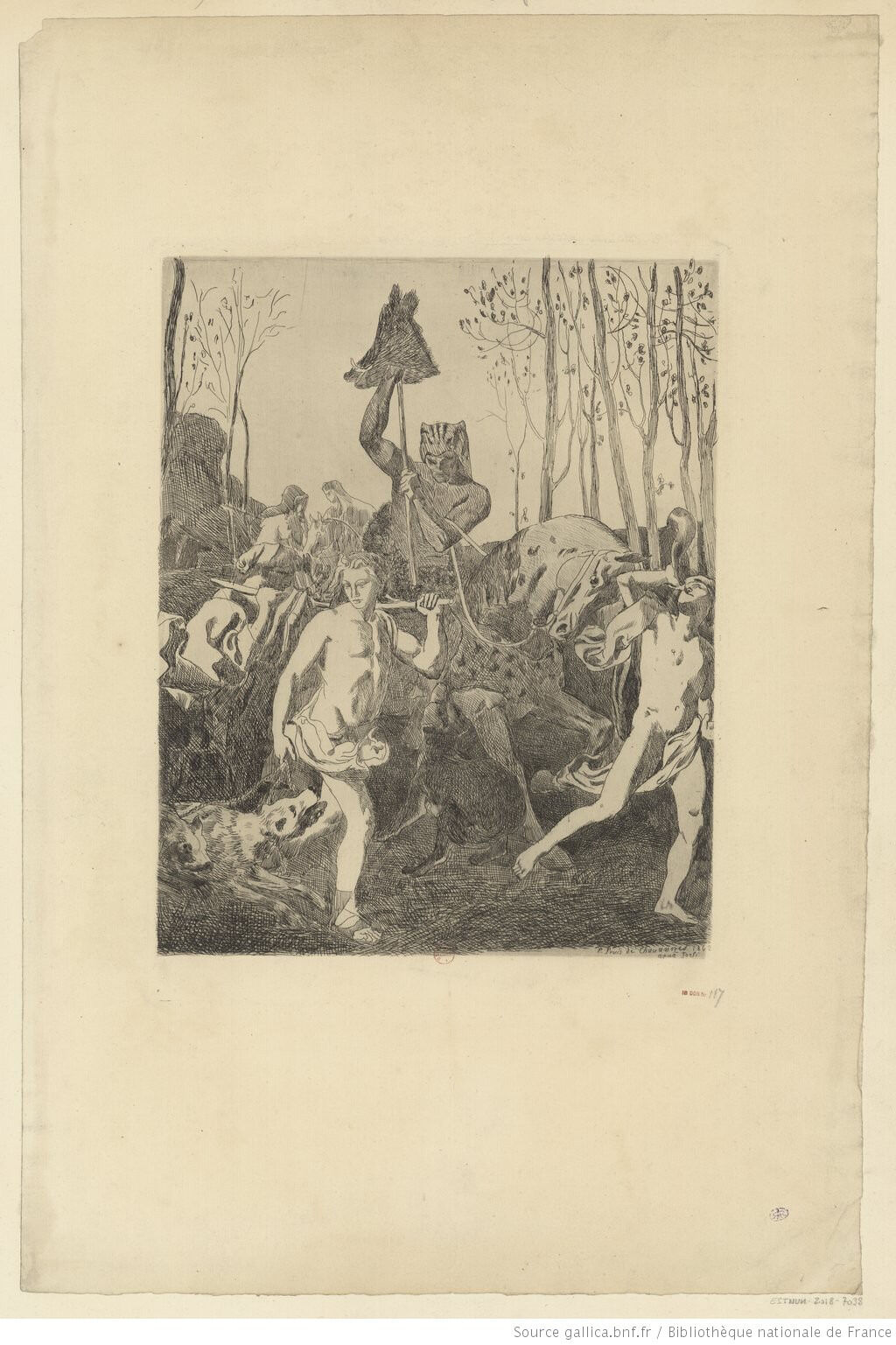
Fig. 5. Pierre Puvis de Chavannes, Return from the Hunt, etching on laid paper, second and last state, 12 1/2 x 9 1/2 in. (31.7 x 24.2 cm), Bibliothèque nationale de France, Paris, département des Estampes et photographie, DC-303 (H)-FOL
Toggle Caption
Toggle Dual View
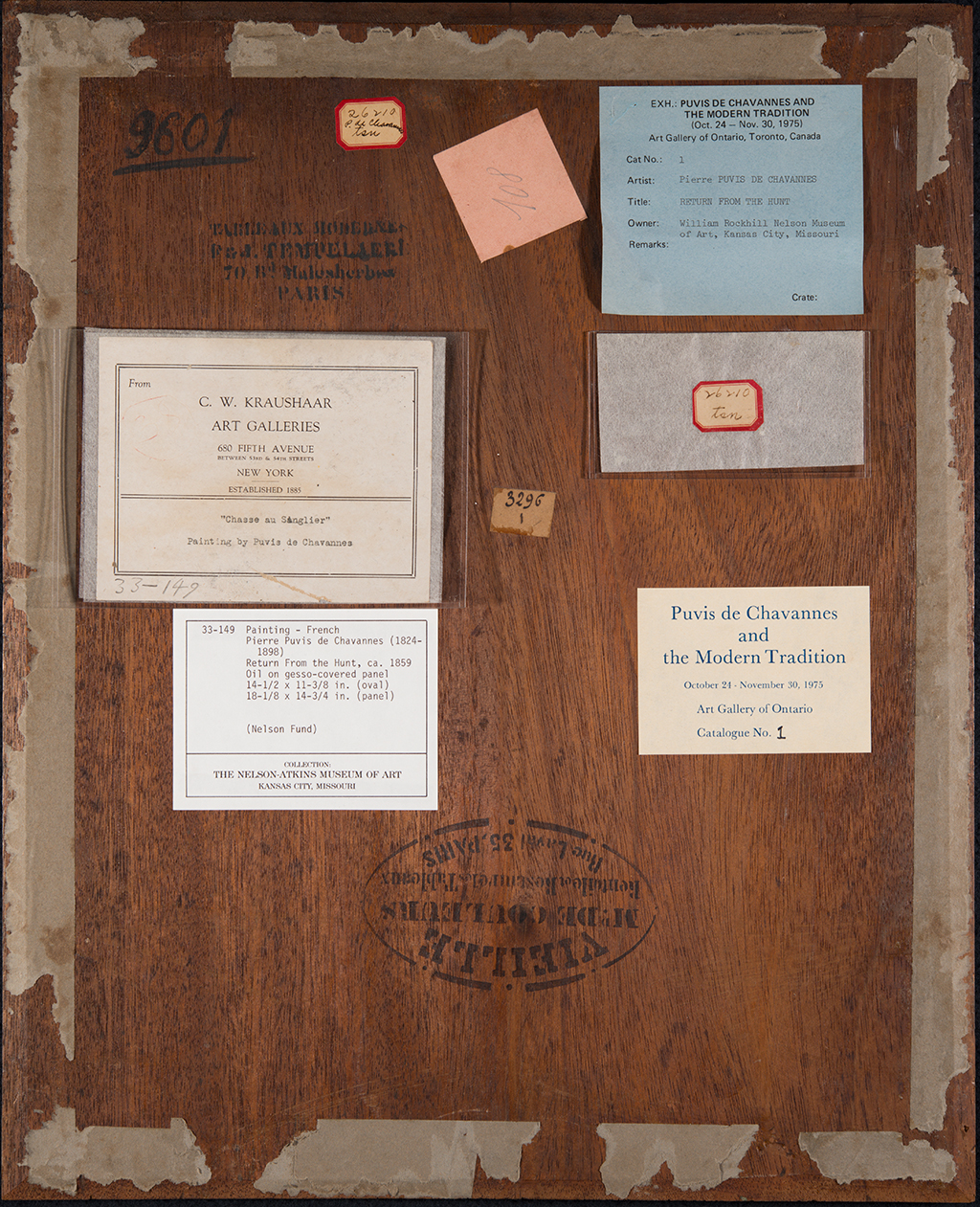
Fig. 6. Panel reverse of Return from the Hunt (ca. 1859–62), showing two supplier stamps
Toggle Caption
Toggle Dual View
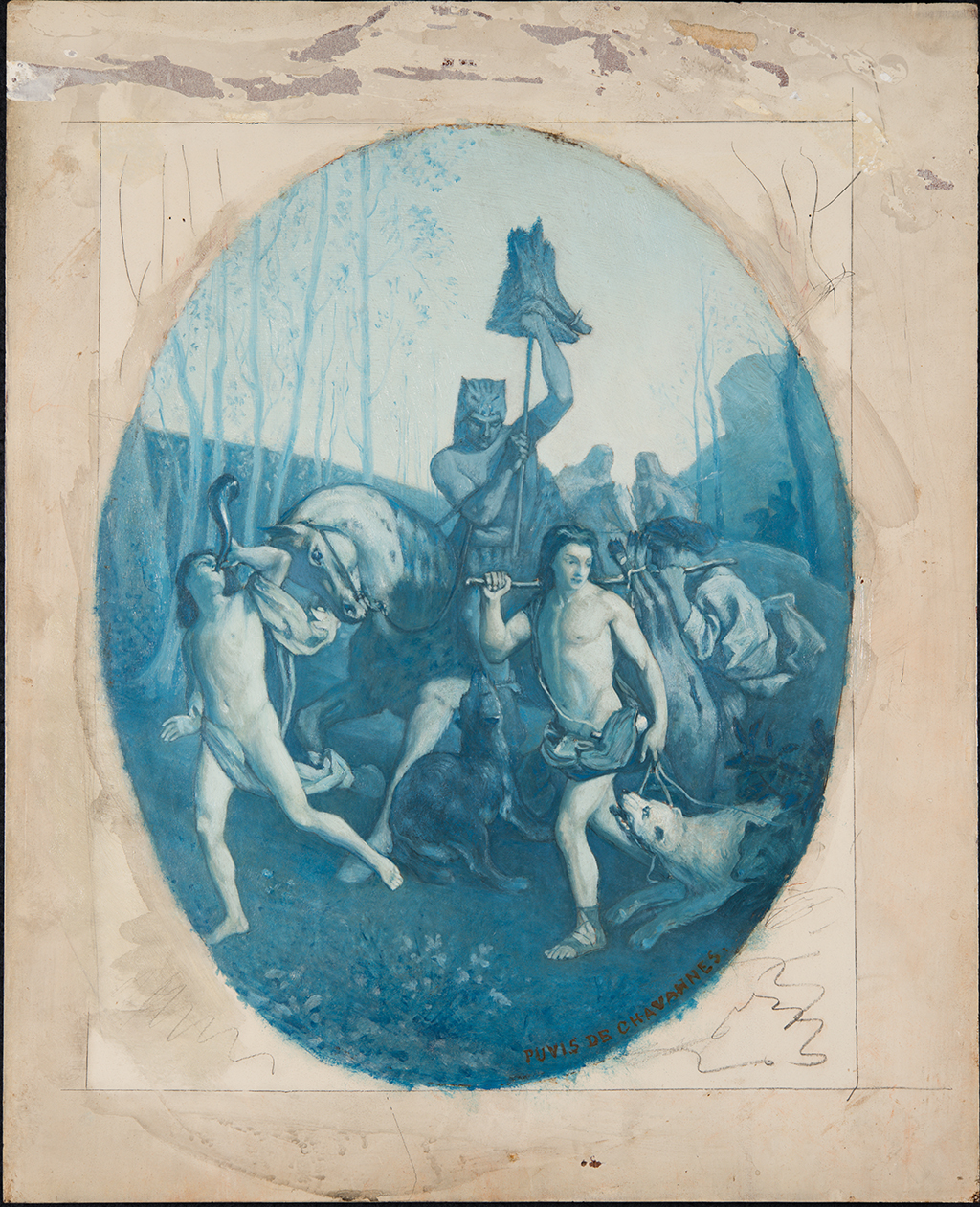
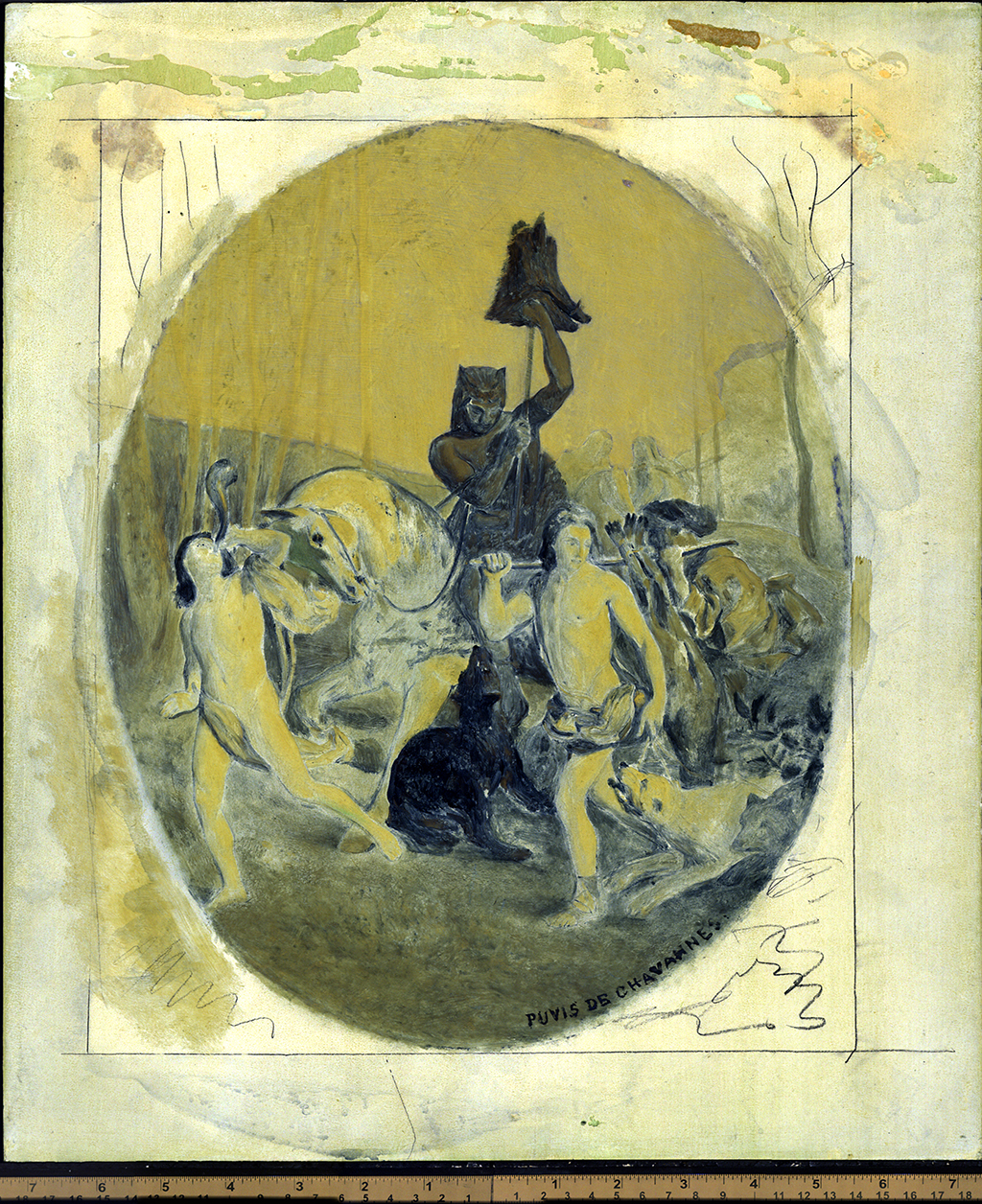
Fig. 7. Overall photograph of Return from the Hunt (ca. 1859–62)
Toggle Caption
Toggle Dual View
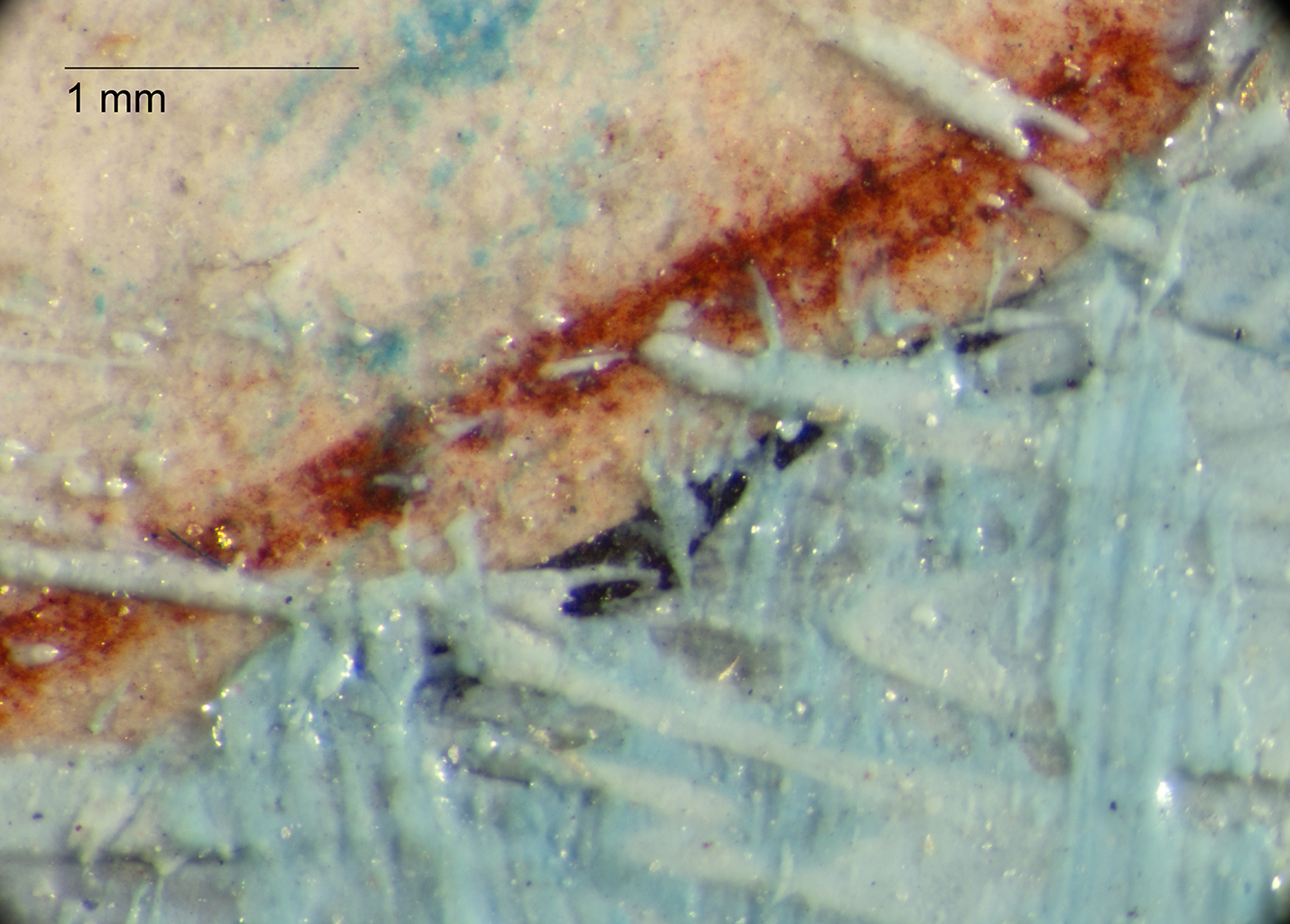
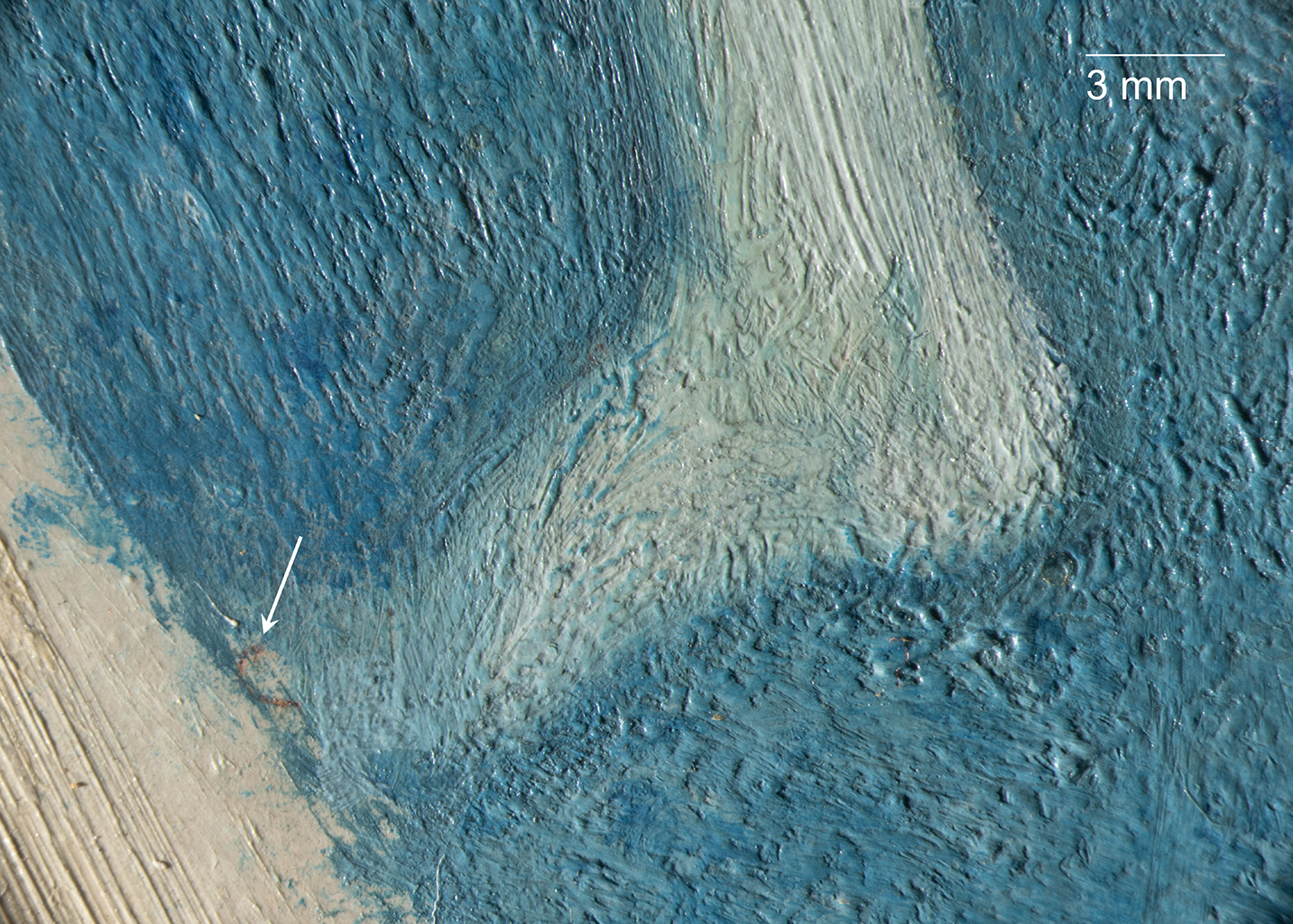
Fig. 8. Photomicrograph of the lower right edge of Return from the Hunt (ca. 1859–62), revealing two lines that were used to mark the elliptical boundary
Toggle Caption
Toggle Dual View
Fig. 9. False-color infrared image with wavelengths of 1436nm assigned to red, 1726nm assigned to green, and 2138nm assigned to blue, Return from the Hunt (ca. 1859–62)
Toggle Caption
Toggle Dual View
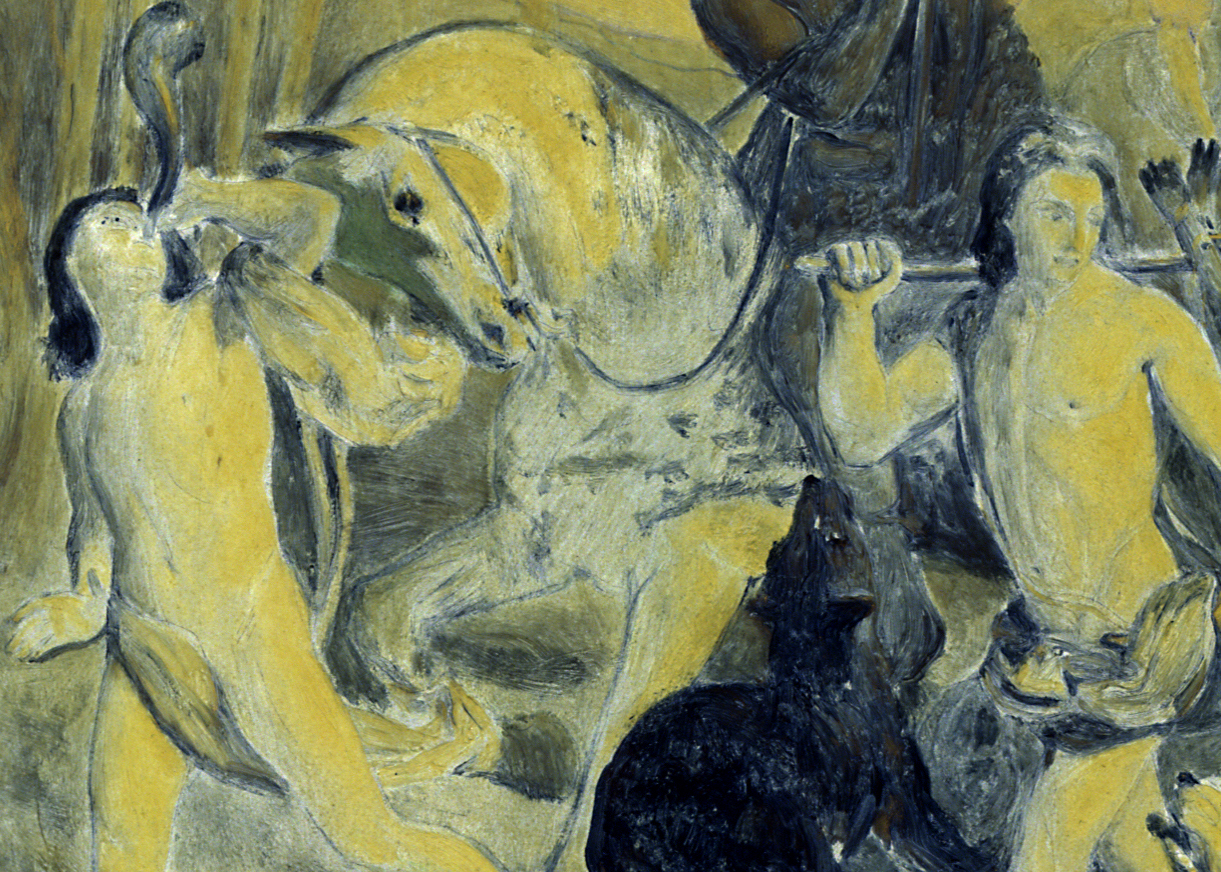
Fig. 10. Detail of false-color infrared image with wavelengths of 1436nm assigned to red, 1726nm assigned to green, and 2138nm assigned to blue, Return from the Hunt (ca. 1859–62). Fine lines mark the contours of forms and define areas of shadow, often with hatching lines (chest of horse).
Toggle Caption
Toggle Dual View
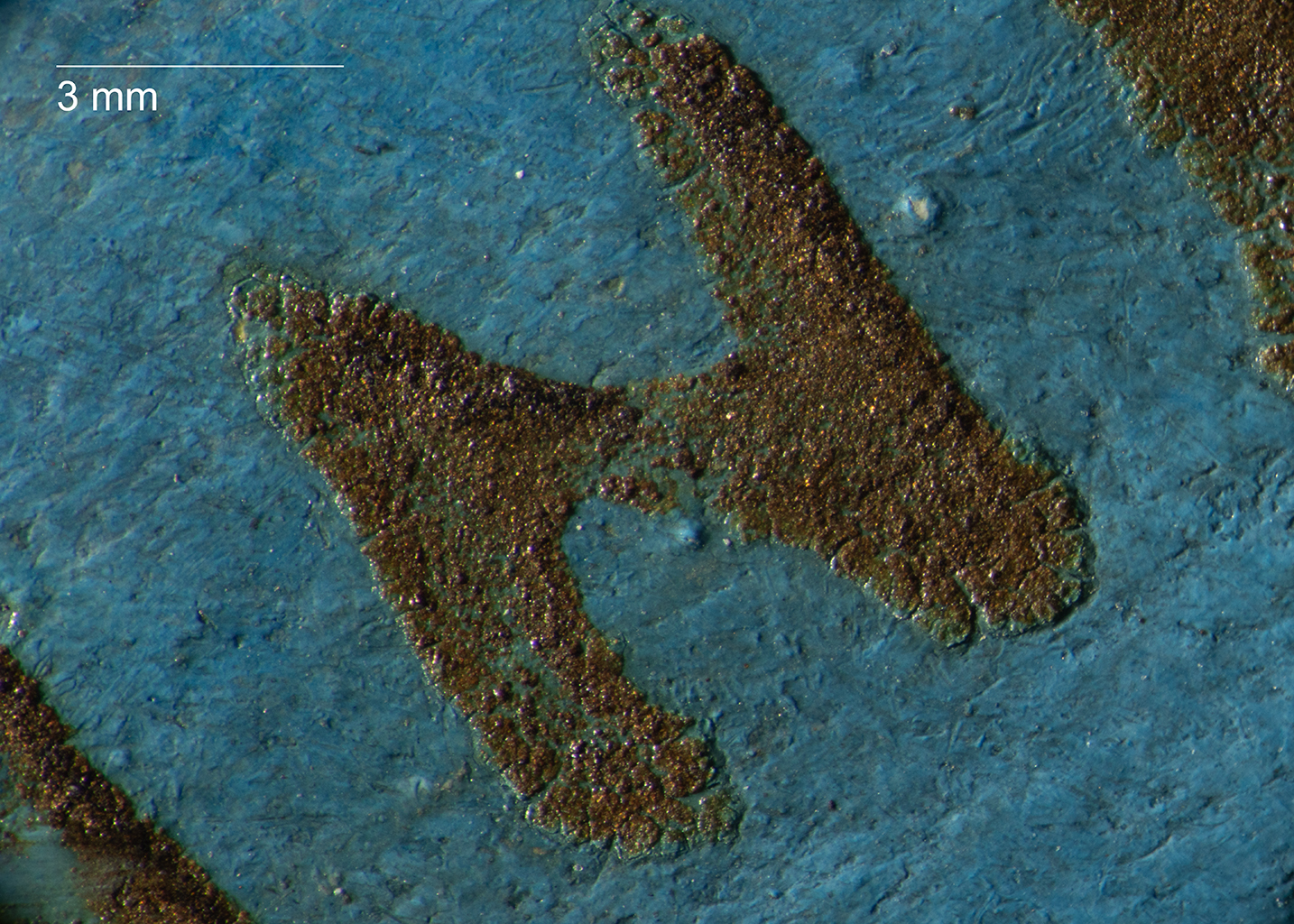
Fig. 11. Photomicrograph of the left figure’s foot, extending beyond the edge of the ellipse, Return from the Hunt (ca. 1859–62)
Toggle Caption
Toggle Dual View
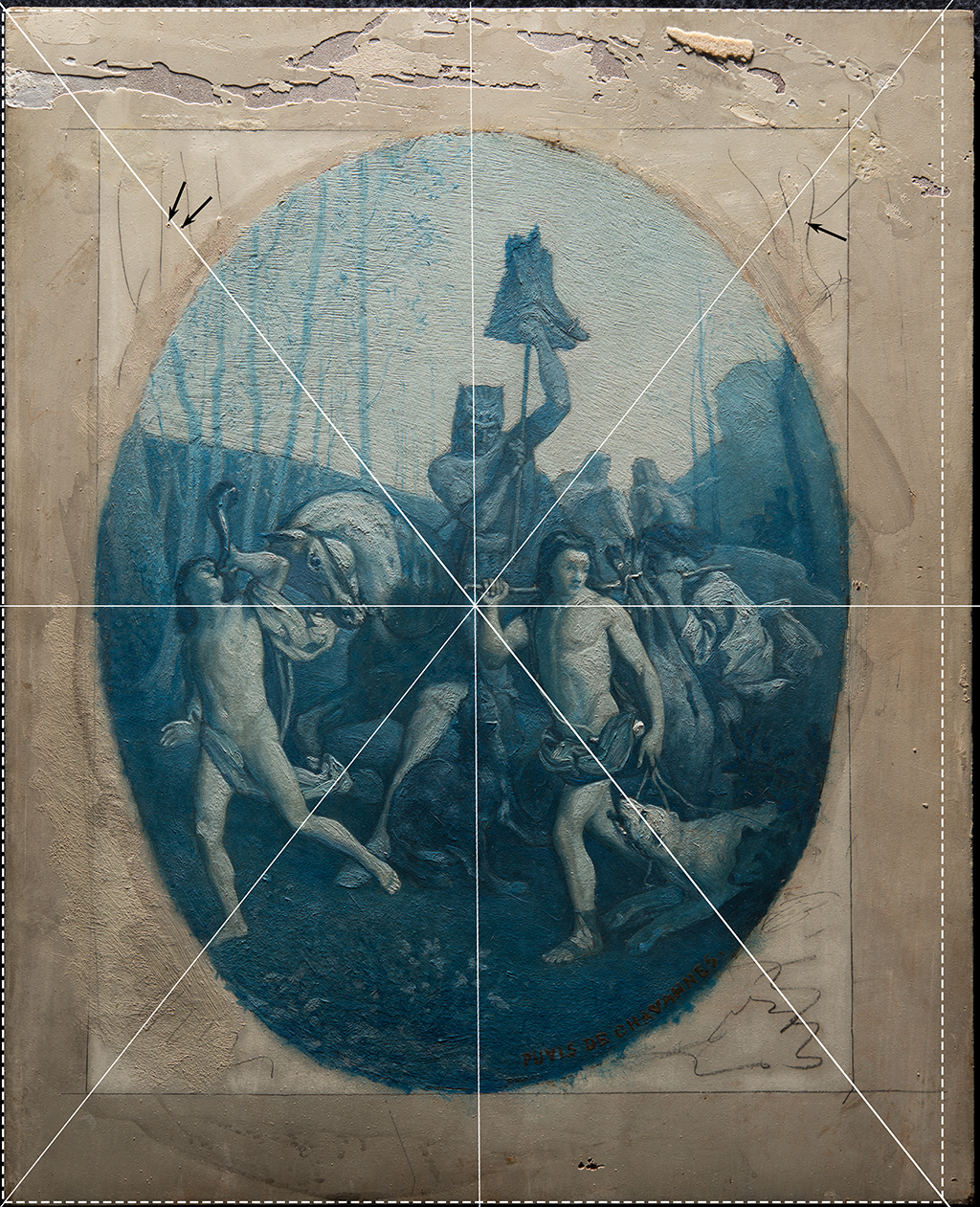
Fig. 12. Raking illumination of Return from the Hunt (ca. 1859–62), showing the textures of the ground, tack holes (upper corners), and paint. The dotted lines mark the equivalent distance of the panel, taking into account a mismeasurement by the artist, while the other lines mark the centers of the ellipse and connect with holes made into the ground and the dog’s muzzle.
Toggle Caption
Toggle Dual View
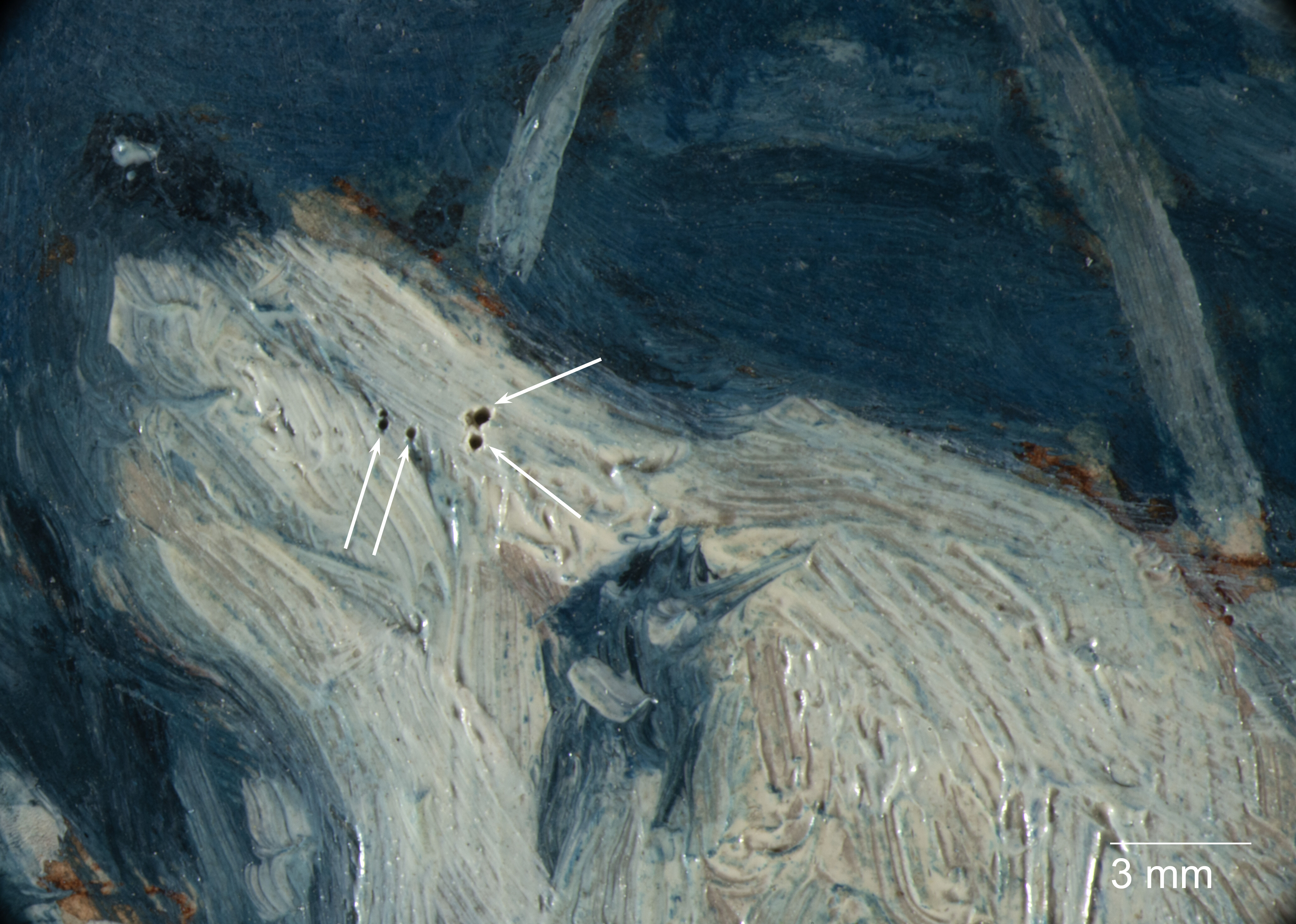
Fig. 13. Photomicrograph of Return from the Hunt (ca. 1859–62), revealing a group of pinholes on the right dog’s muzzle
Toggle Caption
Toggle Dual View
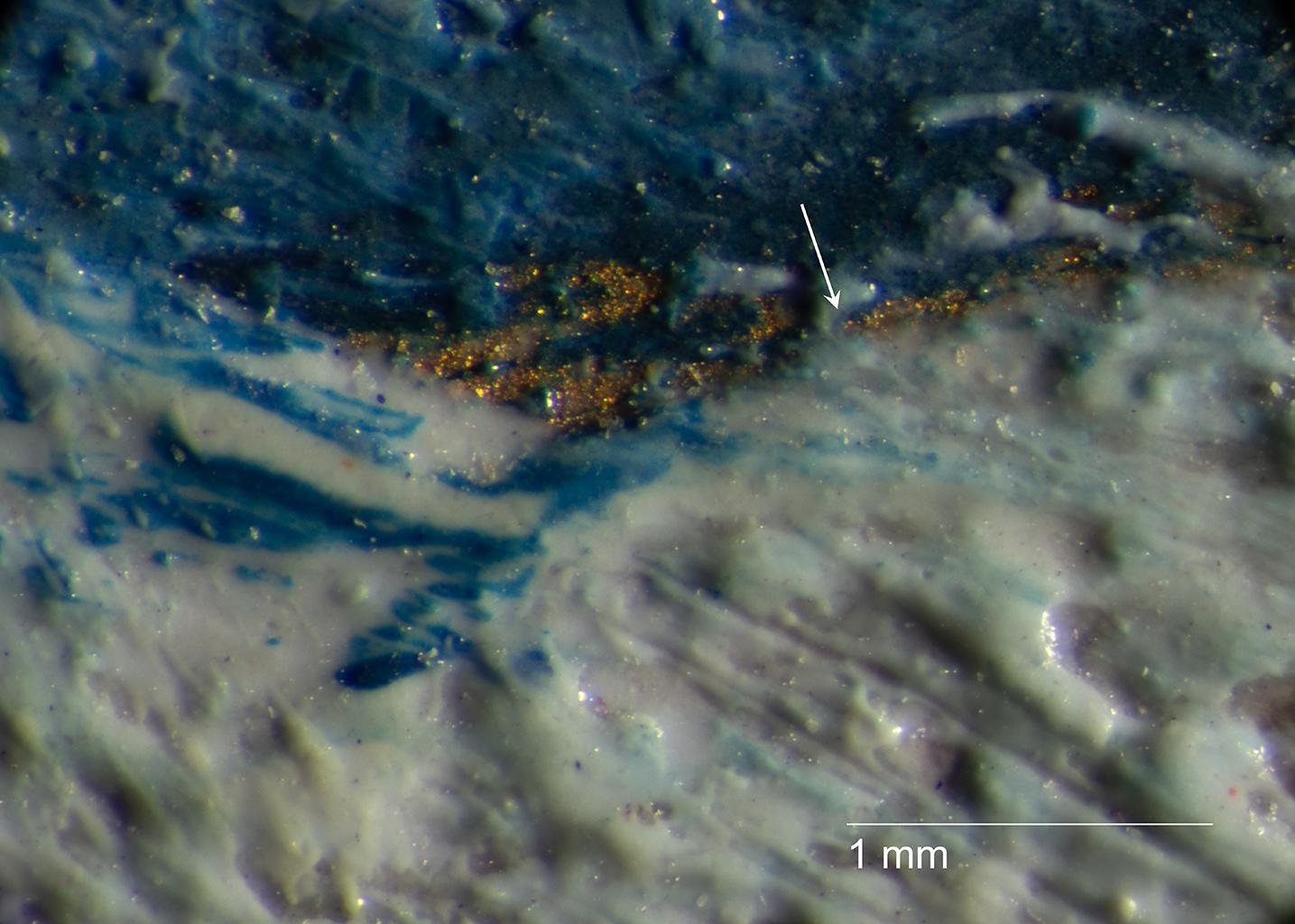
Fig. 14. Photomicrograph with raking illumination, Return from the Hunt (ca. 1859–62), revealing the gold layer that is present beneath the sky
Toggle Caption
Toggle Dual View
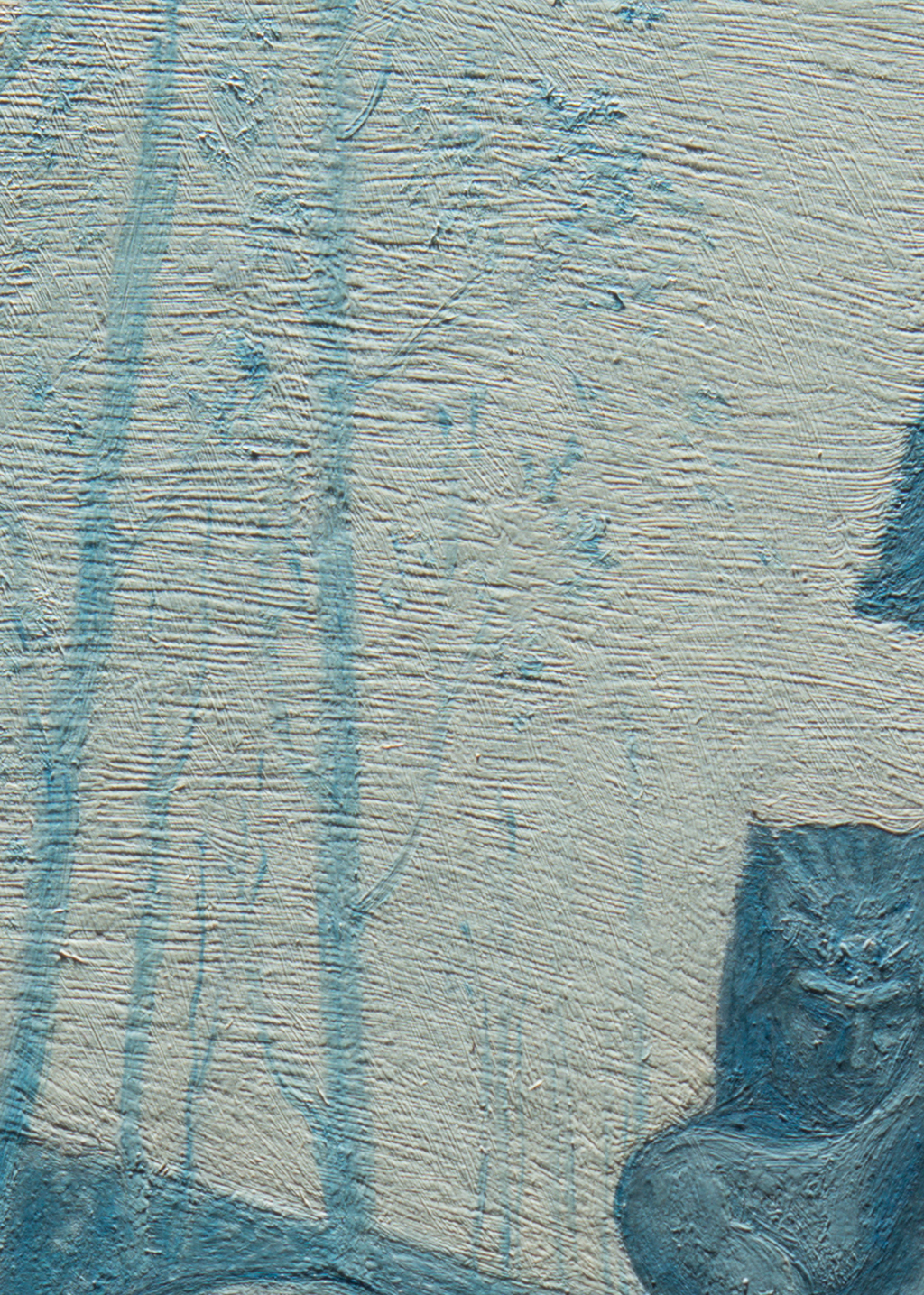
Fig. 15. Photomicrograph of the left sky, Return from the Hunt (ca. 1859–62), showing the two layers of off-white paint applied on top of the gold layer. The first layer of thick paint produced a horizontal, striated appearance, and the thinner second layer was added with somewhat diagonal brushwork.
Toggle Caption
Toggle Dual View
Fig. 16. Photomicrograph of the signature, Return from the Hunt (ca. 1859–62)
Toggle Caption
Toggle Dual View
Pierre Puvis de Chavannes, Return From the Hunt or The Boar Hunt, ca. 1859–62
Aimée Brown Price, “Pierre Puvis de Chavannes, Return From the Hunt or The Boar Hunt, ca. 1859–62,” catalogue entry in French Paintings and Pastels, 1600–1945: The Collections of the Nelson-Atkins Museum of Art, ed. Aimee Marcereau DeGalan (Kansas City: The Nelson-Atkins Museum of Art, 2025), https://doi.org/10.37764/78973.5.530.5407.
MLA:
Price, Aimée Brown. “Pierre Puvis de Chavannes, Return From the Hunt or The Boar Hunt, ca. 1859–62,” catalogue entry. French Paintings and Pastels, 1600–1945: The Collections of The Nelson-Atkins Museum of Art, edited by Aimee Marcereau DeGalan, Nelson-Atkins Museum of Art, 2025. doi: 10.37764/78973.5.530.5407.
Return from the Hunt depicts men riding and striding into the
compositional space, the first of whom trumpets their success on a ram’s
horn while two others carry a deer carcass suspended from a pole, the
excitement intensified by yapping dogs. At center, on horseback, a rider
in a leopard skin (since antiquity, an apt outfit in art for the hunt),
triumphantly sports a boar’s head high atop a stake (possibly his
spear). Somewhat more faintly, in the middle distance, more men on
horseback bring up the rear. A sense of energy emanates from the poses,
the sense of movement, and the drapery that (for propriety’s sake)
swirls about the lower limbs of two virtually unclad figures. Even in
this early painting, the carefully calibrated construction of figures
and spaces that would characterize Puvis’s later work is evident. Here
are the beginnings of the coordinated forms, repeated rhythms, and
rhyming limbs that lock the elements into an ineluctable compositional
whole. A variant version of a subject Puvis had painted earlier, this
work, with its adventurous elliptical format and essentially
monochromatic blue tonalities, also marks his transition to developing
an aesthetic for décorations—of which murals comprise one
category—compositions designed to enhance architecture and subsume
themselves to a wall. Indeed, décorations (not mere decorations, as
the English cognate might suggest) engendered simplified, flattened,
transmogrified, and—though not to beg the question—“artful”
representations of both the actual and fanciful. Décorations provided an
avenue to an aesthetic that differed strikingly from that of traditional
easel painting, prefiguring modernism as we know it in Western art.
Fig. 1. Pierre Puvis de Chavannes, The Four Seasons, 1854–55, oil on canvas, decoration of the dining room at Le Château du Brouchy
fullscreen
Fig. 1. Pierre Puvis de Chavannes, The Four Seasons, 1854–55, oil on canvas, decoration of the dining room at Le Château du Brouchy
Fig. 2. Pierre Puvis de Chavannes, Esau’s Return from the Hunt or Winter, 1854–55, oil on canvas, 98 x 87 1/2 in. (249 x 222.3 xm), private collection, Le Brouchy, France
fullscreen
Fig. 2. Pierre Puvis de Chavannes, Esau’s Return from the Hunt or Winter, 1854–55, oil on canvas, 98 x 87 1/2 in. (249 x 222.3 xm), private collection, Le Brouchy, France
Fig. 3. Pierre Puvis de Chavannes, Return from the Hunt, 1859, oil on canvas, 155 1/2 x 116 1/8 in. (395 x 295 cm), Musée des Beaux-Arts, Marseille, inv. 214
fullscreen
Fig. 3. Pierre Puvis de Chavannes, Return from the Hunt, 1859, oil on canvas, 155 1/2 x 116 1/8 in. (395 x 295 cm), Musée des Beaux-Arts, Marseille, inv. 214
Fig. 4. Attributed to Félix Nadar (Gaspard Félix Tournachon, 1820–1910), after Pierre Puvis de Chavannes, caricature of Return from the Hunt, 1859, reproduced in Journal pour Rire: Le Journal Amusant, no. 185 (July 16, 1859): 5, Bibliothèque nationale de France, Paris
fullscreen
Fig. 4. Attributed to Félix Nadar (Gaspard Félix Tournachon, 1820–1910), after Pierre Puvis de Chavannes, caricature of Return from the Hunt, 1859, reproduced in Journal pour Rire: Le Journal Amusant, no. 185 (July 16, 1859): 5, Bibliothèque nationale de France, Paris
Fig. 5. Pierre Puvis de Chavannes, Return from the Hunt, etching on laid paper, second and last state, 12 1/2 x 9 1/2 in. (31.7 x 24.2 cm), Bibliothèque nationale de France, Paris, département des Estampes et photographie, DC-303 (H)-FOL
fullscreen
Fig. 5. Pierre Puvis de Chavannes, Return from the Hunt, etching on laid paper, second and last state, 12 1/2 x 9 1/2 in. (31.7 x 24.2 cm), Bibliothèque nationale de France, Paris, département des Estampes et photographie, DC-303 (H)-FOL
Various versions of this painting have been published with
somewhat differing titles, even to including or eliminating the
French article “le” or “la.” The Musée d’Orsay calls the Salon
version of 1859, now in Marseilles, Retour de Chasse (Return from
the Hunt), but their own catalogue, Puvis de Chavannes et le musée
des Beaux-Arts de Marseille (Marseille: Musée des Beaux-Arts,
1984), no. 1, p. 52, titles the work Le Retour de la chasse and
The Boar Hunt (La Chasse au Sanglier). Following previously
published sources, Aimée Brown Price, Pierre Puvis de Chavannes,
vol. 2, A Catalogue Raisonné of the Painted Work (New Haven: Yale
University Press, 2010), no. 95, pp. 68–69, lists the Nelson-Atkins
painting as La Chasse au sanglier/ Return from the Hunt or The
Boar Hunt.
For a more extensive discussion of the Le Brouchy murals and
reproductions, see Price, Pierre Puvis de Chavannes, nos. 48–61,
pp. 1:36; 2:34–43. Since 1992, Le Brouchy has been classified as a
Monument Historique; see
https://association-dartagnan.fr/index.php/publications/15-traditions-bressanes/286-le-chateau-du-brouchy
(with several errors, including that Puvis’s paintings there are
“fresques” or frescoes) and
https://fr.wikipedia.org/wiki/Ch%C3%A2teau_du_Brouchy.
The dimensions of the Le Brouchy mural are 98 x 87 1/2 in. (249 x
222.3 cm). For Puvis’s preliminary oil sketch of 1854, which is 21
7/8 x 18 7/8 in. (55.5 x 48 cm.), see Price, Pierre Puvis de
Chavannes, no. 51, pp. 1:36, 57, and 2:35.
In biblical Hebrew, “game” is not what Isaac sought, but
“delicacies.” Game, the result of the hunt, is how the term has been
translated into English—or “gibier” in French (undoubtedly Puvis’s
source). Here this is represented by venison and boar, although in
fact boar would have been forbidden food for the family of this
Hebrew patriarch.
Price, Pierre Puvis de Chavannes, no. 94, pp. 2:67–8, and for further discussion.
Price, Pierre Puvis de Chavannes, 67 (see under “Sources and
Literature”). See also Théophile Gautier, “Exposition de 1859,”
Moniteur Universel (June 23, 1859): 721–22. Puvis’s entries to the
Salon had been rejected since 1850.
The caption of this caricature reads: “Je regrette vivement que ce
second numéro du Salon ne soit pas enluminé comme le premier cela
m’aurait permis de donner un peu de couleur au RETOUR DE CHASSE,
où M. Puvis de Chavannes n’en a pas mis du tout” (I deeply regret
that this second issue of the Salon is not illuminated like the
first, which would have allowed me to add a little color to THE
RETURN FROM THE HUNT, where Mr. Puvis de Chavannes did not add any at all).
My thanks for the superb documentation files at the Nelson-Atkins
Museum of Art for these references and to the staff there for
bringing them to my attention.
Indeed, Ian Kennedy, the former Louis L. and Adelaide C. Ward Curator of
European painting and sculpture, noting just those elements that had
been satirized, inquired whether the Nelson-Atkins Return from the
Hunt might not be a copy, because it was “too wooden and stiff.”
Ian Kennedy to the author, November 10, 2004, NAMA curatorial
files.
See the superb analysis by Douglas Druick in Puvis de Chavannes,
1824–1898, exh. cat. (Paris: Éditions des musées nationaux, 1976),
no. 33, p. 53–55; also Douglas W. Druick, “Puvis and the Printed
Image, 1862–1898,” Nouvelles de l’estampe (1977): 27–35. Druick
wonders whether Félix Braquemond might have had a hand in producing
the print.
Bruno Foucart, in his entry on the print in Puvis de Chavannes:
Une voie singulière au siècle de l’Impressionnisme, exh. cat.
(Amiens: Musée de Picardie, 2006), no. 65, p. 100, relies heavily on
and quotes Druick, “Puvis and the Printed Image,” 28–29, at length.
I have previously written about Puvis’s blue tonalities, notably
in Fantasy (La Fantaisie) (1866; Ohara Museum, Kurashiki, Japan)
and Sleep (Le Sommeil) (1867; Musee des Beaux-Arts, Lille).
Price, Pierre Puvis de Chavannes, plates 63, 64, 72, pp. 1:59–60,
62, and nos. 140 and 151, pp. 2:112–15, 125–28.
On their association and exchanges, see Price, Pierre Puvis de
Chavannes, 1:56, 191n236; and 2:76n3.
Price, Pierre Puvis de Chavannes, nos. 115–16, 123–24, pp.
2:68–69.
It is difficult to say with any certainty, however, that the
signature—in block letters, unlike those in other works of the first
two decades of Puvis’s production (though some of Puvis’s murals
have uppercase letters that are more rectilinear)—are by him.
Moreover, the letters seem to have been painted over several times
and introduced with some insistence.
Price, Pierre Puvis de Chavannes, nos. 104, 105, pp. 1:38–44
and passim, plates 46–47.
“Nelson Gallery of Art Special Number,” Art Digest (December 1,
1933): 22; “$15,000,000 Nelson Art Gallery Opens: Gift of Kansas
City Star Publisher,” Boston Evening Transcript, December 11,
1933, 11; “Art Critics View Nelson Gallery,” New York Times,
December 11, 1933, 24L; “Nelson Gallery of Art Opens,” Editor and
Publisher, December 16, 1933, 10; A. J. Philpott, “Kansas City Now
in Art Center Class: Nelson Gallery, Just Opened, Contains
Remarkable Collection of Paintings, Both Foreign and American,”
Boston Sunday Globe, January 14, 1934, 16; “A Thrill to Art
Expert: M. Jamot is Generous in his Praise of Nelson Gallery,”
Kansas City Times, October 15, 1934, 7.
Mary Schafer, “Pierre Puvis de Chavannes, Return From the Hunt or The Boar Hunt, ca. 1859–62,” technical entry in French Paintings and Pastels, 1600–1945: The Collections of the Nelson-Atkins Museum of Art, ed. Aimee Marcereau DeGalan (Kansas City: The Nelson-Atkins Museum of Art, 2026), https://doi.org/10.37764/78973.5.530.2088.
MLA:
Schafer, Mary. “Pierre Puvis de Chavannes, Return From the Hunt or The Boar Hunt, ca. 1859–62,” technical entry. French Paintings and Pastels, 1600–1945: The Collections of The Nelson-Atkins Museum of Art, edited by Aimee Marcereau DeGalan, Nelson-Atkins Museum of Art, 2026. doi: 10.37764/78973.5.530.2088.
The Vieille stamp is oriented 180 degrees from the painting’s
orientation and reads: “VIEILLE / M[D]DE COULEURS / Rentoile
et Restaure les Tableaux / Rue Laval 35, PARIS”.
The Tempelaëre stamp is located on the upper left of the panel and
reads: “TABLEAUX MODERNES / F & J. TEMPELAERE / 70 B[d]
Malesherbes / PARIS”.
Tempelaëre’s stock number for the painting, “9601” is handwritten
on the panel reverse. See the accompanying provenance section by
Danielle Hampton Cullen in this catalogue.
See accompanying catalogue essay by Aimée Brown Price. Bruno
Foucart proposed that Puvis may have been inspired by the flattened
simplicity of the 1862 etching (Fig. 5) and created the
Nelson-Atkins painting subsequent to the print. See Bruno Foucart
in his entry on the print in Puvis de Chavannes: Une voie
singulière au siècle de l’Impressionnisme, exh. cat. (Amiens: Musée
de Picardie, 2006), no. 65, p. 100.
In 1864, Puvis was painting elliptical, monochromatic pairs of
paintings (La Guerre and L’Abondance, Musee de Picardie, Amiens,
France), and in later years, he produced allegorical figures with
blue tonalities: La Fantaisie (1866; Ohara Museum, Kurashiki,
Japan) and Sleep (Le Sommeil) (1867; Musee des Beaux-Arts, Lille).
See the accompanying catalogue essay by Brown Price.
See the provenance section by Hampton Cullen and
catalogue essay by Brown Price.
X-ray fluorescence spectrometry (XRF) confirmed the presence of
calcium, strontium, and barium in the ground layer. Strontium is
often a natural minor component of either barite or calcite, while
the barite can be a white pigment in its own right in
nineteenth-century works. See correspondence from John Twilley,
Nelson-Atkins science advisor, to Mary Schafer, January 13, 2026,
NAMA conservation file, 33-149.
White paint or ground is visible on the panel edges, and there is
no evidence that the panel was ever cut down.
Charles Sterling and Margaretta M. Salinger, French Paintings: A
Catalogue of the Collection of the Metropolitan Museum of Art
(Greenwich, CT: New York Graphic Society, 1966), 2:225.
“Préparez soigneusement votre tableau, disait-il à un de ses
élèves, et exécutez-le en lisant votre journal.” All translations
by the author unless otherwise noted. See François Fosca,
“Les Salons de 1924,” Gazette des Beaux-Arts 9, no. 5 (June 1924):
322–23.
The underdrawing materials beneath various parts of Death and
the Maidens (1872; Clark Art Institute, Williamstown, MA) were
identified as “possibly ink and red pencil lines.” See the technical
report by Sandra L. Webber in Nineteenth-Century European Paintings
at the Sterling and Francine Clark Art Institute (New Haven, CT:
Yale University Press, 2012), 2:616.
Although there are two holes present in the upper left corner,
one appears to be a mismeasurement caused by the narrower border on
this side.
No other pinholes or similar marks in the wet paint are evident
elsewhere on the painting, although it is possible that additional
marks were covered by subsequent paint.
Paul A. Lemoisne, Degas et son œuvre (Paris: Paul Brame et C.
M. De Hauke, 1946), 1:144, as cited and translated in Gerd Muehsam,
ed., French Painters and Paintings from the Fourteenth Century to
Post-Impressionism (New York: Frederick Ungar, 1970), 415.
FTIR is unable to confirm the presence or absence of ultramarine,
as the x-rays for its associated elements are too weak.
Correspondence from Twilley to Schafer, January 13, 2026, NAMA
conservation file, 33-149.
See Aimée Brown Price, Pierre Puvis de Chavannes: A Catalogue
Raisonné of the Painted Work (New Haven: Yale University Press,
2010), 2:1.
X-ray fluorescence spectrometry (XRF) confirmed the presence of
copper and zinc in the signature. In person communication with
Twilley, August 18, 2025.
These condition issues were first noted by Forrest Bailey, May
1974, examination report, NAMA conservation file, 33-149. The
painting was reframed with a wooden gilded liner, covering all areas
outside of the painted ellipse.
Bailey, May 27, 1974, treatment report, NAMA conservation file,
33-149.
Danielle Hampton Cullen, “Pierre Puvis de Chavannes, Return From the Hunt or The Boar Hunt, ca. 1859–62,” documentation in French Paintings and Pastels, 1600–1945: The Collections of the Nelson-Atkins Museum of Art, ed. Aimee Marcereau DeGalan (Kansas City: The Nelson-Atkins Museum of Art, 2025), https://doi.org/10.37764/78973.5.530.4033.
MLA:
Hampton Cullen, Danielle. “Pierre Puvis de Chavannes, Return From the Hunt or The Boar Hunt, ca. 1859–62,” documentation. French Paintings and Pastels, 1600–1945: The Collections of The Nelson-Atkins Museum of Art, edited by Aimee Marcereau DeGalan, Nelson-Atkins Museum of Art, 2025. doi: 10.37764/78973.5.530.4033.
Danielle Hampton Cullen, “Pierre Puvis de Chavannes, Return From the Hunt or The Boar Hunt, ca. 1859–62,” documentation in French Paintings and Pastels, 1600–1945: The Collections of the Nelson-Atkins Museum of Art, ed. Aimee Marcereau DeGalan (Kansas City: The Nelson-Atkins Museum of Art, 2025), https://doi.org/10.37764/78973.5.530.4033.
MLA:
Hampton Cullen, Danielle. “Pierre Puvis de Chavannes, Return From the Hunt or The Boar Hunt, ca. 1859–62,” documentation. French Paintings and Pastels, 1600–1945: The Collections of The Nelson-Atkins Museum of Art, edited by Aimee Marcereau DeGalan, Nelson-Atkins Museum of Art, 2025. doi: 10.37764/78973.5.530.4033.
Possibly given by the artist to Charles Ernest Rodolphe “Henri” Salem
Lehmann (1814–82), Paris, by June 13, 1866 [1];
Possibly returned by Lehmann to the artist, sometime after June 13, 1866
[2];
With F. and J. Tempelaere, Paris, stock no. 9601, probably around
1927–August 13, 1931 [3];
Purchased from Tempelaere by C. W. Kraushaar Art Galleries, Inc., New
York, stock no. 26210, as Retour de la chasse au Sangulier [sic],
August 13, 1931–May 5, 1933 [4];
Purchased from C. W. Kraushaar Art Galleries, Inc., by The Nelson-Atkins
Museum of Art, Kansas City, MO, 1933.
Notes
[1] The painting may be one of two camaieux given to the artist’s
friend and painter Henri Lehmann; both pictures were returned
to Puvis by Lehmann around June 13, 1866. See letter from Lehmann to
Puvis, June 13, 1866, private collection, France; cited in
Aimée Brown Price, Pierre Puvis de Chavannes (New Haven: Yale
University Press, 2010), pp. 1:56, 191n236.
[3] See stamp on the painting’s verso, upper left corner: TABLEAUX
MODERNE/ F & J. TEMPELAERE/ 70 Bd Malesherbes/ PARIS. Tempelaere had
their shop in the specified address from 1925 to 1939. See also a
handwritten inscription on the far left of the verso: 9601. This
is a Tempelaere stock number, as confirmed by Sylvie Brame, Galerie
Brame et Lorenceau, Paris. Brame suggested the date of acquisition could
be around 1927. See correspondence from Sylvie Brame, Galerie Brame et
Lorenceau, to Danielle Hampton Cullen, the Nelson-Atkins, August 30,
2022, NAMA curatorial files.
[4] See two octagonal paper labels with red border on the panel’s
verso: “26210/ [tsn?]” and “26210/ P. de Chavannes/ [tsn?].” See
also Archives of American Art, Smithsonian Institution, Washington,
DC, Kraushaar Galleries Records, 1885–2006, Series 6.4, Financial
Records, 1885–1957, Purchase Journal, 1928–1940, box 74, folder 7; and
Sales Journal, 1930–1943, box 76, folder 3, page 136.
Danielle Hampton Cullen, “Pierre Puvis de Chavannes, Return From the Hunt or The Boar Hunt, ca. 1859–62,” documentation in French Paintings and Pastels, 1600–1945: The Collections of the Nelson-Atkins Museum of Art, ed. Aimee Marcereau DeGalan (Kansas City: The Nelson-Atkins Museum of Art, 2025), https://doi.org/10.37764/78973.5.530.4033.
MLA:
Hampton Cullen, Danielle. “Pierre Puvis de Chavannes, Return From the Hunt or The Boar Hunt, ca. 1859–62,” documentation. French Paintings and Pastels, 1600–1945: The Collections of The Nelson-Atkins Museum of Art, edited by Aimee Marcereau DeGalan, Nelson-Atkins Museum of Art, 2025. doi: 10.37764/78973.5.530.4033.
Pierre Puvis de Chavannes, Esau Returning from the
Hunt or Winter (oil sketch), 1854, oil on canvas, 21 7/8 x 18 7/8
in. (55.5 x 48 cm), private collection, Le Brouchy, illustrated in Aimée
Brown Price, Pierre Puvis de Chavannes (New Haven: Yale University
Press, 2010), no. 51 , pp. 2:35–36.
Pierre Puvis de Chavannes, Sketch for Esau’s Return from the Hunt,
1854, oil on canvas, 21 5/8 x 18 7/8 in. (55 x 48 cm), private
collection, illustrated in Puvis de Chavannes et le musée des
Beaux-Arts de Marseille, exh. cat. (Marseille: Le musée, 1984), 52.
Pierre Puvis de Chavannes, Esau’s Return from the Hunt or Winter,
1854–1855, oil on canvas, 98 x 87 1/2 in. (249 x 222.3 cm), private
collection, Le Brouchy, illustrated in Aimée Brown Price, Pierre Puvis
de Chavannes (New Haven: Yale University Press, 2010), no. 56, pp.
2:39–40.
Pierre Puvis de Chavannes, Study for Esau’s Return from the Hunt, ca.
1859, red chalk, 11 1/4 x 9 1/4 in. (28.5 x 23.6 cm), sold
at Collection Robert Lebel: Dessins Anciens et du XIXe Siècle,
(Paris: Sotheby’s, March 25, 2009), 96–97.
Attributed to Félix Nadar, after Pierre Puvis de Chavannes, caricature of Un Retour
de Chasse, 1859, dimensions unknown, illustrated in “Nadar Jury au
Salon de 1859,” Journal pour Rire: Journal Amusant, no. 185 (July
16, 1859): 5.
Pierre Puvis de Chavannes, Return from the Hunt, 1859, oil on canvas,
155 1/2 x 116 1/8 in. (395 x 295 cm), Musée des Beaux-arts, Marseille,
BA 214.
Pierre Puvis de Chavannes, The Abduction or Return of the
Conquerors, ca. 1859–60, oil on wood panel, 18 1/8 x 15 1/2 in. (47.2
x 39.4 cm), private collection, France, illustrated in Aimée Brown
Price, Pierre Puvis de Chavannes (New Haven: Yale University Press,
2010), no. 96, pp. 2:69.
Pierre Puvis de Chavannes, Return from the Hunt, 1862, etching in
black on laid paper, second and last state, 12 1/2 x 9 1/2 in. (31.7 x
24.2 cm), Bibliothèque nationale de France, Paris, Département des
Estampes et de la Photographie, DC-303B-FOL.
Pierre Puvis de Chavannes, Nude Man Sitting, 19th century, black
crayon on translucent paper, 9 1/8 x 6 5/8 in. (23.2 x 16.7 cm), Musée
du Petit Palais, Paris.
Danielle Hampton Cullen, “Pierre Puvis de Chavannes, Return From the Hunt or The Boar Hunt, ca. 1859–62,” documentation in French Paintings and Pastels, 1600–1945: The Collections of the Nelson-Atkins Museum of Art, ed. Aimee Marcereau DeGalan (Kansas City: The Nelson-Atkins Museum of Art, 2025), https://doi.org/10.37764/78973.5.530.4033.
MLA:
Hampton Cullen, Danielle. “Pierre Puvis de Chavannes, Return From the Hunt or The Boar Hunt, ca. 1859–62,” documentation. French Paintings and Pastels, 1600–1945: The Collections of The Nelson-Atkins Museum of Art, edited by Aimee Marcereau DeGalan, Nelson-Atkins Museum of Art, 2025. doi: 10.37764/78973.5.530.4033.
Salle des Dépêches du Figaro, Hôtel du Figaro, Paris, April 9–16,
1878, no. cat.
Exhibition of Modern French Paintings, Water Colors and Drawings:
Including an Important Group of Drawings and Water Colors by Constantin
Guys, C. W. Kraushaar Art Galleries, New York, October 5–31, 1931, no.
10, as Return from the Hunt.
Puvis de Chavannes and the Modern Tradition, Art Gallery of Ontario,
Toronto, October 24–November 30, 1975, no. 1, as Return from the Hunt.
Danielle Hampton Cullen, “Pierre Puvis de Chavannes, Return From the Hunt or The Boar Hunt, ca. 1859–62,” documentation in French Paintings and Pastels, 1600–1945: The Collections of the Nelson-Atkins Museum of Art, ed. Aimee Marcereau DeGalan (Kansas City: The Nelson-Atkins Museum of Art, 2025), https://doi.org/10.37764/78973.5.530.4033.
MLA:
Hampton Cullen, Danielle. “Pierre Puvis de Chavannes, Return From the Hunt or The Boar Hunt, ca. 1859–62,” documentation. French Paintings and Pastels, 1600–1945: The Collections of The Nelson-Atkins Museum of Art, edited by Aimee Marcereau DeGalan, Nelson-Atkins Museum of Art, 2025. doi: 10.37764/78973.5.530.4033.
“Salle des Dépêches du Figaro,” Le Figaro 24, no. 100 (April 10,
1878): 3, as Un Retour de Chasse au Sanglier.
Exhibition of Modern French Paintings, Water Colors and Drawings:
Including an Important Group of Drawings and Water Colors by Constantin
Guys, exh. cat. (New York: C. W. Kraushaar Art Galleries, 1931),
unpaginated, as Return from the Hunt.
Katharine Grant Sterne, “On View in the New York Galleries,”
Parnassus 3, no. 6 (October 1931): 6, as Return from the
Hunt.
“Nelson Gallery of Art Special Number,” Art Digest 8, no. 5 (December
1, 1933): 22, as Return from the Hunt.
“The William Rockhill Nelson Gallery of Art, Kansas City Special
Number,” Art News 32, no. 10 (December 9, 1933): 28, as Return from
the Hunt.
“$15,000,000 Nelson Art Gallery Opens: Gift of Kansas City Star
Publisher,” Boston Evening Transcript 104, no. 288 (December 11,
1933): 11.
“Art Critics View Nelson Gallery,” New York Times 83, no.
27,718 (December 11, 1933): 24L.
“Nelson Gallery of Art Opens,” Editor and Publisher 66, no. 31
(December 16, 1933): 10.
The William Rockhill Nelson Gallery of Art and Mary Atkins Museum of
Fine Arts, Handbook of the William Rockhill Nelson Gallery of
Art (Kansas City, MO: William Rockhill Nelson Gallery of Art and Mary
Atkins Museum of Fine Arts, 1933), 48, 138, (repro.), as Return from
the Hunt.
A. J. Philpott, “Kansas City Now in Art Center Class: Nelson Gallery,
Just Opened, Contains Remarkable Collection of Paintings, Both Foreign
and American,” Boston Sunday Globe 125, no. 14 (January 14, 1934): 16.
“A Thrill to Art Expert: M. Jamot is Generous in his Praise of Nelson
Gallery,” Kansas City Times 97, no. 247 (October 15, 1934): 7.
The William Rockhill Nelson Gallery of Art and Mary Atkins Museum of
Fine Arts, The William Rockhill Nelson Collection, 2nd ed. (Kansas
City, MO: William Rockhill Nelson Gallery of Art and Mary Atkins Museum
of Fine Arts, 1941), 168, as Return from the Hunt.
Ross E. Taggart, ed., Handbook of the Collections in the William
Rockhill Nelson Gallery of Art and Mary Atkins Museum of Fine Arts,
4th ed. (Kansas City, MO: William Rockhill Nelson Gallery of Art and
Mary Atkins Museum of Fine Arts, 1959), 261, as Return from the Hunt.
Ross E. Taggart and George L. McKenna, eds., Handbook of the
Collections in The William Rockhill Nelson Gallery of Art and Mary
Atkins Museum of Fine Arts, Kansas City, Missouri, vol. 1, Art of the
Occident, 5th ed. (Kansas City, MO: William Rockhill Nelson Gallery of
Art and Mary Atkins Museum of Fine Arts, 1973), 258, as Return from the
Hunt.
Richard J. Wattenmaker, Puvis de Chavannes and the Modern Tradition,
exh. cat. (Toronto: Art Gallery of Ontario, 1975), 42–43, (repro.),
as Return from the Hunt.
Puvis de Chavannes: 1824–1898, exh. cat. (Paris: Éditions des
musées nationaux, 1976), 55.
Marie-Christine Boucher, Palais des Beaux-Arts de la Ville de Paris,
Musée du Petit Palais: Catalogue des Dessins et Peintures de Puvis de
Chavannes (Paris: Musée du Petit Palais, 1979), 14.
Puvis de Chavannes et le musée des Beaux-Arts de Marseille, exh.
cat. (Marseille: Le musée, 1984), 52.
Puvis de Chavannes: Une voie singulière au siècle de
l’Impressionnisme, exh. cat. (Amiens: Musée de Picardie, 2006),
99–100, as Retour de chasse.
Aimée Brown Price, Pierre Puvis de Chavannes (New Haven: Yale
University Press, 2010), no. 95, pp. 1:56, 191n236; 2:68–69, as Le
Chasse au sanglier, Return from the Hunt, and The Boar Hunt.
Catherine Futter et al., Bloch Galleries: Highlights from the
Collection of the Nelson-Atkins Museum of Art (Kansas City, MO:
Nelson-Atkins Museum of Art, 2016), 48–49, (repro.), Return from the
Hunt.