Chicago
Aimee Marcereau DeGalan, Editor, French Paintings and Pastels, 1600–1945: The Collections of the Nelson-Atkins Museum of Art (Kansas City: The Nelson-Atkins Museum of Art, 2021–2025), https://doi.org/10.37764/78973.
MLA
Marcereau DeGalan, Aimee. Editor. French Paintings and Pastels, 1600–1945: The Collections of the Nelson-Atkins Museum of Art. The Nelson-Atkins Museum of Art, 2021–2025. doi: 10.37764/78973.
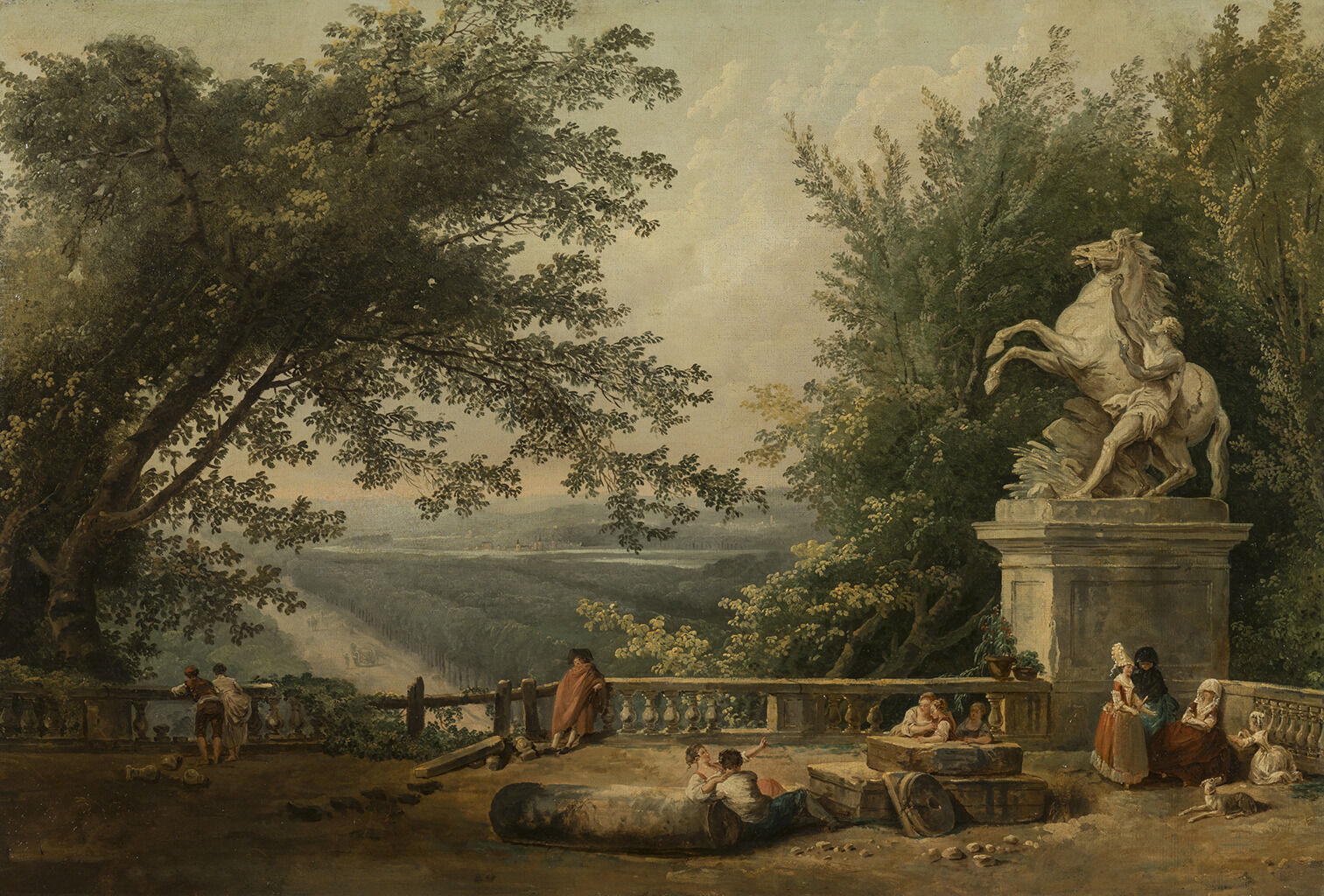
Hubert Robert, Imaginary View of Three Women Contemplating a Château, ca. 1775–80, oil on canvas, 35 1/4 x 52 1/4 in. (89.5 x 132.7 cm), Purchase: William Rockhill Nelson Trust, 31-97
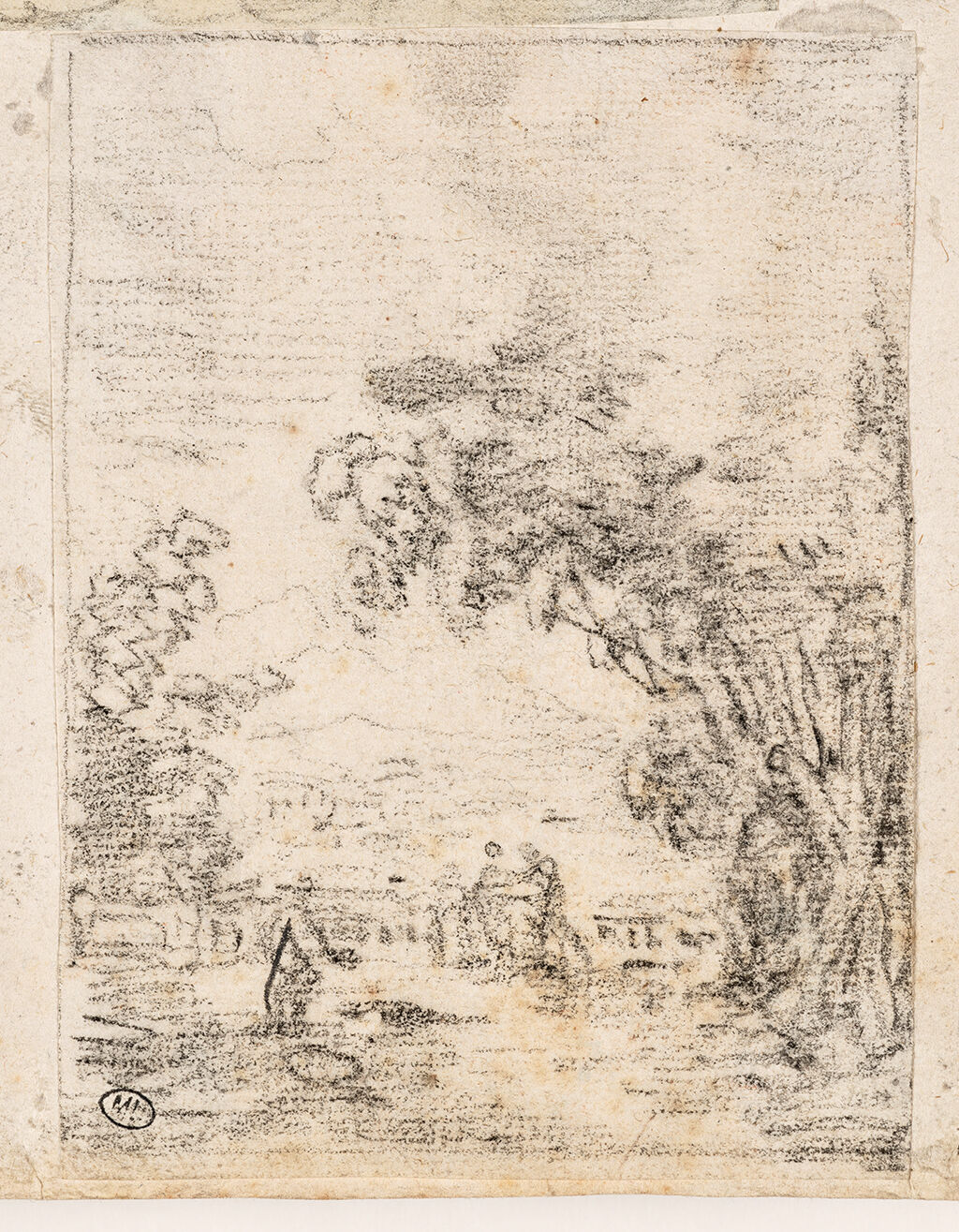
Fig. 2. Hubert Robert, Figures in a Park Bordered by an Overhanging Balustrade, ca. 1775, black chalk on laid paper, 4 9/16 x 3 1/2 in. (11.6 x 8.8 cm), Département des Arts graphiques, Musée du Louvre, Paris, RF 11567, recto
Toggle Caption
Toggle Dual View
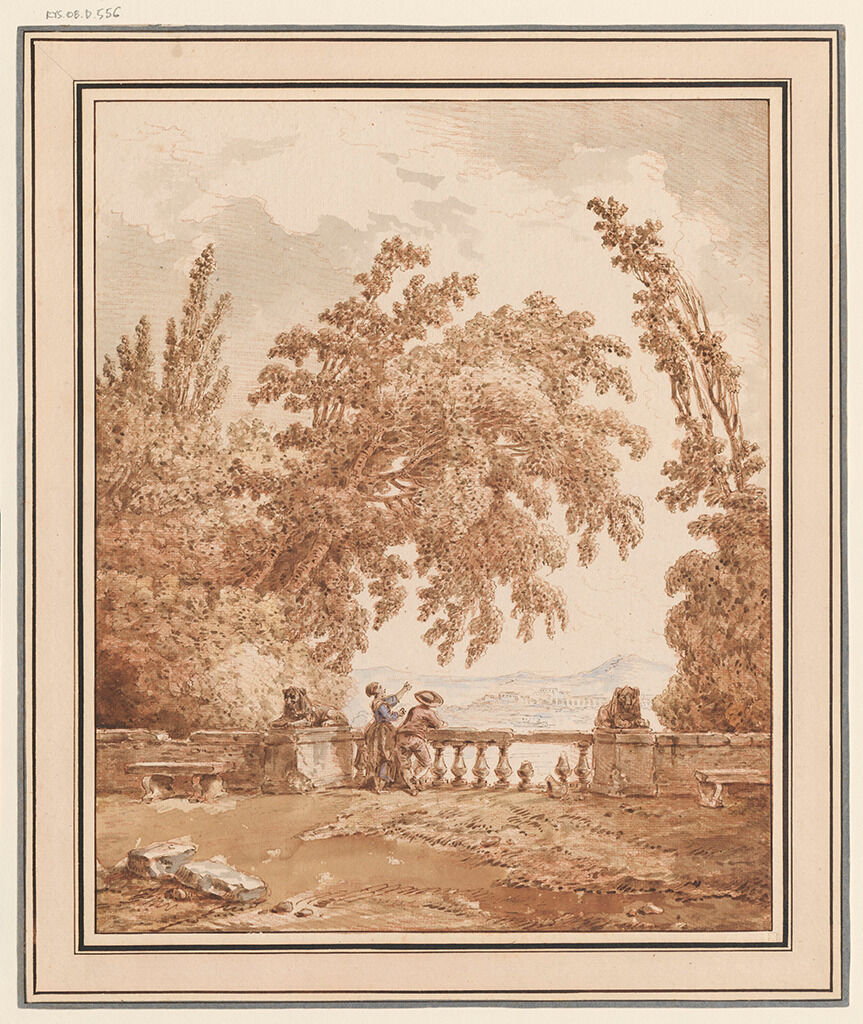
Fig. 3. Hubert Robert, Terrace of an Italian Villa, ca. 1765, watercolor, brown ink, and red chalk counterproof on laid paper, 13 15/16 x 11 7/16 in. (35.5 x 29 cm), National Museum, Warsaw, acc. no. Rys.Ob.d.556 MNW
Toggle Caption
Toggle Dual View
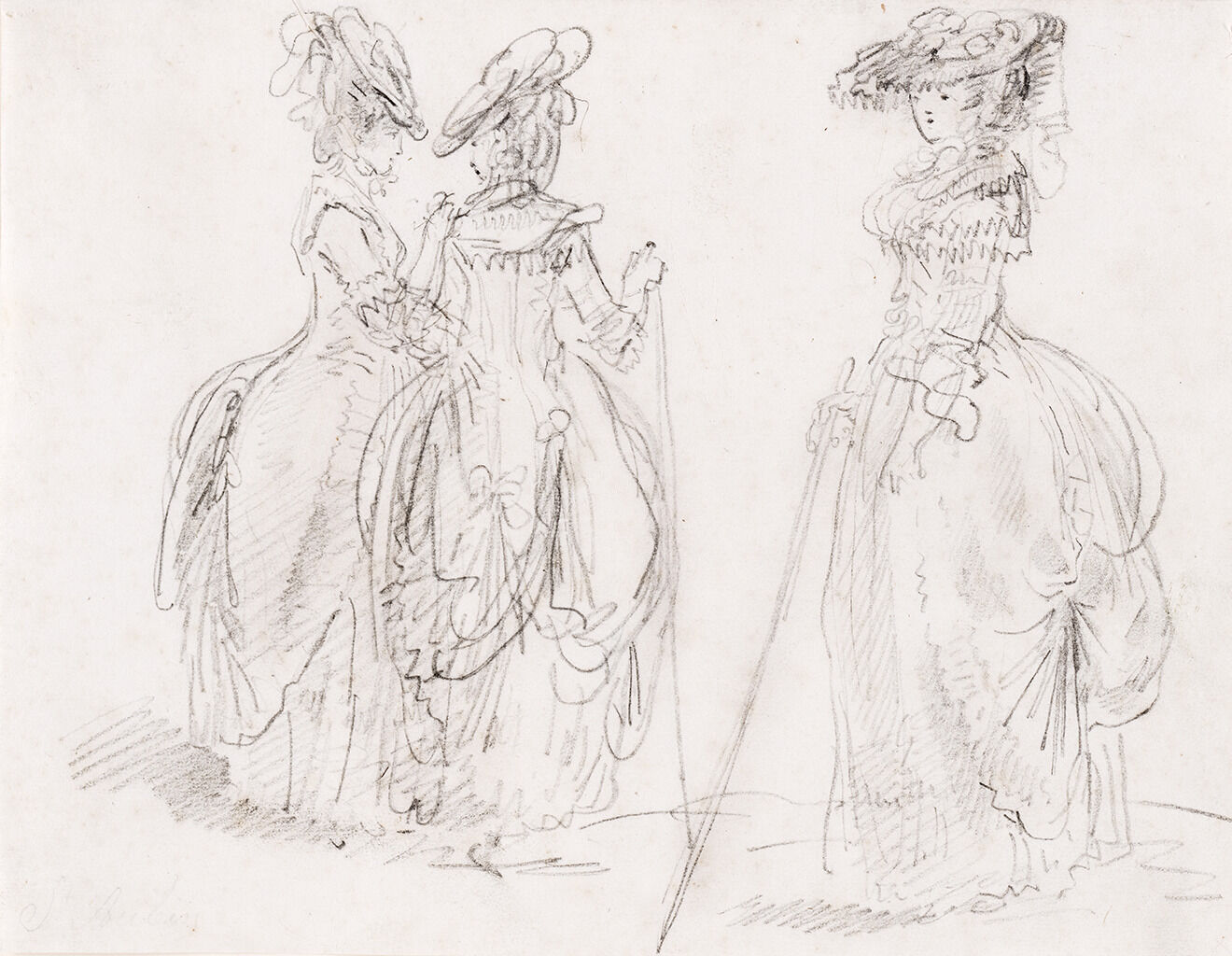
Fig. 4. Hubert Robert, Study for “Imaginary View of Three Women Contemplating a Château,” ca. 1775–80, black chalk on paper, 6 5/8 x 8 5/8 in. (16.8 x 21.9 cm), The Nelson-Atkins Museum of Art, Kansas City, MO, 55-81
Toggle Caption
Toggle Dual View
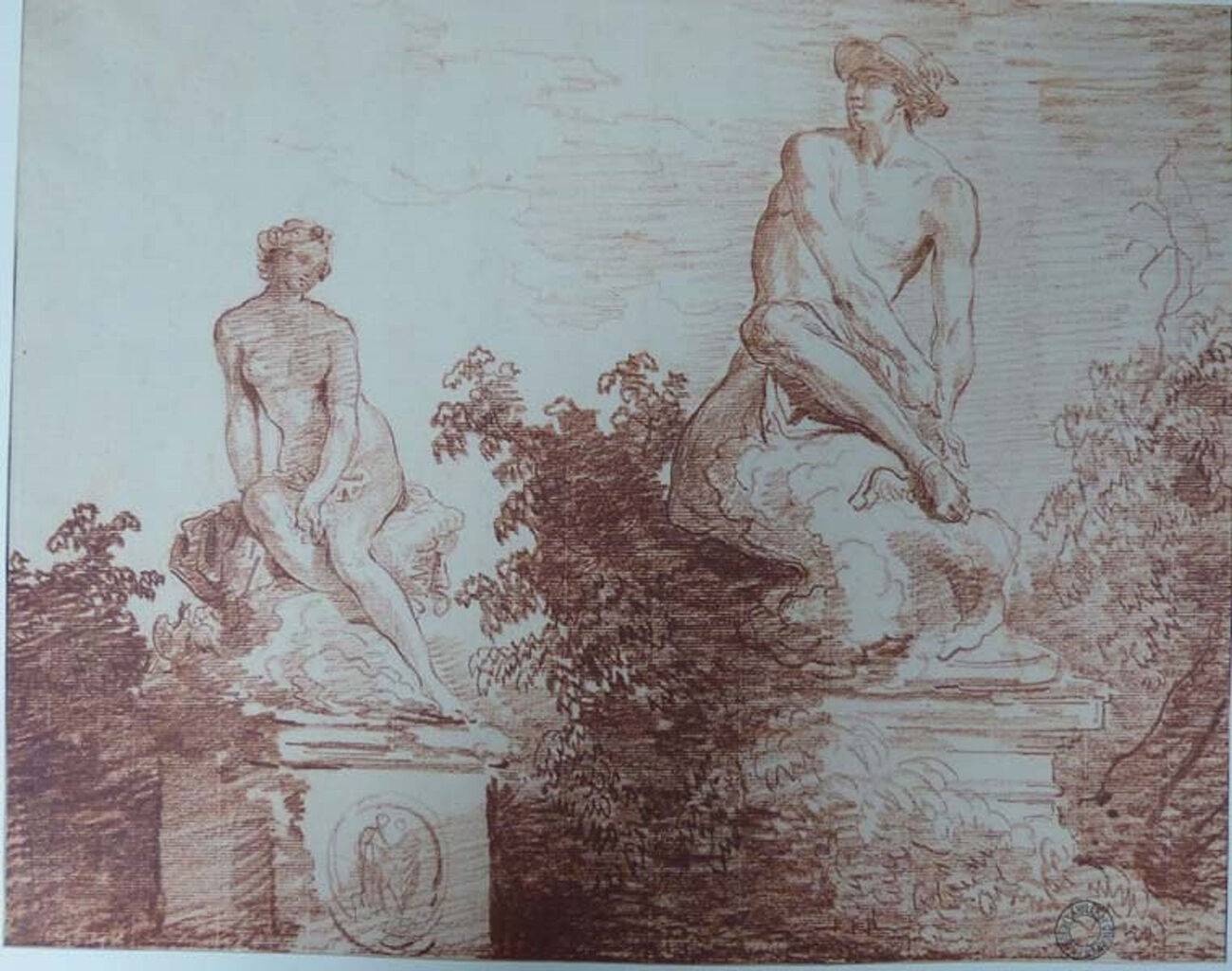
Fig. 5. Hubert Robert, Two Statues in a Park, 1765–70, red chalk drawing on fine cream laid paper, 11 7/16 x 14 1/2 in. (29 x 36.8 cm), Musée des Beaux-Arts, Quimper, inv. no. 873-2-40
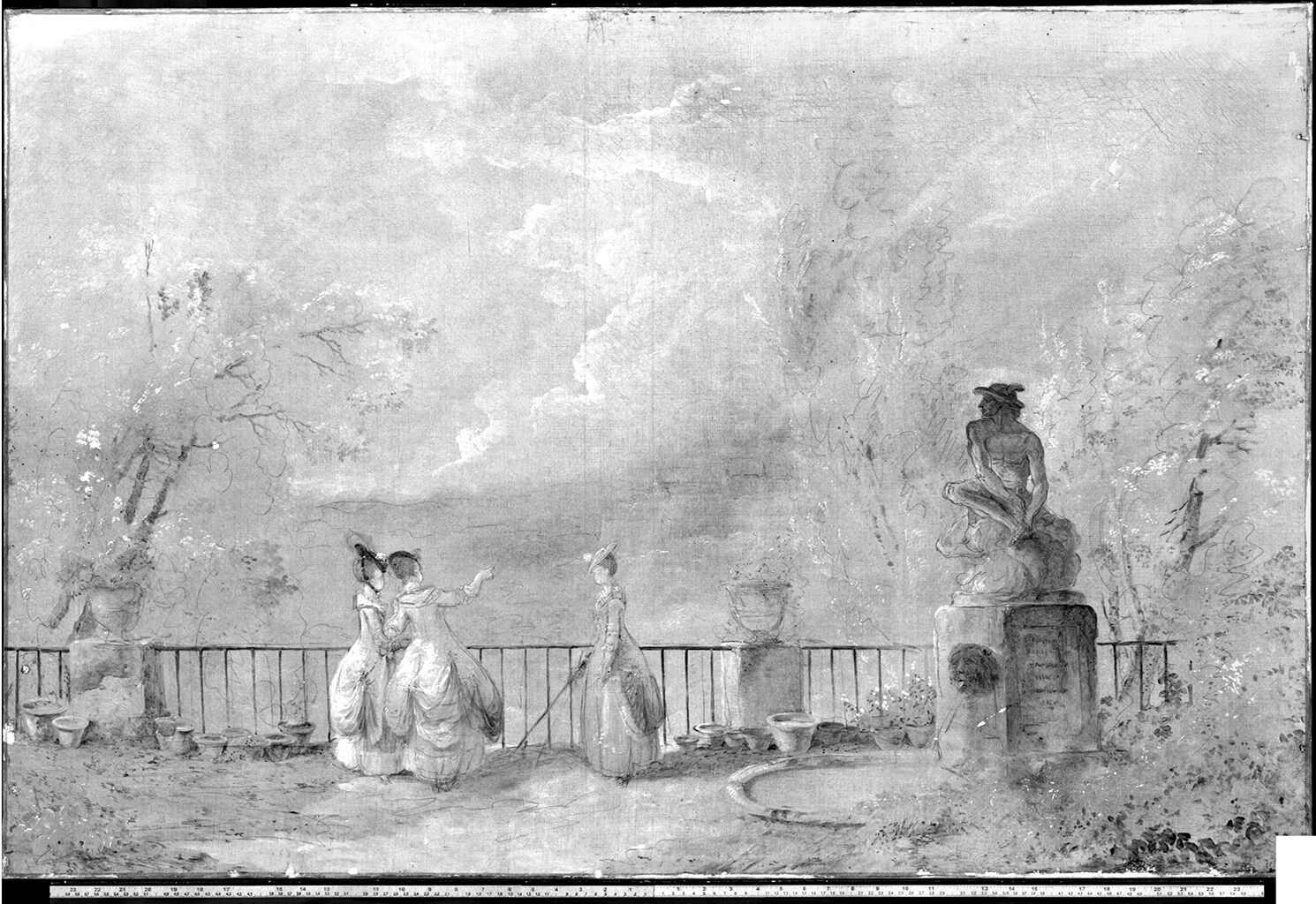
Fig. 8. Infrared reflectogram captured at 2050 nanometers, Imaginary View of Three Women Contemplating a Château (ca. 1775–80), revealing a detailed underdrawing and highlighting the off-center vertical crossbar cracks
Toggle Caption
Toggle Dual View
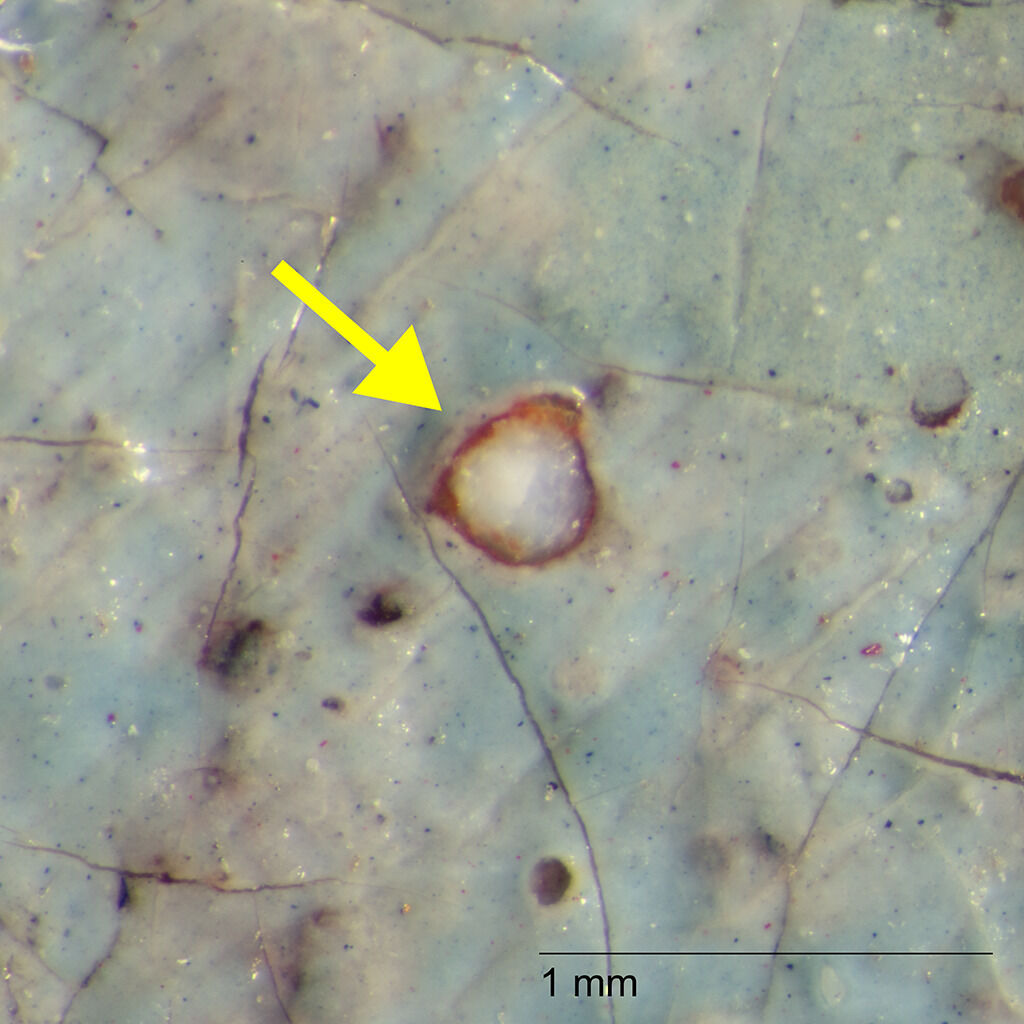
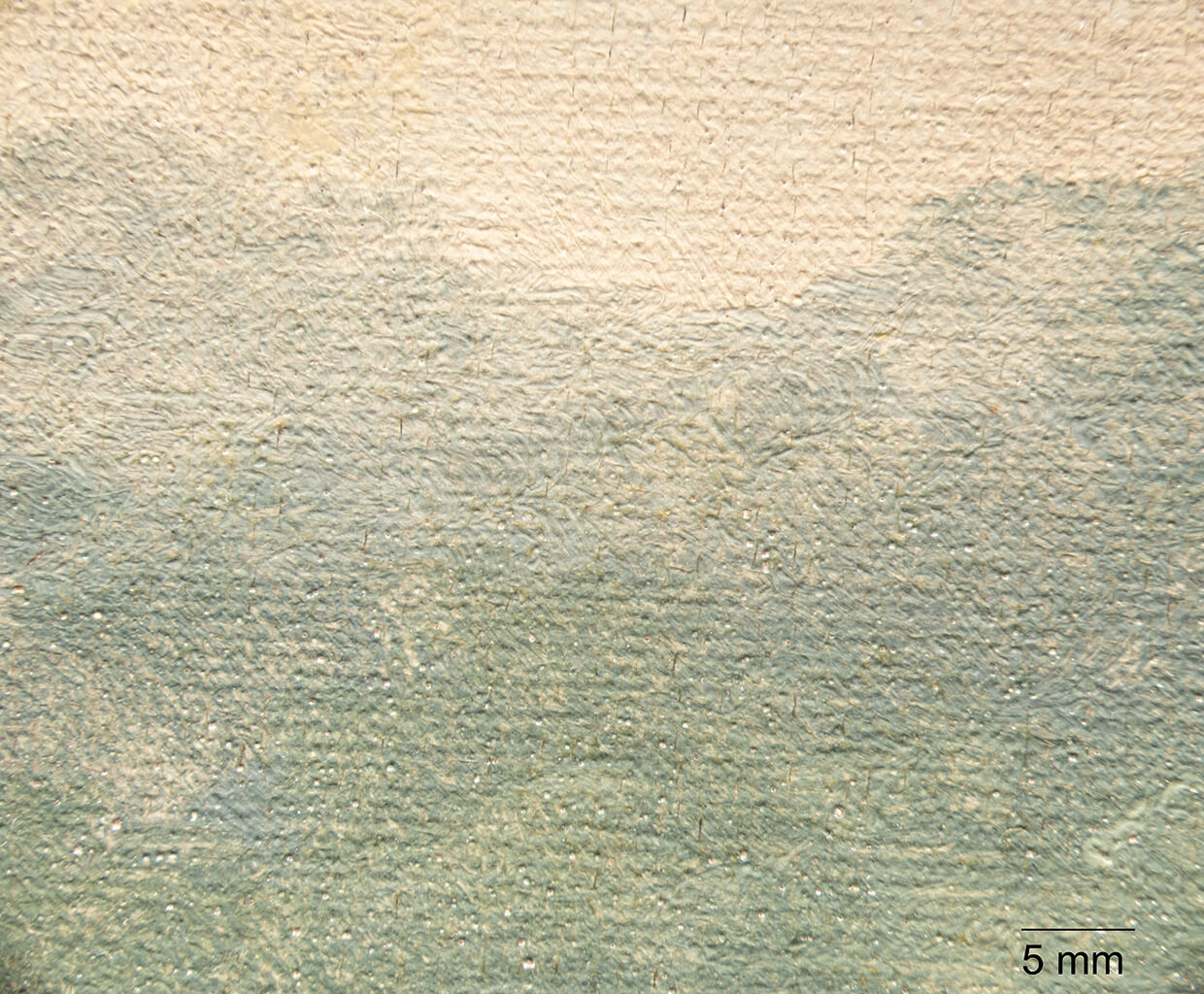
Fig. 9. Photomicrograph of a crater from a metal soap in the sky, revealing the red and white ground layers, Imaginary View of Three Women Contemplating a Château (ca. 1775–80)
Toggle Caption
Toggle Dual View
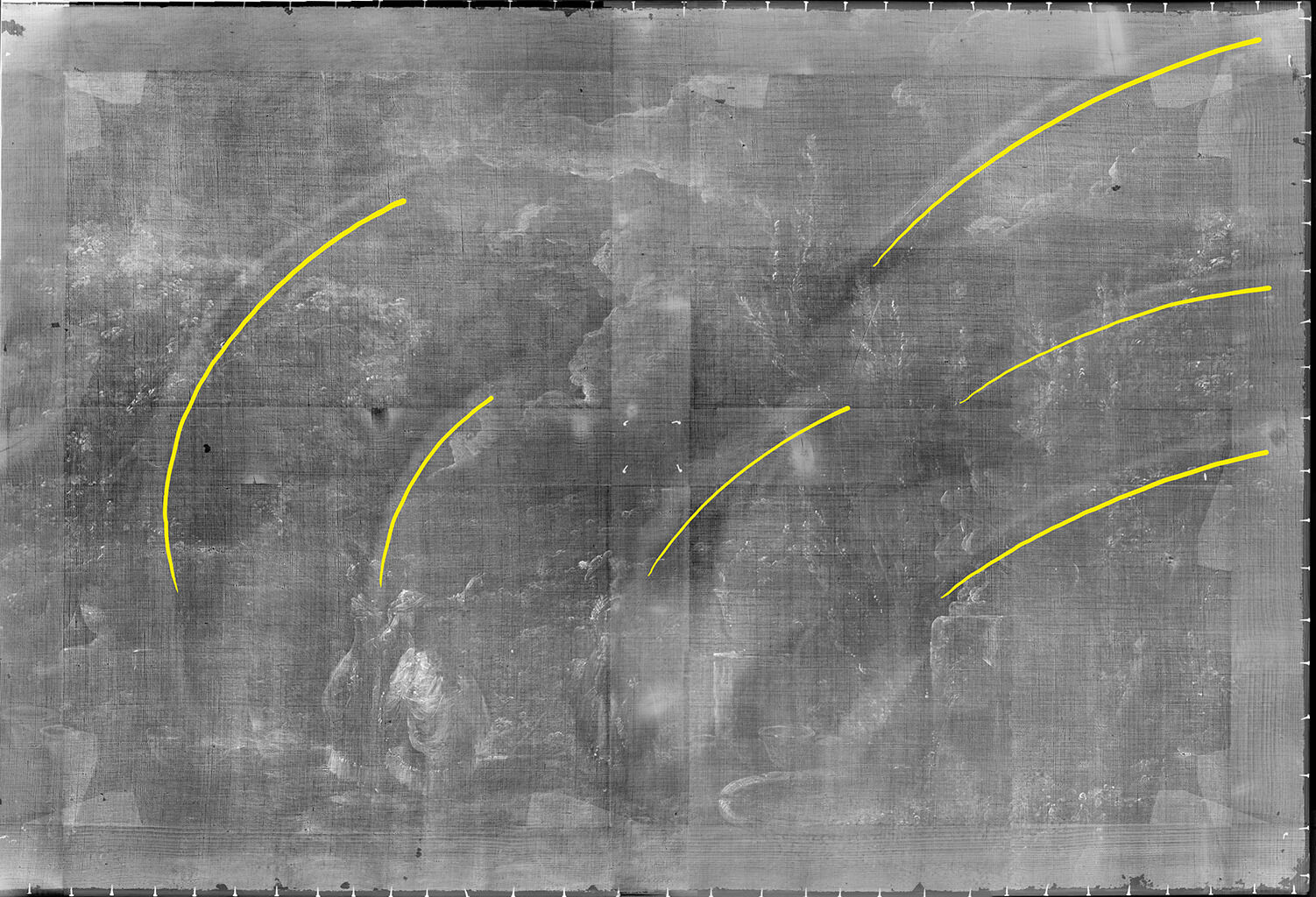
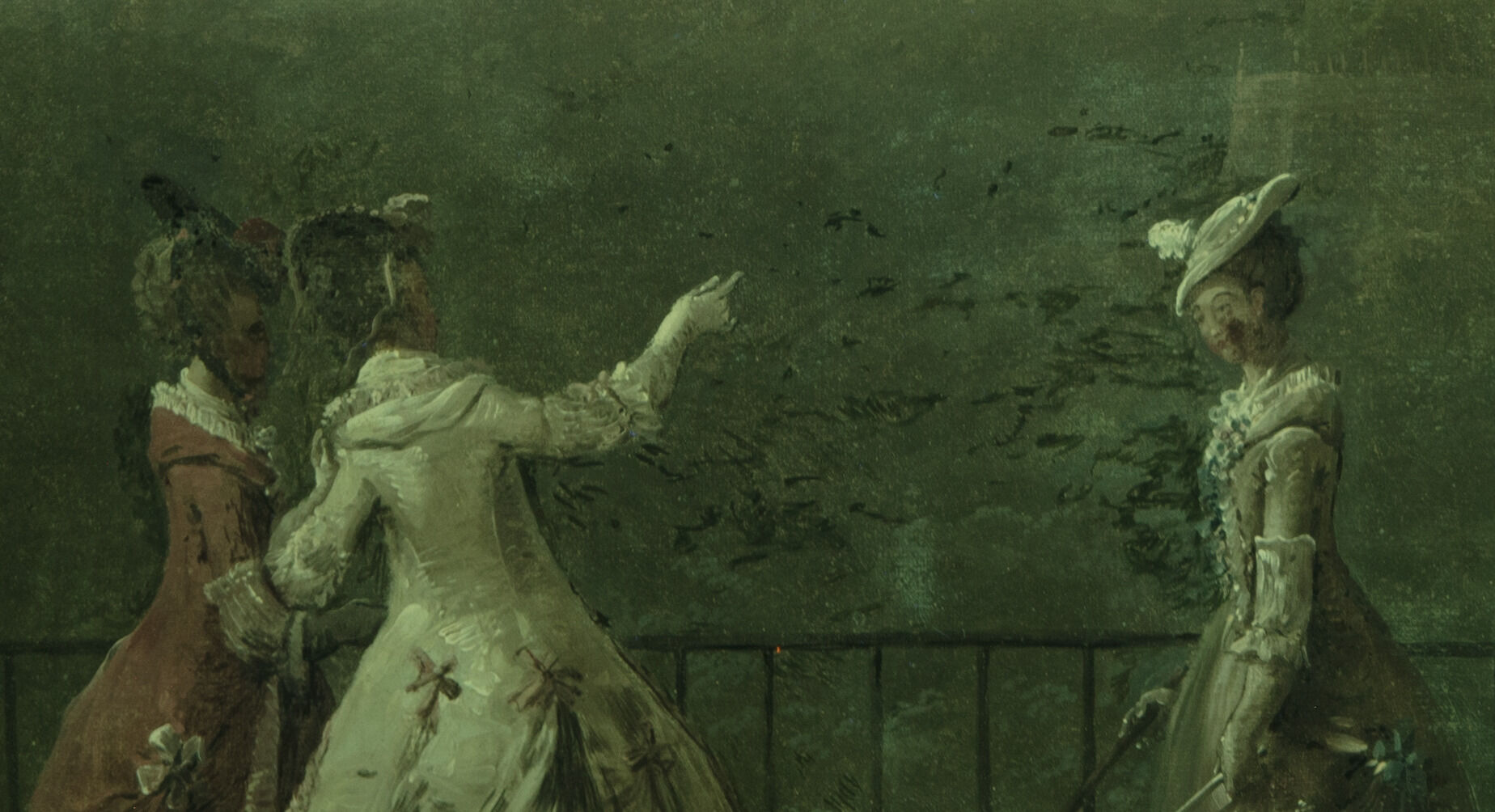
Fig. 10. Composite digital radiograph of Imaginary View of Three Women Contemplating a Château (ca. 1775–80), highlighting the varying thickness of ground application (yellow lines)
Toggle Caption
Toggle Dual View
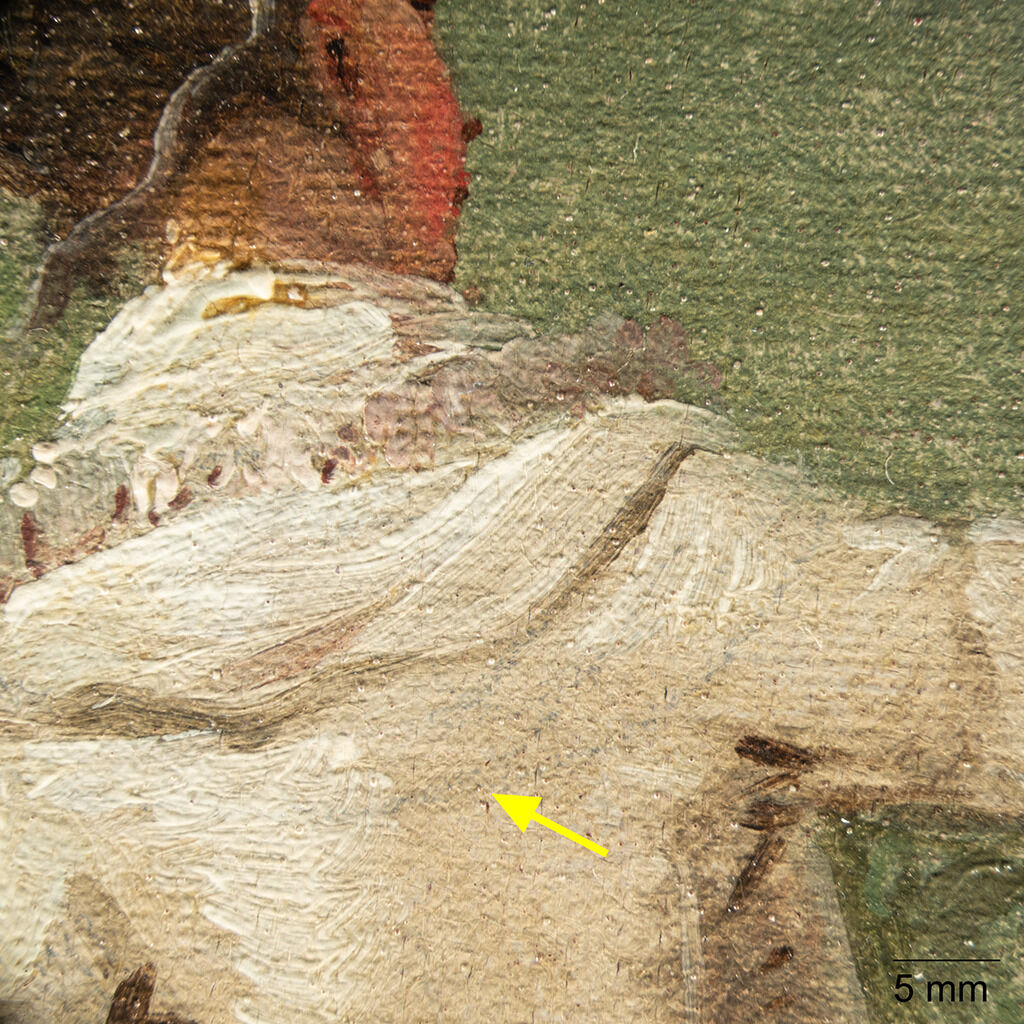
Fig 11. Photomicrograph of the visible underdrawing in the center figure, Imaginary View of Three Women Contemplating a Château (ca. 1775–80)
Toggle Caption
Toggle Dual View
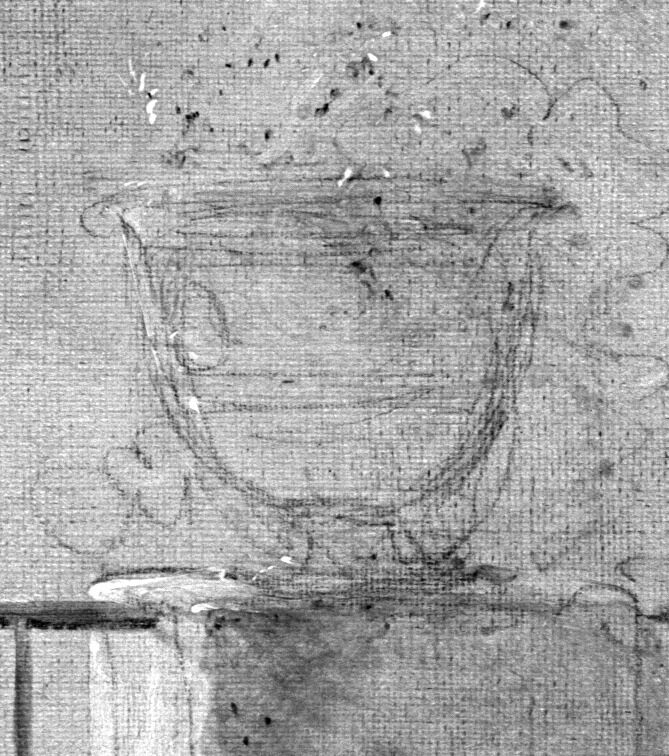
Fig. 12. Infrared reflectogram captured at 2050 nanometers, showing changes in the underdrawing in the large urn on the right, Imaginary View of Three Women Contemplating a Château (ca. 1775–80)
Toggle Caption
Toggle Dual View
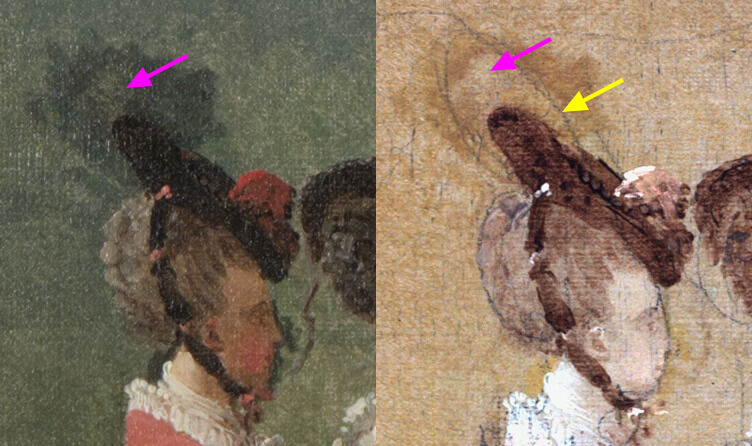
Fig. 13. Two detail images of the left figure’s head, Imaginary View of Three Women Contemplating a Château (ca. 1775–80). On the left, a normal illumination detail. On the right, an infrared reflectogram that reveals the simple oval underdrawing of the figure’s face. The figure’s hat was once much larger, as seen in the underdrawing (yellow arrow) and an earlier painted version (pink arrows).
Toggle Caption
Toggle Dual View
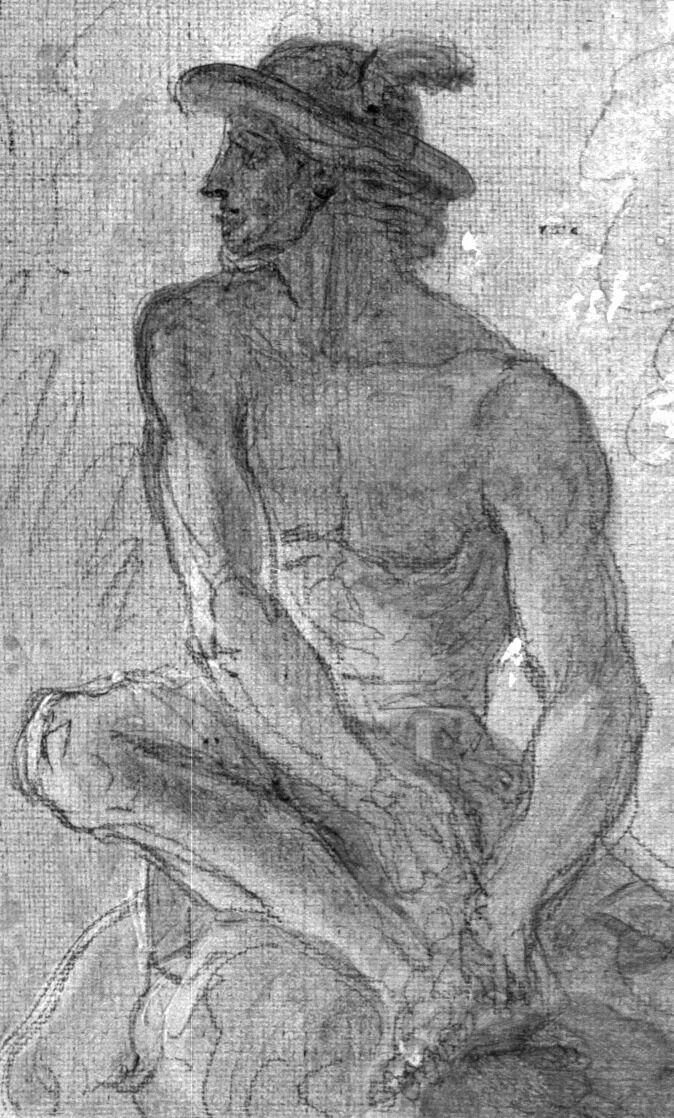
Fig. 14. Infrared reflectogram captured at 2050 nanometers, showing the statue’s highly detailed underdrawing, Imaginary View of Three Women Contemplating a Château (ca. 1775–80)
Toggle Caption
Toggle Dual View
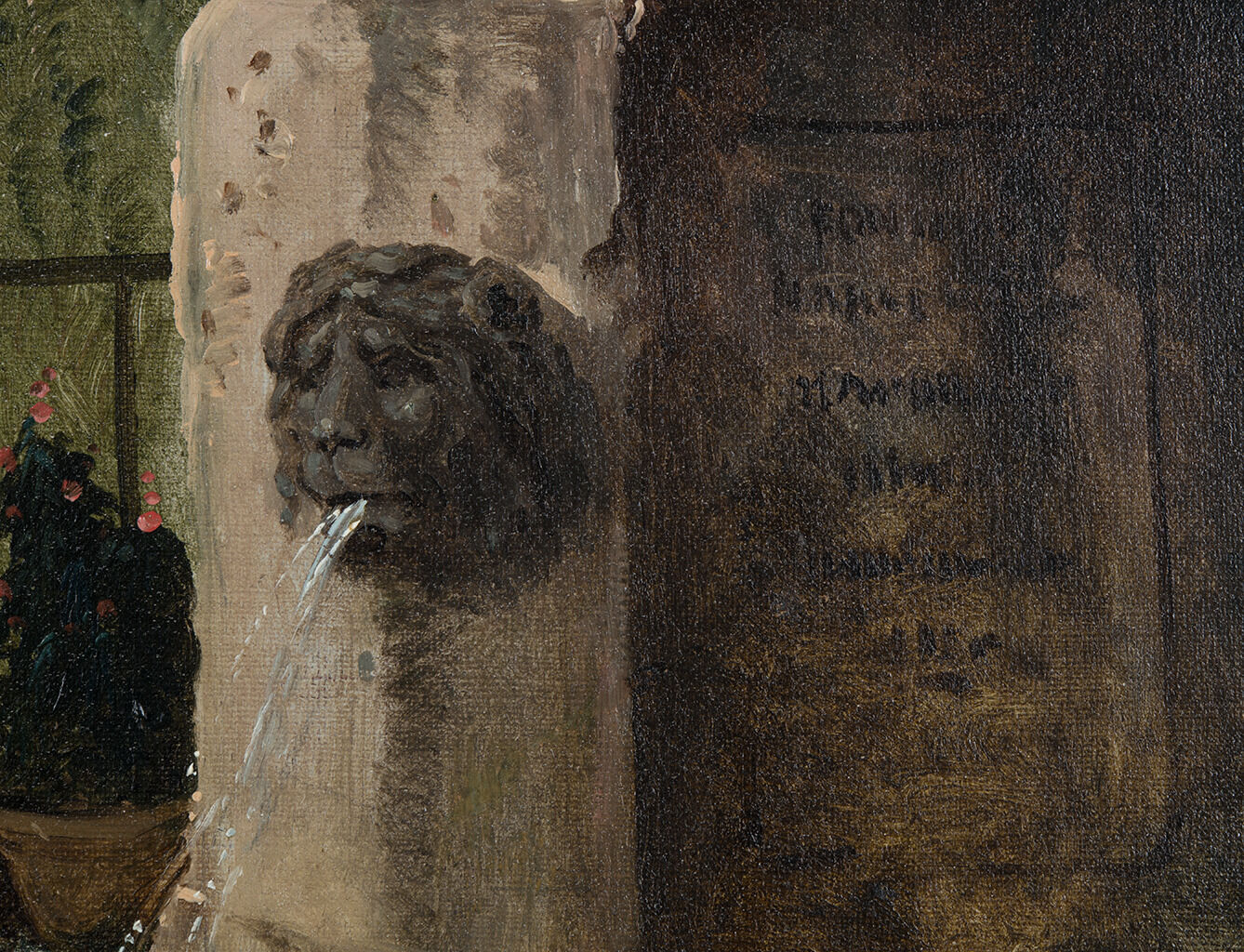
Fig. 15. Detail image of the inscription on the base of the statue, Imaginary View of Three Women Contemplating a Château (ca. 1775–80)
Toggle Caption
Toggle Dual View
Fig. 16. Photomicrograph of soft blending along the upper canopy of trees, Imaginary View of Three Women Contemplating a Château (ca. 1775–80)
Toggle Caption
Toggle Dual View
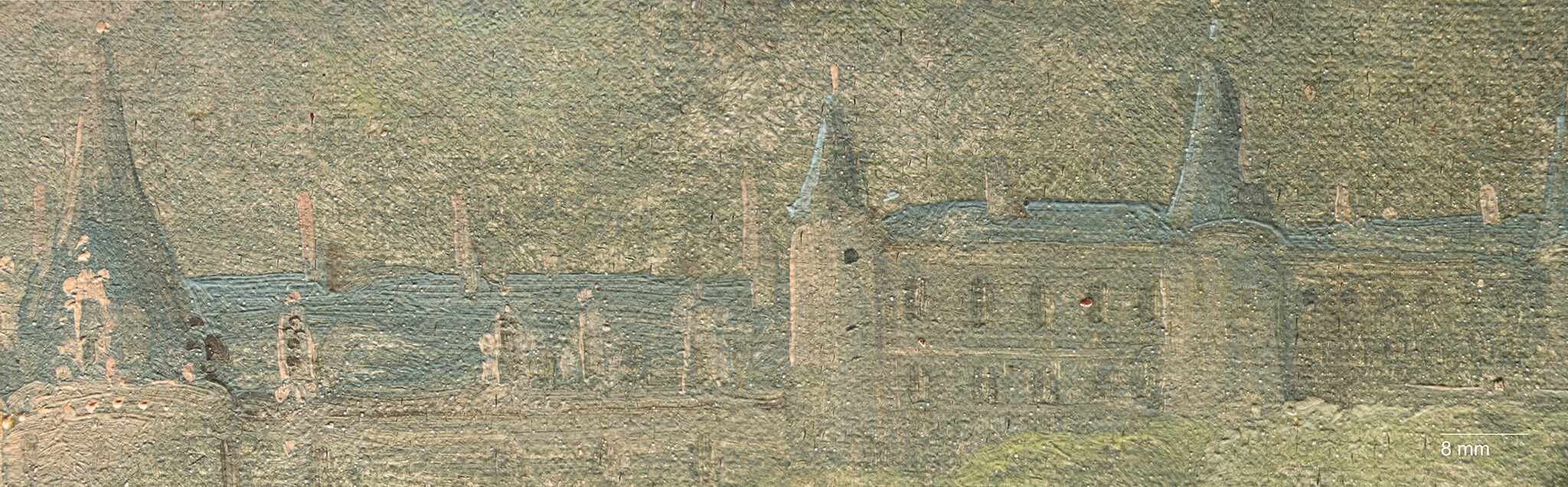
Fig. 17. Photomicrograph of the château in the background, Imaginary View of Three Women Contemplating a Château (ca. 1775–80)
Toggle Caption
Toggle Dual View
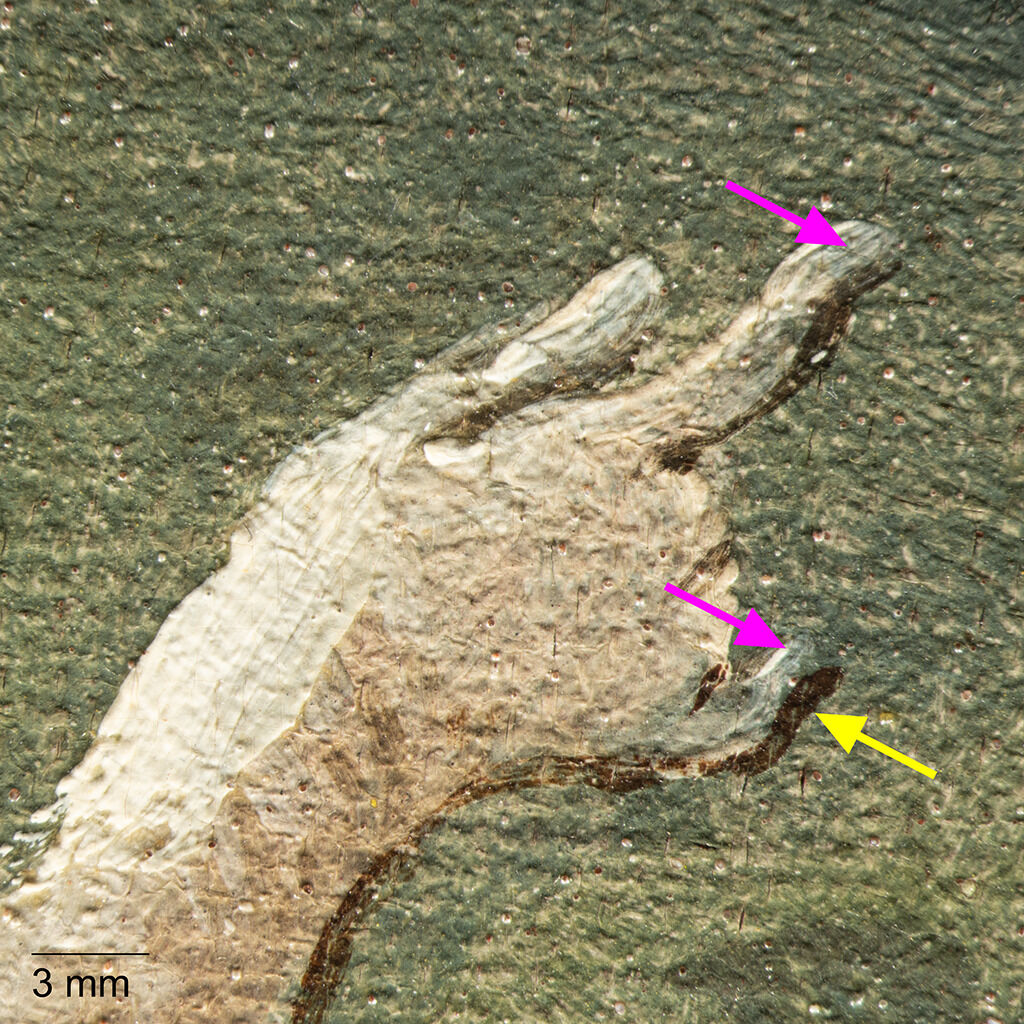
Fig. 18. Photomicrograph of the center figure’s hand, Imaginary View of Three Women Contemplating a Château (ca. 1775–80), showing dark brown outlining to strengthen forms (yellow arrow) and artist’s changes indicated by areas of green visible through the figure’s fingers (pink arrows)
Toggle Caption
Toggle Dual View
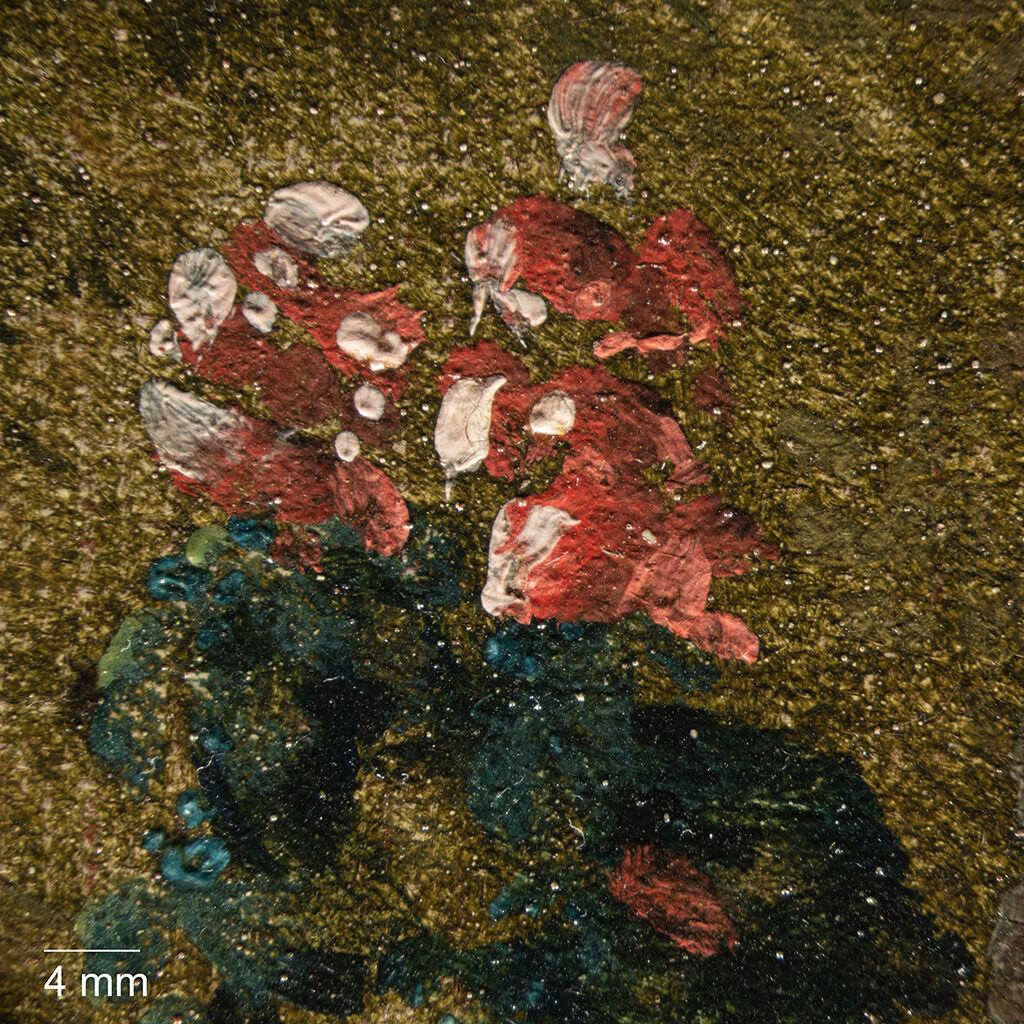
Fig. 19. Photomicrograph of flowers in the urn to the right, showing dabs of paint with slight impasto creating highlights, Imaginary View of Three Women Contemplating a Château (ca. 1775–80)
Toggle Caption
Toggle Dual View
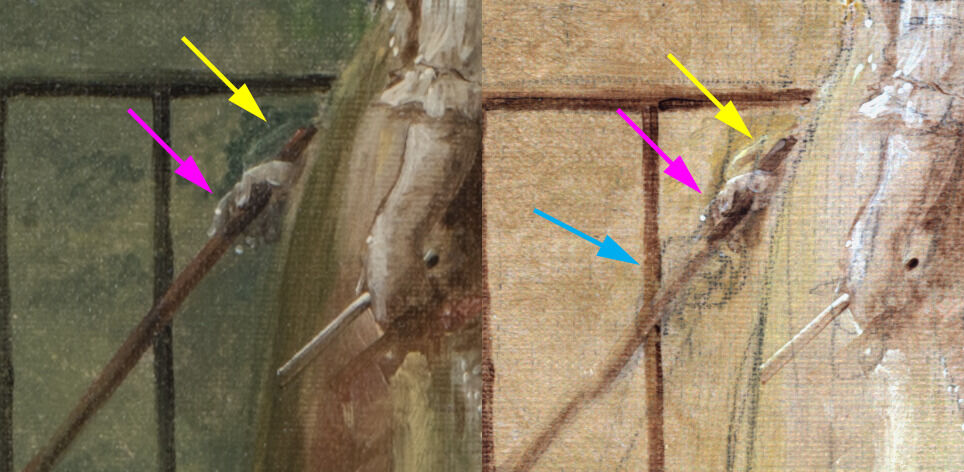
Fig. 20. Details of the right figure’s hand, Imaginary View of Three Women Contemplating a Château (ca. 1775–80). On the left, normal illumination detail. On the right, an infrared reflectogram that shows the hand shifting from a low position in the underdrawing (blue arrow) to a high position in an earlier painted version (yellow arrows), ending in the center in the final composition (pink arrows).
Toggle Caption
Toggle Dual View
Fig. 21. Ultraviolet-induced visible fluorescence image showing the three figures, Imaginary View of Three Women Contemplating a Château (ca. 1775–80)
Toggle Caption
Toggle Dual View
Hubert Robert, Imaginary View of Three Women Contemplating a Château, ca. 1775–80
Imaginary View of Three Women Contemplating a Château
Object Date
ca. 1775–80
Alternate and Variant Titles
Imaginary View of the Terrace at the Château of Marly; The Terrace at the Château de Marly; Vue prise de Marly vers Saint Germain-en-Laye; Three Ladies on the Terrace at Marly
Medium
Oil on canvas
Dimensions (Unframed)
35 1/4 x 52 1/4 in. (89.5 x 132.7 cm)
Credit Line
The Nelson-Atkins Museum of Art. Purchase: William Rockhill Nelson Trust, 31-97
Sarah Catala, “Hubert Robert, Imaginary View of Three Women Contemplating a Château, ca. 1775–80,” catalogue entry in French Paintings and Pastels, 1600–1945: The Collections of the Nelson-Atkins Museum of Art, ed. Aimee Marcereau DeGalan (Kansas City: The Nelson-Atkins Museum of Art, 2026), https://doi.org/10.37764/78973.5.330.5407.
MLA:
Catala, Sarah. “Hubert Robert, Imaginary View of Three Women Contemplating a Château, ca. 1775–80,” catalogue entry. French Paintings and Pastels, 1600–1945: The Collections of The Nelson-Atkins Museum of Art, edited by Aimee Marcereau DeGalan, Nelson-Atkins Museum of Art, 2026. doi: 10.37764/78973.5.330.5407.
Long thought to be a view of the terraces of the Château de Marly, this
painting remains a purposeful mystery. While there is no doubt that this is the
work of Hubert Robert, the interpretation of its subject, proposed by
various commentators over the last century, deserves to be revisited.
When the painting was exhibited to the public in Paris in 1928, it was
presented under the evocative title View from Marly Toward
Saint-Germain-en-Laye. However, Marly’s gardens did not include
elevated terraces with views of a neighboring valley, as seen in this
painting. Quite to the contrary, Marly is nestled in the hollow of a
valley, where it was a favorite retreat for Louis XIV and his court.
Behind the estate was the “Marly Machine,” used to supply water to the
Marly fountains as well as the château and gardens of Versailles. The
Marly Machine was also within sight of the old and new châteaux of
Saint-Germain-en-Laye. However, the château depicted by Robert does not
correspond to either the new château (destroyed in 1810) or the old one,
which today houses the National Museum of Archaeology. Finally, although
the painting’s title had included the word “Marly” since at least 1928,
the Nelson-Atkins Museum retitled it in 2022, during the preparation of
this catalogue, in order to acknowledge its invented nature.1The title in 2022 was Imaginary View of the Terrace at the Château of Marly. For the painting’s relationship to Marly, see Sarah Catala, Hubert Robert: De Rome à Paris, exh. cat. (Paris: Galerie Éric Coatalem, 2021), 46. This
revision not only addresses the complexity of connecting the painting to
Robert’s documented views of Marly but also positions it within the
tradition of capriccio, or architectural fantasy. Robert was an
undisputed master of this genre in France during the second half of the
eighteenth century.
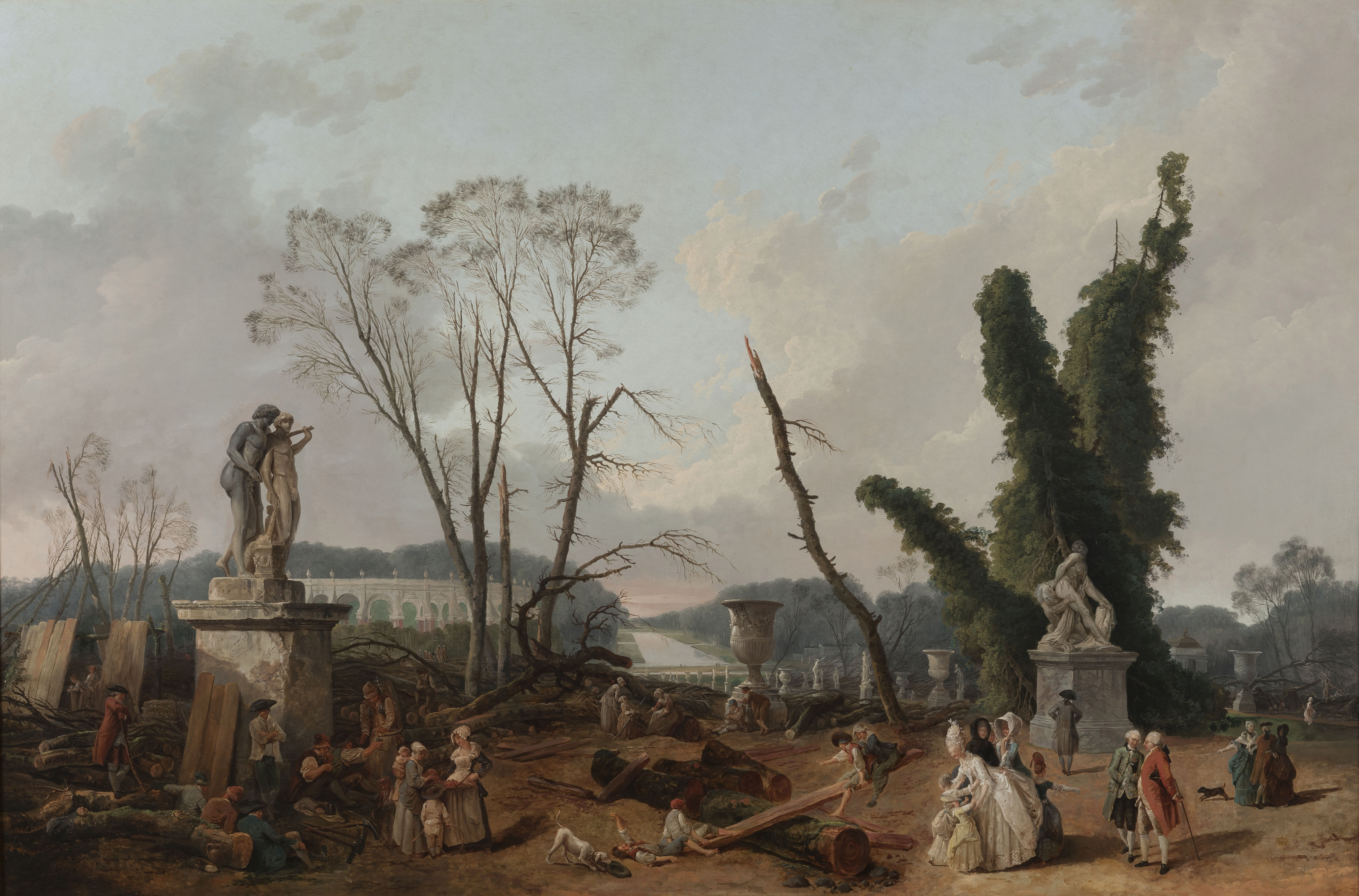
Searching Robert’s work for a perfectly faithful view of a place or a
person is a futile task. Robert was neither a topographer nor a
portraitist but an artist who inspired the imagination of his admirers,
as when he painted the renovation of the gardens surrounding the Palace
of Versailles in 1777 (Fig. 7). The composition of that work, a royal
commission, recalls that of the Nelson-Atkins painting, with the
foreground covering the entire bottom section of the canvas, pushing the
view of nature into the background. Both canvases highlight female
figures in the foreground and sculptures by French artists.16The sculptures in The Entrance to the Tapis Vert at Versailles (Fig. 7) are the work of Pierre Puget (1620–94).
The Nelson-Atkins painting reveals a new direction in Robert’s art after
1775 as he developed a rich dialogue among nature, his paintings, and
his garden projects. While the painting cannot be linked definitively to
Marly or any other specific château, it nevertheless remains an
invaluable testament to Robert’s growing interest in the architecture
marking the end of the Middle Ages and the beginning of the Renaissance
in France. It is precisely the discovery of this vernacular heritage,
and how it became the object of fashionable promenades, that Robert
depicts in this painting.
Sarah Catala
May 2025
Notes
Translated from the original French by Nicole Halton and David
Auerbach, courtesy of Eriksen Translations.
The title in 2022 was Imaginary View of the Terrace at the Château
of Marly. For the painting’s relationship to Marly, see Sarah
Catala, Hubert Robert: De Rome à Paris, exh. cat. (Paris: Galerie
Éric Coatalem, 2021), 46.
Hubert Robert, Vue du Château de Gaillon in Normandy, ca. 1775,
oil on canvas, 165 3/8 x 126 in. (420 x 320 cm), Salle des Etats,
Palais archiépiscopal de Rouen. For an overall image of the painting
as well as it in situ in the Salle des Etats (on the far left), see
“Rouen, le Palais de l’Archevêché,” Patrimoine-Histoire, accessed
September 2, 2025,
https://www.patrimoine-histoire.fr/Patrimoine/Rouen/Rouen-Archeveche.htm.
See also Explication des Peintres, Sculptures, et Gravures de
Messieurs de l’Académie Royale (Paris: Imprimerie de la Veuve
Herissant, 1775), 15, no. 73.
Sarah Catala and Gabriel Wick, eds., Hubert Robert et la Fabrique
des Jardins, exh. cat. (Paris: RMN-Grand Palais, 2017), 21–22.
Explication des Peintres, Sculptures, et Gravures de Messieurs de
l’Académie Royale (Paris: Imprimerie de la Veuve Herissant, 1777),
16–18, nos. 76, 81, 82; Explication des Peintres, Sculptures, et
Gravures de Messieurs de l’Académie Royale (Paris: Imprimerie de la
Veuve Herissant, 1783), 18, no. 66.
See Jean de Cayeux, Hubert Robert et les Jardins (Paris:
Herscher, 1987). In the second half of the eighteenth century,
particularly under Louis XV and Louis XVI, France experienced
widespread enthusiasm for garden design. This was fueled by changing
aesthetic tastes, scientific curiosity, and aristocratic
competition, as royals and financiers vied to create increasingly
refined and imaginative landscapes. Gardens like these required a
great deal of money to be developed and maintained.
See Yuriko Jackall’s entry on the Nelson-Atkins painting, in
Margaret Morgan Grasselli and Yuriko Jackall, Hubert Robert, exh.
cat. (Washington, DC: National Gallery of Art, 2016), 237–38, cat.
70.
The painting is described in the Houdon sale: “Vue intérieure du
Parc de Marly. Ce tableau, orné de figures, est touché avec l’esprit
et la facilité ordinaire aux ouvrages de cet artiste. Hauteur 24
pouces, largeur 32 pouces” (Interior view of the Marly Park. This
painting, decorated with figures, exhibits the spirit and facility
typical of this artist’s works. Height 24 inches, width 32 inches).
See Catalogue de quelques tableaux, peints par le Bourguignon,
Oudry; Danlos du cabinet du C.en Houdon, sculpteur (Paris: F. L.
Regnault, October 8, 1795), 5, no. 5. While the height of the Saint
Petersburg painting differs by five centimeters from the description
in the Houdon sale catalogue, this change probably corresponds to
the upper edge of the canvas being trimmed, where today we see that
the tops of the trees are cut off. The painting owned by Houdon may
have been part of the payment for a posthumous bust of Robert’s
eldest daughter that Houdon exhibited at the Salon of 1783. See
Explication des Peintres, Sculptures, et Gravures (1783), 48, no.
244.
This is addressed in Sarah Catala, “Démarches d’incitation,” in
“Hubert Robert et le temps de la citation” (PhD diss., University of
Lyon Lumière 2, 2020), 211–60. See also Yuna Blajer de la Garza, “A
House Is Not a Home: Citizenship and Belonging in Contemporary
Democracies” (PhD diss., University of Chicago, 2019).
The marble sculpture group Marly Horses was installed at Marly
in 1745 but is now located in the Cour Marly in the Musée du Louvre
in Paris: Guillaume Coustou the elder, Marly Horses, 1745, Carrara
marble, 133 7/8 x 111 13/16 x 50 in. (340 x 284 x 127 cm), Musée du
Louvre, Paris, MR 1803,
https://collections.louvre.fr/en/ark:/53355/cl010091993
(and see also its pendant sculpture, Guillaume Coustou the elder,
Marly Horses, 1745, Carrara marble, 133 7/8 x 111 13/16 x 50 in.
[340 x 284 x 127 cm], Musée du Louvre, Paris, MR1802,
https://collections.louvre.fr/en/ark:/53355/cl010091992).
For the enlarged replica of Mercury (which was commissioned by
King Louis XV to present to Frederick the Great of Prussia), see Jean-Baptiste
Pigalle, Mercury Fastening His Sandal, 1748, marble, 76 3/4 x 47
1/4 x 37 13/16 in. (195 x 120 x 96 cm), Skulpturensammlung und
Museum für Byzantinische Kunst, Bode-Museum, Berlin, no. 356,
https://id.smb.museum/object/1368124/merkur.
For the smaller, original version, see Jean-Baptiste Pigalle,
Mercury Fastening His Sandal, 1744, marble, 22 13/16 x 14 x 13 in.
(58 x 35.5 x 33 cm), Musée du Louvre, Paris, no. MR 1957,
https://collections.louvre.fr/en/ark:/53355/cl010092060.
The red chalk lines, from top to bottom and from right to left,
indicate an inversion of the direction of Robert’s composition,
since he was right-handed. It is not certain whether it was enhanced
by the artist himself.
Robert often used these two motifs in his works. However, there
is a particular affinity with a red chalk drawing at the Louvre,
annotated “Ce 7 janvier 1773” (This January 7, 1773), which suggests
that it was made during a drawing session with the aristocratic and
financial circle of amateurs with whom Robert associated. See Jeune
femme, tenant un panier, descendant des marches près d’une
fontaine, 1773, red chalk on paper, 14 5/16 x 11 in. (36.4 x 27.9
cm), Musée du Louvre, Paris, inv. RF 28984, recto,
https://arts-graphiques.louvre.fr/detail/oeuvres/1/228359-Jeune-femme-tenant-un-panier-descendant-des-marches-pres-dune-fontaine.
As Charlotte Guichard has noted in other instances; see Charlotte
Guichard, La Griffe du peintre, la valeur de l’art (1730–1820)
(Paris: Éditions du Seuil, 2018), 151.
Explication des Peintres, Sculptures, et Gravures (1777),
16–18, nos. 76, 81, 82; Explication des Peintres, Sculptures, et
Gravures (1783), 18, no. 66.
We only know them through the descriptions in the Salon booklets;
the extant works (see “related works” in this entry) do not match
the dimensions and formats.
The paintings of Geoffrin, currently unlocated, are reproduced in
Cayeux, Hubert Robert et les jardins, 120–24; the La Rochefoucauld
painting is Hubert Robert, Vue du château de La Roche-Guyon, ca.
1775, oil on canvas, 76 3/4 x 108 11/16 in. (195 x 276 cm), Musée
des Beaux-Arts, Rouen, inv. 1909.37.1,
https://pop.culture.gouv.fr/notice/joconde/07290022333.
The sculptures in The Entrance to the Tapis Vert at Versailles (Fig. 7)
are the work of Pierre Puget (1620–94).
For compositional reasons, this is also the hypothesis proposed
by Ekaterina Deriabina in “Ruines d’une Terrasse dans le Parc de
Marly,” in Hubert Robert (1733–1808) et Saint-Pétersbourg: Les
commandes de la famille Impériale et des Princes russes entre 1773
et 1802, ed. Hélène Moulin, exh. cat. (Paris: Réunion des Musées
Nationaux, 1999), 152.
As noted by Pierre de Nolhac, Hubert Robert, 1733–1808 (Paris:
Goupil, 1910), 71–72, about a painting that Robert decided
independently to paint for the artist Charlotte Eustache Sophie de
Fuligny Damas, Marquise de Grollier (1741–1828). This painting, used
as a mantelpiece, has dimensions that are very similar to those of
the Nelson-Atkins painting: 92.5 x 126 cm. Today in a private
collection, it is reproduced in Véronique Damian, L’Art au féminin:
Portrait de la marquise de Grollier (1741–1828), par Élisabeth
Louise Vigée Le Brun (1755–1842) (Paris: Galerie Canesso, 2018), 9.
Since then held by the Musée du Louvre: Jean-Baptiste Pigalle,
Mercury Fastening His Sandal, 1753, lead, 73 5/8 x 42 1/2 x 41 3/4
in. (187.1 x 108 x 106 cm), Musée du Louvre, Paris, inv. RF 3023;
see “Mercure attachant ses talonnières,” Ministère de la Culture,
accessed September 2, 2025,
https://pop.culture.gouv.fr/notice/joconde/M5037011602.
This interpretation follows the identification of the statue
proposed by Jean-René Gaborit in Jean-Baptiste Pigalle, 1714–1785:
Sculptures du Musée du Louvre (Paris: Éditions de la Réunion des
musées nationaux, 1985), 45.
The Château de Josselin is located in Brittany. Built between
1490 and 1505, with its Renaissance façade overlooking the courtyard
and the l’Oust River, it is the seat of the aristocratic Rohan
family. While the three towers were still in place in the eighteenth
century, the keep and the gatehouse had been destroyed by 1762. The
castle was renovated beginning in 1860. See “Josselin Castle, Place
de la Congrégation (Josselin),” Ministère de la Culture, accessed
September 2, 2025,
https://pop.culture.gouv.fr/notice/merimee/IA00121519.
See De Nolhac, Hubert Robert, 71–72.
This is a hypothesis based on the similarity of the painting’s
format to the one Robert painted for the Marquise de Grollier (see
n. 19), whose subject was entirely customized. According to Robert’s
own description, the painting depicts a house on fire with people
saving a floral still life by the Marquise. Without Robert’s letter
to the Marquise, reproduced in De Nolhac, Hubert Robert, between
pages 70–71, it would have been impossible to understand Robert’s
economic strategies and artistic liberties. The painting is also
reproduced as an engraving in De Nolhac, Hubert Robert, between
pages 72 and 73.
Susan Pavlik Enterline, “Hubert Robert, Imaginary View of Three Women Contemplating a Château, ca. 1775–80,” technical entry in French Paintings and Pastels, 1600–1945: The Collections of the Nelson-Atkins Museum of Art, ed. Aimee Marcereau DeGalan (Kansas City: The Nelson-Atkins Museum of Art, 2026), https://doi.org/10.37764/78973.5.330.2088.
MLA:
Enterline, Susan Pavlik. “Hubert Robert, Imaginary View of Three Women Contemplating a Château, ca. 1775–80,” technical entry. French Paintings and Pastels, 1600–1945: The Collections of The Nelson-Atkins Museum of Art, edited by Aimee Marcereau DeGalan, Nelson-Atkins Museum of Art, 2026. doi: 10.37764/78973.5.330.2088.
The soft grays of the château (Fig. 17) are the result of Robert’s
wet-into-wet application of pink paint, intentionally pulling it across
the wet green beneath. The same intentional blending with lively
brushwork and dragging of one color over another appears in the figures’
gowns. To add dimension to the statue of Mercury, Robert first built up
shadow, following with brown and gray outlines to strengthen forms, then
using thicker wet-over-wet brushstrokes and dabs for bright areas of
highlight. Similar dark outlining also defines the shape of the figures’
gowns, hands, and faces (Fig. 18). In the immediate foreground, Robert
developed the terrace with brushy application of tans, browns, peach,
and yellow, allowing much of the ground or underpaintingunderpainting: The first applications of paint that begin to block in color and loosely define the compositional elements. Also called ébauche. to remain
visible. Zig-zagging strokes are clear in darker paint, and there is
evidence of frenetic blending, especially at the interface of the
greenery and the ground beneath the figures. In the final stages of
painting, Robert added highlights and details like flowers using thick
dabs of paint (Fig. 19).
Fig. 20. Details of the right figure’s hand, Imaginary View of Three Women Contemplating a Château (ca. 1775–80). On the left, normal illumination detail. On the right, an infrared reflectogram that shows the hand shifting from a low position in the underdrawing (blue arrow) to a high position in an earlier painted version (yellow arrows), ending in the center in the final composition (pink arrows).
fullscreen
Fig. 20. Details of the right figure’s hand, Imaginary View of Three Women Contemplating a Château (ca. 1775–80). On the left, normal illumination detail. On the right, an infrared reflectogram that shows the hand shifting from a low position in the underdrawing (blue arrow) to a high position in an earlier painted version (yellow arrows), ending in the center in the final composition (pink arrows).
Fig. 21. Ultraviolet-induced visible fluorescence image showing the three figures, Imaginary View of Three Women Contemplating a Château (ca. 1775–80)
fullscreen
Fig. 21. Ultraviolet-induced visible fluorescence image showing the three figures, Imaginary View of Three Women Contemplating a Château (ca. 1775–80)
A customs stamp on the reverse of the lining canvas indicates that the
painting was lined before it arrived in the United States.
For a discussion on double grounds, see Elma O’Donoghue, Rafael
Romero, and Joris Dik, “French Eighteenth-Century Painting
Techniques,” supplement, Studies in Conservation 43, no. S1 (1998): 185–89.
The authors also specifically refer to a “fantasy landscape” by
Hubert Robert in Los Angeles County Museum of Art’s collection.
For an explanation of metal soap formation in paintings, see
Francesca Caterina Izzo, Matilde Kratter, Austin Nevin, and
Elisabetta Zendri, “A Critical Review on the Analysis of Metal Soaps
in Oil Paintings,” ChemistryOpen 10, no. 9 (September 2021):
904–21.
See Maartje Witlox and Leslie Carlyle, “‘A Perfect Ground is the
Very Soul of the Art’ (Kingston 1835): Ground Recipes for Oil
Painting 1600–1900,” in ICOM 14th Triennial Meeting, The Hague,
12–16 September 2005 (London: James and James, 2005), 1:519–28.
Charles Fournier des Ormes, a student of Robert, is quoted as
saying the artist “worked with extraordinary facility; he would
often complete a large painting in a single day.” Translated in
Margaret Morgan Grasselli and Yuriko Jackall, Hubert Robert
(Washington, DC: National Gallery of Art, 2016), 53. Robert’s close
friend and fellow artist Elisabeth Louise Vigée Le Brun (1755–1842)
said, “[H]e could paint a picture as fast as he could write a
letter.” Cited and translated in Joseph Baillio, “Robert’s
Decorations for the Chateau de Bagatelle,” in Metropolitan Museum
Journal 27 (1992): 158.
For a discussion of increasing transparency in paint over time,
see Andrea Kirsh and Rustin S. Levinson, Seeing Through Paintings:
Physical Examination in Art Historical Studies (New Haven: Yale
University Press, 2000), 161.
James Roth, treatment report, December 1946, NAMA
conservation file, no. 31-97. A label on the stretcher indicates that
Marcel-Jules Rougeron treated the painting. Rougeron (1875–1954) was
a paintings restorer, art dealer, and collector in New York. For
more on Roth and conservation at the Nelson-Atkins, see Seth Adam
Hindin, “How the West Was Won: Charles Muskavitch, James Roth, and
the Arrival of ‘Scientific’ Art Conservation in the Western United
States,” Journal of Art Historiography, no. 11 (December 2014):
https://arthistoriography.wordpress.com/wp-content/uploads/2014/11/hindin.pdf.
There are no records of subsequent treatment, but
NAMA conservation files are incomplete prior to 1973.
Mary Schafer, technical notes, April 12, 2011, NAMA
conservation file, no. 31-97. The presence of a synthetic varnish
was confirmed through solvent tests.
Glynnis Napier Stevenson, “Hubert Robert, Imaginary View of Three Women Contemplating a Château, ca. 1775–80,” documentation in French Paintings and Pastels, 1600–1945: The Collections of the Nelson-Atkins Museum of Art, ed. Aimee Marcereau DeGalan (Kansas City: The Nelson-Atkins Museum of Art, 2026), https://doi.org/10.37764/78973.5.330.4033.
MLA:
Stevenson, Glynnis Napier. “Hubert Robert, Imaginary View of Three Women Contemplating a Château, ca. 1775–80,” documentation. French Paintings and Pastels, 1600–1945: The Collections of The Nelson-Atkins Museum of Art, edited by Aimee Marcereau DeGalan, Nelson-Atkins Museum of Art, 2026. doi: 10.37764/78973.5.330.4033.
Glynnis Napier Stevenson, “Hubert Robert, Imaginary View of Three Women Contemplating a Château, ca. 1775–80,” documentation in French Paintings and Pastels, 1600–1945: The Collections of the Nelson-Atkins Museum of Art, ed. Aimee Marcereau DeGalan (Kansas City: The Nelson-Atkins Museum of Art, 2026), https://doi.org/10.37764/78973.5.330.4033.
MLA:
Stevenson, Glynnis Napier. “Hubert Robert, Imaginary View of Three Women Contemplating a Château, ca. 1775–80,” documentation. French Paintings and Pastels, 1600–1945: The Collections of The Nelson-Atkins Museum of Art, edited by Aimee Marcereau DeGalan, Nelson-Atkins Museum of Art, 2026. doi: 10.37764/78973.5.330.4033.
Possibly Baron Gustave Samuel James de Rothschild (1829–1911), Paris, by
May 25, 1892 [1];
Possibly given to his daughter, Berthe Juliette Gudule Leonino (née de
Rothschild, 1870–1896), Paris, May 25, 1892–December 14, 1896 [2];
Baron Emmanuel David Berénd Leonino (1864–1936), Paris, by June
1928–July 24, 1931 [3];
Purchased from Leonino by Charles Michel, Paris, by July 24, 1931;
Purchased from Charles Michel, through Richard Owen and Harold Woodbury
Parsons, by The Nelson-Atkins Museum of Art, Kansas City, MO, 1931
[4].
Notes
[1] According to dealer Richard Owen, April 25,
1932, “The picture formerly was in the collection of the Baron Gustav
[sic] de Rothschild of Paris, and on his death passed into the hands
of Baron Leonino, his son-in-law, from whom it was purchased.” See
letter from Owen to Paul Gardner, NAMA, April 25, 1932,
NAMA curatorial files. However, Baron de Rothschild’s posthumous
inventory from 1912 does not include any definitive indication of the Nelson-Atkins
painting. There was one painting, no. 756, by the French
eighteenth-century school, entitled Personnages dans un parc (Figures in a Park), that
might correspond to The Nelson-Atkins painting, but it was not noted as
being given to Baron Leonino. Sixty other paintings from Baron de
Rothschild’s collection were given to Baron Leonino, but none of them
correspond to the Nelson-Atkins painting. See “Inventaire après le décès
de Monsieur le Baron Gustave de Rothschild,” April 26, 1912,
000/1037/122, and 000/929/38 (OE/346), The Rothschild Archive, London.
[2] It is possible that Baron de Rothschild’s daughter, Juliette
Leonino (née de Rothschild), and her husband, Baron Leonino, already
owned the Nelson-Atkins painting before the time of Baron de
Rothschild’s posthumous inventory in 1912. In fact, a manuscript note
in the Nelson-Atkins files says that Baron de Rothschild
gave the painting as a wedding present to Juliette on May 25, 1892.
See manuscript note, ca. 1934, NAMA curatorial files.
MacKenzie Mallon, provenance specialist, and Glynnis Stevenson, project
assistant, NAMA, researched at the Rothschild Archive, London, and there
is nothing definitive placing this painting in the collection of
Gustave de Rothschild nor Juliette Leonino.
[3] Although Baron Leonino may have inherited the painting when his
wife died in 1896, he was a collector too and may have purchased the
painting himself. He definitely had the painting by June 1928 when he
lent it to the La Saison de Bagatelle exhibition.
[4] See letter from Harold Woodbury Parsons to Herbert V. Jones, NAMA,
February 15, 1932, NAMA curatorial files. Edward Morton is also
erroneously given as the seller of the painting in several of the Nelson-Atkins
documents, but he was the secretary to dealer Richard Owen, London.
Glynnis Napier Stevenson, “Hubert Robert, Imaginary View of Three Women Contemplating a Château, ca. 1775–80,” documentation in French Paintings and Pastels, 1600–1945: The Collections of the Nelson-Atkins Museum of Art, ed. Aimee Marcereau DeGalan (Kansas City: The Nelson-Atkins Museum of Art, 2026), https://doi.org/10.37764/78973.5.330.4033.
MLA:
Stevenson, Glynnis Napier. “Hubert Robert, Imaginary View of Three Women Contemplating a Château, ca. 1775–80,” documentation. French Paintings and Pastels, 1600–1945: The Collections of The Nelson-Atkins Museum of Art, edited by Aimee Marcereau DeGalan, Nelson-Atkins Museum of Art, 2026. doi: 10.37764/78973.5.330.4033.
Jean-Baptiste Pigalle, Mercury Fastening His Sandal, 1744, marble,
22 13/16 x 14 x 13 in. (58 x 35.5 x 33 cm), Musée du Louvre, Paris, no. MR 1957.
Jean-Baptiste Pigalle, Mercury Fastening His Sandal, 1748, marble, 76
3/4 x 47 1/4 x 37 13/16 in. (195 x 120 x 96 cm), Skulpturensammlung und
Museum für Byzantinische Kunst, Bode-Museum, Berlin, no. 356.
Jean-Baptiste Pigalle, Mercury Fastening His Sandal, 1753, lead,
73 5/8 x 42 1/2 x 41 3/4 in. (187.1 x 108 x 106 cm), Musée du Louvre, Paris, inv. RF 3023.
Jean-Baptiste Pigalle, Mercury Fastening His Sandal, cast 1753, bronze,
73 5/8 x 42 1/2 x 41 3/4 in. (187.1 x 108 x 106 cm), Musée du Louvre, Paris, no. RF 3023.
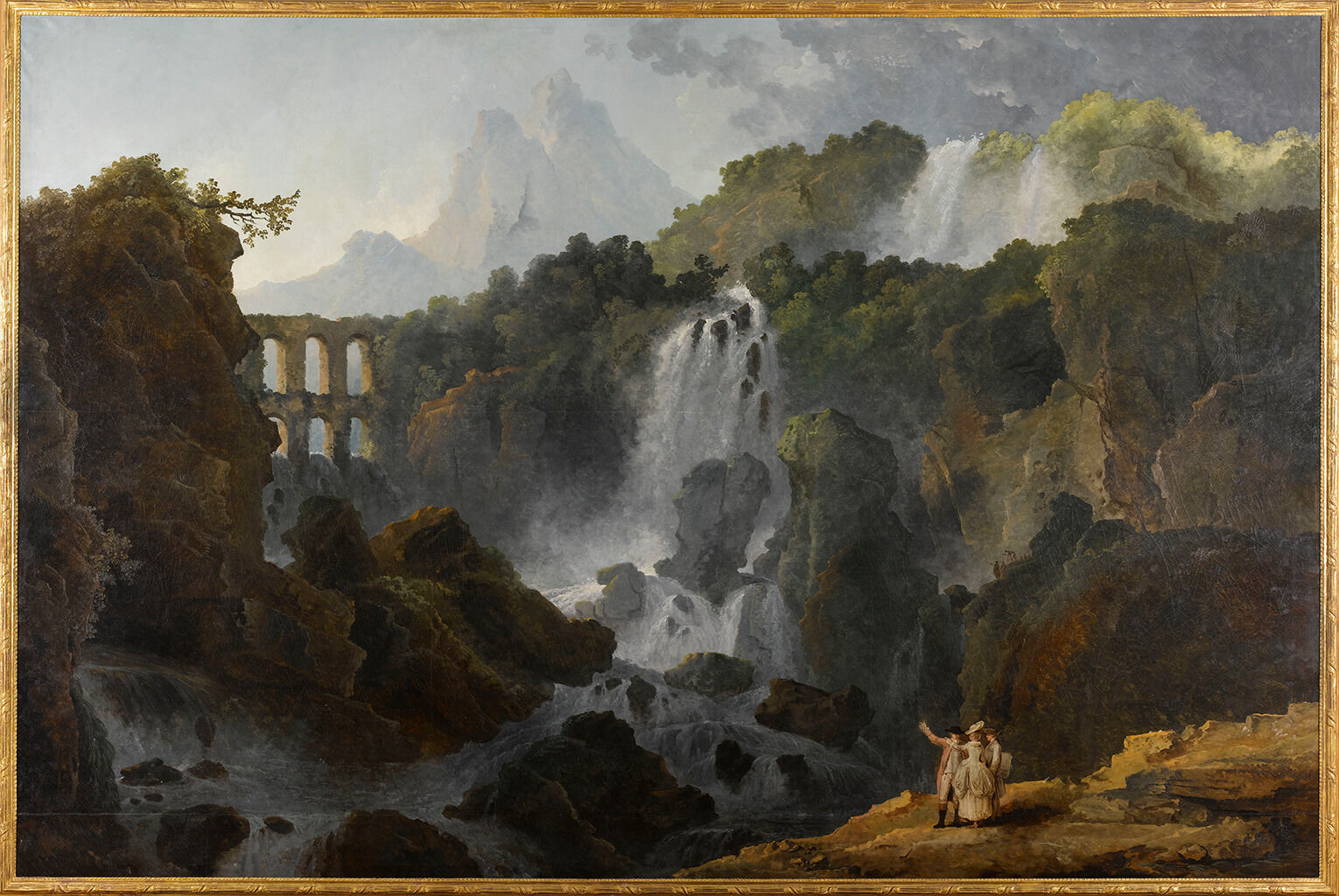
Hubert Robert, Imaginary View of the Tivoli Waterfall, 1779, oil on canvas,
97 5/8 x 148 13/16 in. (248 x 378 cm), Château de Maisons, Maisons-Laffitte, acc. no. MAI 1989000058.
Hubert Robert, Ruins on the Terrace in Marly Park, early 1780s, oil on
canvas, 23 3/16 x 34 1/4 in. (59 x 87 cm), The State Hermitage Museum, St.
Petersburg, Russia.
Preparatory Works
Citation
Chicago:
Glynnis Napier Stevenson, “Hubert Robert, Imaginary View of Three Women Contemplating a Château, ca. 1775–80,” documentation in French Paintings and Pastels, 1600–1945: The Collections of the Nelson-Atkins Museum of Art, ed. Aimee Marcereau DeGalan (Kansas City: The Nelson-Atkins Museum of Art, 2026), https://doi.org/10.37764/78973.5.330.4033.
MLA:
Stevenson, Glynnis Napier. “Hubert Robert, Imaginary View of Three Women Contemplating a Château, ca. 1775–80,” documentation. French Paintings and Pastels, 1600–1945: The Collections of The Nelson-Atkins Museum of Art, edited by Aimee Marcereau DeGalan, Nelson-Atkins Museum of Art, 2026. doi: 10.37764/78973.5.330.4033.
Hubert Robert, Two Statues in a Park, 1765–70, red chalk drawing on
fine cream laid paper, 11 7/16 x 14 1/2 in. (29 x 36.8 cm), Musée des
Beaux-Arts, Quimper, 873-2-40.
Hubert Robert, Terrace of an Italian Villa, ca. 1765, watercolor,
brown ink, and red chalk counterproof on laid paper, 13 15/16 x 11 7/16 in.
(35.5 x 29 cm), National Museum, Warsaw, acc. no. Rys.Ob.d.556 MNW.
Hubert Robert, Young Woman Holding a Basket, Descending Steps Near a Fountain,
1773, red chalk on paper, 14 5/16 x 11 in. (36.4 x 27.9 cm), Musée du Louvre,
Paris, inv. RF 28984, recto
Hubert Robert, Figures in a Park Bordered by an Overhanging
Balustrade, ca. 1775, black crayon on laid paper, 4 3/5 x 3 1/2 in.
(11.6 x 8.8 cm), Musée du Louvre, Paris, Département des Arts graphiques, RF 11567,
recto.
Hubert Robert, Study for “Imaginary View of Three Women Contemplating a Château,”
ca. 1775–80, black chalk, 6 5/8 x 8 5/8 in. (16.8 x 21.9 cm),
The Nelson-Atkins Museum of Art, Kansas City, MO, 55-81.
Glynnis Napier Stevenson, “Hubert Robert, Imaginary View of Three Women Contemplating a Château, ca. 1775–80,” documentation in French Paintings and Pastels, 1600–1945: The Collections of the Nelson-Atkins Museum of Art, ed. Aimee Marcereau DeGalan (Kansas City: The Nelson-Atkins Museum of Art, 2026), https://doi.org/10.37764/78973.5.330.4033.
MLA:
Stevenson, Glynnis Napier. “Hubert Robert, Imaginary View of Three Women Contemplating a Château, ca. 1775–80,” documentation. French Paintings and Pastels, 1600–1945: The Collections of The Nelson-Atkins Museum of Art, edited by Aimee Marcereau DeGalan, Nelson-Atkins Museum of Art, 2026. doi: 10.37764/78973.5.330.4033.
La Saison de Bagatelle: Exposition des Peintres de Jardins des XVIIIe
et XIXe Siècles, Château de Bagatelle, Paris, June–July 1928, no. 79,
as Vue prise de Marly vers Saint Germain-en-Laye.
Exposition de l’Art des Jardins et des Peintres de la Fleur, Musée des
Beaux-Arts Jules Chéret, Nice, March–April 1929, no. 201, as Vue prise
de Marly vers Saint Germain-en-laye.
Exhibition, Kansas City Art Institute, Kansas City, MO, April 11–May 20,
1932.
Loan Exhibition of Prints, Drawings, and Paintings Illustrating the
Development of the Fountain, Fogg Art Museum, Harvard University,
Cambridge, MA, April 4–27, 1935, no. 46, as The Terrace at Marly.
French Painting and Sculpture of the XVIII Century, The Metropolitan
Museum of Art, New York, November 6, 1935–January 5, 1936, no. 53, as
Terrace of the Château de Marly.
French Painting, 1100–1900, Carnegie Institute, Pittsburgh, October
18–December 2, 1951, no. 91, as Terrace of Château de Marly.
French Eighteenth Century Painters: Loan Exhibition for the Benefit of
the Education Program of The Minneapolis Institute of Arts, Minneapolis
Institute of Arts, October 6–November 2, 1954; Wildenstein, New York,
November 16–December 11, 1954, no. 24, as Terrace of the Château de
Marly.
Great French Paintings: An Exhibition in Memory of Chauncey McCormick,
The Art Institute of Chicago, January 20–February 20, 1955, no. 36, as
Terrace at the Château de Marly.
The Century of Mozart, The Nelson-Atkins Museum of Art, Kansas City,
MO, January 15–March 4, 1956, no. 94, as Terrace of the Château de
Marly.
Homage to Mozart: A Loan Exhibition of European Painting, 1750–1800,
Honoring the 200th Anniversary of Mozart’s Birth, Wadsworth Atheneum,
Hartford, CT, March 22–April 29, 1956, no. 52, as Terrace of the
Chateau de Marly.
Fontinalia: The Art of the Fountain and the Fountain in Art: A Loan
Exhibition of Sculpture, Paintings, Drawings, Prints, and Photographs,
The University of Kansas Museum of Art, Spooner Hall, Lawrence, KS,
October 19–November 30, 1957, no. 45, as The Terrace at Marly.
The French Tradition, Marion Koogler McNay Art Institute, San Antonio,
TX, February 8–March 12, 1961, no cat., as Terrace of the Chateau de
Marly.
Hubert Robert, 1733–1808: Paintings and Drawings, Vassar College Art
Gallery, Poughkeepsie, NY, October 9–November 11, 1962, no. 15, as
Terrace of the Chateau de Marly.
The Romantic Era: Birth and Flowering, 1750–1850, Art Association of
Indianapolis, Herron Museum of Art, February 21–April 11, 1965, no. 5,
as Terrace of the Chateau de Marly.
The Eye of Thomas Jefferson, National Gallery of Art, Washington, DC,
June 5–September 6, 1976, no. 208, as The Terrace of the Château at
Marly.
Hubert Robert: The Pleasure of Ruins, Wildenstein, New York, November
15–December 16, 1988, unnumbered, as Terrace of the Château de Marly.
Hubert Robert, Musée du Louvre, Paris, March 9–May 30, 2016; National
Gallery of Art, Washington, DC, June 26–October 2, 2016, no. 70
(Washington, DC, only), as The Terrace at the Château de Marly.
Glynnis Napier Stevenson, “Hubert Robert, Imaginary View of Three Women Contemplating a Château, ca. 1775–80,” documentation in French Paintings and Pastels, 1600–1945: The Collections of the Nelson-Atkins Museum of Art, ed. Aimee Marcereau DeGalan (Kansas City: The Nelson-Atkins Museum of Art, 2026), https://doi.org/10.37764/78973.5.330.4033.
MLA:
Stevenson, Glynnis Napier. “Hubert Robert, Imaginary View of Three Women Contemplating a Château, ca. 1775–80,” documentation. French Paintings and Pastels, 1600–1945: The Collections of The Nelson-Atkins Museum of Art, edited by Aimee Marcereau DeGalan, Nelson-Atkins Museum of Art, 2026. doi: 10.37764/78973.5.330.4033.
Possibly Joshua James Foster, French Art from Watteau to Prud’hon
(Princeton, NJ: Princeton University Press, 1907), 3:65, as Vue de
Marly.
La Saison de Bagatelle: Exposition des Peintres de Jardins des XVIIIe
et XIXe Siècles, exh. cat. (Paris: Frazier-Soye, 1928), 16, (repro.),
as Vue prise de Marly vers Saint-Germain-en-Laye.
Xavier d’Orfeuil, “La Vie qui passe: Les Peintres de jardins à
Bagatelle,” Le Gaulois, no. 18516 (June 16, 1928): 1, as Vue prise de
Marly vers Saint-Germain-en-Laye.
May Birkhead, “Paris Exhibits Art of Watteau Period: Works of Eighteenth
Century Painters Shown In Setting of Bagatelle Garden,” New York Times
77, no. 25,726 (July 1, 1928): E[1].
René Barotte, “Les grandes expositions: Au Château de Bagatelle,”
L’Homme libre, no. 4383 (July 23, 1928): 2, as Les jardins de Marly.
H. Marcel Magne, “L’Art des Jardins a [sic] Bagatelle,” La
Renaissance de l’art français et des industries de luxe, no. 8 (August
1928): 356.
Raymond Bouyer, “Revue de l’Exposition au Bagatelle,” Bulletin de l’Art
ancien et moderne, no. 751 (September–October 1928): 305, (repro.), as
Vue prise d’un jardin de Marly.
Exposition de l’Art des Jardins et des Peintres de la Fleur, exh. cat.
(Nice: Musée des beaux-arts Jules Chéret, 1929), 38, (repro.), as Vue
prise de Marly vers Saint-Germain-en-Laye.
Georges Avril, “L’Exposition de l’art des jardins au musée Jules
Chéret,” L’Éclaireur du dimanche et “La Vie pratique, Courrier des
étrangers,” no. 404 (March 31, 1929): 21, (repro.), as Vue prise de
Marly vers Saint-Germain-en-Laye.
“Musée Jules Chéret a [sic] Nice: L’art des Jardins,” Bulletin des
musées de France, no. 7 (July 1929): 159, as la vue de Marly.
Paul Sentenac, Hubert Robert (Paris: Les Éditions Rieder, 1929), 52,
63n44, (repro.), as Vue de Saint-Germain prise d’une terrasse de
Marly.
“The Nelson Collection Grows,” Kansas City Star 52, no. 120 (January
15, 1932): D.
“Art News,” Kansas City Journal-Post 78, no. 224 (January 17, 1932):
2-C, erroneously as Terrace at St. Germain.
“View New Nelson Art: Purchases for Gallery Inspected by Institute
Trustees,” Kansas City Star 52, no. 122 (January 17, 1932): 3, 8A,
(repro.).
“Kansas City Museum Acquires Nine More Works from Nelson Fund,” Art
Digest 6, no. 9 (February 1, 1932): 7, (repro.), as Three Ladies on
the Terrace at Marly.
“Additional Old Masters Secured for Kansas City,” Art News 30, no. 19
(February 6, 1932): 1, as The Terrace of Chateau de Marly.
M[inna] K. P[owell], “Art: Mr. Parsons Will Be Heard Thursday Night
on ‘The Italian Renaissance,’” Kansas City Times 95, no. 88 (April 12,
1932): 10.
M[inna] K. P[owell], “Art: Art Paid Its Chief Homage to Beautiful
Women in Eighteenth-Century France, Paul Gardner Tells Audience in
Epperson Hall,” Kansas City Times 93, no. 119 (May 18, 1932): 11.
Georges Isarlov, La Peinture Française à l’Exposition de Londres 1932
(Paris: José Corti, 1932), 26.
Edmond Pilon, “Le Bi-Centenaire du peintre Hubert Robert (1733–1808),”
Le Correspondant 331 (May 25, 1933): 523, as Vue de Saint-Germain
prise d’une terrasse de Marly.
André Delacour, “À travers les revues: L’esprit de la peinture: Le
bi-centenaire de Hubert-Robert,” L’Européen, no. 214 (June 2, 1933):
4, as Vue de Saint-Germain prise d’une terrasse de Marly.
“American Art Notes: New Nelson Gallery of Art,” Connoisseur 92, no.
388 (December 1933): 419.
“Nelson Gallery of Art Special Number,” Art Digest 8, no. 5 (December
1, 1933): 13, 20, 22, (repro.), as Terrace of the Chateau of Marly and
Three Ladies on Terrace of Chateau de Marly.
Pierre Domène, “Le nouveau musée de Kansas City,” Beaux-Arts 72, no.
48 (December 1, 1933): 2.
“The William Rockhill Nelson Gallery of Art, Kansas City Special
Number,” Art News 32, no. 10 (December 9, 1933): 28, 30, as Terrace
of Chateau de Marly.
Minna K. Powell, “The First Exhibition of the Great Art Treasures:
Paintings and Sculpture, Tapestries and Panels, Period Rooms and
Beautiful Galleries Are Revealed in the Collections Now Housed in the
Nelson-Atkins Museum,” Kansas City Star 54, no. 84 (December 10,
1933): 4C, as The Terrace of the Chateau of Marly.
Luigi Vaiani, “Art Dream Becomes Reality with Official Gallery Opening
at Hand: Critic Views Wide Collection of Beauty as Public Prepares to
Pay its First Visit to Museum,” Kansas City Journal-Post 80, no. 187
(December 11, 1933): 7.
“Praises the Gallery: Dr. Nelson M’Cleary, Noted Artist, a Visitor,”
Kansas City Star 54, no. 98 (December 24, 1933): 9A, as Terrace of
the Chateau of Marly.
The William Rockhill Nelson Gallery of Art and Mary Atkins Museum of
Fine Arts, Handbook of the William Rockhill Nelson Gallery of Art
(Kansas City, MO: William Rockhill Nelson Gallery of Art and Mary Atkins
Museum of Fine Arts, 1933), 41, 46, (repro.), as Terrace of Chateau of
Marly.
“Museums, Art Associations and Other Organizations,” in “For the Year
1933,” American Art Annual 30 (1934): 175, as Chateau Marly.
George Isarlov, “Notes d’Art: L’Exposition Hubert-Robert,” La Concorde
(January 5, 1934).
A. J. Philpott, “Kansas City Now in Art Center Class: Nelson Gallery,
Just Opened, Contains Remarkable Collection of Paintings, Both Foreign
and American,” Boston Sunday Globe 125, no. 14 (January 14, 1934): 16,
as Chateau Terrace.
“A Thrill to Art Expert: M. Jamot is Generous in his Praise of Nelson
Gallery; Early French Section in Particular Is Pleasing to the Curator
of Paintings at the Louvre,” Kansas City Times 97, no. 247 (October
15, 1934): 7.
Bertha H[arris] Wiles, Loan Exhibition of Prints, Drawings, and
Paintings Illustrating the Development of the Fountain, exh. cat.
(Boston: Fogg Art Museum, 1935), unpaginated, as The Terrace at Marly.
French Painting and Sculpture of the XVIII Century, exh. cat. (New
York: Metropolitan Museum of Art, 1935), 10, (repro.), as Terrace of
the Château de Marly.
News Flashes (The William Rockhill Nelson Gallery of Art and Atkins
Museum of Fine Arts) 2, no. 4 (January 1–16, 1936): 3.
Jean Morgan, “La Double Erreur: Dernière Partie,” Revue Des Deux
Mondes 40, no. 3 (August 1, 1937): 650.
The William Rockhill Nelson Gallery of Art and Mary Atkins Museum of
Fine Arts, The William Rockhill Nelson Collection, 2nd ed. (Kansas
City, MO: William Rockhill Nelson Gallery of Art and Mary Atkins Museum
of Fine Arts, 1941), 41, 47, 168, (repro.), as Terrace of the Chateau
of Marly.
Dorothy Adlow, “Terrace of the Chateau of Marly: A Painting by Hubert
Robert,” Christian Science Monitor 34, no. 71 (February 17, 1942): 12,
(repro.), as Terrace of the Château de Marly.
Jeanne and Alfred Marie, Marly (Paris: Editions Tel, 1947), 19.
The William Rockhill Nelson Gallery of Art and Mary Atkins Museum of
Fine Arts, The William Rockhill Nelson Collection, 3rd ed. (Kansas
City, MO: William Rockhill Nelson Gallery of Art and Mary Atkins Museum
of Fine Arts, 1949), 61, (repro.), as Terrace of the Chateau de Marly.
French Painting, 1100–1900, exh. cat. (Pittsburgh: Carnegie Institute,
1951), (repro.), as Terrace of Château de Marly.
French Eighteenth Century Painters: Loan Exhibition for the Benefit of
the Education Program of The Minneapolis Institute of Arts, exh. cat.
(New York: Wildenstein, 1954), unpaginated, as Terrace of the Château
de Marly.
Pierre Rossillion, “Art et urbanisme: Les forêts de l’Ile-de-France,”
Le Jardin des Arts 1, no. 12 (October 1955): 705, (repro.), as Vue de
Marly sur Saint Germain.
Winifred Shields, “Sketch of French Landscape Acquired by Nelson
Gallery: Drawing Purchased from a Dealer is a Preliminary Study for the
‘Terrace of the Chateau [sic] of Marly,’ a Painting Long in the
Collection Here,” Kansas City Star 75, no. 329 (August 12, 1955): 14,
(repro.), as Terrace of the Chateau of Marly.
Great French Paintings: An Exhibition in Memory of Chauncey McCormick,
exh. cat. (Chicago: Art Institute of Chicago, 1955), unpaginated, as
Terrace at the Château de Marly.
“The Century of Mozart: January 15 through March 4, 1956,” exh. cat.,
Bulletin (The Nelson Gallery and Atkins Museum) 1, no. 1 (January
1956): 13, 31, as Terrace of the Château de Marly.
“Special Exhibition: The Century of Mozart,” Gallery News (The William
Rockhill Nelson Gallery of Art and Mary Atkins Museum of Fine Arts) 23,
no. 5 (February 1956): unpaginated, as Terrace of the Chateau de
Marly.
Homage to Mozart: A Loan Exhibition of European Painting, 1750–1800,
Honoring the 200th Anniversary of Mozart’s Birth, exh. cat. (Hartford,
CT: Wadsworth Atheneum, 1956), 21, as Terrace of the Chateau de Marly.
Fontinalia: The Art of the Fountain and the Fountain in Art; A Loan
Exhibition of Sculpture, Paintings, Drawings, Prints, and Photographs,
exh. cat. (Lawrence, KS: University of Kansas Museum of Art, 1957), 25,
as The Terrace at Marly.
Ross E. Taggart, ed., Handbook of the Collections in the William
Rockhill Nelson Gallery of Art and Mary Atkins Museum of Fine Arts, 4th
ed. (Kansas City, MO: William Rockhill Nelson Gallery of Art and Mary
Atkins Museum of Fine Arts, 1959), 113, 261, (repro.), as Terrace of
the Château de Marly.
Thomas J. McCormick, Hubert Robert, 1733–1808: Paintings and Drawings,
exh. cat. (Poughkeepsie, NY: Vassar College Art Gallery, 1962),
unpaginated, as Terrace of the Chateau de Marly.
Clare Le Corbeiller, “Mercury, Messenger of Taste,” Metropolitan Museum
of Art Bulletin 22, no. 1 (Summer 1963): 26–27, (repro.), as The
Terrace of the Château de Marly.
“Gallic Fete at Gallery,” newspaper unknown (ca. November 1964),
(repro.), clipping, scrapbook, NAMA Archives, vol. 20, p. 83.
The Romantic Era: Birth and Flowering, 1750–1850, exh. cat.
(Indianapolis: Art Association of Indianapolis, Herron Museum of Art,
1965), (repro.), as Terrace of the Chateau de Marly.
W. G. Constable, “‘The Romantic Era’ Exhibition,” Connoisseur 158, no.
638 (April 1965): 257, (repro.), as The Terrace at the Château de
Marly.
Ralph T. Coe, “The Baroque and Rococo in France and Italy,” Apollo 96,
no. 130 (December 1972): 537–39, (repro.) [repr. in Denys Sutton, ed.,
William Rockhill Nelson Gallery, Atkins Museum of Fine Arts, Kansas
City (London: Apollo Magazine, 1972), 69–71, (repro.)], as Terrace of
Château de Marly.
Ross E. Taggart and George L. McKenna, eds., Handbook of the
Collections in The William Rockhill Nelson Gallery of Art and Mary
Atkins Museum of Fine Arts, Kansas City, Missouri, vol. 1, Art of the
Occident, 5th ed. (Kansas City, MO: William Rockhill Nelson Gallery of
Art and Mary Atkins Museum of Fine Arts, 1973), 137, 258, (repro.), as
Terrace of the Chateau de Marly.
The Elegant Academics: Chroniclers of Nineteenth-Century Parisian
Life, exh. cat. (Hartford, CT: Wadsworth Atheneum, 1974), 21, as The
Terrace of the Château de Marly.
William Howard Adams, ed., The Eye of Thomas Jefferson, exh. cat.
(Washington, DC: National Gallery of Art, 1976), 132, 368, (repro.), as
The Terrace of the Château at Marly.
Joseph A. Lastelic, “Jefferson Exhibit Probes Remarkable Mind,” Kansas
City Times 108, no. 229 (May 31, 1976): 18C, as Terrace of the
Chateau de Marly.
Jean-René Gaborit, Jean-Baptiste Pigalle, 1714–1785: Sculptures du
Musée du Louvre (Paris: Editions de la Réunion des musées nationaux,
1985), 44–45, (repro.), as Terrasse du château de Marly.
Collection de Monsieur et Madame Roberto Polo: Vingt-six Chefs-d’Œuvre
de la Peinture Française du XVIIIe siècle (Paris: Ader Picard Tajan,
May 30, 1988), 50, as Terrasse du Château de Marly.
Hubert Robert: The Pleasure of Ruins, exh. cat. (New York:
Wildenstein, 1988), 46, 87, (repro.), as Terrace of the Château de
Marly.
Joseph Baillio, “Hubert Robert’s Decorations for the Chateau de
Bagatelle,” Metropolitan Museum Journal 27 (1992): 164–65, 181n28,
(repro.), as The Terrace of the Château de Marly.
Roger Ward and Patricia J. Fidler, eds., The Nelson-Atkins Museum of
Art: A Handbook of the Collection (New York: Hudson Hills Press, in
association with Nelson-Atkins Museum of Art, 1993), 195, (repro.), as
The Terrace of the Château de Marly.
William Howard Adams, The Paris Years of Thomas Jefferson (New Haven:
Yale University Press, 1997), 240, (repro.), as The Terrace of the
Château at Marly.
Arts of France: Important French Furniture, Paintings, Sculpture,
Silver, Porcelain, and Tapestries (New York: Christie, Manson and Woods,
October 23, 1998), 189, as The Terrace of the Château at Marly.
Sophie Barthélémy, Dessins français XVIIe–XIXe siècles: florilège de la
collection du musée des Beaux-Arts de Quimper (Quimper: Musée des
Beaux-Arts, 1999), 58, (repro.), as La Terrasse du château de Marly.
Hélène Moulin, ed., Hubert Robert (1733–1808) et Saint-Pétersbourg: Les commandes de la
famille Impériale et des Princes russes entre 1773 et 1802, exh. cat.
(Paris: Réunion des Musées Nationaux, 1999), 152–53, (repro.), as La
Terrasse du château de Marly.
Pierre Nora, ed., Rethinking France: Les Lieux de Mémoire (Chicago:
University of Chicago Press, 2001), 2:316, 447, (repro.), as View from
Marly near Saint-Germain-en-Laye (Vue prise de Marly vers
Saint-Germain-en-Laye).
Collection privée Parisienne: important mobilier, objets d’art,
tableaux et dessins anciens, porcelaine de chine (Paris: Sotheby’s,
December 16, 2004), 62, 64, Terrasse du parc de Marly.
“Vibrant Galleries Offer Fresh View of European Art,” Member Magazine
(The Nelson-Atkins Museum of Art) (Fall 2006): 6, (repro.), as The
Terrace at the Château de Marly.
Deborah Emont Scott, ed., The Nelson-Atkins Museum of Art: A Handbook
of the Collection, 7th ed. (Kansas City, MO: Nelson-Atkins Museum of
Art, 2008), 106, (repro.), as The Terrace at the Château de Marly.
Kimberly Chrisman-Campbell, Fashion Victims: Dress at the Court of
Louis XVI and Marie-Antoinette (New Haven: Yale University Press,
2015), 72–73, 113, 115, (repro.), as The Terrace at the Château de
Marly.
Margaret Morgan Grasselli and Yuriko Jackall, Hubert Robert, exh. cat.
(Washington, DC: National Gallery of Art, 2016), 160, 237–78, (repro.),
as The Terrace at the Château de Marly.
Sarah Catala, “Hubert Robert: Le Temps de la Citationˮ (PhD diss.,
Université Lumière Lyon 2, 2020), 245, as Terrasse inspirée de Marly
avec le château de Saint-Germain-en-Laye.
Yuriko Jackall and Kari Rayner, “Becoming Hubert Robert: Some New
Suggestions,” Burlington Magazine 163, no. 1416 (March 2021): 248–49,
252, as Terrace at the Château de Marly.
Sarah Catala, Hubert Robert: de Rome à Paris, exh. cat. (Paris:
Galerie Éric Coatalem, 2021), 46, as La terrasse du château de Marly.