What’s in a name? It gets complicated when Glenn sits down with professional genealogist Kathleen Brandt to trace his ancestors. Looking at his family history under the microscope, Glenn turns to poetry and a sculpture of a young girl peering through a telescope to process some disorienting findings. This all leads to acclaimed filmmaker Kevin Willmott and what it means to break free from the bondage of history to imagine new stories and engage in creative acts of reclamation.
Discussion Prompts
How far back can you trace your own heritage? Sketch out your family tree with as many branches and people as possible. Where are there gaps in your knowledge and why? How does this shape how you understand yourself?
Kevin Willmott describes the “American Challenge” as embracing “being uncomfortable.” Can you think of examples where you leaned into discomfort and learned something new about yourself or others?
Think about how Black people have been depicted in the media you consume: social media, films, books, art, music, games, etc. How do you think those representations have influenced your thinking? What particular examples have shaped or changed your mindset?
About the guests
Kathleen Brandt, professional international genealogist and consultant, reveals her research into Glenn’s personal ancestry.
Kevin Willmott, filmmaker and Academy-award winning screenwriter, illuminates the power of art to tell stories and project visions of possible futures and alternate realities.
Featured art
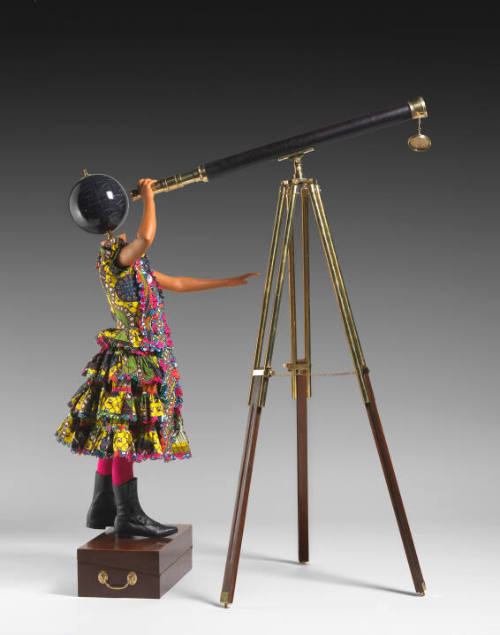
Yinka Shonibare, English Nigerian (born 1962). Planets in My Head, Physics 2010. Purchase: acquired through the generosity of G. Kenneth Baum in honor of Ann Baum on the occasion of her birthday, 2011.23.A-E. Art © Yinka Shonibare MBE. Courtesy James Cohan Gallery, New York/ Shanghai / Artists Rights Society (ARS), New York.
Yinka Shonibare’s Planets in My Head, Physics celebrates the mystery of the night sky and the thrill of discovery. Here, a curious young girl, wearing high-top button shoes and a Victorian dress cut from Colonialist fabric, steps upon a wooden case to peer through a telescope into the vast beyond. Her head, a black celestial globe, dances with the names of physicists and astronomers. Like us, she is the inheritor of knowledge gleaned through centuries of time by scholars from every part of the world. Archimedes, Galileo, Einstein and Hawking are there, as are Shen Kuo, Ibn Rushd (Averroes), Yoshio Nishina and Brahmagupta. Additional works in Shonibare’s Planets in My Head series include Arts and Literature.
Names of Physicists and Astronomers on Shonibare’s Celestial Globe Head:
Nicolaus Copernicus, Democritus Donald, Edwards Marcelo, Danny de Sousa, Samos Al-Hassan ibn al-Haytham, Hippolyte Louis Fizeau, Enrique Lodel Palumbo, Ghulam Murtaza, Leo Esaki, Charles-Augustin de Coulomb, Charles Edouard Guillaume, Archimedes of Syracuse, Brahmagupta, Abdul Hameed Nayyar, Dignaga, Zhang Heng, Hafeez-ur-Rehman Hoorani, Lev Gorkov, Leucippus, Yuval Ne’eman, Richard Gans, Herman Ludwig Ferdinand von Helmholz, Hideki Yukawa, Albert Einstein, Thomas Alva Edison, Slu Shen, Claudius Ptolemaeus, Al-Kindi (Abu Yusef Yaqoub ibn Ishaq Al-Kindi), Sir Leonard George Holden Huxley, Pakudha Katyayana, Hugh Le Caine, William Henry Eccles, Su Song, Nikola Tesla, Hans Bethe, Keith Alexander Nugent, John McNeil Hunter, Gan De, Hipparchos, Ashok Das, Rutherford Adkins, Mohammed Masud Ahmad, Sir Marcus ‘Mark’ Laurence Elwin Oliphant, Isaac Newton, Al-Biruni (Abu Rayhan Muhammed ibn Ahmad Biruni), Rudolf Julius Emanuel Clausius, Stephen William Hawking, G.O.S. Ekhaguere, Galileo Galilei, Sin-Itiro Tomonaga, Al-Farabi, Al-Tusi, Sir Roger Penrose, Xu Guangqi, Yoichiro Nambu, Sundance Osland Bilson-Thompson, Jagadish Chandra Bose, Cesare Mansueto Giulio Lattes, Thomas Young, Sima Qian, Toshihide Maskawa, Satyendra Nath Bose, Ibn Taymiyah, Erwin Rudolf Josef Alexander Schrödinger, Terence James Elkins, Shen Kuo, Werner Israel, Leonhard Euler, Pierre-Simon, Marquise de Laplace, Ibn Rushd, Yoshio Nishima, Sir Harrie Stewart Wilson Massey, Al-Ghazali, Ibn Sina, Blaise Pascal, Aiyalam Parameswaran Balachandran, Halson V. Eagleson, Miguel Alcubierre Moya, Dharma Kiru, Behram Kursunoglu, and Sekazi Mungwa
This family unit, composed of a kaleidoscope of rich, jewel-like colors and a variety of fabrics, gazes out at the viewer, demanding to be seen. The figures exude confidence in the significance of their story. The Kindred family represents the “courageous, brave, or beautiful” people Bisa Butler celebrates in her textile portraits. In works like these, she aims to “noble-ize the normal, if invisible, successful Black community.”
Further reading
Afrofuturism: discover how Black identity, agency, and freedom have been expressed through art, creative movements, and activism that envisioned liberated futures for African Americans as told by the National Museum of African American History and Culture.
Did Slaves Take Their Owners Last Name?: this article analyzes how name selection was influenced by social pressure, personal preference, and survival.
Guernica: a monumental painting and protest against war by the Spanish artist Pablo Picasso
Destination Planet Negro: preview Kevin Wilmott’s 2013 satirical sci-fi film on race, segregation, and time travel before purchasing on your preferred streaming service
10 Million Names: a collaborative project dedicated to recovering the names of an estimated 10 million men, women, and children of African Descent who were enslaved in the territory that would become the United States between the 1500s and 1865.
About the host
Glenn A. North is an award-winning poet and community leader based in Kansas City, Missouri. He is currently the Director of Inclusive Learning & Creative Impact at The Museum of Kansas City. He has previously served at the Bruce R. Watkins Cultural Center, American Jazz Museum, and The Black Archives of Mid-America. Having earned an M.F.A. in Poetry from the University of Missouri-Kansas City, Glenn also conducts Ekphrastic poetry workshops and uses poetry to address issues of social justice, diversity, equity, inclusion, and self-empowerment.
Credits
A Frame of Mind is a podcast of The Nelson-Atkins Museum of Art. This episode was produced and co-written by Glenn North and Christine Murray. Editing and sound design by Brandi Howell. Interview recording by Rick Anderson and Tim Harte. Studio engineering by Simpson Sound Lab. Fact checking and copyediting by Kate Carpenter. Theme music by The Black Creatures. Cover art by Two Tone Press.
Special thanks to advisory group members Jimmy Beason II, Wolfe Brack, Marlee Bunch, José Faus, and Subashini Nadarajah.
Produced in partnership with Adina Duke, Kim Masteller, and Anne Manning,
This podcast is produced with generous support from The Honorable Jon R. Gray (Ret.) and Dr. Valerie Chow.