Searching for his origins, Glenn comes face to face with a haunting image of slavery in America: a tiny photograph of a cotton plantation takes him back to the invention of photography as a source for truth-telling today. The scene testifies to the long shadow of slavery and the slow, systematic stripping away of equities that have ruptured Black relationships to the land. Can that same photograph also collapse time and place and regenerate links between generations? This episode brings our season to a close, but new seeds have come of it. To sow them is to shape a new chapter in our story.
Discussion Prompts
Imagine your last trip to get groceries. How did you get there? How long did it take? What obstacles, if any, did you encounter? What types of fresh produce were available? How does access to fresh and affordable fruits and vegetables impact your physical health and security?
Frederick Douglass talked about photography as a way to assert personhood. Glenn and Ryan Tenney consider this photograph as both evidence and a way to give testimony. In what ways do works of art function as both a window and a witness on the world?
In Glenn’s final poem, the narrator refuses to be silenced and challenges America to reckon with its history of enslavement. What responsibilities do museums or nations have to tell the truth about their past? And how might museums foster hope for future generations?
About the guests
April Watson, senior curator of photography at the Nelson-Atkins, welcomes us into the museum’s storage vault to share a singular photograph and its significance to the American experience.
Ryan Tenney, artist-farmer, digs into the root causes behind dramatic changes in Black farming and his sense of responsibility to continue the story.
Featured art
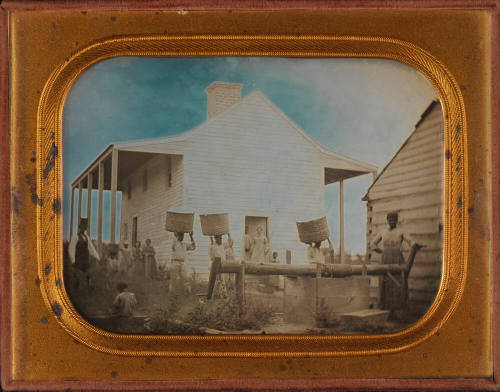
Unknown artist. Enslaved people on a cotton plantation, about 1850. Gift of the Hall Family Foundation, 2019.56.9.
This rare daguerreotype depicts enslaved African American men, women, and children working on a small Southern cotton plantation. The man wearing a top hat at the far left is believed to be their enslaver, Samuel T. Gentry, who lived in rural Georgia.
This image, considered to the be earliest surviving photograph of enslaved labor, records a painful chapter in U.S. history. In the practice of chattel slavery, enslaved African Americans were legally considered property. They were forcibly separated from their families and made to work in brutal, inhumane conditions. In the decades leading up to the Civil War, the cotton industry relied on enslaved labor to fuel the economy: cotton constituted over 60 percent of America’s exports in the 1850s.
Further reading
The Daguerreotype Medium: explore the process and cameras used to create a daguerreotype, one of the earliest forms of photography.
Returning Generation Black Farmers Collective: led by Kansas City’s Sankara Farms, this collective aims to uplift the future of Black Farmers in Missouri by providing mentorships, stipends, workshops, training, and resource assistance.
How the United States Department of Agriculture (USDA) distorted data to conceal decades of discrimination against Black farmers: this investigative report points to the Census of Agriculture, the nation’s definitive count of America’s farmers, to unpack the slow-moving, institutional oppression of a sprawling government bureaucracy.
Kansas City food deserts expand as grocery stores close: published in October 2025, this article explores growing concerns about food deserts in Kansas City and a newfound reliance on community farms.
George Washington Carver: a biography of one of the most prolific Black Agricultural scientists and inventors.
About the host
Glenn A. North is an award-winning poet and community leader based in Kansas City, Missouri. He is currently the Director of Inclusive Learning & Creative Impact at The Museum of Kansas City. He has previously served at the Bruce R. Watkins Cultural Center, American Jazz Museum, and The Black Archives of Mid-America. Having earned an M.F.A. in Poetry from the University of Missouri-Kansas City, Glenn also conducts Ekphrastic poetry workshops and uses poetry to address issues of social justice, diversity, equity, inclusion, and self-empowerment.
Credits
A Frame of Mind is a podcast of The Nelson-Atkins Museum of Art. This episode was produced and co-written by Glenn North and Christine Murray. Editing and sound design by Brandi Howell. Interview recording by Rick Anderson and Tim Harte. Studio engineering by Simpson Sound Lab. Fact checking and copyediting by Kate Carpenter. Theme music by The Black Creatures. Cover art by Two Tone Press.
Special thanks to advisory group members Jimmy Beason II, Wolfe Brack, Marlee Bunch, José Faus, and Subashini Nadarajah.
Produced in partnership with Adina Duke, Kim Masteller, and Anne Manning,
This podcast is produced with generous support from The Honorable Jon R. Gray (Ret.) and Dr. Valerie Chow.