In Episode 1, Glenn North confronts what it means to be a Black man in America in 2026. Can art help us grasp who we are and how we’ve ended up here? Glenn thinks so. He introduces us to a favorite work by the Ghanaian artist El Anatsui, Dusasa 1. Like many of El Anatsui’s works, this is a large tapestry made up of battered pieces of metal with painful associations, held together by fragile links. Glenn then takes us on his own journey to Ghana, Africa, in conversation with his friend and traveling companion, Khyra Chiles. Did Glenn find the answers he seeks on this trip?
Discussion Prompts
Which factors contribute to your sense of belonging? In what ways do race and racialized experiences shape and influence a sense of belonging?
Glenn and Khyra describe their visit to the Slave Castle in Ghana—the violence and degradation endured by enslaved people and the generational trauma that follows. How did you respond to their vivid account, and how do you connect their perspectives to your own lived experiences?
Glenn discusses Dusasa I by El Anatsui, a work that confronts painful histories and the enduring impacts of the transatlantic slave trade, while also drawing viewers in with its shimmering metal surface, flowing forms, and vibrant patterns. How does this tension between beauty and discomfort shape the viewer’s experience? Do you think it is more important for art to comfort us, or to challenge and unsettle us?
When Khyra speaks about the ideas of the writer and civil rights activist James Baldwin, she calls attention to the “dash” between African and American and the difficulty of trying to be who you are without knowing who you were. What dashes or gaps exist in your own identity?
About the guests
Khyra Chiles, friend and fellow traveler of Glenn North, reflects on her experience visiting Ghana for the first time.
Julián Zugazagoitia, Director and CEO of The Nelson-Atkins Museum of Art, offers art and museums as pathways for asking brave questions.
Featured art
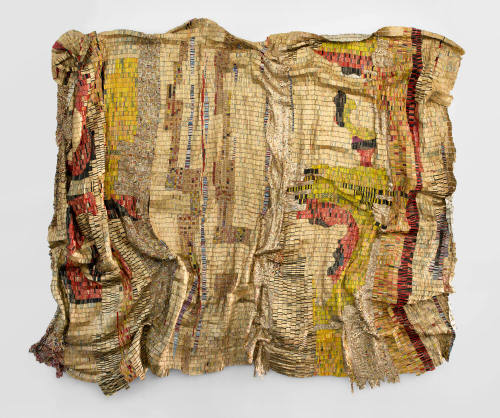
El Anatsui, Ghanaian (born 1944). Dusasa I, 2007. Purchase: acquired through the generosity of the William T. Kemper Foundation–Commerce Bank, Trustee, 2008.2. Art © El Anatsui, courtesy of the artist and Jack Shainman Gallery, NY.
Dusasa I was created from recycled liquor-bottle tops that have been flattened and stitched together using copper wire. Working with the metal shapes, El Anatsui allows the materials and colors to suggest the composition. The artist’s use of liquor-bottle tops acknowledges both the historical role of liquor as a commodity traded by colonial powers for slaves and its ritual use as a libation, when it is poured as a form of prayer. The colors and forms of Dusasa I are related to kente cloth, an African textile made by the Asante and Ewe peoples of Ghana. The title Dusasa comes from Ewe words, du and sasa, meaning a fusion of disparate element on a monumental scale.
Further reading
Remembering “Roots”: a reflection on the landmark premiere of Alex Haley’s “Roots” and its enduring legacy.
won’t you celebrate with me: a poem by Lucille Clifton published in the Collected Poems of Lucille Clifton, 1991.
Interview with El Anatsui: a nine-minute video interview with the artist on his practice and the power of uniting things.
About the host
Glenn A. North is an award-winning poet and community leader based in Kansas City, Missouri. He is currently the Director of Inclusive Learning & Creative Impact at The Museum of Kansas City. He has previously served at the Bruce R. Watkins Cultural Center, American Jazz Museum, and The Black Archives of Mid-America. Having earned an M.F.A. in Poetry from the University of Missouri-Kansas City, Glenn also conducts Ekphrastic poetry workshops and uses poetry to address issues of social justice, diversity, equity, inclusion, and self-empowerment.
Credits
A Frame of Mind is a podcast of The Nelson-Atkins Museum of Art. This episode was produced and co-written by Glenn North and Christine Murray. Editing and sound design by Brandi Howell. Interview recording by Rick Anderson and Tim Harte. Studio engineering by Simpson Sound Lab. Fact checking and copyediting by Kate Carpenter. Theme music by The Black Creatures. Cover art by Two Tone Press.
Special thanks to advisory group members Jimmy Beason II, Wolfe Brack, Marlee Bunch, José Faus, and Subashini Nadarajah.
Produced in partnership with Adina Duke, Kim Masteller, and Anne Manning,
This podcast is produced with generous support from The Honorable Jon R. Gray (Ret.) and Dr. Valerie Chow.