The artist will join a discussion about his Bach-inspired collection, now on display at the museum
Kansas City, MO–Mixed-media artist Farhad Ostovani will visit The Nelson-Atkins Museum of Art this October for a discussion on an exhibition of his work now on display at the museum. This special event explores the intersection of sight and sound in Farhad Ostovani: Goldberg Variations.
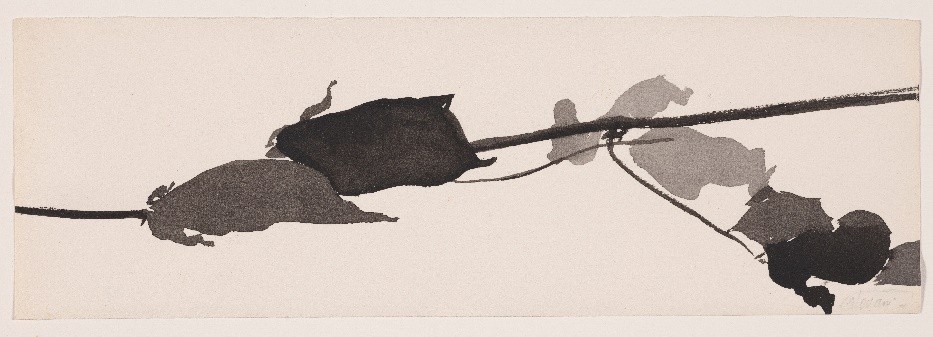
Inspired by Johann Sebastian Bach’s beloved keyboard composition, Ostovani’s series on the Goldberg Variations depicts plant forms—the flowerless stems and leaves of rose plants—which move and twist across empty space. Working with ink and brush, impressions, and chalk lines, he builds up his compositions from delicate layers of Nepalese paper. These botanical forms are his invented symbolic language for depicting the auditory experience of music.
“Farhad Ostovani is an artist of great sensitivity,” said Julián Zugazagoitia, Director & CEO of the Nelson-Atkins. “He has the ability to strip his subject down to its bare essence. In his Goldberg Variations, a gesture of line or a pool of ink can tell the life story of a plant, or the trace melody in a progression of music. These quiet works encourage us to stop and reflect.”
Ostovani began work on his Variations during an artist’s retreat at Doland Mountain in California, collecting specimens of rose plants. When he returned to the project a year after his father’s death, he found that the plant specimens had decayed. Listening to Variation No. 25, the most melancholic of the compositions, Ostovani began to paint again, creating studies while processing his grief for his father. The two-panel composition of Variation No. 25 featured in the exhibition became the first work in his Goldberg Variations series.
The exhibition also features Ostovani’s Aria, a thirty-panel grid that embodies the mood and structure of the opening composition of the Goldberg Variations, and a group of ink on paper studies for Variation No. 25 that captures Ostovani’s artistic process. Guests can listen to Nikolayeva’s recordings of these Goldberg Variations in the gallery and “see” the music for themselves. “Ostovani often works on a subject as part of a series, examining it from different viewpoints, using different media and artistic techniques,” said Kimberly Masteller, Curator, South and Southeast Asian Art. “He calls these serial works ‘meditations’, and this particular series was created as he processed the illness and death of his father.”
Nelson-Atkins guests can hear from Ostovani about his affinity for art, music, and nature in Between Image and Sound: Farhad Ostovani at 6 p.m., Thursday October 29 in the museum’s Atkins Auditorium. The evening will open with a piano piece written for the event by Kansas City-based composer, Yunfei Li. The piece, which was inspired both by Bach’s iconic composition and Ostovani’s work, will be performed by Dr. Yi-Yang Chen, assistant professor of piano at the University of Kansas.
Following the performance, Ostovani will join his editor, Robert Bemis, and Nelson-Atkins Director and CEO Julián Zugazagoitia in conversation about the artist’s life and career. Tickets are $12 for the public, $10 for members, and $6 for students and can be purchased on the Nelson-Atkins website.
Ostovani’s memoir, Aliof’s Garden is available for purchase from the Museum Store, either in person or online.
About the Artist
Ostovani, a contemporary artist known for his minimal and conceptual studies of natural subjects, was born in 1950 in Lahidjan, Iran. He studied Fine Art at the University of Tehran in 1970, moved to Paris in 1974 to continue his studies, and now lives and works in France.
Image caption: Farhad Ostovani, Iranian (born 1950). Study for Goldberg Variations, 1996–1997. Watercolor and ink on paper, 4 1/8 × 12 1/2 inches (10.5 × 31.8 cm). Gift of the artist, 2024.70.22.