Catalogue Entry
Citation
Chicago:
Joseph Baillio, “Jean Marc Nattier, Portrait of Isidore Florimond Marié, Seigneur de Toulle et de Foucaucourt-hors-Nesle, a Knight of the Royal French Military Order of Saint-Louis, 1741,” catalogue entry in French Paintings and Pastels, 1600–1945: The Collections of the Nelson-Atkins Museum of Art, ed. Aimee Marcereau DeGalan (Kansas City: The Nelson-Atkins Museum of Art, 2024), https://doi.org/10.37764/78973.5.324.5407.
MLA:
Baillio, Joseph. “Jean Marc Nattier, Portrait of Isidore Florimond Marié, Seigneur de Toulle et de Foucaucourt-hors-Nesle, a Knight of the Royal French Military Order of Saint-Louis, 1741,” catalogue entry. French Paintings and Pastels and Pastels, 1600–1945: The Collections of The Nelson-Atkins Museum of Art, edited by Aimee Marcereau DeGalan, Nelson-Atkins Museum of Art, 2024. doi: 10.37764/78973.5.324.5407.
The sons of Marc Nattier (1642–1705)—a relatively minor portraitist during the second half of the reign of Louis XIV—and the miniaturist Marie Courtois (ca. 1655–1703), Jean Marc Nattier and his older brother, Jean-Baptiste (1678–1726), learned the practical aspects of painting, drawing, and composition in their father’s studio. For a time they attended the drawing and theoretical classes of the Académie Royale de peinture et de sculpture (Royal Academy of Painting and Sculpture), of which Marc Nattier was a member in good standing. The two siblings were awarded a yearly stipend from the royal arts administration and were prizewinners in the Académie’s student competitions. Their painting styles were remarkably similar, with Jean-Baptiste styling himself Nattier l’aîné (the oldest) and Jean Marc signing his works Nattier le jeune (the young). In 1709, with the support of the Academician Jean Jouvenet (1644–1717), the younger Nattier was offered a scholarship to study in Rome, but he declined the honor in order to further a lucrative career as a portraitist. In 1715, Jean Marc sought entry into the Académie as a history painter, but he only completed his diploma piece—Perseus Petrifying Phineus with the Head of the Gorgon (Musée des Beaux-Arts, Tours)—three years later.
Jean Marc was summoned to Holland in 1717 on orders
from the Russian Tsar Peter I (Peter the Great), who
was by then in the second phase of his “Grand
Embassy,” a learning and diplomatic tour of socially,
culturally, and scientifically advanced Western
European countries. During the time he resided in
Amsterdam and the Hague, Nattier painted a
three-quarter-length portrait of the Tsarina Catherine
I (1717; The State Hermitage, Saint Petersburg) and
produced a generic battle piece intended to
commemorate Russia’s 1709 victory over the Swedish
troops at Poltava in the Ukraine (Battle at Lesnaya, 1717; Pushkin Museum, Moscow). When the young
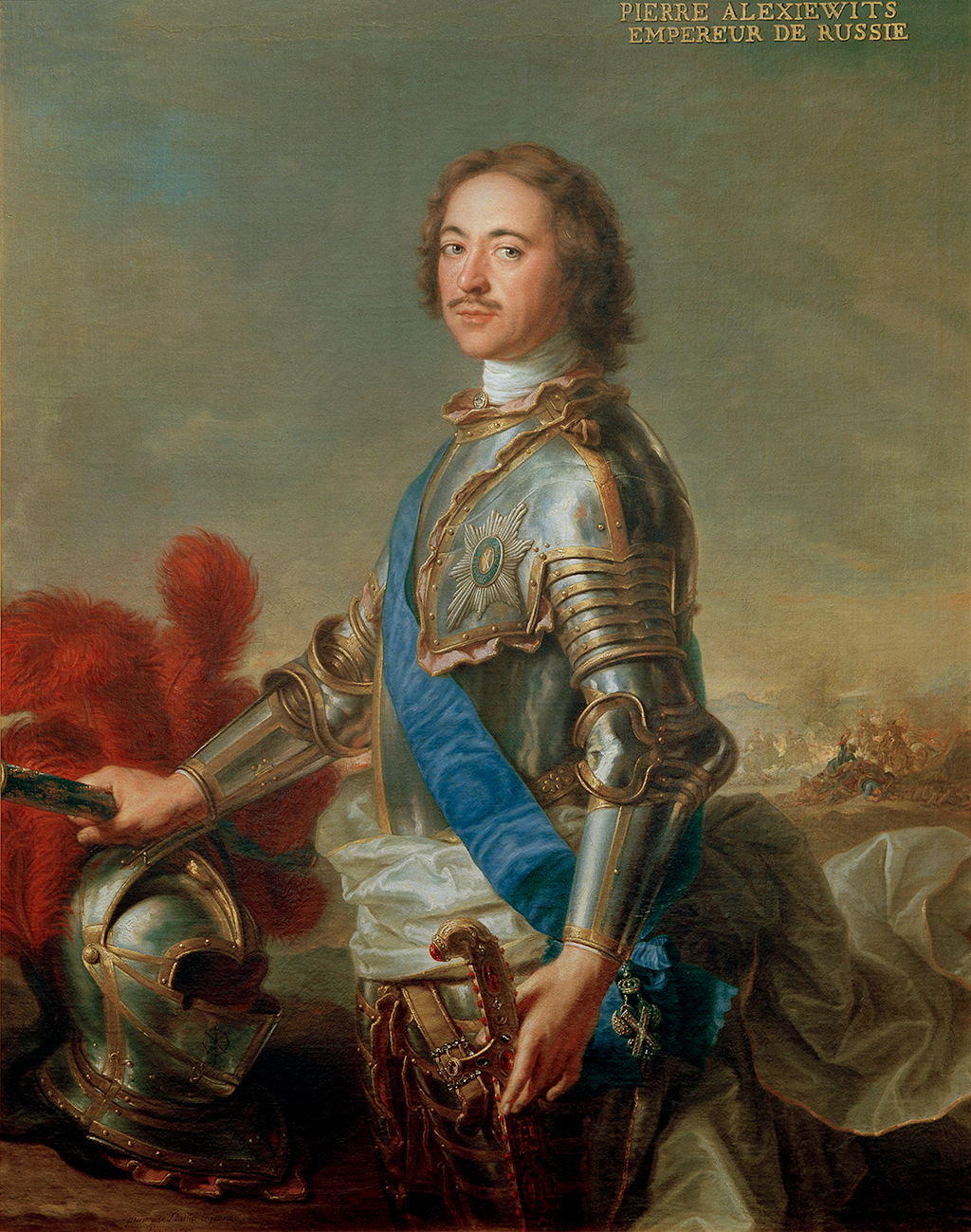
French artist returned to Paris, he painted from life
a likeness of the Tsar wearing a suit of plate armor
(Fig. 1), which was the first of many military
portraits of men wearing medieval-like suits of armor,
with battle scenes raging in the background to set off
their martial attire.1Peter had chosen to be depicted in a complete
suit of armor by Godfrey Kneller in London in 1698
for his host King William III (The Royal
Collection Trust, The Queen’s Gallery, Buckingham
Palace, inv. no. RCIN 405645,
https://www.rct.uk
During the Renaissance and Baroque eras, this portrait
specialty had been codified in Italy (especially
Venice) and Flanders, as well as in France, where
under the last Valois and first Bourbon monarchs it
was practiced by the likes of Jean and François Clouet
(South Netherlandish, active France, ca.
1485–1540/1541, and French, ca. 1516–72), Frans
Pourbus (Flemish, 1569–1622), Philippe de Champaigne
(1602–74), Charles Le Brun (1619–90), and Charles La
Fosse (1636–1716). But it was brought to its fullest
expression by such court painters as Hyacinthe Rigaud
(1659–1743),2See for example,
Presumed Portrait of Comte Robert Jean Antoine
François Franquetot de Coigny, 1699, Musée des Beaux-Arts, Caen
https://mba.caen.fr
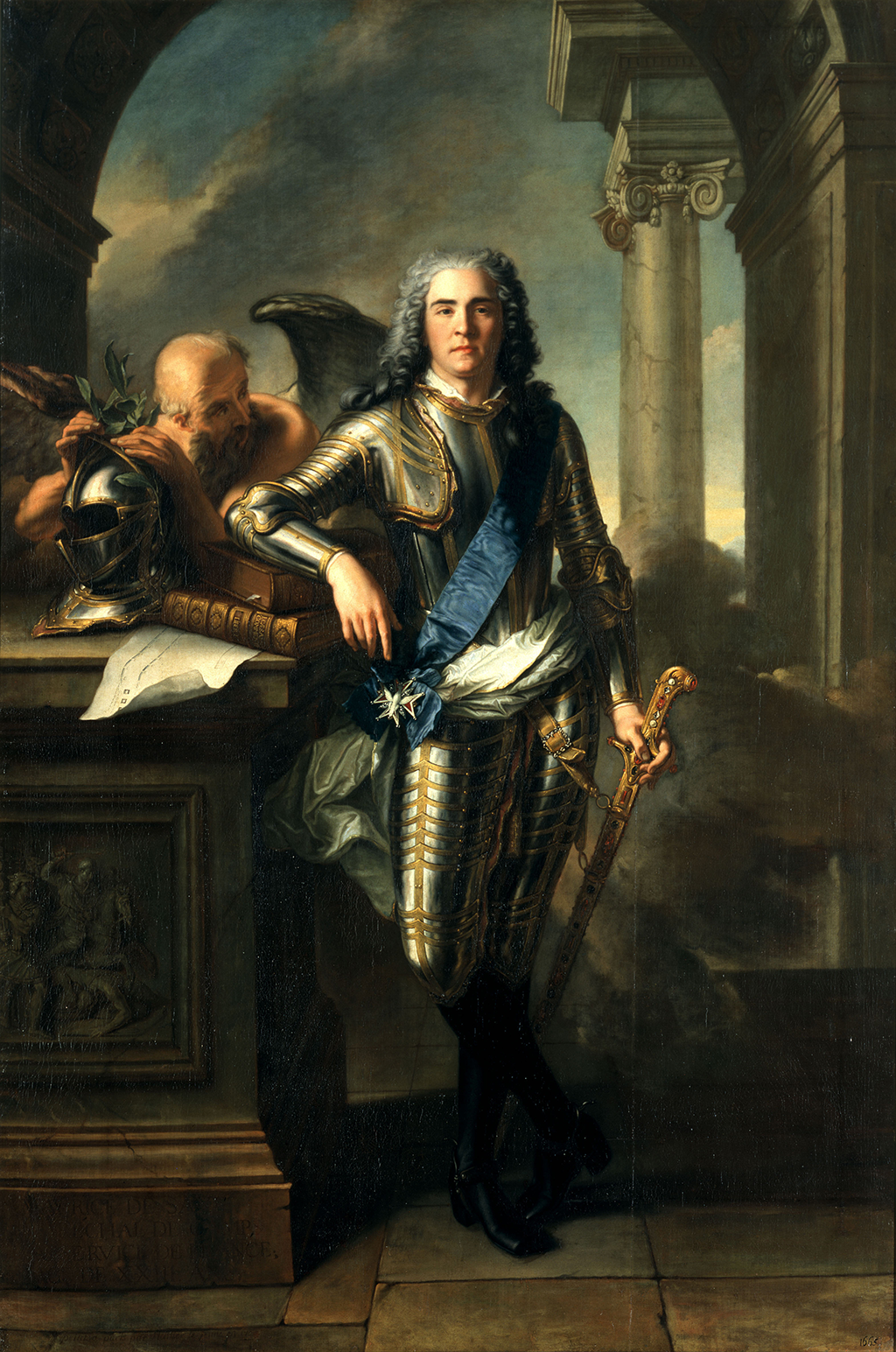
In 1719, the Nattier brothers were financially ruined in John Law’s Mississippi Bubble scheme.3The Mississippi Bubble “was a financial scheme in eighteenth-century France that triggered a speculative frenzy and ended in financial collapse.” See “Mississippi Bubble,” Encyclopedia Britannica, online edition, last edited October 18, 2002, https://www.britannica.com/event/Mississippi-Bubble. By August 1717, Antoine Crozat’s largely economic hold on Louisiana had been transferred to another monopoly, the Compagnie d’Occident or Compagnie du Mississippi, a scheme hatched by the Scottish economist John Law, who sold the idea to the Régent, Philippe, duc d’Orléans. To capitalize his plan for encouraging trade between France and its overseas colonies in the lower part of North America, Law created a royal bank and issued paper money backed by neither coinage nor bullion. As an enticement to attract gullible investors, he advertised Louisiana as an El Dorado where fortunes could be easily realized. The result was rampant speculation, and people like the Nattier brothers clamored to buy bonds and concessions of plantation land in the faraway colony. In the end, Law’s System collapsed in the so-called “Mississippi Bubble,” and many of those who had invested in it were left with worthless bonds, debt papers, and currency, or landed estates they were incapable of managing from afar. Jean Marc’s career, however, soon recovered. In 1721, he was hired to make drawings after paintings in the collection of the Regent, Philippe d’Orléans, the series of which was called the Recueil Crozat. He then associated himself with Jean-Baptiste Massé (1687–1767) on a vast engraving project recording Charles Le Brun’s ceiling decorations for the Palace of Versailles, specifically the Galerie des Glaces and the Salons de la Paix et de la Guerre. On the Feast of Corpus Christi in 1725, Nattier sent to the Exposition de la Jeunesse, near the Pont-Neuf in Paris, his full-length swagger portrait of Count Moritz Hermann of Saxony (Fig. 2), the son of Augustus the Strong, Elector of Saxony, and his Swedish mistress, Countess Aurora Von Königsmark. In it, the count is dressed in a suit of armor decorated with the insignia of the Polish Order of the White Eagle and is leaning on a sheathed saber.
For several decades, the artist’s glamorous portraits of women made up as Greco-Roman deities or occasionally as women of the Turkish harem, and his likenesses of men outfitted as fabled heroes or warriors draped in the ceremonial vestments of some noble order, were all the rage. These works relied for their effect on lavish displays of sumptuous fabrics and accessories. Moreover, while flattering his sitters, he somehow managed to capture near-perfect likenesses. The Venetian adventurer Giacomo Casanova, who met Nattier during one of his stays in Paris, commented on this skill, saying that his portraits of women “add an aura of imperceptible beauty to a perfect likeness.”4“. . . ajoutent un caractère imperceptible de beauté” (add an aura of imperceptible beauty to a perfect likeness). Giovanni Giacomo Casanova de Seingalt, Mémoires (Paris: Bibliothèque de la Pléiade, 1959), 2:489–90.
From the mid-1730s through the mid-1740s, Nattier
became a regular at
Salon, the: Exhibitions organized by the
French Royal Academy of Painting and Sculpture
(Académie Royale de Peinture et de Sculpture) and
its successor the Academy of Fine Arts (Académie
des Beaux Arts), which took place in Paris from
1667 onward.
and earned the title of painter-in-ordinary to the
king, completing portraits of the queen and her
children, including the dauphin, as well as the king’s
favorite mistress, the future Marquise de Pompadour.
In 1741,
Nattier painted the Nelson-Atkins portrait of a knight
of the Order of Saint-Louis, a military distinction
founded in 1693 by Louis XIV to distinguish valiant
and meritorious commissioned officers in the royal
armed services without regard to their birth and
social rank.5For a detailed history of the Order of
Saint-Louis, now extinct, as well as a listing of
the promotions that took place during the War of
the Austrian Succession, see Alexandre Mazas and
Théodore Anne,
Histoire de l’ordre royal et militaire de
Saint-Louis, depuis son institution en 1693
jusqu’en 1830, 2nd ed. (Paris: Firmin-Didot frères, fils,
1861), especially 1:311–35. At the beginning of
the second volume is a recapitulation of the names
of officers not cited in the first, and in the
third volume is an “Alphabetical table of the
names of dignitaries and knights of the royal and
military order of Saint-Louis cited in this work,”
3:555–608, and a list of the knights of the order
whose names were discovered after the original
list was published, 609–23.
The painting has
sometimes been misdated to the year 1744 or even
1747, due perhaps to the illegible last digit near
the artist’s signature at lower left. However,
with the aid of recent photomicroscopy undertaken
by Sophia Boosalis, Kress Conservation Fellow,
Nelson-Atkins Museum, the date is clearly
“1741.”
(The painting has sometimes been misdated in the
literature to the year 1744 or even 1747,
due perhaps to the illegible last digit near the
artist’s signature at lower left.) The subject is
obviously a relatively high-ranking troop commander in
the royal infantry or the cavalry of Louis XV, then in
the twenty-sixth
year of his reign. The handsome monarch was at the
time still very popular and was called
“le Bien Aimé” (the Well Beloved); Nattier
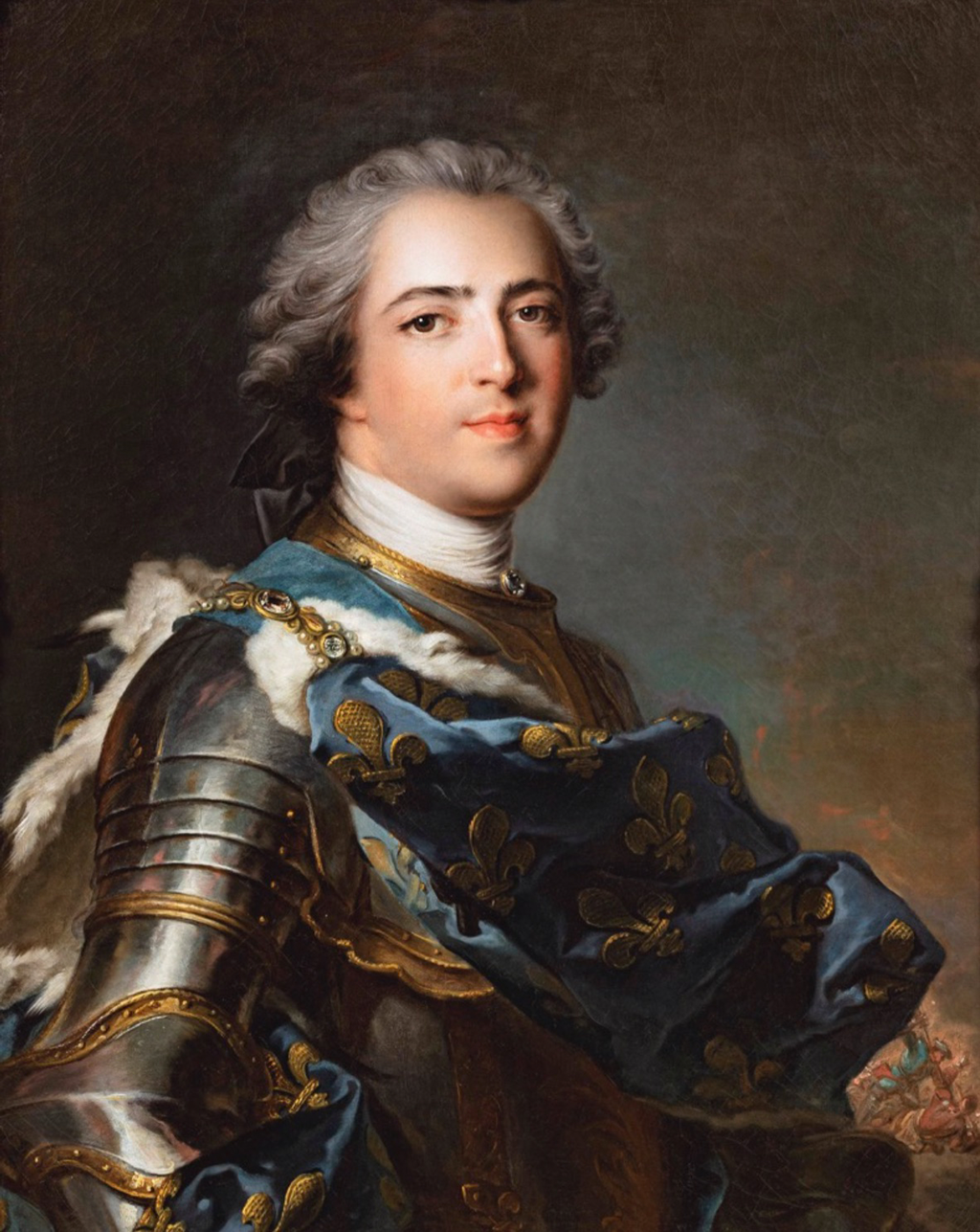
also painted a nearly half-length portrait of him in
armor draped in an ermine-lined blue cloak sewn with
gold fleurs-de-lis (Fig. 3).6The portrait is best known from a version Nattier
created with studio assistance, which is today in
the State Hermitage Museum, St. Petersburg, inv.
no. ГЭ-1123,
https://www.hermitagemuseum.org
The War of the Austrian Succession (1740–48), which had come on the heels of the War of the Polish Succession (1733–38), was going full throttle. France, Spain, Saxony, and Bavaria, allied with Frederick the Great of Prussia, were united in their efforts to prevent the Habsburg Archduchess of Austria, Maria Theresa, from succeeding to the throne of her father, the late Holy Roman Emperor Charles VI. During the campaign of 1744, Louis XV personally led some ninety thousand troops into the southern Netherlands, and, having pushed back the Habsburg invasion there, moved troops into Alsace and Lorraine. The French were thrown into disarray when the king fell gravely ill, but after recovering, he once again took to the field.7The war, which was also fought in North America, the West Indies, and the Indian subcontinent, continued until a general cessation of hostilities in 1748 and the signing of the Treaty of Aix-la-Chapelle. France’s intervention was ultimately for nought, since Maria Theresa retained control of most of her father’s empire. The treaty, which many French people regarded as ignominious and favorable only to King Frederick of Prussia, made Louis XV lose much of his popularity among his own people.
These were the specific circumstances in which this dashing, nearly half-length portrait of a commissioned officer of the French royal infantry was painted. Dressed in a fawn-colored coat with large turned-back red cuffs held in place by silver buttons, he stands in front of a field on which a battle is raging, against a patch of cloud-streaked sky. Over his uniform, the rather strongly built man—whose receding hairline suggests that he is in his thirties or early forties—wears a cuirass: The breastplate and back plate of armor, which are fastened together., a pair of pauldrons: Plate armor that covers one’s shoulders. at the shoulders, and faulds: Plate armor worn below a breastplate to protect the waist and hips. to protect his hips. Across the subject’s chest is a white silk sash tied in a large bow under his left arm. Peeking out from under the shoulder plate on his left side are the scarlet ribbon and gold-and-enamel star of the royal military order of Saint-Louis, of which he is obviously a knight.
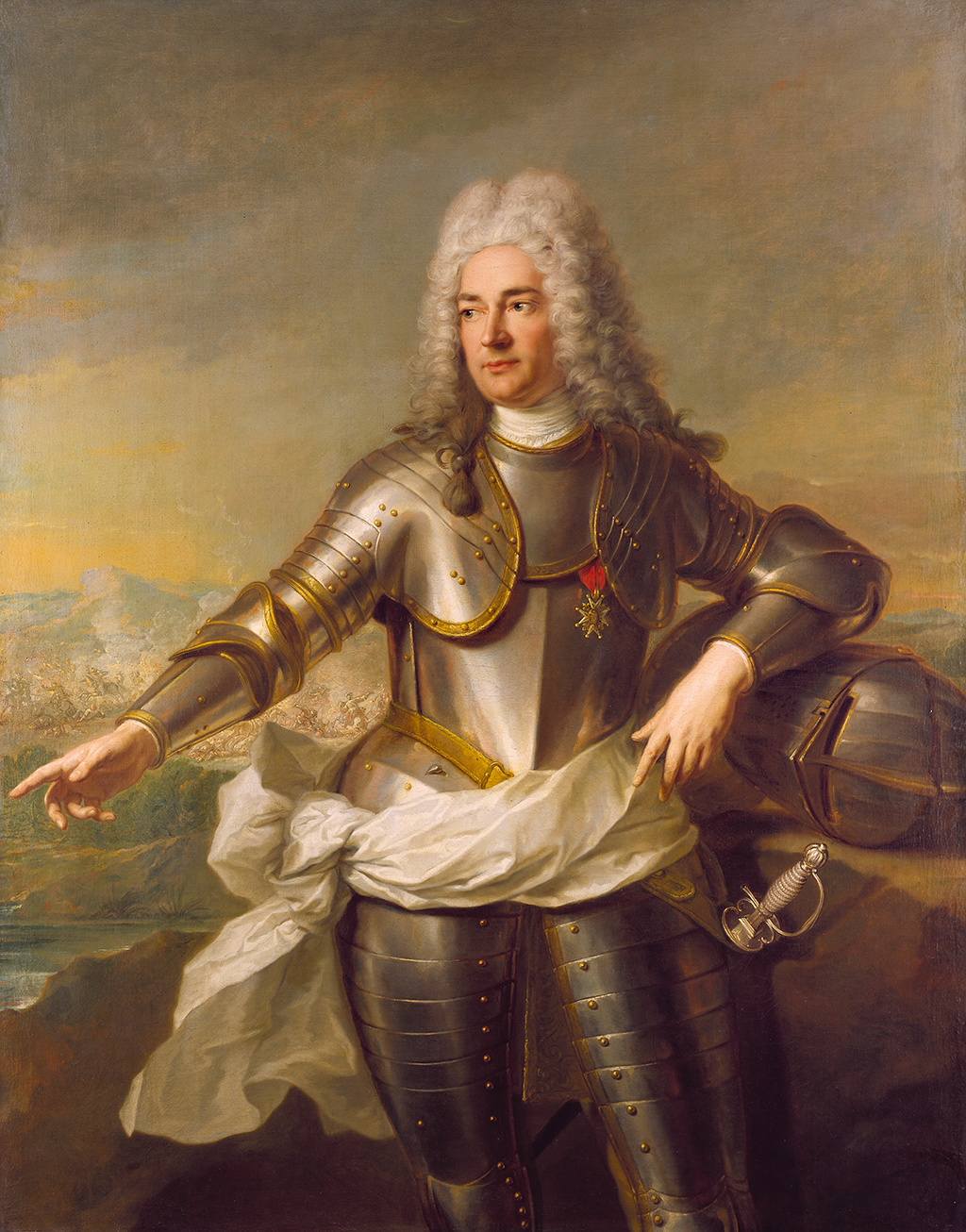
A precedent may be found in an earlier but equally
martial portrait by Nattier now in a private
collection: a knee-length rendering of an officer
wearing the same decoration and white sash as a battle
rages in the background (Fig. 4). In the Nelson-Atkins
picture, the reds of both the ribbon and the cuffs are
reflected on the surface of the breastplate. The
sitter’s neck is swathed in a white muslin scarf,
while an undergarment of black taffeta protects his
body and his uniform from the uncomfortable plate
armor. His natural hair is dressed and powdered, and
the strands of the ponytail falling at the rear are
held in place by a ribbon and a pouch of the same
black fabric, an accessory known as a catogan. He
turns his face to his left, where he directs the gaze
of his brown eyes beneath rather heavy arched brows.
The nostrils of his prominent, upturned nose are
flared. His cheeks are ruddy, as are his lips, which
are raised in a smile that seems at odds with the
drama of the bloody scene taking place behind him.
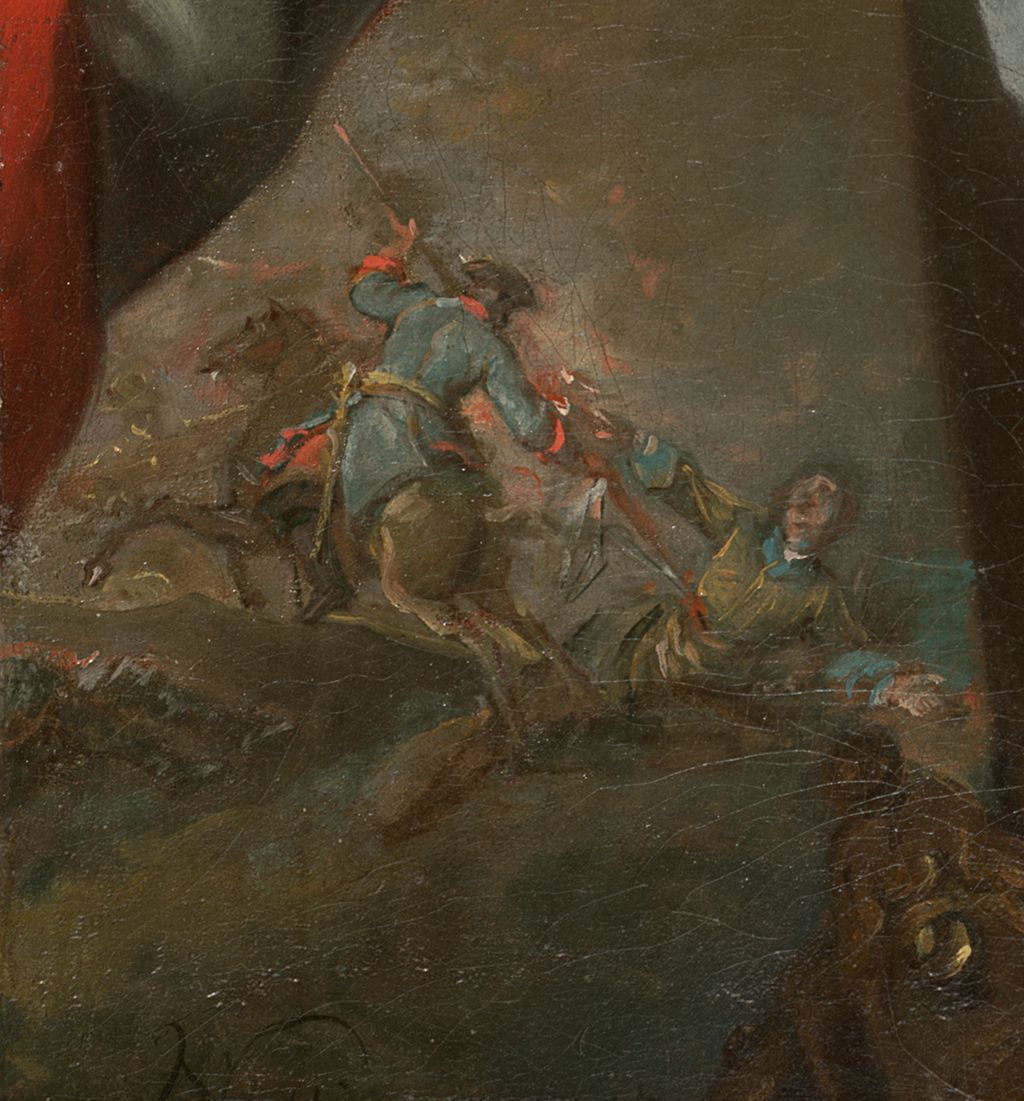
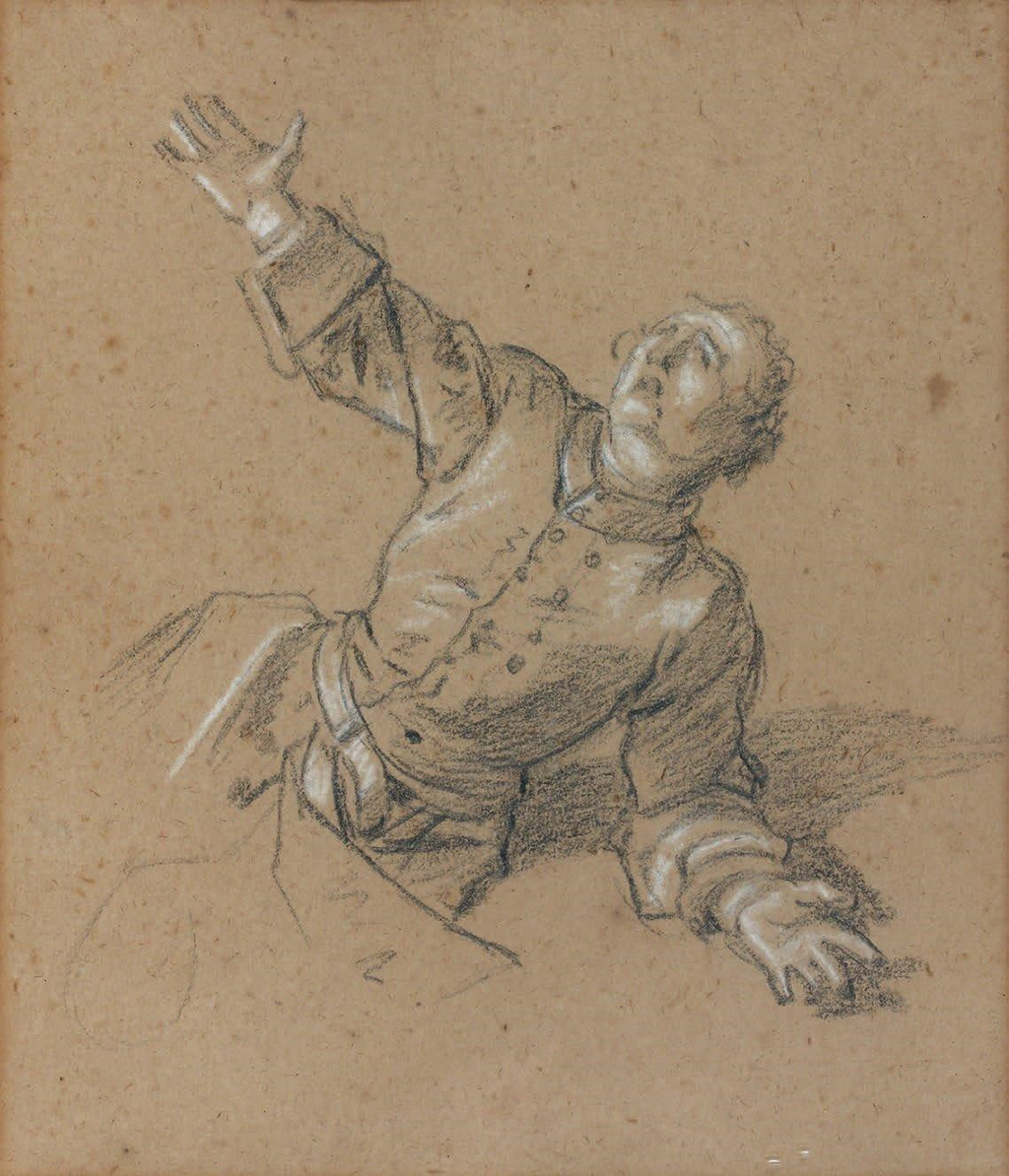
Perhaps alluding to
one of the campaigns fought by the French in Bavaria,
Bohemia, and along the Rhine, Nattier depicted an
infantryman knocked to the ground as he is being
speared by an enemy combatant on horseback (Fig. 5),
a scene for which there exists a related autograph
figural drawing (Fig. 6).8Sold at auction in Paris, Millon et Associés,
Hôtel Drouot, April 12, 2013, lot 159. Presently
available through Stéphane Renard Fine Art, Paris,
https://www.stephanerenard
Based on information contained in the Nelson-Atkins
curatorial files, the painting seems to have descended
in the De Toulle and Dary (or d’Ary) de Senarpont
families in the old French province of Picardie.9A letter from the dealer Germain Seligmann to
Ross E. Taggart, Senior Curator at NAMA, includes
a passage about the work’s proposed De Senarpont
history: “We did find, but how tenuous, a link
that there had been a portrait of an officer by
Nattier in the Château de Foucancourt-hors-Nesle
[sic], which was included in an otherwise
unimportant auction at the beginning of the
century. Upon which, some time ago, I had the
visit in New York of a Frenchman who, being a
descendant of that Senarpont family, was not
averse to believing that this brilliant officer
could have been one of his ancestors.” Germain
Seligmann to Ross E. Taggart, May 11, 1976, NAMA
curatorial files.
The Château de Senarpont,
part of a fiefdom that belonged in the
mid-eighteenth century to the De Monchy and
Nassau-Sieghen families, was acquired in 1785 from
Prince Charles Othon de Nassau-Seighen, who had
previously destroyed a wing of it with cannon fire
in a misguided attempt to show his guests what a
military siege was like. The purchaser was
Alexandre Marie Léon, comte Dary d’Ernemont, a
Lieutenant Colonel in the Régiment de Foix and a
knight of the military order of Saint-Louis. See
Alcius Ledieu, “La Vallée de Liger et ses
environs,”
Mémoires de la Société d’émulation
d’Abbeville, ser. 3 (Abbeville: C. Paillart, 1887),
4:356–57.
The last male scion of the Darys was Adolphe-Léon,
comte Dary, marquis de Senarpont (1806–90), who left
the painting to his widow, the dowager Marie Léonie
Dary, marquise de Senarpont (1836–1912). The auction
of many of the contents of the Château de
Foucaucourt-hors-Nesle, where the painting likely
remained since its creation, were sold four months
after the marquise’s demise on January 10, 1912. The
Nelson-Atkins Nattier may have been featured in that
sale, the catalogue for which included a painting
described simply as “Un Portrait d’homme, par Nattier” and dated (misdated, if it is the Nelson-Atkins
painting) to the year 1747.
The current Senarpont heir, Charles de Broissard, posited that Nattier’s sitter should be identified as Isidore Florimond Marié, seigneur de Toulle et de Foucaucourt-hors-Nesle (1705–92).10Charles de Boissard to Joseph Baillio, January 10, 21, and 22, 2019. During the War of the Austrian Succession, Marié de Toulle served as a captain in the unit of the Grammont Cavalerie,11The Burgundian nobleman Pierre de Grammont Fallon, called the “marquis de Grammont” (1708–95), was in charge of the cavalry unit to which Isidore Florimond Marié de Toulle belonged during the first half of the 1740s, notably during the campaigns fought by the French in Bavaria, Bohemia, and along the Rhine under various marshals. The sitter’s name appears in the list of members of the Académie d’Amiens, in [Jacques Hébrail and Joseph de La Porte], La France Littéraire (Paris: Chez la Venve Duchesne, 1769), 1:47: “MARIÉ DE TOULLE, Chevalier de l’Ordre Royale [sic] et Militaire de Saint-Louis.” For a description of the uniform of the Grammont Cavalerie, see [Charles Louis d’Authville des Amourettes], Essai sur la Cavalerie, tant ancienne que moderne (Paris: Chez Charles-Antoine Jombert, 1756), 161. It would make sense if Nattier’s portrait was intended to commemorate’s the sitter’s induction into the Order of Saint-Louis. the uniform of which matches the regimentals worn by the subject of the portrait. In his retirement, he served as Inspector-General of the Royal Stables in the region of the Soissonais and was a member of the Académie des Arts, Sciences, et Belles-Lettres of the city of Amiens.12François-Irénée Darsy, Les doléances du peuple et les victimes: Souvenirs de la Révolution en Picardie (Amiens: Imprimerie A. Douillet et Cie, 1887), 56. He authored an unpublished memoir that was once part of the archives of the Académie d’Amiens.13“Mémoires pour servir à l’histoire de la Campagne de Bohême, en 1741 et 1742.” See Jacques Lelong, Bibliothèque historique de la France, ed. Charles Marie Fevret de Fontette, rev. ed. (Paris: Jean-Thomas Herissant, 1769), 2:617, no. 24631. The text mistakenly identifies the name of the manuscript’s author as “M. de Soulle [sic] de l’Académie d’Amiens” and adds: “M. de Soulle [sic], Chevalier de S. Louis, a fait cette Campagne, étant alors Capitaine Commandant au Régiment, Cavalerie” (M. de Soulle [sic], Knight of Saint Louis, made this campaign, being then Commanding Captain of the Regiment, Cavalry). Marié de Toulle was married to Marie Thérèse Gresset (ca. 1718–78), the sister of the famous poet, dramatist, theologian, and member of the Académie Française, Jean-Baptiste Louis Gresset (1704–77), both of whom were natives of Amiens.14Gresset’s literary masterpiece was his humorous poem Vert-Vert ou les voyages du perroquet de la Visitation de Nevers (1734). Gresset’s shoulder-length, oval portrait had been painted in 1741 by Jean Marc Nattier, a rather poorly preserved work today in the Musée de Picardie in Amiens,15Inv. no. M.P. 1875-28. See Pierre de Nolhac, Nattier: Peintre de la cour de Louis XV (Paris: H. Floury, 1925), 50–51, 92–93, and 255. which was ultimately engraved by Augustin de Saint-Aubin. Perhaps on the advice of his brother-in-law, Marié de Toulle may have commissioned Nattier that same year to commemorate his successes on the battlefield.
Notes
-
Peter had chosen to be depicted in a complete suit of armor by Godfrey Kneller in London in 1698 for his host King William III (The Royal Collection Trust, The Queen’s Gallery, Buckingham Palace, inv. no. RCIN 405645, https://www.rct.uk/collection/405645/peter-the-great-tsar-of-russia-1672-1725.
-
See for example, Presumed Portrait of Comte Robert Jean Antoine François Franquetot de Coigny, 1699, Musée des Beaux-Arts, Caen, https://mba.caen.fr/oeuvre/portrait-presume-du-comte-de-coigny-gouverneur-de-caen.
-
The Mississippi Bubble “was a financial scheme in eighteenth-century France that triggered a speculative frenzy and ended in financial collapse.” See “Mississippi Bubble,” Encyclopedia Britannica, online edition, last edited October 18, 2002, https://www.britannica.com
/event . By August 1717, Antoine Crozat’s largely economic hold on Louisiana had been transferred to another monopoly, the Compagnie d’Occident or Compagnie du Mississippi, a scheme hatched by the Scottish economist John Law, who sold the idea to the Régent, Philippe, duc d’Orléans. To capitalize his plan for encouraging trade between France and its overseas colonies in the lower part of North America, Law created a royal bank and issued paper money backed by neither coinage nor bullion. As an enticement to attract gullible investors, he advertised Louisiana as an El Dorado where fortunes could be easily realized. The result was rampant speculation, and people like the Nattier brothers clamored to buy bonds and concessions of plantation land in the faraway colony. In the end, Law’s System collapsed in the so-called “Mississippi Bubble,” and many of those who had invested in it were left with worthless bonds, debt papers, and currency, or landed estates they were incapable of managing from afar./Mississippi -Bubble -
“. . . ajoutent un caractère imperceptible de beauté” (add an aura of imperceptible beauty to a perfect likeness). Giovanni Giacomo Casanova de Seingalt, Mémoires (Paris: Bibliothèque de la Pléiade, 1959), 2:489–90.
-
For a detailed history of the Order of Saint-Louis, now extinct, as well as a listing of the promotions that took place during the War of the Austrian Succession, see Alexandre Mazas and Théodore Anne, Histoire de l’ordre royal et militaire de Saint-Louis, depuis son institution en 1693 jusqu’en 1830, 2nd ed. (Paris: Firmin-Didot frères, fils, 1861), especially 1:311–35. At the beginning of the second volume is a recapitulation of the names of officers not cited in the first, and in the third volume is an “Alphabetical table of the names of dignitaries and knights of the royal and military order of Saint-Louis cited in this work,” 3:555–608, and a list of the knights of the order whose names were discovered after the original list was published, 609–23.
The painting has sometimes been misdated to the year 1744 or even 1747, due perhaps to the illegible last digit near the artist’s signature at lower left. However, with the aid of recent photomicroscopy undertaken by Sophia Boosalis, Kress Conservation Fellow, Nelson-Atkins Museum, the date is clearly “1741.”
-
The portrait is best known from a version Nattier created with studio assistance, which is today in the State Hermitage Museum, St. Petersburg, inv. no. ГЭ-1123, https://www.hermitagemuseum.org
/wps . Another version was last recorded with Perrin Antiquaires, Paris (at TEFAF, Maastricht, June 2022; see Fig. 3). Neither version is signed nor dated./portal /hermitage /digital -collection /01.+paintings /37412 -
The war, which was also fought in North America, the West Indies, and the Indian subcontinent, continued until a general cessation of hostilities in 1748 and the signing of the Treaty of Aix-la-Chapelle. France’s intervention was ultimately for nought, since Maria Theresa retained control of most of her father’s empire. The treaty, which many French people regarded as ignominious and favorable only to King Frederick of Prussia, made Louis XV lose much of his popularity among his own people.
-
Sold at auction in Paris, Millon et Associés, Hôtel Drouot, April 12, 2013, lot 159. Presently available through Stéphane Renard Fine Art, Paris, https://www.stephanerenard-fineart.com/artworks/categories/10/19-jean-marc-nattier-soldier-begging-for-mercy-study-for-the-victory-1717/.
-
A letter from the dealer Germain Seligmann to Ross E. Taggart, Senior Curator at NAMA, includes a passage about the work’s proposed De Senarpont history: “We did find, but how tenuous, a link that there had been a portrait of an officer by Nattier in the Château de Foucancourt-hors-Nesle [sic], which was included in an otherwise unimportant auction at the beginning of the century. Upon which, some time ago, I had the visit in New York of a Frenchman who, being a descendant of that Senarpont family, was not averse to believing that this brilliant officer could have been one of his ancestors.” Germain Seligmann to Ross E. Taggart, May 11, 1976, NAMA curatorial files.
The Château de Senarpont, part of a fiefdom that belonged in the mid-eighteenth century to the De Monchy and Nassau-Sieghen families, was acquired in 1785 from Prince Charles Othon de Nassau-Seighen, who had previously destroyed a wing of it with cannon fire in a misguided attempt to show his guests what a military siege was like. The purchaser was Alexandre Marie Léon, comte Dary d’Ernemont, a Lieutenant Colonel in the Régiment de Foix and a knight of the military order of Saint-Louis. See Alcius Ledieu, “La Vallée de Liger et ses environs,” Mémoires de la Société d’émulation d’Abbeville, ser. 3 (Abbeville: C. Paillart, 1887), 4:356–57.
-
Charles de Boissard to Joseph Baillio, January 10, 21, and 22, 2019.
-
The Burgundian nobleman Pierre de Grammont Fallon, called the “marquis de Grammont” (1708–95), was in charge of the cavalry unit to which Isidore Florimond Marié de Toulle belonged during the first half of the 1740s, notably during the campaigns fought by the French in Bavaria, Bohemia, and along the Rhine under various marshals. The sitter’s name appears in the list of members of the Académie d’Amiens, in [Jacques Hébrail and Joseph de La Porte], La France Littéraire (Paris: Chez la Venve Duchesne, 1769), 1:47: “MARIÉ DE TOULLE, Chevalier de l’Ordre Royale [sic] et Militaire de Saint-Louis.” For a description of the uniform of the Grammont Cavalerie, see [Charles Louis d’Authville des Amourettes], Essai sur la Cavalerie, tant ancienne que moderne (Paris: Chez Charles-Antoine Jombert, 1756), 161. It would make sense if Nattier’s portrait was intended to commemorate’s the sitter’s induction into the Order of Saint-Louis.
-
François-Irénée Darsy, Les doléances du peuple et les victimes: Souvenirs de la Révolution en Picardie (Amiens: Imprimerie A. Douillet et Cie, 1887), 56.
-
“Mémoires pour servir à l’histoire de la Campagne de Bohême, en 1741 et 1742.” See Jacques Lelong, Bibliothèque historique de la France, ed. Charles Marie Fevret de Fontette, rev. ed. (Paris: Jean-Thomas Herissant, 1769), 2:617, no. 24631. The text mistakenly identifies the name of the manuscript’s author as “M. de Soulle [sic] de l’Académie d’Amiens” and adds: “M. de Soulle [sic], Chevalier de S. Louis, a fait cette Campagne, étant alors Capitaine Commandant au Régiment, Cavalerie” (M. de Soulle [sic], Knight of Saint Louis, made this campaign, being then Commanding Captain of the Regiment, Cavalry).
-
Gresset’s literary masterpiece was his humorous poem Vert-Vert ou les voyages du perroquet de la Visitation de Nevers (1734).
-
Inv. no. M.P. 1875-28. See Pierre de Nolhac, Nattier: Peintre de la cour de Louis XV (Paris: H. Floury, 1925), 50–51, 92–93, and 255.
Technical Entry
Citation
Chicago:
Sophia Boosalis, “Jean Marc Nattier, Portrait of Isidore Florimond Marié, Seigneur de Toulle et de Foucaucourt-hors-Nesle, a Knight of the Royal French Military Order of Saint-Louis, 1741,” technical entry in French Paintings and Pastels, 1600–1945: The Collections of the Nelson-Atkins Museum of Art, ed. Aimee Marcereau DeGalan (Kansas City: The Nelson-Atkins Museum of Art, 2026), https://doi.org/10.37764/78973.5.324.2088.
MLA:
Boosalis, Sophia. “Jean Marc Nattier, Portrait of Isidore Florimond Marié, Seigneur de Toulle et de Foucaucourt-hors-Nesle, a Knight of the Royal French Military Order of Saint-Louis, 1741,” technical entry. French Paintings and Pastels, 1600–1945: The Collections of The Nelson-Atkins Museum of Art, edited by Aimee Marcereau DeGalan, Nelson-Atkins Museum of Art, 2026. doi: 10.37764/78973.5.324.2088.
The Nelson-Atkins portrait of a knight of the Order of Saint-Louis was painted by Jean Marc Nattier in 1741, at the peak of his artistic career.1See the accompanying catalogue entry by Joseph Baillio. The portrait was executed on a plain weave: A basic textile weave in which one weft thread alternates over and under the warp threads. Often this structure consists of one thread in each direction, but threads can be doubled (basket weave) or tripled to create more complex plain weave. Plain weave is sometimes called tabby weave. canvas with numerous weave irregularities.2The canvas fibers are of uneven thickness with many knots and slubs. Forrest Bailey, treatment report, May 26, 1978, NAMA conservation file, 77-2. Information about the original canvas is limited, as the tacking margins: The outer edges of canvas that wrap around and are attached to the stretcher or strainer with tacks or staples. See also tacking edge. were removed during a previous lining: A procedure used to reinforce a weakened canvas that involves adhering a second fabric support using adhesive, most often a glue-paste mixture, wax, or synthetic adhesive. and the outermost edges are covered by retouching: Paint application by a conservator or restorer to cover losses and unify the original composition. Retouching is an aspect of conservation treatment that is aesthetic in nature and that differs from more limited procedures undertaken solely to stabilize original material. Sometimes referred to as inpainting or retouch.. Microscopic examination reveals that the primary canvas was prepared with a double ground layer: An opaque preparatory layer applied to the support, either commercially or by the artist, to prevent absorption of the paint into the canvas or panel. See also priming layer. consisting of a lower white and an upper light gray layer with coarse black particles (Fig. 7).

No underdrawing: A drawn or painted sketch beneath the paint layer. The underdrawing can be made from dry materials, such as graphite or charcoal, or wet materials, such as ink or paint. was detected beneath the paint layers using infrared reflectography (IRR): A form of infrared imaging that exploits the behavior of painting materials at wavelengths beyond those accessible to infrared photography. These advantages sometimes include a continuing increase in the transparency of pigments beyond wavelengths accessible to infrared photography (i.e, beyond 1,000 nanometers), rendering underdrawing more clearly. The resulting image is called an infrared reflectogram. Devices that came into common use in the 1980s such as the infrared vidicon effectively revealed these features but suffered from lack of sharpness and uneven response. Vidicons continue to be used out to 2,200 nanometers but several newer pixelated detectors including indium gallium arsenide and indium antimonide array detectors offer improvements. All of these devices are optimally used with filters constraining their response to those parts of the infrared spectrum that reveal the most within the constraints of the palette used for a given painting. They can be used for transmitted light imaging as well as in reflection. or examination with the stereomicroscope. Nattier appears to have simultaneously painted the background and sitter’s face directly onto the canvas.3Nattier appears to have painted certain faces alla prima (directly on the canvas) to save time during the height of his career; see Philippe Renard, “La méthode et la technique du maître,” in Jean-Marc Nattier (1685–1766): Un artiste parisien à la cour de Louis XV (Saint-Rémy-en-l’Eau, France: Monelle Hayot, 1999), 100. Shades of brown were applied to the background with loose brushwork that streaked the fluid paint. Cool gray paint, mixed with varying amounts of lead white, was applied to both sides of the sky, and this scumble: A thin layer of opaque or semi-opaque paint that partially covers and modifies the underlying paint. application creates an optical blue. In the lower left and right sky, Nattier layered opaque pale gray tinged with peach and yellow.
Nattier blocked in the sitter’s face with beige paint
while leaving
reserve: An area of the composition left
unpainted with the intention of inserting a
feature at a later stage in the painting
process.
for the facial features (Fig. 8). Brown and light gray
wash: An application of thin paint that
has been diluted with solvent.
were used to establish the shadows, complemented by
pink washes to accentuate the sitter’s rosy nose and
cheeks. The facial features were rendered
wet-over-wet: An oil painting technique
which involves drawing a stroke of one color
across the wet paint of another color.
with a loose application of brown, brownish-red,
bright pink, and gray. Nattier added final touches of
white, light yellow, and light pink paint for
highlights, along with semi-transparent dark brown
paint to strengthen the shadow along the right side of
face. He painted the sitter’s hair with loose curving
strokes of white, pale gray, reddish-brown, and
black.4This technique for depicting hair can be seen in
other portraits such as
Portrait of a Woman (1753) at the
Metropolitan Museum of Art; see
https://www.metmuseum.org

The sitter’s uniform was executed using a variety of painting techniques, including loose, broad brushstrokes, washes, and finely painted impasto: A thick application of paint, often creating texture such as peaks and ridges., often applied wet-into-wet: An oil painting technique which involves blending of colors on the picture surface.. Nattier rendered the different fabrics by layering loose, short strokes of opaque paint wet-over-wet on top of a flat mid-tone. The armor consists of semi-transparent washes combined with scumbles to achieve subtle gradation, and subsequent thicker opaque highlights capture the reflective qualities of the metal. Brass rivets and gold bands were detailed with precise dabs and fine brushstrokes of white, yellow, brown, and black paint, applied both wet-into-wet and wet-over-wet (Fig. 9). Examination of the portrait with ultraviolet (UV) radiation: A segment of the electromagnetic spectrum, just beyond the sensitivity of the human eye, with wavelengths ranging from 100–400 nanometers. For a description of its use in the study of art objects, see ultraviolet (UV) fluorescence or UV-induced visible fluorescence. revealed a bright orange-red fluorescence in the red ribbon of the St. Louis metal, which may indicate the organic pigment madder lake (Fig. 10).5Madder lake is an organic pigment made from the root of the madder plant and used in dyes. Jo Kirby, Marika Spring, Katherine Higgitt, “The Technology of Eighteenth- and Nineteenth- Century Red Lake Pigments,” National Gallery Technical Bulletin 28 (2007): 56–73.


For a commissioned portrait, Nattier likely discussed the canvas size, format, sitter’s attire, and pose with his client, and worked from an initial idea, perhaps a drawing or another military portrait.6Renard, “La méthode et la technique du maître,” 100. For the Nelson-Atkins painting, Nattier made changes as he constructed the figure’s torso. Examination under a microscope indicates that the sitter’s sleeves were initially reddish orange, most likely containing vermillion (Fig. 11).7Single-point x-ray fluorescence (XRF) detected a strong peak for mercury, along with peaks for lead, calcium, and iron. The presence of mercury indicates that Nattier likely used the red pigment vermillion, composed of mercuric sulfide. See Sophia Boosalis, XRF spectrum, March 19, 2025, NAMA conservation file, 77-2. Nattier later obscured this layer with an overlying opaque beige paint, leaving traces of the bright red visible along the contours of both sleeves. Broad brushstrokes of lead white paint, followed by finer brushstrokes of black paint, were applied wet-over-wet to depict the folds in the fabric. Nattier proceeded to paint the sitter’s cuffs by applying the same reddish-orange paint, allowing the top edge to slightly extend over the beige sleeves.8Similar XRF results were obtained for the red cuff and the beige sleeve. See Boosalis, NAMA conservation file, 77-2. The position of the proper left red cuff was adjusted, widening the angle of the sitter’s forearm (Fig. 12). Like the pentimento (pl: pentimenti): A change to the composition made by the artist that is visible on the paint surface. Often with time, pentimenti become more visible as the upper layers of paint become more transparent with age. Italian for "repentance" or "a change of mind." in the sleeves, the artist’s change in the cuff is revealed through abrasion: A loss of surface material due to rubbing, scraping, frequent touching, or inexpert solvent cleaning. and further confirmed by IRR. With these modifications in place, Nattier lowered the proper left white shirt cuff as seen in the x-radiograph. After altering the angle of the forearm, Nattier likely required more space to accommodate the gloved hand, which may have led him to expand the size of the canvas.


The original height of Nattier’s canvas was approximately 78.1 centimeters, until at some point during the painting process, the artist appears to have attached a secondary strip of canvas, approximately 2.86 centimeters high, to the bottom edge. While this step might seem unusual, two other portraits were similarly expanded by the artist: Madame Henriette de France as a Vestal Virgin (ca. 1749; Detroit Institute of Arts) and Portrait of Louis Léon de Bouthillier-Chavigny, Count of Beaujeu (Fig. 13).9The author is grateful to Ellen Hanspach-Barnal (painting conservator) and Grace An (Andrew W. Mellon fellow in painting conservation) at the Detroit Institute of Art (DIA) for sharing the conservation file of Madame Henriette de France as a Vestal Virgin (ca. 1749). Nattier added a vertical canvas strip on the left and right sides of this portrait. The right strip (approximately 7.3 cm) was attached before the ground preparation of the main canvas, while the left strip (approximately 10.47 cm) was likely added during painting. See Alfred Ackerman, condition notes, November 2006, DIA conservation file, 43.417., 10Photographs from William Suhr’s 1960 treatment of Portrait of Louis Léon de Bouthillier-Chavigny, Count of Beaujeu (1745; Speed Art Museum) show a narrow vertical strip along the left edge of the main canvas. Technical imaging of the canvas seam may provide further insights into Nattier’s practice of expanding his canvas supports. “William Suhr Papers, 1846–2003,” Getty Research Institute, Los Angeles, Nattier, Jean-Marc, box 48, folders 30–38. For the Nelson-Atkins portrait, it is clear that the preparatory layers were already applied to the main canvas before this enlargement, as primary cusping: A scalloped pattern along the canvas edges that relates to how the canvas was stretched. Primary cusping reveals where tacks secured the canvas to the support while the ground layer was applied. Secondary cusping can form when a pre-primed canvas is re-stretched by the artist prior to painting. is present along all four edges (Fig. 14).11See film-based radiographs, no.126, May 25, 1976, NAMA conservation file, 77-2. The strip was sewn onto the trimmed, previously stretched bottom edge using an overhand stitched seam, which is visible in the X-ray radiography (also referred to as x-radiography or radiography): Radiography is an examination tool analogous to the use of X-rays in medicine whereby denser components of a painted composition can be recorded as an inverted shadow image cast on film or a digital X-ray imaging plate from a source such as an X-ray tube. The method has been used for more than a century and is most effective with dense pigments incorporating metallic elements such as lead or zinc. It can reveal artist changes, underlying compositions, and information concerning the artwork’s construction and condition. The resulting image is called an x-radiograph or radiograph. It differs from the uses of X-ray spectrometry in being dependent on the density of the paint to absorb X-rays before they reach the film or image plate and being non-specific as to which elements are responsible for the resulting shadow image. (Fig. 15). The attached strip was cut from a plain-weave canvas.12It remains unclear whether the strip was cut from a pre-primed canvas. The x-radiograph reveals cusping along the strip, which may be attributable to an earlier ground application or to paint layers applied after the strip was added. A light gray, lead-containing layer was applied across the seam to create a smoother transition between the added strip and the main canvas.13The Nelson-Atkins painting appears to share similarities with second canvas additions in Madame Henriette de France as a Vestal Virgin (ca. 1749; Detroit Institute of Art). Nattier expanded the main canvas by attaching two vertical canvas strips using different methods. The first addition was already sewn onto the main canvas when an overall ground was applied. In comparison, the second addition was cut from a primed canvas, and a “new ground” was applied over the canvas strip and partially onto the main canvas to create a cohesive surface across the seam. See Alfred Ackerman, “Technical Notes on Nattier’s ‘Portrait of a Woman as a Vestal Virgin,’” Bulletin of the Detroit Institute of Arts 83, no. 1/4 (2009): 38. It is notable that Nattier declined to cover the picture plane with an overall ground layer to start anew, which suggests that the composition may have been laid out when he chose to add the canvas strip. This format change likely occurred early in the painting process as evidenced by the artist’s repositioning of the sitter’s arm, uninterrupted brushwork across the seam, and documented examples of reformatting on other Nattier works.


Pentimenti are frequently observed in Nattier’s
paintings, and numerous additional adjustments are
evident in the Nelson-Atkins portrait.14The author extends gratitude to Elise Effmann
Clifford (head of painting conservation) at The
Fine Arts Museums of San Francisco for sharing the
conservation files and radiographs of
Thalia, Muse of Comedy (1739;
https://www.famsf.org

Nattier made subtle adjustments to the folds and contours of the sash draped across the lower half of the sitter’s torso. The lower part of the sash appears to have been reworked at least once during the painting process. The radiograph reveals that the lead-containing paint of the sash extended into the armor, creating more voluminous fabric between the sitter’s waist and proper left arm (Fig. 12). Nattier reduced the volume of the sash by enlarging the sitter’s waist and further minimized the fabric through the application of background paint. Additionally, slightly raised black lines are visible where solvent cleaning has abraded the upper paint layers of the tied sash (Fig. 17). These lines more closely correspond to the final version of the sash’s tails, suggesting they may have served as guiding outlines.

In the final stage of painting, Nattier embellished the background of the portrait by copying a chalk study of a dying soldier (Fig. 6).15Nattier is known to have made preparatory sketches on paper to refine poses, drapery, and details, and for reusing them as visual sources for his paintings. See Renard, “La méthode et la technique du maître,” 99–100; and Mary Tavener Holmes, “Jean-Marc Nattier, 25. Self-Portrait,” in Perrin Stein and Mary Tavener Holmes, Eighteenth-Century French Drawings in New York Collections, exh. cat. (New York: Metropolitan Museum of Art, 1999), 58–59. Nattier outlined the contours of the figure with fluid brownish-black paint before minimally blocking in areas with opaque paint and a few highlighting strokes (Fig. 5). Although no known drawing of the cavalryman exists, it appears to have been painted in a similar manner as the infantryman and has no hints of an underdrawing. The soldier being speared by an enemy combatant on horseback also appears in the background of the Portrait of Pierre-Victoire, Baron of Besenval (174[-]) in the State Hermitage Museum, St. Petersburg.16There are subtle differences in the depiction of the infantryman being speared by an enemy cavalryman in the Nelson-Atkins and the State Hermitage Museum (SHM) portraits, with the most notable difference being the color of the uniforms. Unlike the Nelson-Atkins portrait, the dying soldier in the SHM portrait seems to adhere to the original sketch by leaving the figure’s proper right arm unchanged. The sequence in which the paintings were completed remains uncertain due to ambiguity surrounding the date of Portrait of Pierre-Victoire, Baron of Besenval.
In 1979, the Nelson-Atkins painting was relined, and its early twentieth-century French strainer: A wooden structure to which the painting’s canvas is attached. Unlike stretchers, strainers cannot be expanded. was replaced with an expansion-bolt stretcher: A wooden structure to which the painting’s canvas is attached. Unlike strainers, stretchers can be expanded slightly at the joints to improve canvas tension and avoid sagging due to humidity changes or aging..17Forrest Bailey, examination report, March 3, 1978, NAMA conservation file, 77-2. Earlier in its history, the painting had been stretched onto an auxiliary support with a wide horizontal cross-member that caused stretcher cracks: Linear cracks or deformations in the painting’s surface that correspond to the inner edges of the underlying stretcher or strainer members. to form across the center of the composition. The removal of the tacking margins during a previous lining makes it challenging to determine the original dimensions of the painting; however, cusping along the outer edges suggests that its current dimensions are close to the original size. As a result of lining, the impasto is noticeably flattened, particularly in the sitter’s proper left shirt cuff. The painting exhibits a random, curved, and interconnected craquelure pattern typical of eighteenth-century French paintings, as well as numerous impact cracks: A characteristic crack pattern that forms after a blow to a painting. When these appear as circular, spiral, or spiderweb-like, they are sometimes called sigmoid cracks.. Scattered lead soap protrusions are present throughout and are visually distracting in the background. Signs of overcleaning and abrasion are predominantly in the sitter’s torso and medal (Fig. 10). The painting is varnished with Paraloid B-72, and retouching is present primarily along the outer edges and the canvas seam.18Bailey, treatment report, May 26, 1978, NAMA conservation file, 77-2.
Notes
-
See the accompanying catalogue entry by Joseph Baillio.
-
The canvas fibers are of uneven thickness with many knots and slubs. Forrest Bailey, treatment report, May 26, 1978, NAMA conservation file, 77-2.
-
Nattier appears to have painted certain faces alla prima (directly on the canvas) to save time during the height of his career; see Philippe Renard, “La méthode et la technique du maître,” in Jean-Marc Nattier (1685–1766): Un artiste parisien à la cour de Louis XV (Saint-Rémy-en-l’Eau, France: Monelle Hayot, 1999), 100.
-
This technique for depicting hair can be seen in other portraits such as Portrait of a Woman (1753) at the Metropolitan Museum of Art; see https://www.metmuseum.org
/art ./collection /search /437182 -
Madder lake is an organic pigment made from the root of the madder plant and used in dyes. Jo Kirby, Marika Spring, Katherine Higgitt, “The Technology of Eighteenth- and Nineteenth- Century Red Lake Pigments,” National Gallery Technical Bulletin 28 (2007): 56–73.
-
Renard, “La méthode et la technique du maître,” 100.
-
Single-point x-ray fluorescence (XRF) detected a strong peak for mercury, along with peaks for lead, calcium, and iron. The presence of mercury indicates that Nattier likely used the red pigment vermillion, composed of mercuric sulfide. See Sophia Boosalis, XRF spectrum, March 19, 2025, NAMA conservation file, 77-2.
-
Similar XRF results were obtained for the red cuff and the beige sleeve. See Boosalis, NAMA conservation file, 77-2.
-
The author is grateful to Ellen Hanspach-Barnal (painting conservator) and Grace An (Andrew W. Mellon fellow in painting conservation) at the Detroit Institute of Art (DIA) for sharing the conservation file of Portrait of Madame Henriette de France as a Vestal Virgin (ca. 1749). Nattier added a vertical canvas strip on the left and right sides of this portrait. The right strip (approximately 7.3 cm) was attached before the ground preparation of the main canvas, while the left strip (approximately 10.47 cm) was likely added during painting. See Alfred Ackerman, condition notes, November 2006, DIA conservation file, 43.417.
-
Technical imaging of the canvas seam along the left edge of Portrait of Louis Léon de Bouthillier-Chavigny, Count of Beaujeu (1745; Speed Art Museum) may provide further insights into Nattier’s practice of expanding his canvas supports.
-
See film-based radiographs, no.126, May 25, 1976, NAMA conservation file, 77-2.
-
It remains unclear whether the strip was cut from a pre-primed canvas. The x-radiograph reveals cusping along the strip, which may be attributable to an earlier ground application or to paint layers applied after the strip was added.
-
The Nelson-Atkins painting appears to share similarities with the second canvas additions in Madame Henriette de France as a Vestal Virgin (ca. 1749; Detroit Institute of Art). Nattier expanded the main canvas by attaching two vertical canvas strips using different methods. The first addition was already sewn onto the main canvas when an overall ground was applied. In comparison, the second addition was cut from a primed canvas, and a “new ground” was applied over the canvas strip and partially onto the main canvas to create a cohesive surface across the seam. See Alfred Ackerman, “Technical Notes on Nattier’s ‘Portrait of a Woman as a Vestal Virgin,’” Bulletin of the Detroit Institute of Arts 83, no. 1/4 (2009): 38.
-
The author extends gratitude to Elise Effmann Clifford (head of painting conservation) at The Fine Arts Museums of San Francisco for sharing the conservation files and radiographs of Thalia, Muse of Comedy (1739; https://www.famsf.org
/artworks ) and Terpsichore, Muse of Music and Dance (ca. 1739; https://www.famsf.org/thalia -muse -of -comedy /artworks ). Partial radiographs indicate that Nattier mostly made alterations to the drapery and folds in the figures’ dress, along with subtle changes to their hands and the objects they hold. See film-based radiographs, 1995, The Fine Arts Museums of San Francisco conservation file, 1954.59/60. Numerous pentimenti have been observed in the sitter and background of Madame Henriette de France as a Vestal Virgin (ca. 1749); see Ackerman, “Technical Notes on Nattier’s ‘Portrait of a Woman as a Vestal Virgin,’” 38–39. For technical notes on Manon Balletti (1757; National Gallery, London, https://www.nationalgallery.org.uk/terpsichore -muse -of -music -and -dance /paintings ), see Humphrey Wine, “Jean-Marc Nattier,” The Eighteenth-Century French Paintings (London: National Gallery, 2018), 352./jean -marc -nattier -manon -balletti -
Nattier is known to have made preparatory sketches on paper to refine poses, drapery, and details, and for reusing them as visual sources for his paintings. See Renard, “La méthode et la technique du maître,” 99–100; and Mary Tavener Holmes, “Jean-Marc Nattier, 25. Self-Portrait,” in Perrin Stein and Mary Tavener Holmes, Eighteenth-Century French Drawings in New York Collections, exh. cat. (New York: Metropolitan Museum of Art, 1999), 58–59.
-
There are subtle differences in the depiction of the infantryman being speared by an enemy cavalryman in the Nelson-Atkins and the State Hermitage Museum (SHM) portraits, with the most notable difference being the color of the uniforms. Unlike the Nelson-Atkins portrait, the dying soldier in the SHM portrait seems to adhere to the original sketch by leaving the figure’s proper right arm unchanged. The sequence in which the paintings were completed remains uncertain due to ambiguity surrounding the date of Portrait of Pierre-Victoire, Baron of Besenval.
-
Forrest Bailey, examination report, March 3, 1978, NAMA conservation file, 77-2.
-
Bailey, treatment report, May 26, 1978, NAMA conservation file, 77-2.
Documentation
Citation
Chicago:
Glynnis Napier Stevenson, “Jean Marc Nattier, Portrait of Isidore Florimond Marié, Seigneur de Toulle et de Foucaucourt-hors-Nesle, a Knight of the Royal French Military Order of Saint-Louis, 1741,” documentation in French Paintings and Pastels, 1600–1945: The Collections of the Nelson-Atkins Museum of Art, ed. Aimee Marcereau DeGalan (Kansas City: The Nelson-Atkins Museum of Art, 2024), https://doi.org/10.37764/78973.5.324.4033.
MLA:
Stevenson, Glynnis Napier. “Jean Marc Nattier, Portrait of Isidore Florimond Marié, Seigneur de Toulle et de Foucaucourt-hors-Nesle, a Knight of the Royal French Military Order of Saint-Louis, 1741,” documentation. French Paintings and Pastels, 1600–1945: The Collections of The Nelson-Atkins Museum of Art, edited by Aimee Marcereau DeGalan, Nelson-Atkins Museum of Art, 2024. doi: 10.37764/78973.5.324.4033.
Provenance
Probably commissioned by the sitter, Isidore Florimond Marié de Toulle (1705–92), seigneur de Toulle and seigneur de Foucaucourt-hors-Nesle, chevalier de Saint-Louis, Amiens and Foucaucourt-Hors-Nesle, France, 1741–January 19, 1792 [1];
Probably by decent to his son, Louis Jean-Baptiste Marie Marié de Toulle (1759–1808), Amiens and Foucaucourt-Hors-Nesle, France, 1792–October 4, 1808;
Probably inherited by his wife, Marie Marguerite Françoise de Toulle (née François, 1769–1840), Foucaucourt-Hors-Nesle, France, 1808–January 14, 1840;
Probably by descent to her daughter Marie-Agathe Marié (née de Toulle, 1794–1875), Comtesse Dary de Senarpont, Foucaucourt-Hors-Nesle, France, 1840–February 25, 1875 [2];
Probably to her brother-in-law, Adolphe Léon Dary (1806–90), Comte Dary and Marquis de Senarpont, Château de Senarpont, Château de Foucaucourt-hors-Nesle, Amiens, France, and Paris, 1875–July 9, 1890 [3];
Inherited by his widow, Marie Léonie Dary (née de Chevigné, 1836–1912), Comtesse Dary and Marquise de Senarpont, Château de Senarpont, Château de Foucaucourt-hors-Nesle, France, and Paris, 1890–January 10, 1912 [4];
Purchased from her posthumous sale, Vente après Décès D’un très Bon Mobilier Ancien et Moderne, Dépendant de la Succession de Madame la Marquise de Senarpont et garnissant Le Château de Foucaucourt-hors-Nesle, Commune de Foucaucourt-hors, Nesle, Somme, Château de Foucaucourt-hors-Nesle, France, May 21, 1912, unnumbered, as Un Portrait d’Homme, and dated 1747, to Hecquet, Amiens, 1912 [5];
Louis Gabriel Albert (1885–1972) and Antoinette Céleste (née Lasson, 1890–1962) Watel-Dehaynin, Paris, by March 19, 1962–July 23, 1972 [6];
Purchased at his posthumous sale, Tableaux anciens, dessins, pastels et tableaux par ou attribués à L.-L. Boilly, G.-M. Crespi, J.-H. Fragonard, J.-B. Greuze, J.-B. Huet, Sir Th. Lawrence, M.-N. Lépicié, J.-M. Nattier, J.-B. Perroneau, Rembrandt, H. Robert, J.-F. Van Son, C. Vernet, J.-M. Vien, M.-L. Vigée Lebrun, des Écoles florentine, française et italienne des XVIe et XVIIIe siècles et de l’Atelier de Van Balen et Van Kessel, Palais Galliera, Paris, March 15, 1973, no. S, as Portrait d’un chevalier de Saint-Louis, through Henri Baderou, by Jacques Seligmann and Co., Inc., New York, stock no. 8990, March 15, 1973–January 19, 1977 [7];
Purchased from Seligmann by The Nelson-Atkins Museum of Art, Kansas City, Missouri, 1977.
Notes
[1] Isidore Florimond Marié de Toulle was a Knight of the Order of Saint-Louis and Captain of the Regiment of the Grammont Cavalry. See “Acte de Mariage, Isidore Florimond Marié de Toulle et Marie Thérèse Gresset, 5 Avril 1752,” Amiens (Saint-Jacques): baptêmes, mariages, sépultures, 1751–1754, Archives de la Somme, Cote 5MI_D132, pp. 68–69, digitized https://archives.somme.fr/ark:/58483/njz862bxsp1k/0c411646-d951-498c-850e-b71760100421. See also correspondence with Christian du Passage, descendant of the Dary de Senarpont family, and Glynnis Stevenson, NAMA, December 20–21, 2023, NAMA curatorial files.
[2] Marie-Agathe Marié de Toulle had an elder sister, Louise Eugénie Marie de Saisseval (née Marié de Toulle, 1790–1844), but she got married around 1811 and probably moved out of the family chateau. Marie-Agathe did not marry until 1847 when she was 52 years old, which was after her mother’s death. She was living in her family home, the chateau de Foucaucourt-Hors-Nesle, France, where the painting was probably still hanging since its creation. See her death notice on February 25, 1875, “BMD Records (Births, Marriages, Deaths), 1857–1880,” Foucaucourt-Hors-Nesle (Somme, France), no. 5MI D698, p. 167, digitized on ancestrylibrary.com.
[3] Marie-Agathe and Alexandre-Alfred had no children; therefore, Alexandre-Alfred’s title went to his younger brother Adolphe-Léon. Ten weeks after Marie-Agathe passed away, her great-niece Marie Léonie married Adolphe-Léon, ensuring that the title of Dary de Senarpont and the chateaux at Senarpont and Foucaucourt-Hors-Nesle remained in the family. In 1890, Adolphe Léon died in the Château de Foucaucourt-hors-Nesle.
[4] Marie Léonie married her great-aunt’s brother-in-law, making Marie-Agathe and Marie Léonie sisters-in-law as well as great-aunt/great-niece.
[5] See copy of fragments of calling cards once attached to the stretcher verso of the painting, which say: “[?]me la C[ . . . ?] de Sen . . . / 3[?] rue C[ . . . ?]” and “[me?] la C[ . . . ] de Senap / 3 rue[ ?] Cam[bacérès?]” Copy of fragments are in the Archives of American Art, Smithsonian Institution, Washington, DC, Jacques Seligmann and Co. Records, Series 2.2: Museum files, KC NAMA, box 220, folder 11, Nattier, pp. 154–55, https://www.aaa.si.edu/collections/jacques-seligmann–co-records-9936/subseries-2-2/box-220-folder-11. See also letter from Germain Seligman to Henri Baderou, Paris, April 11, 1973, NAMA curatorial files. These calling cards are the best evidence that this painting is the same as the “Portrait d’Homme par Nattier” in the 1912 sale.
Raymond de Boissard, Marquis de Senarpont, and great-great-step-grandson to Marie Léonie Dary, said that the Nattier painting sold from De Chevigné’s collection in 1912 to a M. Hecquet from Amiens for 27,000 francs. See letter from de Boissard to Seligman, October 23, 1973, copy in NAMA curatorial files.
The De Senarpont family also had property in Amiens, but nothing more is known about Hecquet and if he was related or if he might have been an agent for the family.
[6] Ader, the auctioneer in charge of the 1973 sale, told Baderou that the Nattier painting came from the “Vatel de Hennin” collection. See letters between Henri Baderou and Germain Seligman, April 2, 1973, and April 11, 1973, NAMA curatorial files. Antoinette Watel-Dehaynin is cited as a collector of eighteenth-century French paintings as early as 1914 and again in 1917. It is possible she purchased the Nattier from Hecquet shortly after the 1912 sale. At the very latest, the couple probably owned the painting before her death in 1962.
[7] The museum was considering the purchase of the painting as early as April 1976; see letter from Ted Coe, Curator of European Art, NAMA, to Germain Seligman, April 12, 1976, NAMA curatorial files.
Exhibitions
None known at this time.
References
Probably Louis Andrieux, Vente après Décès d’Un très Bon Mobilier Ancien et Moderne, Dépendant de la Succession de Madame la Marquise de Senarpont et garnissant Le Château de Foucaucourt-hors-Nesle, Commune de Foucaucourt-hors, Nesle, Somme (Oisemont, France: Louis Andrieux, May 19–21, 1912), unpaginated, as Un Portrait d’Homme.
Tableaux anciens, dessins, pastels et tableaux par ou attribués à L.-L. Boilly, G.-M. Crespi, J.-H. Fragonard, J.-B. Greuze, J.-B. Huet, Sir Th. Lawrence, M.-N. Lépicié, J.-M. Nattier, J.-B. Perroneau, Rembrandt, H. Robert, J.-F. Van Son, C. Vernet, J.-M. Vien, M.-L. Vigée Lebrun, des Écoles florentine, française et italienne des XVIe et XVIIIe siècles et de l’Atelier de Van Balen et Van Kessel (Paris: Palais Galliera, March 15, 1973), unpaginated, (repro.), as Portrait d’un chevalier de Saint-Louis.
“La Chronique des Arts: Principales acquisitions des musées en 1977,” Gazette des Beaux-arts 91, no. 1310 (March 1978): 48, (repro.), as Portrait d’un chevalier de l’ordre de Saint Louis.
Paul Mitchell and Lynn Roberts, Frameworks: Form, Function, and Ornament in European Portrait Frames (London: Paul Mitchell, 1996), 208–09, 441n16, (repro.), as Portrait of a Chevalier of the Order of St Louis.
Philippe Renard, Jean-Marc Nattier (1685–1766): Un artiste parisien à la cour de Louis XV (Saint-Rémy-en-l’Eau, France: Éditions Monelle Hayot, 1999), 70.
Xavier Salmon, Jean-Marc Nattier, 1685–1766, exh. cat. (Paris: Éditions de la Réunion des musées nationaux, 1999), 55, 63–64, 304, (repro.), as Chevalier de Saint-Louis.
Guillaume Faroult, Catalogue de la Collection La Caze (Paris: Musée du Louvre Éditions, [2007]), CD-ROM, 612, as Portrait d’un chevalier de l’ordre de Saint-Louis.
Alexandra Zvereva, ed., Tableaux Anciens et Sculptures; Old Master Paintings and Sculptures, trans. Christine Rolland, exh. cat. (Paris: Galerie Alexis Bordes, September 12–November 28, 2014), unpaginated.