Catalogue Entry
Read more about this painting at the associated catalogue entry.
Technical Entry
Citation
Chicago:
Diana M. Jaskierny and John Twilley, “Claude Gellée, Landscape with a Piping Shepherd, 1667,” technical entry in French Paintings and Pastels, 1600–1945: The Collections of the Nelson-Atkins Museum of Art, ed. Aimee Marcereau DeGalan (Kansas City: The Nelson-Atkins Museum of Art, 2024), https://doi.org/10.37764/78973.5.208.2088.
MLA:
Jaskierny, Diana M., and John Twilley. “Claude Gellée, Landscape with a Piping Shepherd, 1667,” technical entry. French Paintings and Pastels and Pastels, 1600–1945: The Collections of The Nelson-Atkins Museum of Art, edited by Aimee Marcereau DeGalan, Nelson-Atkins Museum of Art, 2024. doi: 10.37764/78973.5.208.2088.
In 1667, Claude Gellée, also known as Claude Lorrain or Le Lorrain (1604–82), completed the painting Landscape with a Piping Shepherd, a work that demonstrates his skill in capturing atmospheric perspective: An artistic technique used to create the illusion of depth in a composition in which distant elements are cooler and more diffuse, causing them to recede.. Questions exist regarding the original size of the painting because the tacking margins: The outer edges of canvas that wrap around and are attached to the stretcher or strainer with tacks or staples. See also tacking edge. of the twill weave: A canvas weave in which one weft thread passes over one or more warp threads before passing under two or more warp threads, creating a pronounced diagonal pattern. canvas are no longer extant.1Evidence of the twill weave is visible in the film-based x-radiograph, no. X, NAMA conservation file, 31-57. The canvas was resized to enlarge the composition at an unknown date. An attempt was made to recreate the original dimensions during a conservation campaign at the Nelson-Atkins in 1971.
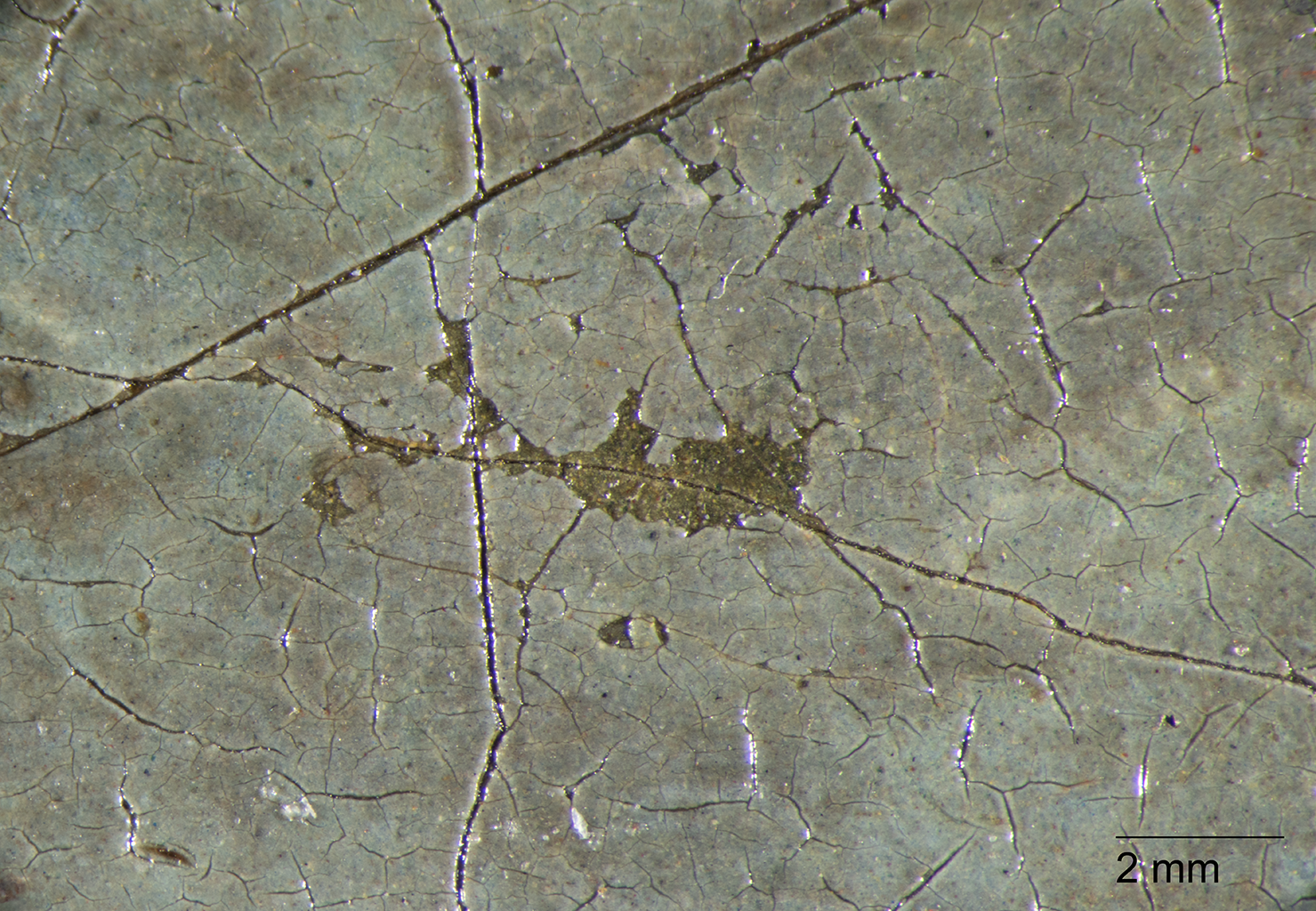
The off-white ground layer: An opaque preparatory layer applied to the support, either commercially or by the artist, to prevent absorption of the paint into the canvas or panel. See also priming layer. of the painting is visible only through microscopy and in limited areas of abrasion: A loss of surface material due to rubbing, scraping, frequent touching, or inexpert solvent cleaning. along cracks. While there is no imprimatura: A thin layer of paint applied over the ground layer to establish an overall tonality., colored preparatory layers were applied to selected regions of the composition. A light gray layer is revealed by paint losses in the sky,2The lower gray layer in the sky may have appeared bluer when it was first applied, shifting to gray due to smalt degradation. while a dark brown preparatory layer was applied over the ground within the majority of the foreground and large tree. This can be identified in large traction cracks: Also known as drying cracks, these are formed as the paint dries. They are usually the result of a “lean” paint with a small percentage of oil drying faster than an underlying “fat” paint layer with a higher percentage of oil. The quick drying of the top layer causes the paint layer to shrink and crack. especially prevalent in the tree.3Many traction cracks contain retouching, while some allow this dark preparatory layer to remain exposed. Within the distant middle ground, specifically under and around the bridge, a muted green preparatory layer was used (Fig. 16).
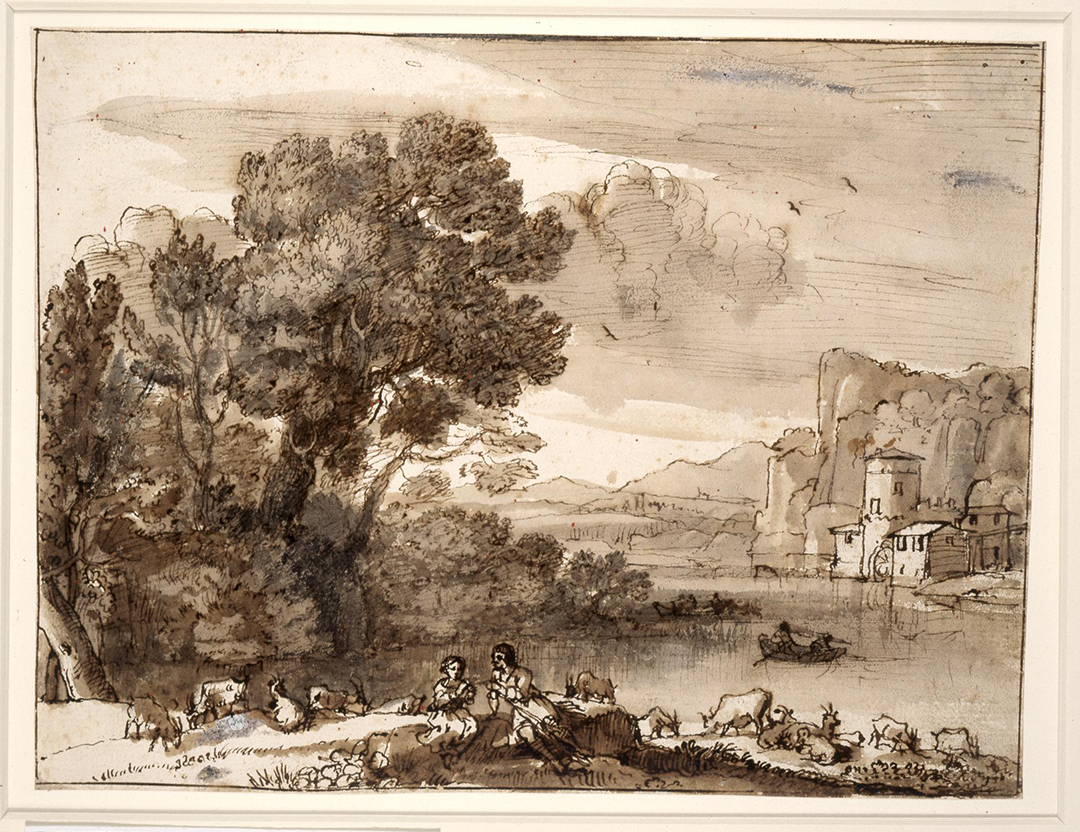
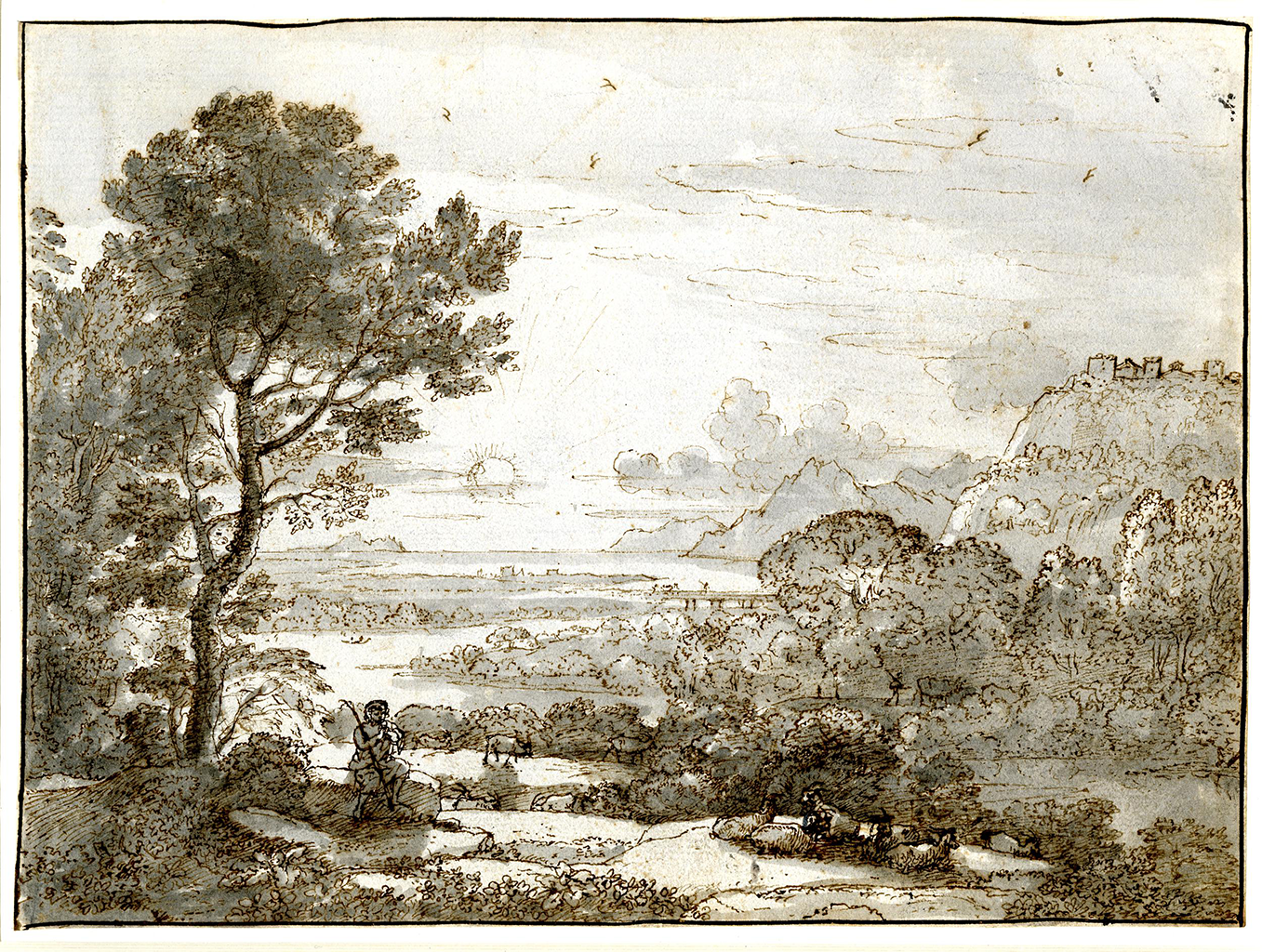
No preparatory underdrawing: A drawn or painted sketch beneath the paint layer. The underdrawing can be made from dry materials, such as graphite or charcoal, or wet materials, such as ink or paint. was visible through either microscopy or infrared reflectography (IRR): A form of infrared imaging that exploits the behavior of painting materials at wavelengths beyond those accessible to infrared photography. These advantages sometimes include a continuing increase in the transparency of pigments beyond wavelengths accessible to infrared photography (i.e, beyond 1,000 nanometers), rendering underdrawing more clearly. The resulting image is called an infrared reflectogram. Devices that came into common use in the 1980s such as the infrared vidicon effectively revealed these features but suffered from lack of sharpness and uneven response. Vidicons continue to be used out to 2,200 nanometers but several newer pixelated detectors including indium gallium arsenide and indium antimonide array detectors offer improvements. All of these devices are optimally used with filters constraining their response to those parts of the infrared spectrum that reveal the most within the constraints of the palette used for a given painting. They can be used for transmitted light imaging as well as in reflection.. Additionally, no incised lines were found. A prolific draftsman, Claude often formulated his compositions with an ink drawing before transferring the design to a canvas. In this case, the known drawings corresponding to Landscape with a Piping Shepherd and Mill on the Tiber (32-78) belong to the artist’s record of his completed paintings, Liber Veritatis.4Claude Lorrain created this sketchbook as a record of his completed paintings in order to prevent forgeries and confusion of his works. Both drawings are titled Pastoral Landscape, and in reference to the corresponding drawing for Landscape with a Piping Shepherd, Michael Kitson states that “the drawing corresponds to the painting exactly.” Michael Kitson, Claude Lorrain: Liber Veritatis (London: British Museum Publications, 1978), 7, 160. In his comparison between Mill on the Tiber and its corresponding drawing, (Fig. 17), Michael Kitson speaks of the presence of birds in the drawing and their absence in the painting. However, as birds are present in both Mill on the Tiber compositions, it is possible that Kitson’s note relates to Landscape with a Piping Shepherd and its drawing (Fig. 18), in which this discrepancy occurs.
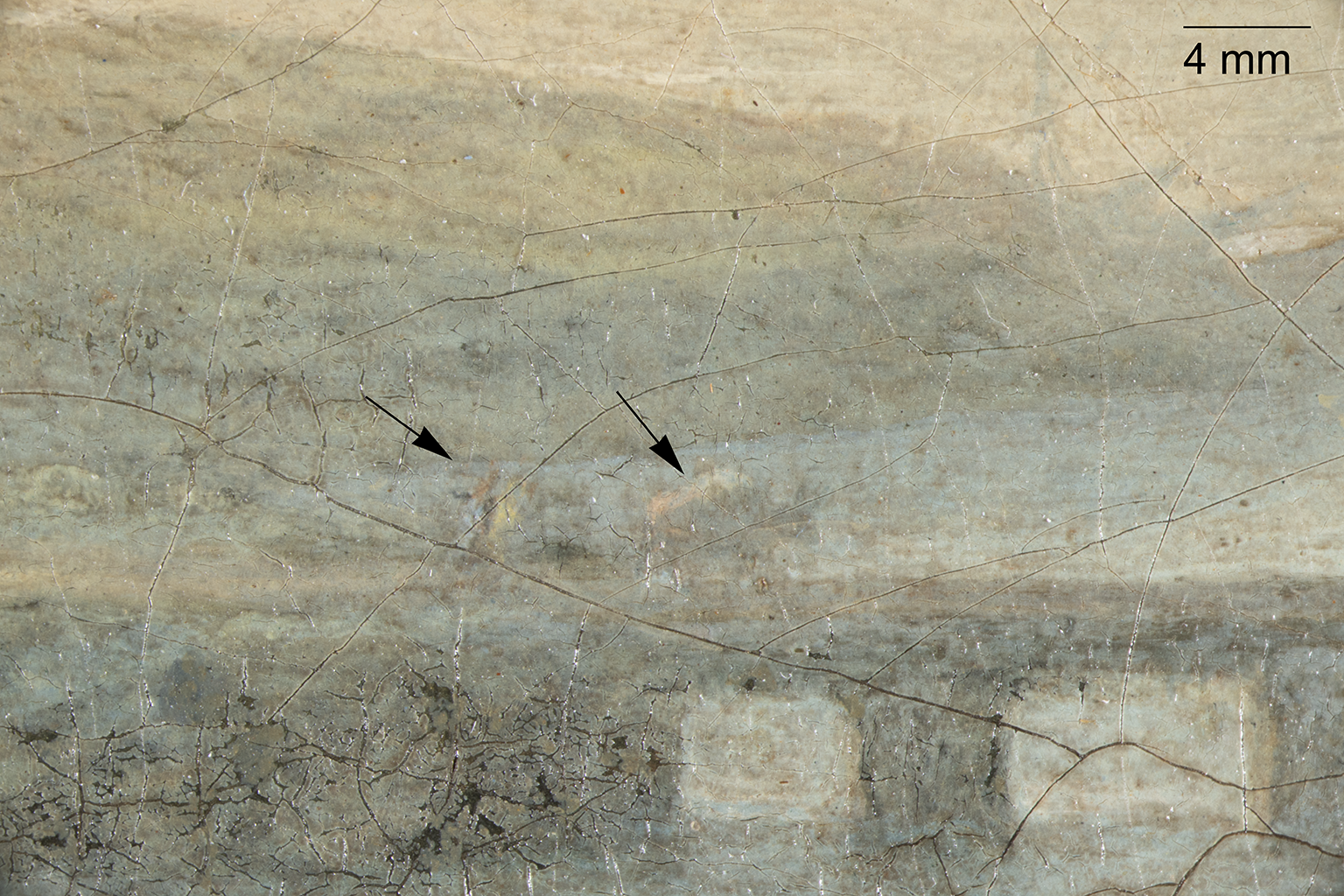
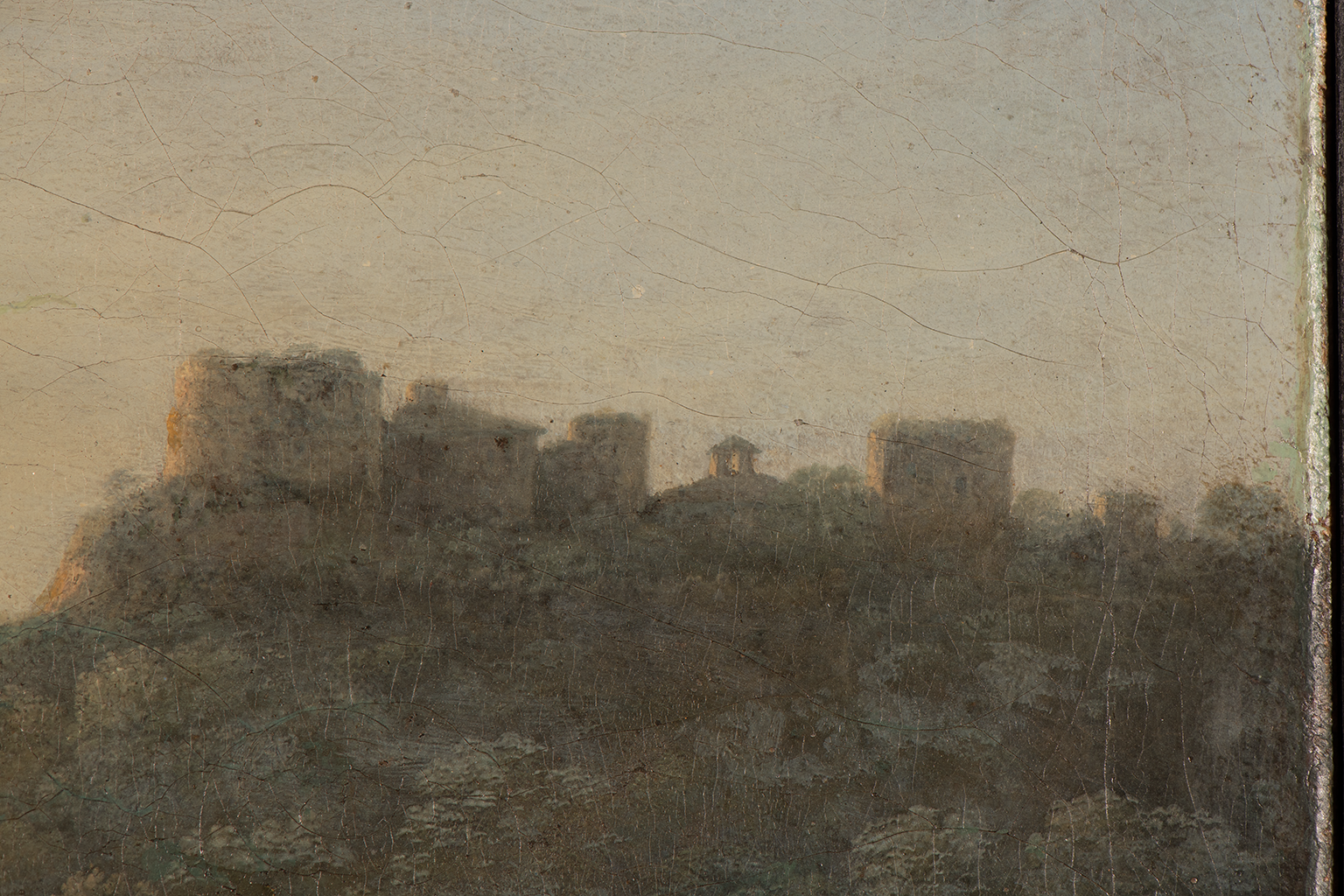
Claude formed the majority of the composition with wet-over-wet: An oil painting technique which involves drawing a stroke of one color across the wet paint of another color. paint application, in which edges blend softly into one another to produce a diffused appearance. The sky was built from the sun outward with radiating brushwork. Similarly soft wet-over-wet painting created the distant bridge and the buildings along the cliff. In the middle ground, a series of figures, perhaps an animal and cart with a driver, cross the bridge. The muted tones of these figures nearly blend into their surroundings (Fig. 19). As the composition progressed and the paint was nearly dry, highlights were added with wet-over-dry: An oil painting technique that involves layering paint over an already dried layer, resulting in no intermixing of paint or disruption to the lower paint strokes. paint strokes. Bright dashes of paint were placed along the lower edges of the clouds, while on the distant buildings on the cliff, warm peach highlights were added along each building’s left side to indicate the glow from the sun (Fig. 20).
As with many of Claude’s landscape paintings, the central figure, here a shepherd, lacks the delicacy in paint handling of the other compositional elements, appearing heavy and stilted. Early sources speculate that the inconsistency in technique could be due to Claude’s employment of Filippo Lauri (Italian, 1623–94) to incorporate figures into his landscapes. However, this has not been proven. Claude’s compositions are more successful in cases where the figures play a significant role in relation to the landscape.5Marcel Roethlisberger, “Claude Lorrain: Some New Perspectives,” in “Claude Lorrain 1600–1682: A Symposium,” ed. Pamela Askew, special issue, Studies in the History of Art 14 (1984): 59–61.
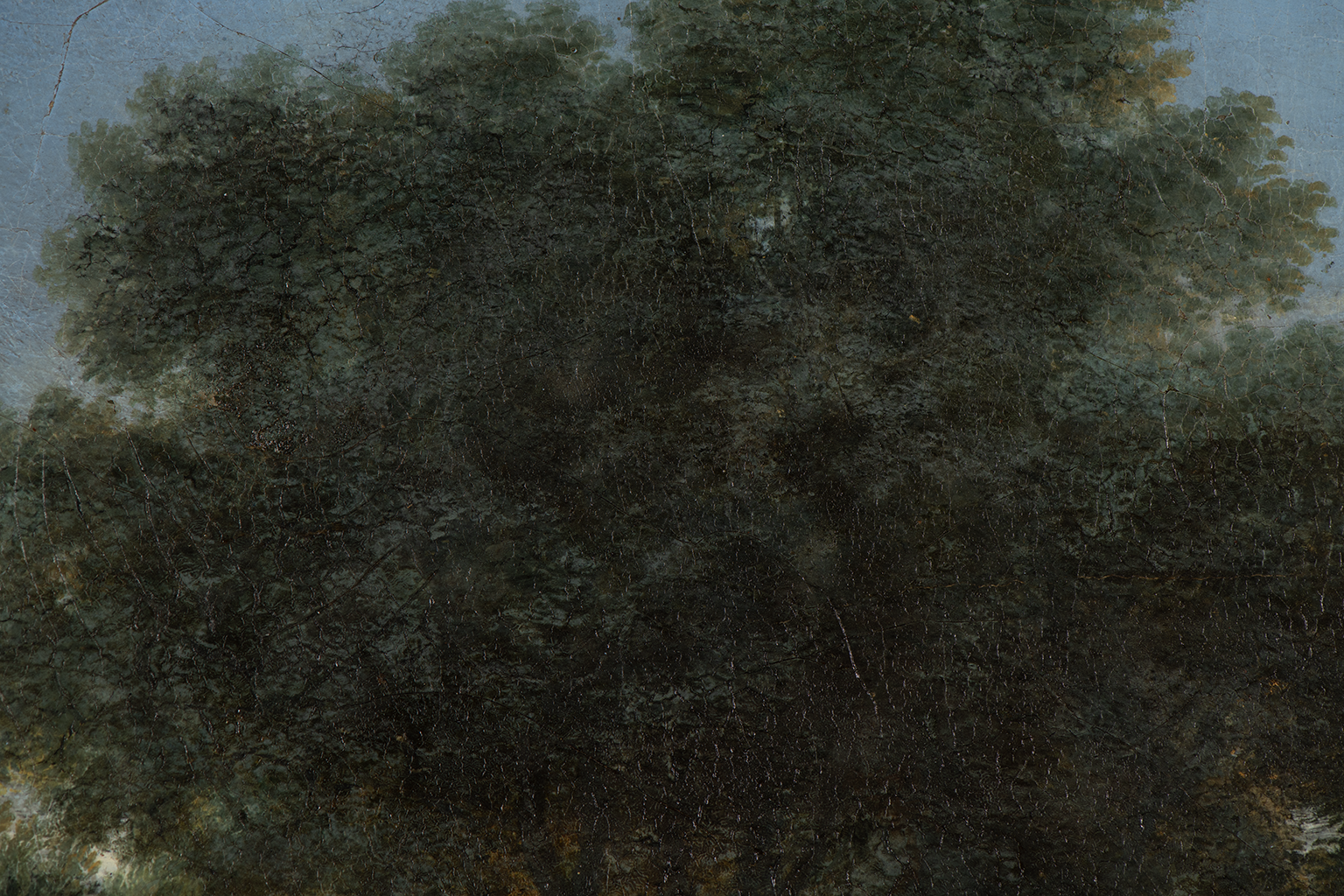
An uneven bluish haze or blanching: A whitish haze or discoloration that may indicate deterioration of a varnish layer or an alteration of the paint film caused by inappropriate cleaning. is visible across all dark and most mid-toned regions in the composition. This, in combination with traction cracks and paint wrinkling, has reduced the legibility of the brushwork of the tree (Fig. 21). The signature on the rock below the figure’s proper left leg is nearly indecipherable because of the paint surface condition.6The signature was identified by Hal Prestwood, conservation technician, Nelson-Atkins, in 2004 as: “Claudio [or CLꜶDIO] / ROMA [or ROMӔ] 1667.” Hal Prestwood, February 17, 2004, digital documentation, NAMA conservation file, no. 31-57. In addition, the contrast between planes, and therefore the atmospheric perspective of which Claude was lauded a master, has been lost due to this haze.7David C. Ditner, “Claude and the Ideal Landscape Tradition in Great Britain,” Bulletin of the Cleveland Museum of Art 70, no. 4 (April 1983): 152. Similar blanching has been found throughout Claude’s oeuvre, and theories on its cause range from poor choices in materials to restoration campaigns. Both Claude paintings in the Nelson-Atkins collection were studied in an effort to understand the causes of this blanching. Comparative samples were taken in blanched and non-blanched regions of various colors, from which cross sections were prepared in order to study the alteration. Their various strata were examined with the optical microscope, and elemental compositions were obtained in the scanning electron microscopy (SEM): Performed on a microsample of paint, the SEM provides a means of studying particle shapes beyond the magnification limits of the light microscope. This becomes increasingly important with the painting materials introduced in the early modern era, which are finer and more diverse than traditional artists’ materials. The SEM is routinely used in conjunction with an X-ray spectrometer, so that elemental identifications can be made selectively on the same minute scale as the electron beam producing the images. SEM methods are particularly valuable in studying unstable pigments, adverse interactions between incompatible pigments, and interactions between pigments and surrounding paint medium, all of which can have profound effects on the appearance of a painting., paying particular attention to the alteration of pigments and the formation of deterioration products atop the layers. In addition to identifying contributory factors to the blanching, a partial palette was established.
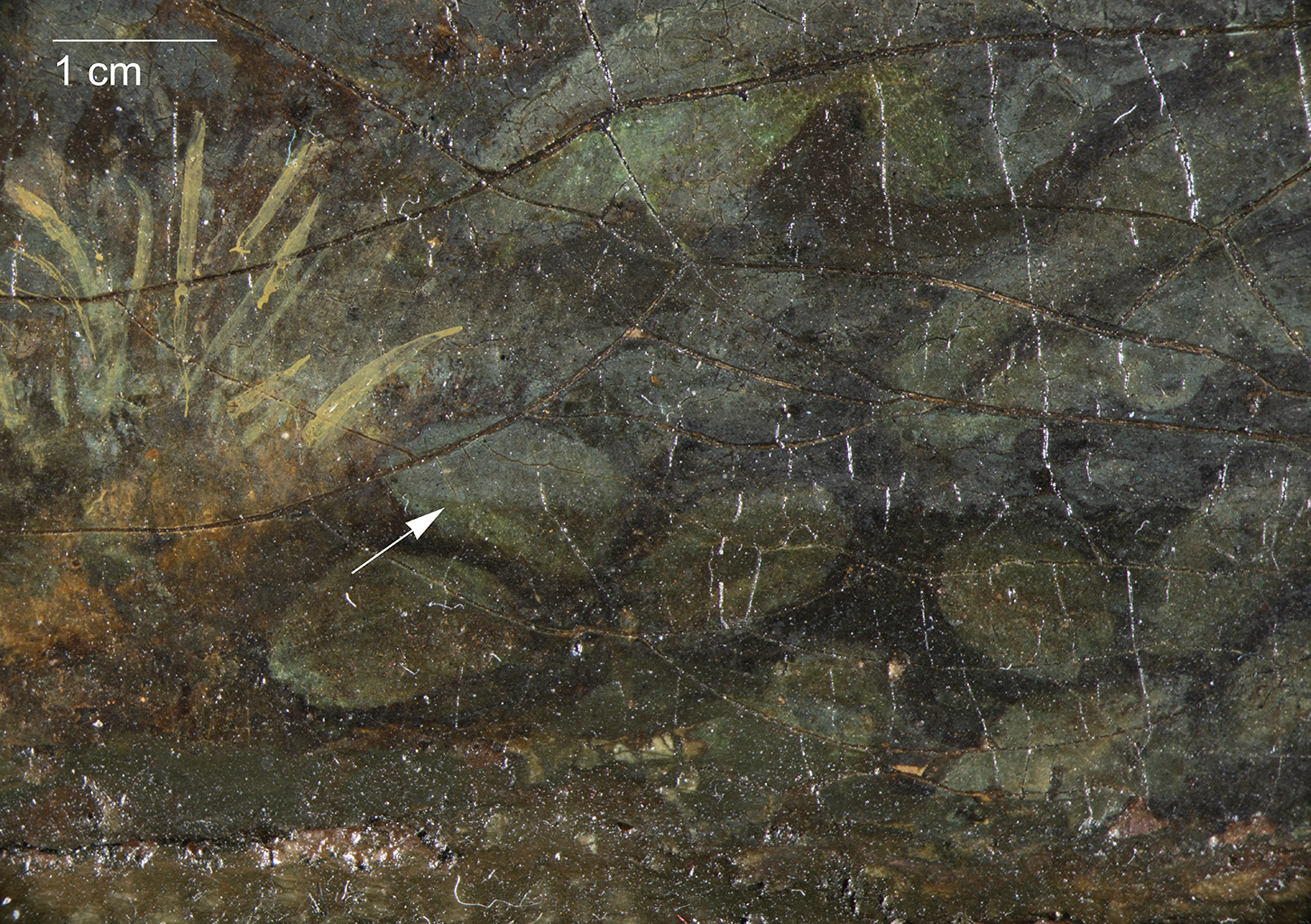
Minute layers of lead-containing reaction products were found on the uppermost paint layer in these analyses. Chloride and sulfate, whose origins remain unknown, were often identified in the reaction products. Unlike Mill on the Tiber (32-78), the haze in Landscape with a Piping Shepherd is relatively uniform and does not appear to follow brushwork or specific-colored passages, nor are there any central passages lacking the haze that could relate to past cleanings. Along the bottom edge, however, there is a clear delineation between the affected and unaffected areas, crossing the leaves in the foreground (Fig. 22). This division between hazy and clear portions of the same brushwork does not correspond with overlap of the frame rabbet: A recessed inner channel or groove on the back of a picture frame that secures artwork and/or glazing within the frame. Frame rabbets are typically padded with a soft material to prevent frame abrasion or indentations where it comes into contact with the artwork. Referred to as “rebate” in British English or any existing restorations. However, it may relate to early restorations or to actions taken during the reformatting. While other studies have found that the thickness of the paint could impact the severity of blanching, that does not appear to be the case in Piping Shepherd, where blanching occurs across the picture plane: The two-dimensional surface where the artist applies paint., regardless of paint application.8Karin Groen, “Scanning Electron-Microscopy as an Aid in the Study of Blanching,” in The Hamilton Kerr Institute Bulletin Number 1: The First Ten Years; The Examination and Conservation of Paintings 1977 to 1987, ed. Ian McClure (Cambridge: Hamilton Kerr Institute of the Fitzwilliam Museum, University of Cambridge, 1988), 49.
The pigments found in both Nelson-Atkins paintings are consistent with those identified in other Claude paintings as the “typical Claude mixture.”9Groen, “Scanning Electron-Microscopy as an Aid in the Study of Blanching,” 49. The majority of the pigments are finely ground and are utilized in complex admixtures. Throughout the foliage, green earth, smalt, and lead-tin yellow are present, with Naples yellow used within highlights. Ultramarine blue is the primary blue in the sky. Vermilion and bone black were also identified, and lead white is prevalent throughout the painting.
The painting has undergone multiple restoration and conservation campaigns throughout its history.10A brief note in the NAMA curatorial file states that on a Claude Lorrain painting, the following treatment was completed in 1933 by M. J. Rougeron: “Dissolve varnish and repainted parts on the edge. Re-place priming, properly restore aged and damaged parts. Light glazing, varnish and encaustic finish.” It is unclear if this note is in reference to this painting or Mill on the Tiber (32-78). Marcel Jules Rougeron was a paintings restorer, art dealer, and collector in New York. The most recent conservation campaign was completed in 1971, when the painting was cleaned, a glue-paste lining: A procedure used to reinforce a weakened canvas that involves adhering a second fabric support using adhesive, most often a glue-paste mixture, wax, or synthetic adhesive. was removed, a new wax-resin lining was completed, and the canvas was reformatted to its current size.11James Roth, September 15, 1971, treatment report, NAMA conservation file, 31-57. This reformatting reduced the picture plane by approximately 1 1/2 inches vertically and 1 inch horizontally. During this campaign, an attempt was made to reduce the blanching; however, the haze was not successfully removed. A significant amount of retouching: Paint application by a conservator or restorer to cover losses and unify the original composition. Retouching is an aspect of conservation treatment that is aesthetic in nature and that differs from more limited procedures undertaken solely to stabilize original material. Sometimes referred to as inpainting or retouch. was completed to integrate traction cracks and create a cohesive image. Warm retouching was liberally added within the foliage, presumably to balance the overly blue appearance caused by the blanching, and a synthetic varnish was applied to the surface.
Notes
-
Evidence of the twill weave is visible in the film-based x-radiograph, no. X, NAMA conservation file, 31-57.
-
The lower gray layer in the sky may have appeared bluer when it was first applied, shifting to gray due to smalt degradation.
-
Many traction cracks contain retouching, while some allow this dark preparatory layer to remain exposed.
-
Claude Lorrain created this sketchbook as a record of his completed paintings in order to prevent forgeries and confusion of his works. Both drawings are titled Pastoral Landscape, and in reference to the corresponding drawing for Landscape with a Piping Shepherd, Michael Kitson states that “the drawing corresponds to the painting exactly.” Michael Kitson, Claude Lorrain: Liber Veritatis (London: British Museum Publications, 1978), 7, 160.
-
Marcel Roethlisberger, “Claude Lorrain: Some New Perspectives,” in “Claude Lorrain 1600–1682: A Symposium,” ed. Pamela Askew, special issue, Studies in the History of Art 14 (1984): 59–61.
-
The signature was identified by Hal Prestwood, conservation technician, Nelson-Atkins, in 2004 as: “Claudio [or CLꜶDIO] / ROMA [or ROMӔ] 1667.” Hal Prestwood, February 17, 2004, digital documentation, NAMA conservation file, no. 31-57.
-
David C. Ditner, “Claude and the Ideal Landscape Tradition in Great Britain,” Bulletin of the Cleveland Museum of Art 70, no. 4 (April 1983): 152.
-
Karin Groen, “Scanning Electron-Microscopy as an Aid in the Study of Blanching,” in The Hamilton Kerr Institute Bulletin Number 1: The First Ten Years; The Examination and Conservation of Paintings 1977 to 1987, ed. Ian McClure (Cambridge: Hamilton Kerr Institute of the Fitzwilliam Museum, University of Cambridge, 1988), 49.
-
Groen, “Scanning Electron-Microscopy as an Aid in the Study of Blanching,” 49.
-
A brief note in the Nelson-Atkins curatorial file states that on a Claude Lorrain painting, the following treatment was completed in 1933 by M. J. Rougeron: “Dissolve varnish and repainted parts on the edge. Re-place priming, properly restore aged and damaged parts. Light glazing, varnish and encaustic finish.” It is unclear if this note is in reference to this painting or Mill on the Tiber (32-78). Marcel Jules Rougeron was a paintings restorer, art dealer, and collector in New York.
-
James Roth, September 15, 1971, treatment report, Nelson-Atkins conservation file, 31-57.
Documentation
Citation
Chicago:
Glynnis Napier Stevenson and Brigid M. Boyle, “Claude Gellée, called Le Lorrain, Landscape with a Piping Shepherd, 1667,” documentation in French Paintings and Pastels, 1600–1945: The Collections of The Nelson-Atkins Museum of Art, ed. Aimee Marcereau DeGalan (Kansas City: The Nelson-Atkins Museum of Art, 2024), https://doi.org/10.37764/78973.5.208.4033.
MLA:
Stevenson, Glynnis Napier, and Brigid M. Boyle. “Claude Gellée, called Le Lorrain, Landscape with a Piping Shepherd, 1667,” documentation. French Paintings and Pastels, 1600–1945: The Collections of The Nelson-Atkins Museum of Art, edited by Aimee Marcereau DeGalan, Nelson-Atkins Museum of Art, 2024. doi: 10.37764/78973.5.208.4033.
Provenance
Probably purchased from the artist by Cornelis de Wael on behalf of Don Antonio Ruffo (1610–78), 1st Principe della Scaletta, Messina, Italy, 1667–December 26, 1673 [1];
Probably given to his son, Don Placido Ruffo (1646–1710), 2nd Principe della Scaletta and 1st Principe della Floresta, Messina, Italy, 1673–May 5, 1710 [2];
Probably by descent to his son, Don Antonio Ruffo e La Rocca (ca. 1680–1739), 3rd Principe della Scaletta and 2nd Principe della Floresta, Messina, Italy, 1710–39;
Probably by descent to his son, Don Calogero Ruffo (ca. 1706–43), 4th Principe della Scaletta and 3rd Principe della Floresta, Messina, Italy, 1739–43;
Probably estate of Don Calogero Ruffo, ca. 1743–50 [3];
Probably inherited by his uncle, Don Giovanni Ruffo e La Rocca (ca. 1684–ca. 1755/1756), 5th Principe della Scaletta, Messina, Italy, 1750–1755/1756 [4];
Probably by descent to his son, Don Antonio Ruffo (1707–78), 6th Principe della Scaletta, Messina, Italy, 1755/1756–October 15, 1778;
Probably by descent to his son, Don Giovanni Ruffo (1751–1808), 7th Principe della Scaletta, Messina, Italy, 1778–March 11, 1808 [5];
Lord Charles Kinnaird (1780–1826), 8th Lord Kinnaird of Inchture, Scotland, by late 1812;
Purchased from Lord Kinnaird by John Glover (1767–1849), London and Patterdale, UK, by January 1, 1813–36 [6];
Jointly purchased from Glover, through John Lord and George Stanley, by John Smith and Robert Hume, London, Smith stock book A 1822–ca. 1850, no. 1070, as Landscape Youth Playing on Pipe, by September 6, 1836–38 [7];
Purchased from Smith and Hume by William Hornby (1797–1869), The Hook, Hampshire, UK, April 18, 1838;
Bought back from Hornby by John Smith and Sons, London, by 1841 [8];
Purchased from John Smith and Sons by Sir Thomas Baring (1772–1848), 2nd Baronet, London, June 18, 1841–April 3, 1848 [9];
Purchased by his son, Thomas Baring (1799–1873), London, 1848–November 18, 1873 [10];
By descent to his nephew, Thomas George Baring (1826–1904), 1st Earl of Northbrook, London, 1873–November 15, 1904 [11];
By descent to his son, Francis George Baring (1850–1929), 2nd Earl of Northbrook, London, 1904–at least 1926 [12];
With Durlacher Brothers, London, by September 9, 1930 [13];
Transferred to Durlacher Brothers, New York, by January 27, 1931 [14];
Purchased from Durlacher Brothers, through Harold Woodbury Parsons, by The Nelson-Atkins Museum of Art, Kansas City, MO, 1931.
Notes
[1] Cornelis de Wael (Flemish, 1592–1667) was a
dealer and painter of marine subjects who lived
primarily in Genoa (1631–56) and Rome (1656–67).
He is thought to be the “Deveal” whom Claude
mentions in connection with
https://www.britishmuseum.org
[2] The painting was part of Don Antonio’s propter nuptias (marriage gift) to his son Don Placido, which was finalized on December 26, 1673. In Vincenzo Ruffo’s compilation of his family’s inventories, he sets off the paintings given as wedding gifts with asterisks. See Vincenzo Ruffo, “Galleria Ruffo nel secolo XVII in Messina (con lettere di pittori ed altri documenti inediti),” Bollettino d’Arte 10, nos. 9–10 (September–October 1916): 314, 316, under the “Catalogo generale dei 364 quadri della galleria,” where the paintings are number 108*: “Lorenese (Claudio il), Paesaggio con due figure ed alcune capre, 2-1/2 x 3 ; La nascita del Sole, 2 1/2 x 3.”
[3] In 1743, Don Calogero (eldest son of the younger Don Antonio) died childless, causing problems of succession between his sister, Antonia Ruffo, and uncle, Don Giovanni Ruffo e La Rocca (the younger Don Antonio’s brother). Don Giovanni got the title of 5th Principe della Scaletta and the Palazzo Regio Campo in Messina, which included the Claude paintings; Donna Antonia Ruffo got the title of Principessa della Floresta. See Rosanna De Gennaro, “Aggiunta alle notizie sulla collezione di Antonio Ruffo: ‘nota di quadri vincolati in primogeniture’ scampati al terremoto del 5 febbraio 1783,” Napoli nobilissima 2, no. 5/6 (September–December 2001): 211.
[4] See note 3.
[5] See “Note of paintings bound in primogeniture, recovered by Don Giovanni Ruffo, prince della Scaletta from the ruins of the palace which fell in Messina with the horrible earthquake of 5 February 1783,” where two Claude paintings are listed as nos. 85–86 and located in the chapel: “Due paesini, di palmi 2 1/2 e 3, di monsieur Claudio Lorenese, onze 40.” These are probably Mill on the Tiber and Landscape with a Piping Shepherd. See De Gennaro, “Aggiunta alle notizie sulla collezione di Antonio Ruffo,” 213–14.
[6] According to John Smith, John Glover purchased Landscape with a Piping Shepherd from Lord Kinnaird for £1000 (date not specified); see John Smith, A Catalogue Raisonné of the Works of the Most Eminent Dutch, Flemish, and French Painters (London: Smith and Son, 1837), 8:289. The only painting by Claude in Lord Kinnaird’s sale, A Genuine and Highly Select Collection of Sixteen Pictures: Being Chef d’Œuvres of the Most Eminent Artists of the Different Schools, Collected by a Nobleman at Phillips, London, on May 21, 1811, was lot 11, an “elegant Italian landscape” that was offered for £640.10, but it was bought in. Therefore, it is more likely that Glover purchased Landscape with a Piping Shepherd directly from Lord Kinnaird—whom he had known since at least 1808—in a private sale. David Hansen proposes that it is “feasible” that Glover purchased both Mill on the Tiber and Landscape with a Piping Shepherd from Kinnaird in late 1812, because the English landscape painter Joseph Farington (1747–1821) noted in his diary entry for January 1, 1813, that Glover “had lately given 1700 guineas for two pictures painted by Claude”; see David Hansen, John Glover and the Colonial Picturesque, exh. cat. (Hobart, Tasmania: Tasmanian Museum and Art Gallery, 2003), 135. See also Hansen’s essay for Glover’s copy after the Nelson-Atkins picture in Important Australian and International Art: including property formerly in the collection of the Late Mr Irvin Rockman CBE (Melbourne: Smith and Singer, November 22, 2011), 36, where he asserts that Glover bought Landscape with a Piping Shepherd from Kinnaird in 1812.
On September 4, 1830, John Glover emigrated with his family to Van Diemen’s Land (now Tasmania). Prior to this, Landscape with a Piping Shepherd was bought in at his emigration sale of May 12, 1830, for 700 guineas; see John Smith, A Catalogue Raisonné of the Works of the Most Eminent Dutch, Flemish, and French Painters, 8:289. According to the same source, its pendant Mill on the Tiber was also bought in by the auctioneer George Stanley for 700 guineas. It seems evident that George Stanley, in his capacity as auctioneer, bought in both pictures on John Glover’s behalf, likely before leaving them with Glover’s son-in-law and London agent, John Lord (1795–1854). They remained in Lord’s custody until at least July 1835, when the exhibition of Glover’s work (and his two Claudes) closed.
[7] See letter from John Smith, London, to John Mountjoy Smith, Rome, September 6, 1836, in Charles Sebag-Montefiore and Julia I. Armstrong-Totten, A Dynasty of Dealers: John Smith and Successors 1801–1924; A Study of the Art Market in Nineteenth-Century London (London: Roxburghe Club, 2013), 219–21. Smith and Hume paid £1840 for Landscape with a Piping Shepherd and Mill on the Tiber. See also “Records of John Smith and successors, 1812–1892,” daybook 3, part 1, 1837–1847, p. 93, Getty Research Institute, Los Angeles.
[8] Sebag-Montefiore and Armstrong-Totten, A Dynasty of Dealers, 220n111.
[9] Baring purchased Landscape with a Piping Shepherd for £800. See Sebag-Montefiore and Armstrong-Totten, A Dynasty of Dealers, 220n111; and “Records of John Smith and successors, 1812–1892,” daybook 3, part 1, 1837–1847, p. 337, Getty Research Institute, Los Angeles.
[10] Sir Thomas Baring’s will stipulated that his collection be sold after his death. Thomas Baring purchased his father’s Italian, Spanish, and French pictures when they were put up for sale; see the introduction to A Descriptive Catalogue of the Collection of Pictures Belonging to the Earl of Northbrook (London: Griffith, Farran, Okeden, and Welsh, 1889), unpaginated.
[11] Thomas George Baring was the eldest son of Thomas Baring’s older brother, Francis Thornhill Baring (1796–1866), 1st Baron Northbrook. He succeeded his father in 1866 as the 2nd Baron Northbrook and became 1st Earl of Northbrook in 1876; see Sebag-Montefiore and Armstrong-Totten, A Dynasty of Dealers, 65.
[12] See Louis Dimier, Histoire de la Peinture Française: Du Retour de Vouet à la Mort de Lebrun, 1627 à 1690 (Paris: G. van Oest, 1926), 1:76, 86. The painting likely remained in Francis George Baring’s collection until his death on April 12, 1929.
In the catalogue raisonné, Marcel Rœthlisberger erroneously states that the painting was in the possession of Colnaghi, London, by 1929/1930; see Marcel Rœthlisberger, Claude Lorrain: The Paintings (New Haven: Yale University Press, 1961), 304. However, researchers have not found evidence of the two Nelson-Atkins canvases in the Colnaghi archives. See email from Catherine Taylor, Head of Archives and Records, Waddesdon Manor, to Glynnis Stevenson, NAMA, April 22, 2021, NAMA curatorial files.
[13] See letters from Harold Woodbury Parsons, art advisor for the Nelson-Atkins Museum of Art, to J. C. Nichols, Trustee for the Nelson-Atkins Museum of Art, September 9, 1930, and November 22, 1930, NAMA curatorial files.
[14] Durlacher shipped the painting to Kansas City on January 27, 1931. See letter from R. Kirk Askew, Jr., Durlacher Bros., New York, to Robert A. Holland, curator of collections, The Nelson-Atkins Museum of Art, January 27, 1931, NAMA curatorial files.
Preparatory Works
Claude Gellée (Claude Lorrain), Landscape with Apollo and Mercury, Record of a Painting in the Collection of Maj-Gen E H Goulburn (England), from the Liber Veritatis; A figure on a rock in the foreground, cattle, some herded by another figure, and goats nearby, a river with wooded banks moves into the right foreground, 1666, pen and brown ink, with gray and brown wash, heightened with white; on blue paper, 7 5/8 x 10 in. (19.4 x 25.6 cm), Liber Veritatis, no. 170, British Museum, London, P_1957-1214-176.
Copies
Claude Gellée (Claude Lorrain), Pastoral landscape, record of painting in William Rockhill Nelson Gallery of Art, Kansas City, Missouri from the Liber Veritatis; In foreground figure (Apollo) sitting on a rock at left, and a herd of goats, beyond herdsman (Mercury?) at right, and river meandering into background, 1667, pen and brown ink, and gray wash, with gray-brown wash on paper, 7 5/8 x 10 3/16 in. (19.3 x 25.8 cm), Liber Veritatis, no. 172, British Museum, London, 1957,1214.178.
Richard Earlom (English, 1743–1822), after Claude Gellée (Claude Lorrain), Landscape with a Piping Shepherd, 1776, etching with mezzotint, plate: 8 1/4 x 10 1/4 in. (21 x 26 cm); sheet: 10 1/4 x 16 7/8 in. (26 x 42.8 cm), The Nelson-Atkins Museum of Art, Kansas City, MO, Purchase: acquired through the Print Duplicate Fund, 68–6/2.
Matthew Dubourg (British, active 1786–1838), after Claude Gellée (Claude Lorrain), Landscape, 1809, engraving print proof on India paper, no dimensions given, Victoria and Albert Museum, London, DYCE.2927.
John Glover (English, 1767–1849), after Claude Gellée (Claude Lorrain), Landscape with a Piping Shepherd, ca. 1815, oil on canvas, 21 x 27 in. (53.3 x 68.6 cm), Queen Victoria Museum and Art Gallery, Launceston, Tasmania, QVM:2011:FP:0009.
John Glover, after Claude Gellée (Claude Lorrain), Landscape with Piping Shepherd, 1833, oil on canvas, 28 1/2 x 43 9/10 in. (72.5 x 111.5 cm), National Gallery of Australia, Canberra, 2011.1273.
Exhibitions
Possibly Mr. Glover’s Exhibition, 16, Old Bond Street, London, opened April 24, 1820, no cat.
Possibly Mr. Glover’s Exhibition, 16, Old Bond Street, London, May–June 1821, no cat.
Possibly Glover’s Exhibition, 16, Old Bond Street, London, 1823, no. 65 or 84, as either One of the most beautiful pictures or Landscape.
Pictures, Descriptive of the Scenery, and Customs of the Inhabitants of Van Dieman’s Land, Together with Views in England, Italy, etc. Painted by John Glover, Esq.; To Which are Added Two Genuine, and Highly Finished Landscapes, by the Celebrated Claude Lorraine [sic], 106 New Bond Street, London, June–July 1835, no. 68 or 69, as Two Landscapes by Claude Lorraine [sic].
Exhibition of the Works of the Old Masters, Associated with Works of Deceased Masters of the British School, Winter Exhibition, Royal Academy, London, January–March 1871, no. 166, as A Landscape: Sunrise.
Exhibition of Works by the Old Masters and by Deceased Masters of the British School; Including a Special Selection from the Works of Frank Holl, R. A., and a Collection of Water-Colour Drawings by Joseph M. W. Turner, R. A., Winter Exhibition, Royal Academy, London, January 7–March 16, 1889, no. 88, as Shepherd Playing on a Pipe.
Exhibition of Works by the Old Masters Including a Special Collection of Paintings and Drawings by Claude, Winter Exhibition, Royal Academy, London, January 6–March 15, 1902, no. 71, as A Shepherd Playing on a Pipe.
Old Masters: XVII and XVIII Century French Art; Contemporary British Painting and Sculpture, Spring Exhibition, Whitechapel Art Gallery, London, February 8–April 3, 1907, no. 26, as A Shepherd Playing on Pipe.
Exposition du Paysage Français de Poussin à Corot, Palais des Beaux-Arts, Paris, May–June 1925, no. 119, as Paysage avec un pâtre jouant du fifre.
Exhibition, Kansas City Art Institute, MO, December–January 1931, no cat., as Landscape with a Piping Shepherd.
Landscape Paintings from the Sixteenth to the Twentieth Century, Berkshire Museum, Pittsfield, MA, June 25–July 20, 1937, no. 9, as Landscape with a Piping Shepherd.
An Exhibition of Paintings and Drawings of Claude Lorrain, 1600–1682, Durlacher Brothers, New York, January 19–February 12, 1938, no. 3, as Landscape with a Piping Shepherd.
Temporary Exhibition, The Nelson-Atkins Museum of Art, Kansas City, MO, December 1941–January 1942, no cat., as Landscape with a Piping Shepherd.
Renaissance and Baroque Art, Seattle Art Museum, February 8–March 5, 1950, no. 82, as Landscape with Piping Shepherd.
Claude Lorrain, 1600–1682: Paintings, Drawings, Prints, Smith College Museum of Art, Northampton, MA, May 1–June 23, 1952, no. 4, as Landscape with a Piping Shepherd.
Opening Exhibition, George Thames Hunter Gallery of Art, Chattanooga, TN, July 12–August 3, 1952, as Landscape with a Piping Shepherd.
John Glover and the Colonial Picturesque, Tasmanian Museum and Art Gallery, Hobart, Tasmania, Australia, November 28, 2003–February 1, 2004; Art Gallery of South Australia, Adelaide, February 19–April 12, 2004; National Gallery of Australia, Canberra, April 24–July 18, 2004; National Gallery of Victoria, Melbourne, August 13–October 3, 2004, no. 2, as Landscape with Piping Shepherd.
References
A Genuine and Highly Select Collection of Sixteen Pictures: Being Chef d’Œuvres of the Most Eminent Artists of the Different Schools, Collected by a Nobleman ([London]: [Phillips], May 21, 1811), 4, as An elegant Italian Landscape.
Liber veritatis, or, A collection of prints, after the original designs of Claude le Lorrain: in the collection of His Grace the duke of Devonshire; executed by Richard Earlom, in the manner and taste of the drawings; to which is added, a descriptive catalogue of each print; together with the names of those for whom, and the places for which, the original pictures were first painted, taken from the hand-writing of Claude le Lorrain on the back of each drawing, and of the present possessors of many of the original pictures (1819; repr. London: Boydell, [1841?]), 2:4, 8, as A Shepherd playing on a pipe, five Goats repose near him, and seven others are browsing in the surrounding meadows of a rich and well wooded landscape.
Possibly “Mr. Glover’s Exhibition,” Literary Chronicle and Weekly Review, no. 106 (May 26, 1821): 334.
Possibly “Mr. Glover’s Exhibition,” Repository of Arts, Literature, Fashions, Manufactures, etc. 11, no. 66 (June 1, 1821): 374.
Possibly “Fine Arts: Mr. Glover’s Pictures,” New Monthly Magazine and Literary Journal 9 (1823): 397.
“Sales by Auction: Mr. Glover’s Pictures, and Landscapes by Claude,” Times (London), no. 14,209 (April 24, 1830): 4.
“Sales by Auction: Mr. Glover’s Pictures, and Landscapes by Claude,” Times (London), no. 14,213 (April 29, 1830): 4.
A Catalogue of Sixty Pictures Painted by John Glover, Esq., and Two Landscapes by Claude, His Property ([London]: [Stanley], April 29, 1830), 6, as Landscape, Morning.
Peregrine Langton Massingberd, “Journal of
Peregrine Langton Massingberd (as filmed by
AJCP),” 1832–1833, originals in Massingberd Family
Archives, Lincolnshire Archives, Lincoln, UK;
microfilm of the records as part of the Australian
Joint Copying Project, National Library of
Australia, M M719,
https://nla.gov.au
A Catalogue of Pictures, Descriptive of the Scenery, and Customs of the Inhabitants of Van Dieman’s Land, Together with Views in England, Italy, etc. Painted by John Glover, Esq.; To Which are Added Two Genuine, and Highly Finished Landscapes, by the Celebrated Claude Lorraine [sic], exh. cat. (1835; repr., London: J. Rogers, 1868), 4, as Two Landscapes.
John Smith, A Catalogue Raisonné of the Works of the Most Eminent Dutch, Flemish, and French Painters, vol. 8, The Life and Works of Nicholas Poussin, Claude Lorraine [sic], and Jean Baptiste Greuze (London: Smith and Son, 1837), 288–89, 472, as A Shepherd playing on a Pipe.
John Smith, Supplement to the Catalogue Raisonné of the Works of the Most Eminent Dutch, Flemish, and French Painters; In which is included a short Biographical Notice of the Artists, with a Copious Description of Nearly The Whole of Their Pictures; A Statement of The Price At Which Such Pictures Have Been Sold At Public Sales On The Continent And In England; A Reference To The Galleries and Private Collections, In Which A Large Portion Are At Present; And The Names Of The Artists By Whom They Have Been Engraved To Which Is Added, A Brief Notice Of The Scholars And Imitators Of The Great Masters Of The Above Schools, pt. 9 (London: Mssrs. Smith, 1842), 808, as (The Companion.) Shepherd playing on a Pipe.
John Mitford, ed., “Obituary–Mr. John Glover,” Gentleman’s Magazine (July 1850): 97.
[Gustav Friedrich] Waagen, Treasures of Art in Great Britain: Being an Account of the Chief Collections of Paintings, Drawings, Sculptures, Illuminated Mss., etc. (London: John Murray, 1854), 2:177, as A landscape, with trees and water; in front a shepherd piping. A charming picture, of his middle time.
Exhibition of the Works of the Old Masters, Associated with Works of Deceased Masters of the British School, exh. cat. (London: William Clowes and Sons, 1871), 16, 38–39, as A Landscape: Sunrise.
[Emilia Francis Strong Dilke], Claude Lorrain: Sa Vie et ses Œuvres d’après des documents inédits (Paris: J. Rouam, 1884), 94, 96, 191, 233, as Effet de soleil couchant.
Owen J. Dullea, Claude Gellée le Lorrain (London: S. Low, Marston, Searle, and Rivington, 1887), 116, 125, as Landscape: Shepherd Piping and goats.
George Redford, Art Sales: A History of Sales of Pictures and Other Works of Art (London: Bradbury, Agnew, 1888), 2:275, as Italian landscape. Cabinet size.
Exhibition of Works by the Old Masters and by Deceased Masters of the British School; Including a Special Selection from the Works of Frank Holl, R. A., and a Collection of Water-Colour Drawings by Joseph M. W. Turner, R. A., exh. cat. (London: William Clowes and Sons, 1889), 23, 69–70, as Shepherd Playing on a Pipe.
W. J. James Weale and Jean Paul Richter, A Descriptive Catalogue of the Collection of Pictures Belonging to the Earl of Northbrook: The Dutch, Flemish, and French Schools by Mr. W. H. James Weale; The Italian and Spanish Schools By Dr. Jean Paul Richter (London: Griffith, Farran, Okeden, and Welsh, 1889), 189, 192, 216, as A Shepherd Playing on a Pipe and Shepherd Playing the Flute.
George Grahame, Claude Lorrain: Painter and Etcher (London: Seeley, 1895), 51.
Exhibition of Works by the Old Masters Including a Special Collection of Paintings and Drawings by Claude, exh. cat. (London: William Clowes and Sons, 1902), 20, 65–66, as A Shepherd Playing on a Pipe.
H. C., “Correspondance d’Angleterre: Exposition de maîtres anciens à la Royal Academy (Suite),” La Chronique des arts et de la curiosité: supplément à la Gazette des beaux-arts, no. 11 (March 15, 1902): 85.
Verlags-Katalog von Franz Hanfstængl Kunstverlag München (Munich: Franz Hanfstængl, 1903), 2:56, as Schäfer auf einer Pfeife spielend.
Raymond Bouyer, Les grands artistes: Leur vie. — leur œuvre; Claude Lorrain (Paris: Henri Laurens, [1905]), 97, 126, (repro.), as Le Chevrier au soleil couchant.
Edward Dillon, Claude (London: Methuen, 1905), 187.
Masters in Art: A series of Illustrated Monographs (Boston: Bates and Guild, 1905), 6:377, as Two Landscapes.
Spring Exhibition: Section I.—Old Masters: XVII. and XVIII. Century French Art; Section II. Contemporary British Painting and Sculpture, exh. cat. ([London]: Whitechapel Art Gallery, 1907), 6, as A Shepherd Playing on Pipe.
The Masterpieces of Claude (1600–1682) (London: Gowans and Gray, 1911), 7, 67, (repro.), as Shepherd Playing the Pipe / Berger jouant sur le pipeau / Schäfer auf einer Pfeife spielend and Shepherd playing a flute.
Algernon Graves, A Century of Loan Exhibitions, 1813–1912 (New York: Burt Franklin, 1913), 1:179, as Shepherd playing on Pipe.
Probably Vincenzo Ruffo, “Galleria Ruffo nel secolo XVII in Messina (con lettere di pittori ed altri documenti inediti),” Bollettino d’Arte 10, nos. 5–6 (May–June 1916): 167n6, 175n2, 190, 192; nos. 7–8 (July–August 1916): 238; nos. 9–10 (September–October 1916): 316, as Nascita del Sole.
Algernon Graves, Art Sales from Early in the Eighteenth Century to Early in the Twentieth Century: (mostly Old Master and Early English Pictures) (London: Algernon Graves, 1918), 1:110, as Landscape–Morning.
Basil S[omerset] Long, “John Glover: Born 1767, Died 1849,” Walker’s Quarterly, no. 15 (April 1924): 18, 47, as either One of the most beautiful pictures or Landscape.
Henri Lapauze, Camille Gronkowski, and Adrien Fauchier-Magnan, Exposition du Paysage Français de Poussin à Corot, exh. cat. (Paris: Imprimerie Crété, 1925), 17, as Paysage avec un pâtre jouant au fifre.
Léon Plée, “Exposition du Paysage Français de Poussin à Corot,” Les Annales politiques et littéraires, no. 2185 (May 10, 1925): unpaginated, as Le Paysage au Pâtre.
Edouard Sarradin, “Au Petit Palais: L’Exposition du Paysage français de Poussin à Corot,” Journal des débats politiques et littéraires, no. 129 (May 10, 1925): 3, as le Paysage avec un pâtre jouant au fifre.
Louis Hourticq, “L’Exposition du paysage français de Poussin à Corot,” La Revue de l’Art Ancient et Moderne 48, no. 267 (June 1925): 11, (repro.), as Paysage avec un pâtre jouant du fifre.
Robert De La Sizeranne, “Au Petit Palais: Le Paysage français de Poussin à Corot,” Revue Des Deux Mondes (1829–1971), 27, no. 3 (June 1, 1925): 670.
Robert Rey, “Les Arts: L’exposition du ‘paysage français de Poussin à Corot’ au Petit-Palais,” L’Europe nouvelle, no. 381 (June 6, 1925): 747, Paysage avec un pâtre jouant au fifre.
Louis Dimier, Histoire de la Peinture Française: Du Retour de Vouet à la Mort de Lebrun, 1627 à 1690 (Paris: G. van Oest, 1926), 1:76, 86, (repro.), as Berger jouant de la flûte au soleil couchant.
Arthur M. Hind, Catalogue of Drawings of Claude Lorrain preserved in the Department Preserved in the Department of Prints and Drawings with special reference to an exhibition including other masters of classical landscape, exh. cat. (London: British Museum, 1926), iv, xv, 25.
Louis Hourticq et al., Le Paysage Français de Poussin à Corot à l’Exposition du Petit Palais (Mai–Juin 1925), exh. cat. (Paris: Éditions de la Gazette des Beaux-Arts, 1926), 115, as Paysage avec un pâtre jouant du fifre.
“A Big Gallery Addition: Rembrandt and Hals Paintings to Nelson Group,” Kansas City Star 51, no. 148 (February 12, 1931): 3.
“Kansas City Gets $1,000,000 Art Here: William Rockhill Nelson Trust Buys Paintings by Rubens, Rembrandt and Others; Guelph Objects Included; Treasures to be Placed in New Structure Being Built by Publisher’s Endowment,” New York Times 80, no. 26,690 (February 20, 1931): 16.
“Nelson’s Museum Gets Scores of Old Masters,” Jefferson City Post-Tribune 65, no. 350 (February 20, 1931): 2.
“Nelson Trust Pays Million for Art,” [Jackson, Mississippi newspaper] (February 20, 1931): 49, clipping, scrapbook, NAMA archives, vol. 1.
“Add Seven Art Works: Group for Nelson Gallery on View at Institute; Outstanding Are Paintings by Paul Veronese, Jacques Louis David, Claude Lorrain, and Thomas Gainsborough,” Kansas City Star 51, no. 182 (March 18, 1931): 15, as Landscape with a Piping Shepherd.
“Art,” Kansas City Times 94, no. 67 (March 19, 1931): 7.
“More Works of Art Purchased for the Nelson Gallery of Art,”Kansas City Star 51, no. 186 (March 22, 1931): [1], (repro.), as Landscape with a Piping Shepherd.
J. L. G., “Varia: Art,” Romanic Review 22, no. 2 (April–June 1931): 184.
“With the Spirit of Art: Two Hundred Kansas Citians Discuss Cultural Needs,” Kansas City Star 51, no. 200 (April 5, 1931): 2A.
“Feel the Value of Art: Pictures to Be in the Nelson Gallery Attract Visitors,” Kansas City Times 94, no. 152 (June 26, 1931): 2.
Paul Jamot, “French Painting–I,” Burlington Magazine 59, no. 345 (December 1931): 279, (repro.), as Shepherd playing a pipe.
“What to See In Kansas City: A Guide to Principal Points of Interest Presented in the Style of A Baedeker,” Kansas City Star 52, no. 101 (December 27, 1931): 3C, as Landscape.
Paul Jamot, “French Painting–II,” Burlington Magazine 60, no. 346 (January 1932): 10, as Shepherd playing the flute.
Possibly “Treasure in Lore of Art: ‘Read,’ says Parsons to Those Who Would Appreciate Works; Kansas City Has the Finest Museum in the Country, Adviser for the William Rockhill Nelson Gallery Asserts,” Kansas City Times 95, no. 10 (January 12, 1932): 2.
“Art News,” Kansas City Journal-Post, no. 224 (January 17, 1932): 2C.
“View New Nelson Art: Purchases for Gallery Inspected by Institute Trustees; Poussin’s ‘Triumph of Bacchus’ is Discussed by H. W. Parsons at Dinner in Honor of Exhibit Judges,” Kansas City Star 52, no. 122 (January 17, 1932): 8A, as Piping Shepherd.
M[inna] K. P[owell], “In Gallery and Studio,” Kansas City Star 52, no. 128 (January 23, 1932): E, as Piping Shepherd.
“Nelson Art Treasures Draw Admiring Throng: Thousands Flock to Temporary Exhibition of Paintings at Kansas City Art Institute Every Day,” Weekly Kansas City Star 42, no. 48 (January 27, 1932): 4.
“Four Old Masters for Collection in Kansas City,” Art News 30, no. 18 (January 30, 1932): 12, as Landscape with Piping Shepherd.
“Kansas City Now Possesses Masterpieces by Poussin and Claude,” Art Digest 6, no. 10 (February 15, 1932): 32, as Landscape with Piping Shepherd.
“A Strong Home for Art: Father Gerrer, a Connoisseur, Visits the Nelson Gallery,” Kansas City Times 95, no. 47 (February 24, 1932): 6.
“M. Claudel in Rich Land: A Desire to See Harvest Expressed by Ambassador; The Visitor Goes to View the Kansas City Art Collection and Sees Some Works of His Countrymen,” Kansas City Times 95, no. 70 (March 22, 1932): 11.
“In Gallery and Studio,” Kansas City Star 53, no. 266 (June 10, 1933): 4.
M[inna] K. P[owell], “Art Shows the Layman Something He is Unable to See for Himself; Masterpieces in the William Rockhill Nelson Gallery of Art Will Open New Vistas to Those With Unsatisfied Longings,” Kansas City Star 54, no. 49 (November 5, 1933): 8D.
Thomas Carr Howe, “Kansas City Has Fine Art Museum: Nelson Gallery Ranks with the Best,” [unknown newspaper] (ca. December 1933): 6, clipping, scrapbook, NAMA Archives, vol. 5.
“Nelson Gallery of Art Special Number,” Art Digest 8, no. 5 (December 1, 1933): 13, 21, (repro.), as Landscape with a Piping Shepherd.
“American Art Notes,” Connoisseur 92, no. 388 (December 2, 1933): 419.
“The William Rockhill Nelson Gallery of Art Special Number,” Art News 32, no. 10 (December 9, 1933): 28, 30, as Landscape with a Piping Shepherd.
Minna K. Powell, “The First Exhibition of the Great Art Treasures: Paintings and Sculpture, Tapestries and Panels, Period Rooms and Beautiful Galleries are Revealed in the Collections Now Housed in the Nelson-Atkins Museum—Some of the Rare Objects and Pictures Described,” Kansas City Star 54, no. 84 (December 10, 1933): 4C, as Landscape with a Piping Shepherd.
Luigi Vaiani, “Art Dream Becomes Reality with Official Gallery Opening at Hand: Critic Views Wide Collection of Beauty as Public Prepares to Pay its First Visit to Museum,” Kansas City Journal-Post, no. 187 (December 11, 1933): 7.
“Praises the Gallery: Dr. Nelson M’Cleary, Noted Artist, a Visitor; In a Visit to Nelson Collection the Former Kansas Citian Gives Warmest Approval to the Exhibits,” Kansas City Star 54, no. 98 (December 24, 1933): 9A.
The William Rockhill Nelson Gallery of Art and Mary Atkins Museum of Fine Arts, Handbook of the William Rockhill Nelson Gallery of Art (Kansas City, MO: William Rockhill Nelson Gallery of Art and Mary Atkins Museum of Fine Arts, 1933), 40, 43, (repro.), as Landscape with a Piping Shepherd.
Possibly A. J. Philpott, “Kansas City Now in Art Center Class: Nelson Gallery, Just Opened, Contains Remarkable Collection of Paintings, Both Foreign and American,” Boston Sunday Globe 125, no. 14 (January 14, 1934): 16.
M[inna] K. P[owell], “In Gallery and Studio,” Kansas City Star 54, no. 125 (January 20, 1934): 5.
“Masterpiece of the Week,” News Flashes (The William Rockhill Nelson Gallery of Art and Atkins Museum of Fine Arts) 1, no. 5 (January 1–15, 1935): 2, as The Piping Shepherd.
“Claude Gellee [sic] Landscape is This Week’s Masterpiece at Gallery,” Kansas City Journal-Post, no. 113 (January 13, 1935): 8B, (repro.), as The Landscape With a Piping Shepherd.
“Visitors,” News Flashes (The William Rockhill Nelson Gallery of Art and Atkins Museum of Fine Arts) 3, no. 7 (May 1–31, 1937): 3, as Landscape with a Piping Shepherd.
Sheldon Cheney, A New World History of Art, 2nd ed. (1937; New York: Viking Press, 1939), 503, 731, (repro.), as Landscape with a Piping Shepherd.
C. H. T., “Public’s Interest in the Arts Spurred by Studies of Experts,”Kansas City Star 58, no. 64 (November 20, 1937): D, as Landscape with Piping Shepherd.
Landscape Paintings from the Sixteenth to the Twentieth Century, exh. cat. (Pittsfield, MA: Berkshire Museum, 1937), unpaginated, as Landscape with a Piping Shepherd.
“Pittsfield Is Host At Museum Fete: Critics and Guests Attend the Reopening of Memorial Room and the Auditorium; Landscapes Are Shown; Loan Collection Is Exhibited as Program Marks Modernization of Berkshire Institution,” New York Times 87, no. 29,008 (June 26, 1937): L18.
“Field Notes: Berkshire Reopening,” Magazine of Art 30, no. 7 (July 1937): 446, (repro.), as Landscape with a Piping Shepherd.
An Exhibition of Paintings and Drawings by Claude Lorrain, 1600–1682, exh. cat. (New York: Durlacher Brothers, 1938), unpaginated, as Landscape with a Piping Shepherd.
M[inna] K. P[owell], “In Gallery and Studio: News and Views of the Week in Art,” Kansas City Star 58, no. 119 (January 14, 1938): 15.
Edward Alden Jewell, “Notable Claude Lorrain Show,” New York Times 87, no. 29,215 (January 19, 1938): L21.
Edward Alden Jewell, “Gallery Displays Lorraine [sic] Pictures: First Exhibition of Early French Master in America Appears at Durlacher’s; Nine Canvases Are Hung; 14 Drawings Included in Show Offering Major Portion of U.S.-Owned Material,” New York Times 87, no. 29,217 (January 21, 1938): L17, as Landscape with a Piping Shepherd.
M. U., “Claude in a Double Role: Durlacher Galleries Make a Surprising Display of his Paintings and Drawings,” New York Sun 105, no. 120 (January 22, 1938): 10, (repro.), as Landscape with a Piping Shepherd.
Edward Alden Jewell, “A Century of Landscape: Whitney Exhibition Reveals Development in American Painting from 1800 to 1900; Claude Lorraine [sic],” New York Times 87, no. 29,219 (January 23, 1938): 9X.
M[inna] K. P[owell], “In Gallery and Studio: News and Views of the Week in Art,” Kansas City Star 58, no. 133 (January 28, 1938): 22, as The Piping Shepherd.
Margaret Breuning, “Art in New York,” Parnassus 10, no. 2 (February 1938): 22, as Landscape with a Piping Shepherd.
H. C. H., “Art and Artists: Gallery’s New Credi Shows Greatness of Florentine Art,” Kansas City Star 59, no. 167 (March 3, 1939): 15, as Landscape With a Piping Shepherd.
Frank Jewett Mather, Jr., Western European Painting of the Renaissance (New York: Henry Holt, 1939), 707, 722, (repro.), as Landscape with a Piping Shepherd.
“Temporary Exhibitions,” Gallery News (William Rockhill Nelson Gallery of Art; Mary Atkins Museum of Fine Arts) 8, no. 3 (December 1941): 2, as Landscape With a Piping Shepherd.
The William Rockhill Nelson Gallery of Art and Mary Atkins Museum of Fine Arts, The William Rockhill Nelson Collection, 2nd ed. (Kansas City, MO: William Rockhill Nelson Gallery of Art and Mary Atkins Museum of Fine Arts, 1941), 40, 45, 168, (repro.), as Landscape With a Piping Shepherd.
“Masterpiece of the Month,” Gallery News (The William Rockhill Nelson Gallery of Art and Mary Atkins Museum of Fine Arts) 13, no. 7 (April 1947): unpaginated.
The William Rockhill Nelson Gallery of Art and Mary Atkins Museum of Fine Arts, The William Rockhill Nelson Collection, 3rd ed. (Kansas City, MO: William Rockhill Nelson Gallery of Art and Mary Atkins Museum of Fine Arts, 1949), 59, (repro.), as Landscape with a Piping Shepherd.
Renaissance and Baroque Art, exh. cat. (Seattle: Seattle Art Museum, 1950), 13, as Landscape with Piping Shepherd.
Claude Lorrain, 1600–1682: Paintings, Drawings, Prints, exh. cat. (Northampton, MA: Smith College Museum of Art, 1952), 2, 4–5, as Landscape with a Piping Shepherd.
Opening Exhibition, exh. cat. (Chattanooga, TN: Chattanooga Art Association, 1952), unpaginated, as Landscape with a Piping Shepherd.
Ross E. Taggart, ed., Handbook of the Collections in the William Rockhill Nelson Gallery of Art and Mary Atkins Museum of Fine Arts, 4th ed. (Kansas City, MO: William Rockhill Nelson Gallery of Art and Mary Atkins Museum of Fine Arts, 1959), 106, (repro.), as Landscape With Piping Goatherd.
“Treasures of Kansas City,” Connoisseur 145, no. 584 (April 1960): 123.
Possibly André Chastel, Nicolas Poussin: Paris, 19–21 Septembre 1958 (Paris: Éditions du CNRS, 1960), 48.
Marcel Rœthlisberger, Claude Lorrain: The Paintings (New Haven: Yale University Press, 1961), no. 172, 1:226, 303–04, 391, 402, 405–06, 408, 417, 499, 541; 2:unpaginated, (repro.), as Pastoral Landscape.
Marcel Rœthlisberger, Claude Lorrain: The Wildenstein Album (Paris: Beaux-Arts, 1962), 31.
Marcel Rœthlisberger, “Additions to Claude,” Burlington Magazine 110, no. 780 (March 1968): 119.
Rudolf Bachleitner, “Antologia di Artisti,” Paragone 21, no. 247 (September 1970): 71–73, (repro.), as Paesaggio con pastore che suona lo zufolo.
Frederick G. Schab, ed., Woodner Collection: A Selection of Old Master Drawings Before 1700, exh. cat. (New York: William H. Schab Gallery, 1971), unpaginated.
Ralph T. Coe, “The Baroque and Rococo in France and Italy,” Apollo 96, no. 130 (December 1972): 535–36 [repr., in Denys Sutton, ed., William Rockhill Nelson Gallery, Atkins Museum of Fine Arts, Kansas City (London: Apollo Magazine, 1972), 67–68].
Important Old Master Paintings (London: Sotheby’s, July 11, 1973), 64.
Michael Kitson, “Claude’s Earliest ‘Coast Scene with the Rape of Europa,’” Burlington Magazine 115, no. 849 (December 1973): 776n7.
Ross E. Taggart and George L. McKenna, eds., Handbook of the Collections in The William Rockhill Nelson Gallery of Art and Mary Atkins Museum of Fine Arts, Kansas City, Missouri, vol. 1, Art of the Occident, 5th ed. (Kansas City, MO: William Rockhill Nelson Gallery of Art and Mary Atkins Museum of Fine Arts, 1973), 127, (repro.), as Landscape with A Piping Goatherd.
Marcel Rœthlisberger and Doretta Cecchi, L’opera completa de Claude Lorrain (Milan: Rizzoli, 1975), 119–20, 127, (repro.), as Paesaggio con Pastori (Paesaggio con Apollo che Custodisce gli Armenti di Admeto e Mercurio che lo Deruba).
Possibly John McPhee, John Glover, exh. cat. (Launceston, Tasmania, Australia: Queen Victoria Museum and Art Gallery, 1977), 10.
Marcel Rœthlisberger, Tout l’œuvre peint de Claude Lorrain, trans. Claude Lauriol (Paris: Flammarion, 1977), 111, 119–20, as Paysage avec bergers (Paysage avec Apollon gardant les troupeaux d’Admète et Mercure les dérobant).
Michael Kitson, Claude Lorrain: Liber Veritatis (London: British Museum Publications, 1978), 159–60, as Pastoral Landscape.
John D. Morse, Old Master Paintings in North America: Over 3000 Masterpieces by 50 Great Artists (New York: Abbeville Press, 1979), 52, as Landscape with a Piping Shepherd.
Marcel Rœthlisberger, Claude Lorrain: The Paintings, 2nd ed. (New York: Hacker Art Books, 1979), no. 172, pp. 1:226, 303–04, 391, 402, 405–06, 408, 417, 499, 541; 2:unpaginated, (repro.), as Pastoral Landscape.
Possibly John McPhee, The Art of John Glover (South Melbourne: Macmillan Company of Australia, 1980), 16.
Claude Lorrain (1600–1682): An Exhibition of Paintings and Drawings, partly from Private Collections, to mark the Artist’s Tercentenary, exh. cat. (London: Thomas Agnew, 1982), 25.
Pierre Rosenberg, France in the Golden Age: Seventeenth-Century French Paintings in American Collections, exh. cat. (New York: Metropolitan Museum of Art, 1982), 359, 378, (repro.), as Landscape with Shepherd Playing Flute.
H[elen] Diane Russell, Claude Lorrain, 1600–1682, exh. cat. (New York: George Braziller, 1982), 166–67, 463, as Landscape with a Piping Shepherd.
Kathryn Cave, ed., The Diary of Joseph Farington (New Haven: Yale University Press, 1983), 12:4276.
Tom L. Freudenheim, ed., American Museum Guides: Fine Arts; A Critical Handbook to the Finest Collections in the United States (New York: Collier, 1983), 112.
Christopher Wright, The French Painters of the Seventeenth Century (Boston: Little, Brown, 1985), 161, as Landscape with Shepherds.
Marcel Rœthlisberger, Tout l’œuvre peint de Claude Lorrain, new ed. (Paris: Flammarion, 1986), no. 245, pp. 111, 119–20, (repro.), as Paysage avec bergers (Paysage avec Apollon gardant les troupeaux d’Admète et Mercure les derobent).
Carlo Del Bravo, “Letture di Poussin e Claude,” Artibus et historiae 9, no. 18 (1988): 169n175.
Manfred Koch-Hillebrecht, Museen in den USA: Gemälde (Munich: Hirmer Verlag, 1992), 246, as Landschaft mit flötendem Schäfer.
Michael Churchman and Scott Erbes, High Ideals and Aspirations: The Nelson-Atkins Museum of Art, 1933–1993 (Kansas City, MO: Nelson-Atkins Museum of Art, 1993), 26.
Jeroen Giltaij, Ruffo En Rembrandt: Over Een Siciliaanse Verzamelaar in de Zeventiende Eeuw Die Drie Schilderijen by Rembrandt Bestelde (Zutphen, The Netherlands: Walburg Pers, 1999), 35, 155–57, as La Nascita del Sole and De opkomst van de zon.
Michael Kitson, Studies on Claude and Poussin (London: Pindar Press, 2000), 139, 140n7.
Probably Rosanna De Gennaro, “Aggiunta alle notizie sulla collezione di Antonio Ruffo: ‘nota di quadri vincolati in primogeniture’ scampati al terremoto del 5 febbraio 1783,” Napoli nobilissima 2, no. 5/6 (September–December 2001): 214.
Seymour Slive, Jacob van Ruisdael: A Complete Catalogue of His Paintings, Drawings and Etchings (New Haven: Yale University Press, 2001), 73, as Landscape with a Piping Shepherd.
David Hansen, John Glover and the Colonial Picturesque, exh. cat. (Hobart, Tasmania: Tasmanian Museum and Art Gallery, 2003), 18, 40–41, 60, 72, 74, 135–37, 163, 176, 208, 248, 282n73, (repro.), as Landscape with Piping Shepherd.
Michael Rosenthal, “Exhibition Reviews; John Glover: Hobart and Adelaide,” Burlington Magazine 146, no. 1213 (April 2004): 289, as Landscape with piping shepherd.
Australian, International, and Aboriginal art (Double Bay, Australia: Bonhams and Goodman, December 5 and 11, 2006), as Landscape with Piping Shepherd.
Andrew Morris, “The Man in a Blue Jacket. John Glover’s Van Diemen’s Land paintings: a clue, or just coincidence?,” Australiana 29, no. 3 (August 2007): 14.
David H. Solkin, ed., Turner and the Masters, exh. cat. (London: Tate, 2009), 58–61, (repro.), as Landscape with a Piping Shepherd.
Important Australian and International Art: including property formerly in the collection of the Late Mr Irvin Rockman CBE (Melbourne: Smith and Singer, November 22, 2011), 36.
Charles Sebag-Montefiore and Julia I. Armstrong-Totten, A Dynasty of Dealers: John Smith and Successors 1801–1924; A Study of the Art Market in Nineteenth-Century London (London: Roxburghe Club, 2013), 22, 26–27, 31n52, 70, 220, 224, 276n29, 297, as Landscape with a Youth Playing a Pipe and Landscape with a Piping Shepherd.
Possibly Harry Bellet, “Don du ciel pour le Musée
Nelson-Atkins: Henry Bloch cède une trentaine de
tableaux impressionnistes à l’établissement de
Kansas City,” Le Monde (March 13, 2017):
http://www.lemonde.fr
Glynnis Stevenson, “John Glover through the Claude Glass,” Australiana 44, no. 1 (February 2022): 10–15, (repro.), as Landscape with a Piping Shepherd.
Important Australian and International Art
(South Yarra, Australia: Menzies, March 27, 2024),
https://www.