Catalogue Entry
Citation
Chicago:
Brigid M. Boyle, “Camille Pissarro, Paris, Rue Saint-Honoré, Sun Effect, Afternoon, 1898,” catalogue entry in French Paintings and Pastels, 1600–1945: The Collections of The Nelson-Atkins Museum of Art, ed. Aimee Marcereau DeGalan (Kansas City: The Nelson-Atkins Museum of Art, 2022), https://doi.org/10.37764/78973.5.650.5407.
MLA:
Boyle, Brigid M. “Camille Pissarro, Paris, Rue Saint-Honoré, Sun Effect, Afternoon, 1898,” catalogue entry. French Paintings and Pastels, 1600–1945: The Collections of The Nelson-Atkins Museum of Art, edited by Aimee Marcereau DeGalan, Nelson-Atkins Museum of Art, 2022. doi: 10.37764/78973.5.650.5407.
Of the seven paintings by Camille Pissarro (1830–1903) in the collection of the Nelson-Atkins Museum of Art, Paris, Rue Saint-Honoré, Sun Effect, Afternoon is the only cityscape; the other six depict life in the Parisian suburbs. This imbalance reflects the artist’s strong preference for the countryside. For most of his five-decade career, rural motifs in the environs of Louveciennes, Éragny, and Pontoise were his chief source of inspiration. Beginning in 1893, however, Pissarro embarked on a series of urban campaigns in Paris, Rouen, Dieppe, and Le Havre at the urging of his longtime dealer Paul Durand-Ruel.1Pissarro had visited Rouen once previously in 1883, but this isolated trip was suggested by his friend Claude Monet (1840–1926) rather than Durand-Ruel. See Claire Durand-Ruel Snollaerts, “Les vues urbaines de Pissarro / Pissarro’s Urban Views,” in Camille Pissarro: Le premier des impressionnistes / The First among the Impressionists, exh. cat. (Paris: Musée Marmottan Monet, 2017), 138, 144. Instead of painting en plein air (adjective: plein-air): French for “outdoors.” The term is used to describe the act of painting quickly outside rather than in a studio., as was his custom, he stationed his easel at upper-story hotel windows and recorded bird’s-eye views of city streets and quays. These shifts in his working method and subject matter stemmed from physical and financial circumstances. Pissarro suffered from a chronic eye infection, which required that he minimize his exposure to dust and wind.2Pissarro’s doctor prescribed silver nitrate eye drops to mitigate his inflammation and pus. See Camille Pissarro to Dr. Parenteau, February 13, 1897, and Camille Pissarro to Lucien Pissarro, November 22, 1897, in Janine Bailly-Herzberg, ed., Correspondance de Camille Pissarro (Paris: Valhermeil, 1989), 4:327, 409–10, letter nos. 1370, 1477. He also depended on Durand-Ruel for his livelihood and was keen to satisfy his principal backer.3Durand-Ruel Snollaerts, “Les vues urbaines de Pissarro,” 165, 170. Thus, when Durand-Ruel advised him in November 1897 to select a new Parisian quartier: The city of Paris is divided into twenty arrondissements, or districts, each of which comprises four quartiers. to paint, the artist obligingly scouted several prospective locations on the right bank.4See Camille Pissarro to Lucien Pissarro, November 9, 1897, in Bailly-Herzberg, Correspondance de Camille Pissarro, 4:396, no. 1462.
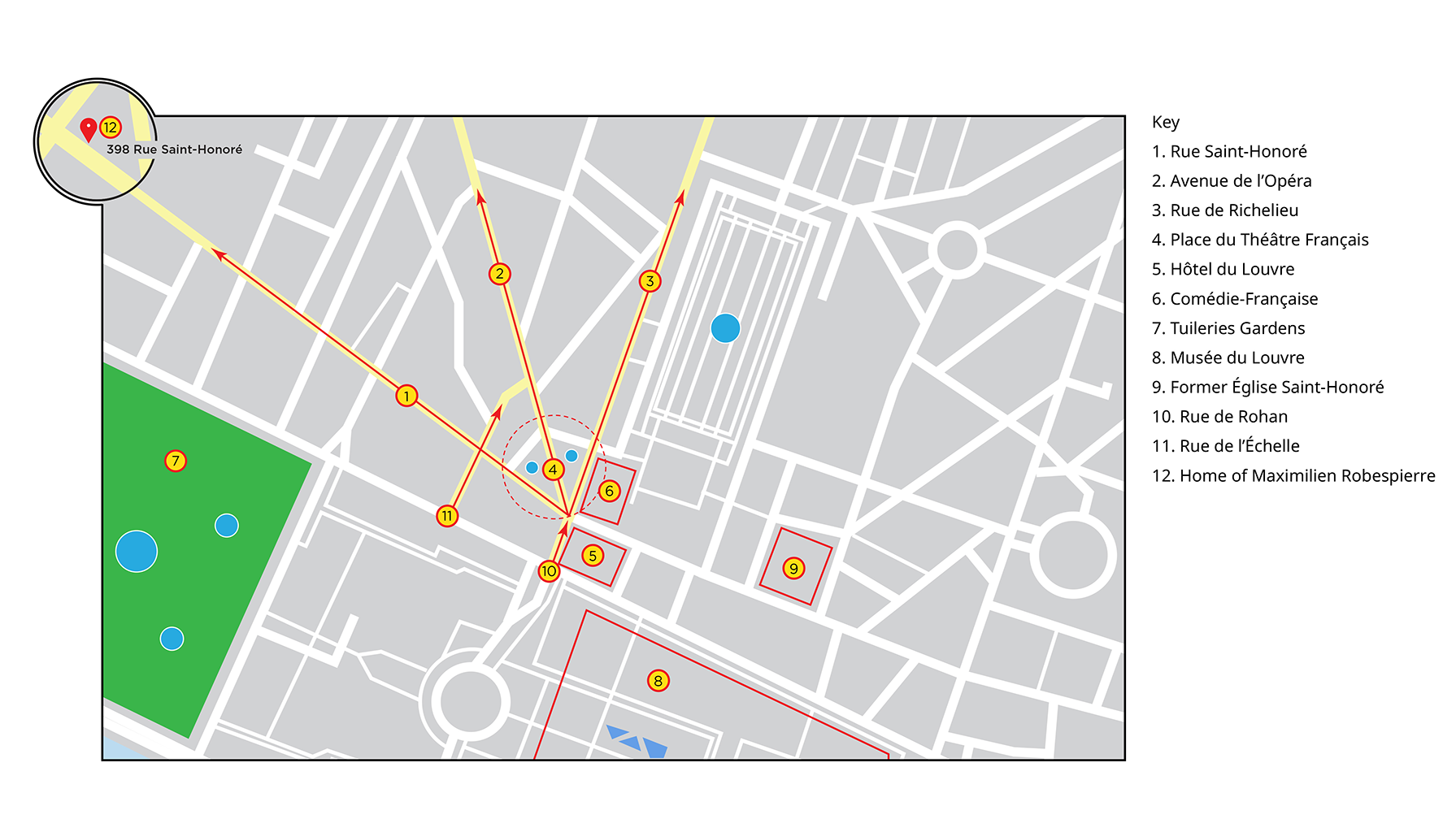
Pissarro settled on the Place du Théâtre Français, in the first arrondissement, for his next metropolitan series (Fig. 1).5Pissarro’s previous Parisian campaigns had centered on the Gare Saint-Lazare in the eighth arrondissement (1893 and 1897) and Montmartre in the eighteenth arrondissement (1897). Known today as the Place André Malraux, this site was originally named for the state-owned theater company that performed in the adjacent Salle Richelieu of the Comédie-Française. It is situated in one of the oldest sections of Paris, just north of the Tuileries Gardens and Louvre Museum, and marks the confluence of three streets: the Rue de Richelieu, Avenue de l’Opéra, and Rue Saint-Honoré, the last of which is the focus of the Nelson-Atkins picture. In existence since the Middle Ages, the Rue Saint-Honoré has a storied history. Its earliest denizens were Catholic canons affiliated with the now-defunct Église Saint-Honoré, a collegiate church.6This thirteenth-century church was nationalized in 1789 and largely demolished in 1792; the surviving remnants were destroyed in 1854. See Robert Hénard, La Rue Saint-Honoré de la Révolution à nos jours (Paris: Émile-Paul, 1909), 463. Today, the Ministère de la Culture building occupies the church’s former site. During the Reign of Terror: A period of the French Revolution that lasted from March 1793 until July 1794. The Revolutionary government, known as the Convention, executed the king, and then set about attacking and executing opponents and anyone else considered a threat to the regime. The Reign of Terror is associated with the Jacobin consolidation of power in the National Convention under their leader Maximilien Robespierre. It ended with his downfall and execution on 9-10 Thermidor (July 27) in the summer of 1794, although spurts of violence and executions continued throughout the Revolution., Jacobin leader Maximilien Robespierre lived with friends on the Rue Saint-Honoré until his death by guillotine in 1794, and Marie Antoinette was conveyed to the scaffold via this street.7Hénard, La Rue Saint-Honoré, 141–42, 147–49. Numerous barricades were erected along the Rue Saint-Honoré during the subsequent revolutions of 1830 and 1848, including at its intersection with the Rue de Rohan, which we glimpse in the left foreground of the Nelson-Atkins painting.8Hénard, La Rue Saint-Honoré, 415. The corner café with the red-and-white striped awning in the Nelson-Atkins work marks this intersection. For a period illustration of one such barricade, see Richard, 28 Juillet 1830. Première barricade, Rue Saint Honoré, lithograph, 8 1/8 x 11 13/16 in. (20.6 x 30 cm), Bibliothèque nationale de France, Paris, https://gallica.bnf.fr/ark:/12148/btv1b540007880. When Prussians laid siege to Paris in 1870, parts of the Comédie-Française were transformed into a hospital ward.9Hénard, La Rue Saint-Honoré, 503. The Comédie-Française is not visible in the Nelson-Atkins picture but appears in several other works from the same series, such as Camille Pissarro, Place du Théâtre Français, 1898, oil on canvas, 29 x 36 in. (73.7 x 91.4 cm), Minneapolis Institute of Art, 18.19. Thus, the Rue Saint-Honoré bore witness to some of the most momentous events of the eighteenth and nineteenth centuries. Yet, what attracted Pissarro to this locale was not its extraordinary history but rather its modernity.
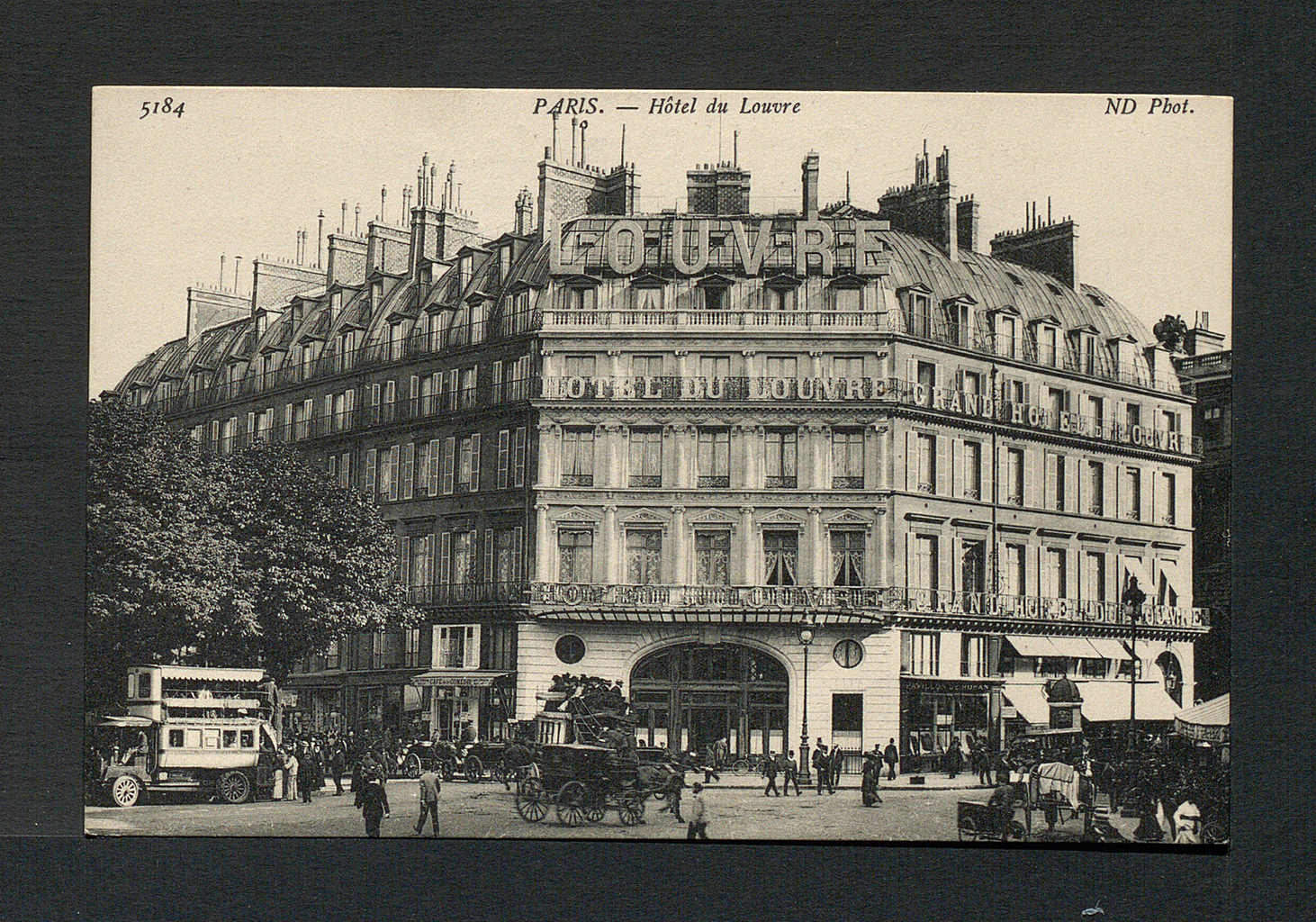
To achieve the vantage point seen in the Nelson-Atkins picture, Pissarro rented a fourth-floor suite at the Hôtel du Louvre, directly across from the Place du Théâtre Français. Founded in 1855, the hotel boasted two hundred richly furnished guestrooms and conveniences like elevators and electric lighting.10The hotel switched from gas to electric lighting prior to 1894. See Henri Maréchal, L’Éclairage à Paris: Étude technique des divers modes d’éclairage employés à Paris (Paris: Librairie polytechnique Baudry et Cie, 1894), 366–67. Pissarro’s accommodations, which consisted of a bedroom, sitting room, and private bathroom, are visible in an early twentieth-century postcard of the establishment (Fig. 2). On the topmost level, three of the five casement windows opening onto the stone Juliet balcony: A shallow balcony fitted to the outside of a building in front of full-length windows or French doors.—the ones beneath the first half of the larger Louvre sign—were part of the artist’s suite.11This sign has since been removed from the building. Only the smaller Hôtel du Louvre sign remains today. The standard cost of these lodgings, according to the travel guide Paris en huit jours (Paris in Eight Days; 1901), was 25 francs per night; however, Pissarro benefited from a reduced nightly rate of 18 francs for long-term visitors.12Paris en huit jours: Guide offert par le Grand Hôtel Terminus de la Gare Saint-Lazare (Paris: P. Mouillot, [1901]), 36. For Pissarro’s rate, see Camille Pissarro to Lucien Pissarro, January 8, 1898, in Bailly-Herzberg, Correspondance de Camille Pissarro, 4:427, no. 1494. This expenditure was a source of anxiety for Pissarro, who was often strapped for cash, but the “superb view” delighted him.13See Camille Pissarro to Lucien Pissarro, December 15 and 21, 1897, in Bailly-Herzberg, Correspondance de Camille Pissarro, 4:417–20, nos. 1489–90. In the latter, Pissarro states: “Je vais avoir des frais considérables, mais Durand a l’air de m’y encourager” (“My costs will be substantial, but Durand seems like he will help me”).
Thanks to the artist’s regular correspondence with his children, a general timeline of his Place du Théâtre Français series can be reconstructed. After spending the Christmas holiday in Éragny, Pissarro returned to Paris on January 5, 1898, and commenced work on two standard-format supports: Commercially prepared supports available through art suppliers, which gained popularity in the nineteenth century during the industrialization of art materials. Available in three formats figure (portrait), paysage (landscape), and marine (marine), these were numbered 1 through 120 to indicate their size. For each numbered size, marine and paysage had two options available: a larger format (haute) and smaller (basse) format. canvases the following day.14Camille Pissarro to Lucien Pissarro, January 6, 1898, in Bailly-Herzberg, Correspondance de Camille Pissarro, 4:425–26, no. 1493. He made steady progress over the next several weeks, reporting on February 22 that he had finished six pictures and begun four others—despite frequent visits from family members and colleagues and the charged political atmosphere surrounding French author Émile Zola’s trial for libel.15Camille Pissarro to Lucien Pissarro, February 22, 1898, in Bailly-Herzberg, Correspondance de Camille Pissarro, 4:453–54, no. 1518. Pissarro’s visitors during those first six weeks included his wife, Julie (January 10–13 and February 6–9), his son Georges (third week of February), and the painter Hippolyte Petitjean (1854–1929) (January 24). He followed Zola’s trial (February 7–23) closely and often discussed the Dreyfus affair in his correspondence. In March, eye complications and bouts of bad weather hampered Pissarro, but by April 11 he had completed all fifteen paintings in the series, three of which took the Rue Saint-Honoré as their primary subject.16See Camille Pissarro to Julie Pissarro, March 5, 1898; Camille Pissarro to Lucien Pissarro, March 7, 1898; and Camille Pissarro to Lucien Pissarro, April 11, 1898, in Bailly-Herzberg, Correspondance de Camille Pissarro, 4:456–59, 469–70, nos. 1521, 1523, 1534. Pissarro had initially intended to offload the entire group onto Durand-Ruel but ultimately reserved three cityscapes for himself. The Nelson-Atkins picture was among the dozen that he shipped to the dealer on April 26 and officially sold to him on May 2, just in time for his June retrospective.17See Camille Pissarro to Paul Durand-Ruel, April 25, 1898; and Camille Pissarro to Lucien Pissarro, April 26, 1898, in Bailly-Herzberg, Correspondance de Camille Pissarro, 4:475–77, nos. 1539–1540. Pissarro’s retrospective was on view from June 1 to 18, 1898, at the Galeries Durand-Ruel.
Although the precise order in which Pissarro executed his Place du Théâtre Français series remains speculative, a start date of early March 1898 for the Kansas City painting is supported by both meteorological observations in the artist’s extant letters and solar-mapping tools developed by Shadowmap Technologies GmbH, as discussed below. On March 7, 1898, Pissarro wrote contentedly to his son: “My work is visibly progressing, this pleases me a great deal, the lighting is so splendid, it’s a feast for the eyes!”18Camille Pissarro to Lucien Pissarro, March 7, 1898, in Bailly-Herzberg, Correspondance de Camille Pissarro, 4:457, no. 1523. “Mon travail avance à vue d’œil, cela m’amuse énormément, les lumières sont si splendides, c’est une fête des yeux!” Emphasis added. His delight with the weather was short-lived, however, because two weeks later, on March 21, Pissarro mentioned to Durand-Ruel that the sun had emerged for the first time in days. Taking advantage of its return, he worked late into the afternoon on his “effect of the setting sun” picture, which Janine Bailly-Herzberg has identified as either the Nelson-Atkins scene or a privately owned painting of the Avenue de l’Opéra.19Camille Pissarro to Paul Durand-Ruel, March 21, 1898, in Bailly-Herzberg, Correspondance de Camille Pissarro, 4:461, no. 1526. Pissarro stated: “Je comptais passer rue Lafitte, mais je suis retenu par mon ‘effet de soleil couchant’ assez tard” (“I had intended to stop by the rue Lafitte, but my ‘effect of the setting sun’ kept me [at the hotel] quite late”). On March 26, winter reared its head again, and Paris was blanketed with snow. Pissarro informed his wife: “I was able to finish my two snow effects. I only have three sun effects that drag on.”20Camille Pissarro to Julie Pissarro, March 26, 1898, in Bailly-Herzberg, Correspondance de Camille Pissarro, 4:463, no. 1528. “J’ai pu finir mes deux effets de neige. Je n’ai plus que trois effets de soleil qui traînent en longueur.” The artist was still fretting about the lack of sunshine and his incomplete works on April 1, suggesting that he began Paris, Rue Saint-Honoré in early March 1898 and added the finishing touches in early April.21Camille Pissarro to Lucien Pissarro, April 1, 1898, in Bailly-Herzberg, Correspondance de Camille Pissarro, 4:467, no. 1531.
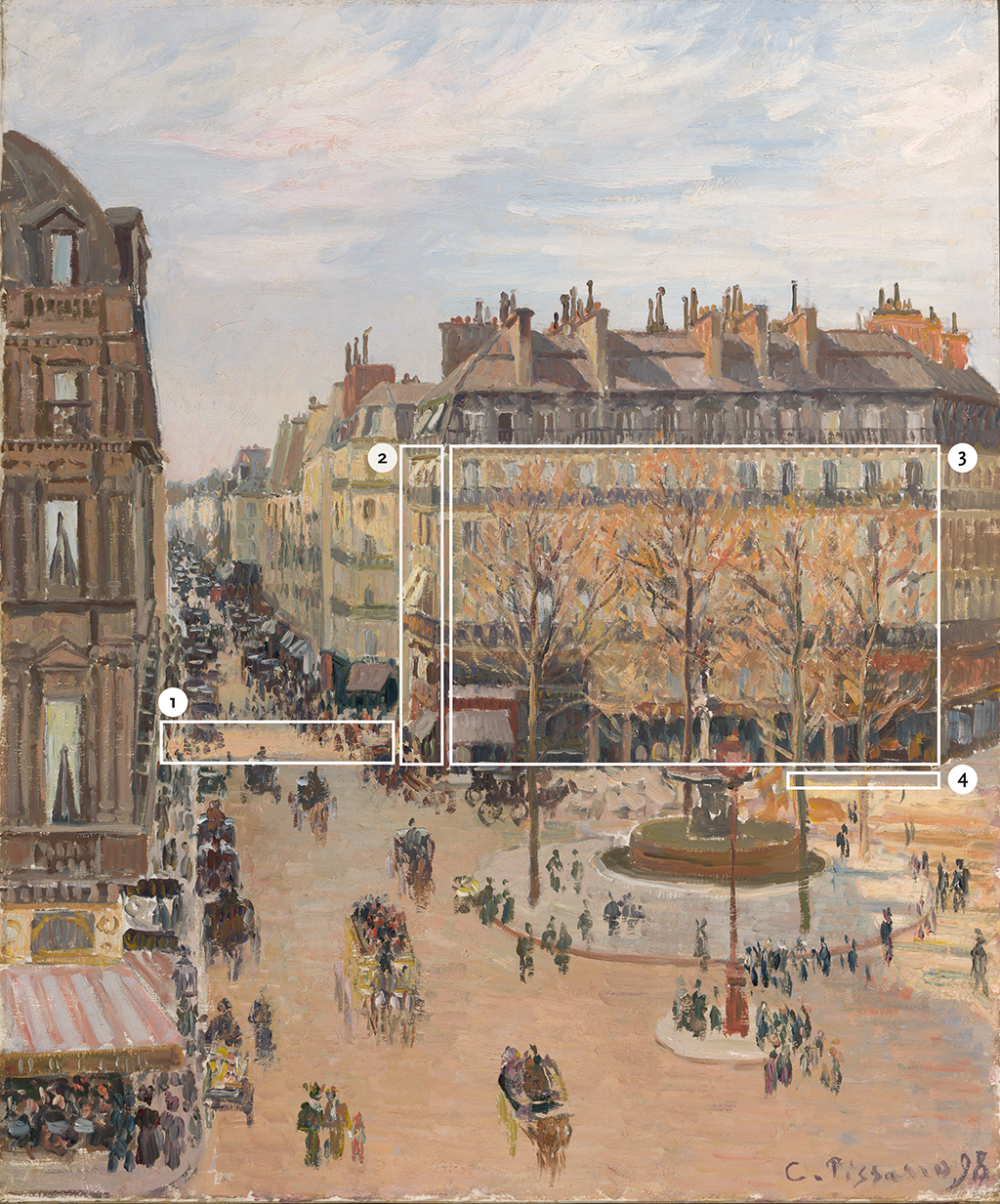
Corroborating this epistolary evidence is Shadowmap, a sophisticated digital platform that visualizes solar shadows on interactive 3-D maps of the world and allows users to track the sun’s position anywhere on earth, at any point in time.22Shadowmap combines data from OpenStreetMap (OSM) and SunCalc to create maps with realistic buildings and solar shadows. Buildings are plotted as blocks, meaning the application does not account for sloped roofs when projecting shadows. See https://shadowmap.org for further details. I thank Simon Mulser, cofounder of Shadowmap, for his kind assistance with this project. In the Nelson-Atkins work, shadows engulf the foreground and three-quarters of the pedestrian island, while sunlight illuminates the Rue de l’Échelle (the nearest cross-street) and most of the central building’s southern façade. A sliver of ground shadow is also present along this edifice’s eastern side, which faces the viewer (Fig. 3). This distribution of light and shade strongly suggests mid-afternoon in early March 1898, as demonstrated by a time-lapse video of the Rue Saint-Honoré created using the Shadowmap application (Fig. 4).23According to descendants of Pissarro’s dealer, the Nelson-Atkins picture is listed as Paris, rue Saint-Honoré, effet de soleil, matin (Paris, Rue Saint-Honoré, Sun Effect, Morning) in Durand-Ruel’s stockbooks. See Paul-Louis Durand-Ruel and Flavie Durand-Ruel to Nicole Myers, NAMA, January 11, 2016, NAMA curatorial files. It seems that Durand-Ruel confused the Kansas City picture with another painting of the Rue Saint-Honoré in the collection of Ordrupgaard in Charlottenlund, Denmark, which depicts a morning scene. For the purposes of this simulation, Monday, March 7, 1898—the day noted for its “splendid” lighting by Pissarro—was selected as the artist’s approximate start date, although he may have begun the Nelson-Atkins painting slightly earlier or later in the month.24Scientists at the Montsouris Observatory in Paris recorded a sunrise of 6:32 a.m. and a sunset of 5:51 p.m. on March 7, 1898. Annuaire de l’Observatoire municipal de Montsouris pour l’année 1898 (Paris: Gauthier-Villars et fils, 1898), 7. Paris operates on Central European Time (CET) today, but in 1898 the city still privileged the Paris meridian over the Greenwich meridian, which meant that their time zone was 9 minutes and 21 seconds behind Greenwich Mean Time (GMT). See Vanessa Ogle, The Global Transformation of Time, 1870–1950 (Cambridge, MA: Harvard University Press, 2015), 38–41. The Shadowmap video accounts for this historical zone and reflects local time in Paris. Around 3 p.m. that day, the solar shadows at the Place du Théâtre Français would have corresponded closely to those seen in the Kansas City picture, confirming the timeframe of inception indicated by Pissarro’s letters.
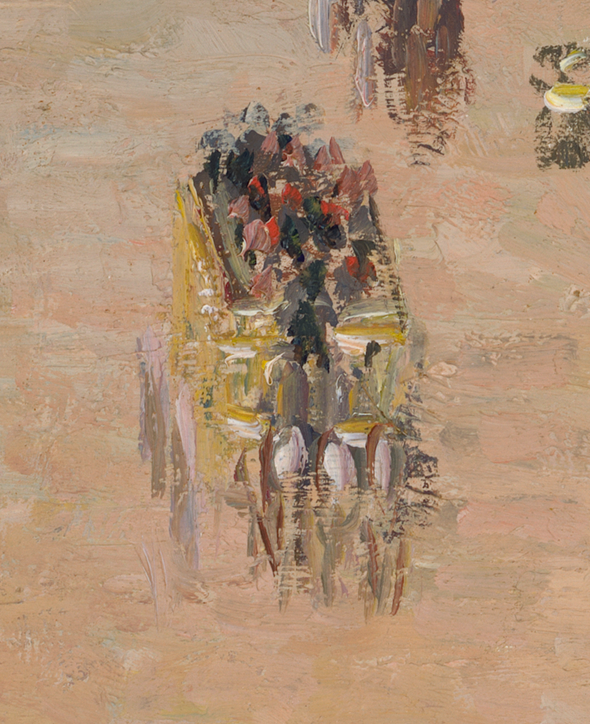
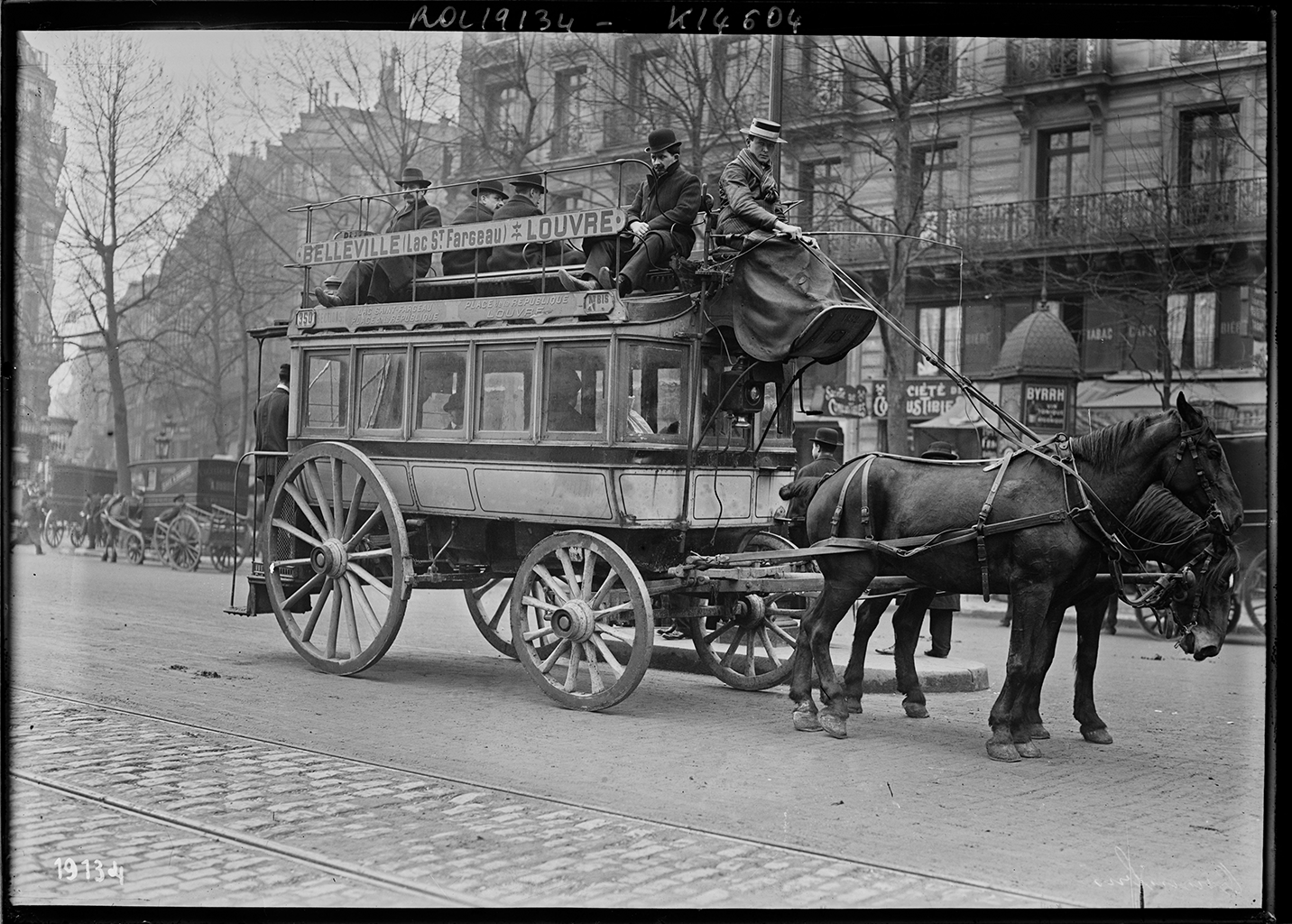
Critics responded enthusiastically to Pissarro’s views of the Place du Théâtre Français at his June 1898 retrospective. They praised his deft handling of atmospheric light and delighted in the sheer modernity of his subject. Most of the buildings, vehicles, landscape elements, and monuments in his paintings were just a few decades old. For example, the îlot (block of houses) between the Rue de Rohan and the Rue de l’Échelle, seen at left in the Nelson-Atkins picture, dates to 1854. Designed by architect Gabriel Jean Antoine Davioud (1823–81), a colleague of Haussmann, Baron: Georges-Eugène Haussmann (1809–91), known as Baron Haussmann, was a civil servant who spearheaded a massive urban renewal scheme in Paris during his tenure as Prefect of the Seine (1853–70). His efforts to modernize the city were dubbed “Haussmannization.”, it is emblematic of Second Empire: The regime of Napoléon III in France, which lasted from 1852 to 1870. styles, with its mansard roof: A roof with two slopes on all sides, where the lower slope is steeper than the upper one. and iron grillwork.25For Davioud’s original sketch of the îlot, see Gabriel Jean Antoine Davioud, “Rue Saint-Honoré 255–257,” in “Expropriations de 1852–1854 pour le prolongement de la rue de Rivoli [Recueil de dessins],” vol. 2, fol. 38, Bibliothèque Historique de la Ville de Paris, CP 3369. Similarly, the yellow, horse-drawn omnibus in the center-left foreground of the Kansas City painting was a fixture of nineteenth-century Paris (Fig. 5). French inventor Stanislas Baudry had launched the city’s first omnibus service in 1828, but the impériale (open top deck with half-price seating) seen here was introduced only in 1853.26Masha Belenky, Engine of Modernity: The Omnibus and Urban Culture in Nineteenth-Century Paris (Manchester: Manchester University Press, 2019), 15–18. A deck seat cost fifteen centimes, whereas an enclosed seat cost thirty centimes. Originally reserved for male passengers, the impériale became gender-integrated in the late 1880s following changes in women’s fashions and societal norms. In Paris, Rue Saint-Honoré, touches of black and gray paint mingle with dots of red and pink pigment on the vehicle’s upper deck, suggesting that male and female travelers are indeed seated together. Horse-drawn omnibuses remained in service until 1913, a decade after Pissarro’s death (Fig. 6).27Belenky, Engine of Modernity, 20–22. In the photograph reproduced here, a customer at the rear of the vehicle climbs the spiral staircase to the impériale, which is already occupied by four men in bowler hats. Pissarro’s inclusion of this mode of transportation in Paris, Rue Saint-Honoré highlights its role in transforming Paris into a modern metropolis.28By 1878, the demand for public transport was such that La Compagnie générale des omnibus added a forty-passenger vehicle to its fleet. Nevertheless, overcrowding remained a problem, which Pissarro experienced firsthand. As he related in one letter: “Je voulais aller aujourd’hui dimanche à la recherche de motifs à Passy et Trocadéro, mais il y a un tel monde aux omnibus à cause du beau soleil que j’y renonce” (“Today (Sunday) I wanted to go search for motifs in Passy and Trocadéro, but the omnibuses were so crowded due to the beautiful sunshine that I abandoned this idea”). See Camille Pissarro to Georges Pissarro, November 14, 1897, in Bailly-Herzberg, Correspondance de Camille Pissarro, 4:403, no. 1468.
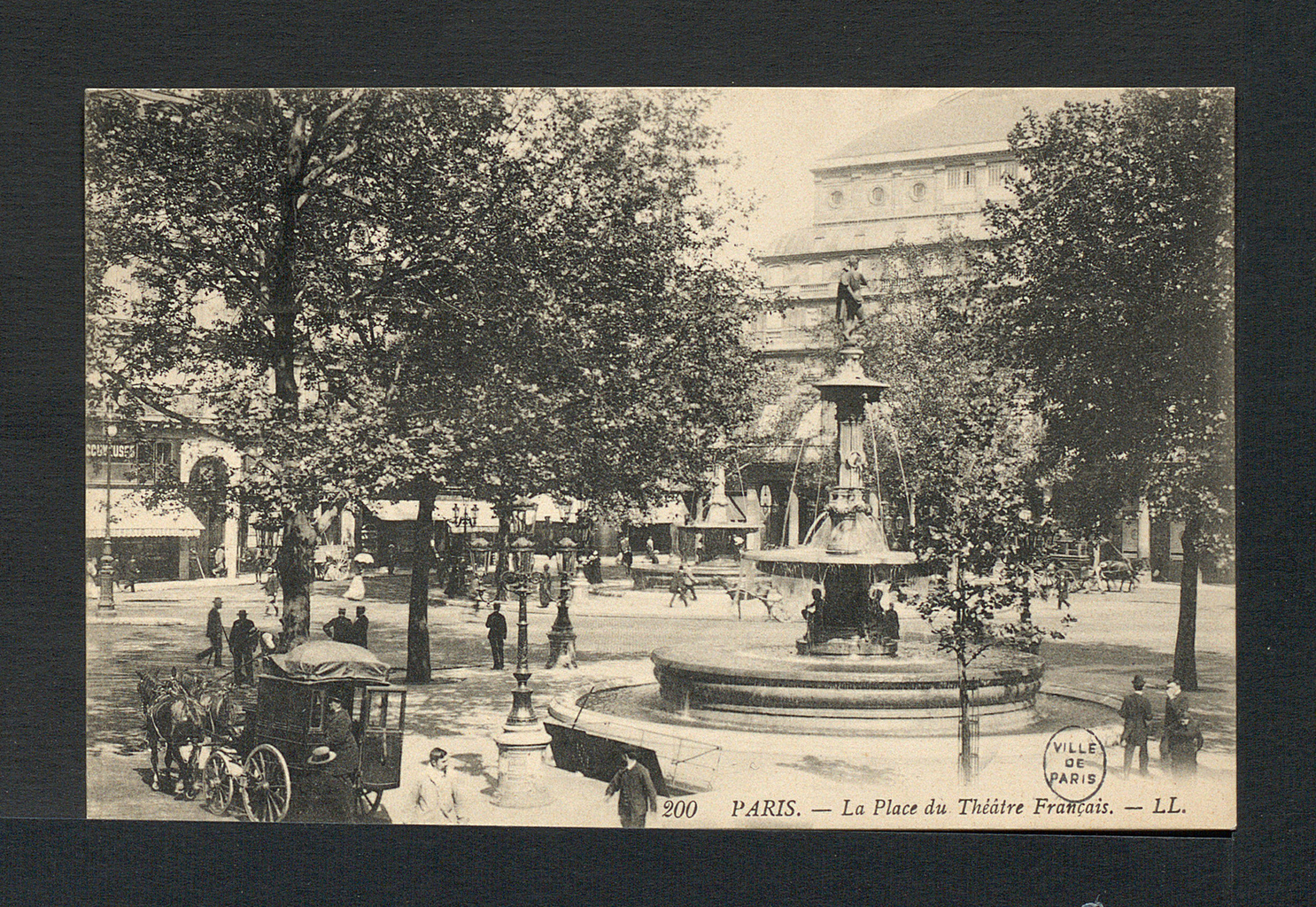
The pedestrian island in the Nelson-Atkins picture was an even more recent development. Engineer and landscape architect Jean Charles Adolphe Alphand (1817–91), head of the new Service des Promenades et Plantations (parks department) under Napoléon III, superintended the design, construction, and maintenance of Paris’s increasing number of parks, squares, and tree-lined streets, including the Place du Théâtre Français.29For Alphand’s life and career, see Gideon Fink Shapiro, “The Promenades of Paris: Alphand and the Urbanization of Garden Art, 1852–1871” (PhD diss., University of Pennsylvania, 2015). Alphand expounded his approach to urban landscape design in Jean Charles Adolphe Alphand, Les Promenades de Paris: Bois de Boulogne, Bois de Vincennes, parcs, squares, boulevards (Paris: J. Rothschild, 1867–1873). Alphand’s collaborators included fellow landscape architect Jean Pierre Barillet (1824–75), who sourced the trees seen in the Nelson-Atkins work from municipal nurseries near the Bois de Vincennes and Bois de Boulogne; and Davioud, who designed the fountain that those trees encircle.30The trees were carefully pruned so that their leaves did not obstruct the streetlamps. Alphand’s guidelines specified that all foliage be 3.5 meters or higher above the ground. Alphand further required that all tree roots be covered by iron grilles, though Pissarro opted to omit these grates from the Nelson-Atkins picture. See Shapiro, “The Promenades of Paris,” 60–61, 213–15. The fountain is one of a pair: its sister monument flanks the east side of the Avenue de l’Opéra and appears in other paintings by Pissarro.31See Joachim Pissarro and Claire Durand-Ruel Snollaerts, Pissarro: Catalogue critique des peintures / Critical Catalogue of Paintings, trans. Mark Hutchinson and Michael Taylor (Paris: Wildenstein Institute, 2005), nos. 1195, 1197–98, 1201–08, pp. 3:749–55. Davioud submitted a proposal for both fountains in 1867, but the Franco-Prussian War: The war of 1870–71 between France (under Napoleon III) and Prussia, in which Prussian troops advanced into France and decisively defeated the French at Sedan. The defeat marked the end of the French Second Empire. For Prussia, the proclamation of the new German Empire at Versailles was the climax of Bismarck’s ambitions to unite Germany. put the project on hold, so they were not realized until 1874.32Gabriel Davioud, architecte (1824–1881), exh. cat. (Alençon, France: Firmin-Didot, 1981), 49. Each one comprises a stone base, marble piedouche: Small pedestal that serves as a support for a bust, vase, or statue., and bronze effigy. A sea nymph statue by Albert-Ernest Carrier-Belleuse (1824–87) crowns the fountain seen in the Nelson-Atkins painting, while a river nymph sculpture by Mathurin Moreau (1822–1912) caps its twin.33For Carrier-Belleuse’s involvement in the sculptural program, see June Ellen Hargrove, “The Life and Work of Albert-Ernest Carrier-Belleuse” (PhD diss., Institute of Fine Arts, New York University, 1976), 165–66. These details are somewhat obscured in Paris, Rue Saint-Honoré by the surrounding foliage and lamppost, but they are discernible in a period postcard of the square (Fig. 7).34The lamppost is also Davioud’s handiwork: he designed this candélabre ordinaire (single, branchless streetlamp) and several other models. See Alphand, Les Promenades de Paris, unnumbered and unpaginated plate titled “Voie publique candélabres.” Here, as in the Kansas City picture, the pedestrian islands facilitate a range of social encounters: people pause to enjoy the shade, chat with other passersby, and hail fiacre: A small four-wheeled carriage for public hire named after the Hôtel de St. Fiacre in Paris, where such vehicles were first hired out.. Haussmann’s Paris offered many opportunities to casually meet old acquaintances and make new ones, and this aspect of modernity assumes prominence in Pissarro’s Place du Théâtre Français campaign.
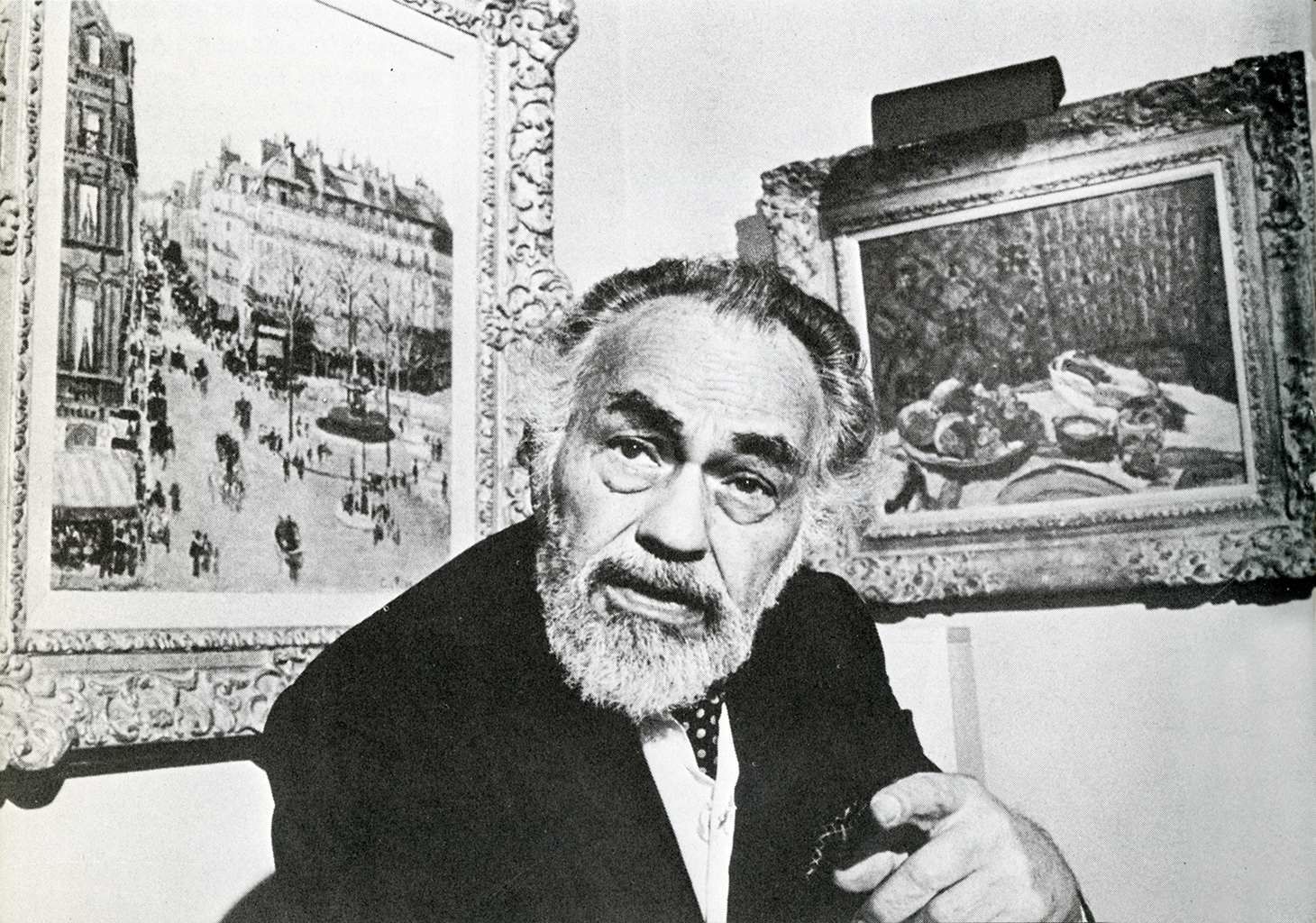
Interestingly, despite Pissarro’s modern subject matter and favorable press, Durand-Ruel failed to find a buyer for the Nelson-Atkins painting for almost two decades, and the purchaser, Josef Stransky (1872–1936), returned it two months later.35Stransky, a conductor for the New York Philharmonic, purchased Paris, Rue Saint-Honoré from Durand-Ruel on February 20, 1917, and returned it on April 20, 1917. However, Paris, Rue Saint-Honoré would eventually land in the very distinguished collection of actor Edward G. Robinson (né Emanuel Goldenberg, 1893–1973). Born in Romania, Robinson immigrated to the United States as a child and performed on Broadway for several years before pivoting to cinema in the 1920s.36Robinson’s first silent film was The Bright Shawl (1923), and his first talkie was The Hole in the Wall (1929). Michael Frank, “Edward G. Robinson: Sterling Collection for the Star of Little Caesar and Double Indemnity,” Architectural Digest 47, no. 4 (April 1990): 181. His breakthrough role as the titular gangster in Little Caesar (1931) set him on the path to stardom and provided him with the financial means to begin collecting art. The actor initially gravitated toward American painters such as Ralph Albert Blakelock (1847–1919) and John Henry Twachtman (1853–1902) but soon acquired a taste for French Impressionism and Post-Impressionism. By the 1950s, he owned no fewer than five Pissarros, three of which were Parisian cityscapes.37See The Gladys Lloyd Robinson and Edward G. Robinson Collection, exh. cat. (Los Angeles: Los Angeles County Museum, 1956), nos. 39–43. Robinson regarded these artworks not just as treasured possessions but as “quiet friends” whose company he cherished.38Robinson once remarked of his collection: “Sometimes late at night, when the house is quiet, and the last guest has gone, I go into my living room and sit down among these quiet friends, and we study each other very gravely, and I hope with mutual pleasure.&rduqo; Jane Robinson, Edward G. Robinson’s World of Art (New York: Harper and Row, 1971), 116. When Robinson and his first wife divorced in 1956, he was devastated to lose most of his collection in the settlement; he retained only fourteen prized pictures, including Paris, Rue Saint-Honoré.39Robinson paid his ex-wife one-half the insurance value of those fourteen artworks. See Roland Balaÿ to Edward G. Robinson, January 18, 1957, M. Knoedler and Co. Records, approximately 1848–1971, The Getty Research Institute, Los Angeles, accession no. 2012.M.54, Series VI, Box 985, Folder 5. The actor refused to part with the Nelson-Atkins picture for the rest of his life, and it even made a cameo appearance in a publicity photograph for his final film, Soylent Green (1973) (Fig. 8).40I am grateful to Danielle Hampton Cullen, project assistant, NAMA, for this discovery. In Robinson’s autobiography, penned the year of his death, he pays tribute to Pissarro’s urban scenes, saying: “I think there is no Paris like Pissarro’s Paris.”41Edward G. Robinson and Leonard Spigelgass, All My Yesterdays: An Autobiography (New York: Hawthorn Books, 1973), 15. This assessment would surely have pleased the artist, who, though a countryman at heart, made significant contributions to the genre of cityscapes.
Notes
-
Pissarro had visited Rouen once previously in 1883, but this isolated trip was suggested by his friend Claude Monet (1840–1926) rather than Durand-Ruel. See Claire Durand-Ruel Snollaerts, “Les vues urbaines de Pissarro / Pissarro’s Urban Views,” in Camille Pissarro: Le premier des impressionnistes / The First among the Impressionists, exh. cat. (Paris: Musée Marmottan Monet, 2017), 138, 144.
-
Pissarro’s doctor prescribed silver nitrate eye drops to mitigate his inflammation and pus. See Camille Pissarro to Dr. Parenteau, February 13, 1897, and Camille Pissarro to Lucien Pissarro, November 22, 1897, in Janine Bailly-Herzberg, ed., Correspondance de Camille Pissarro (Paris: Valhermeil, 1989), 4:327, 409–10, letter nos. 1370, 1477.
-
Durand-Ruel Snollaerts, “Les vues urbaines de Pissarro,” 165, 170.
-
See Camille Pissarro to Lucien Pissarro, November 9, 1897, in Bailly-Herzberg, Correspondance de Camille Pissarro, 4:396, no. 1462.
-
Pissarro’s previous Parisian campaigns had centered on the Gare Saint-Lazare in the eighth arrondissement (1893 and 1897) and Montmartre in the eighteenth arrondissement (1897).
-
This thirteenth-century church was nationalized in 1789 and largely demolished in 1792; the surviving remnants were destroyed in 1854. See Robert Hénard, La Rue Saint-Honoré de la Révolution à nos jours (Paris: Émile-Paul, 1909), 463. Today, the Ministère de la Culture building occupies the church’s former site.
-
Hénard, La Rue Saint-Honoré, 141–42, 147–49.
-
Hénard, La Rue Saint-Honoré, 415. The corner café with the red-and-white striped awning in the Nelson-Atkins work marks this intersection. For a period illustration of one such barricade, see Richard, 28 Juillet 1830. Première barricade, Rue Saint Honoré, lithograph, 8 1/8 x 11 13/16 in. (20.6 x 30 cm), Bibliothèque nationale de France, Paris, https://gallica.bnf.fr
/ark: ./12148 /btv1b540007880 -
Hénard, La Rue Saint-Honoré, 503. The Comédie-Française is not visible in the Nelson-Atkins picture but appears in several other works from the same series, such as Camille Pissarro, Place du Théâtre Français, 1898, oil on canvas, 29 x 36 in. (73.7 x 91.4 cm), Minneapolis Institute of Art, 18.19.
-
The hotel switched from gas to electric lighting prior to 1894. See Henri Maréchal, L’Éclairage à Paris: Étude technique des divers modes d’éclairage employés à Paris (Paris: Librairie polytechnique Baudry et Cie, 1894), 366–67.
-
This sign has since been removed from the building. Only the smaller Hôtel du Louvre sign remains today.
-
Paris en huit jours: Guide offert par le Grand Hôtel Terminus de la Gare Saint-Lazare (Paris: P. Mouillot, [1901]), 36. For Pissarro’s rate, see Camille Pissarro to Lucien Pissarro, January 8, 1898, in Bailly-Herzberg, Correspondance de Camille Pissarro, 4:427, no. 1494.
-
See Camille Pissarro to Lucien Pissarro, December 15 and 21, 1897, in Bailly-Herzberg, Correspondance de Camille Pissarro, 4:417–20, nos. 1489–90. In the latter, Pissarro states: “Je vais avoir des frais considérables, mais Durand a l’air de m’y encourager” (“My costs will be substantial, but Durand seems like he will help me”).
-
Camille Pissarro to Lucien Pissarro, January 6, 1898, in Bailly-Herzberg, Correspondance de Camille Pissarro, 4:425–26, no. 1493.
-
Camille Pissarro to Lucien Pissarro, February 22, 1898, in Bailly-Herzberg, Correspondance de Camille Pissarro, 4:453–54, no. 1518. Pissarro’s visitors during those first six weeks included his wife, Julie (January 10–13 and February 6–9), his son Georges (third week of February), and the painter Hippolyte Petitjean (1854–1929) (January 24). He followed Zola’s trial (February 7–23) closely and often discussed the Dreyfus affair in his correspondence.
-
See Camille Pissarro to Julie Pissarro, March 5, 1898; Camille Pissarro to Lucien Pissarro, March 7, 1898; and Camille Pissarro to Lucien Pissarro, April 11, 1898, in Bailly-Herzberg, Correspondance de Camille Pissarro, 4:456–59, 469–70, nos. 1521, 1523, 1534.
-
See Camille Pissarro to Paul Durand-Ruel, April 25, 1898; and Camille Pissarro to Lucien Pissarro, April 26, 1898, in Bailly-Herzberg, Correspondance de Camille Pissarro, 4:475–77, nos. 1539–1540. Pissarro’s retrospective was on view from June 1 to 18, 1898, at the Galeries Durand-Ruel.
-
Camille Pissarro to Lucien Pissarro, March 7, 1898, in Bailly-Herzberg, Correspondance de Camille Pissarro, 4:457, no. 1523. “Mon travail avance à vue d’œil, cela m’amuse énormément, les lumières sont si splendides, c’est une fête des yeux!” Emphasis added.
-
Camille Pissarro to Paul Durand-Ruel, March 21, 1898, in Bailly-Herzberg, Correspondance de Camille Pissarro, 4:461, no. 1526. Pissarro stated: “Je comptais passer rue Lafitte, mais je suis retenu par mon ‘effet de soleil couchant’ assez tard” (“I had intended to stop by the rue Lafitte, but my ‘effect of the setting sun’ kept me [at the hotel] quite late”).
-
Camille Pissarro to Julie Pissarro, March 26, 1898, in Bailly-Herzberg, Correspondance de Camille Pissarro, 4:463, no. 1528. “J’ai pu finir mes deux effets de neige. Je n’ai plus que trois effets de soleil qui traînent en longueur.”
-
Camille Pissarro to Lucien Pissarro, April 1, 1898, in Bailly-Herzberg, Correspondance de Camille Pissarro, 4:467, no. 1531.
-
Shadowmap combines data from OpenStreetMap (OSM) and SunCalc to create maps with realistic buildings and solar shadows. Buildings are plotted as blocks, meaning the application does not account for sloped roofs when projecting shadows. See https://shadowmap.org for further details. I thank Simon Mulser, cofounder of Shadowmap, for his kind assistance with this project.
-
According to descendants of Pissarro’s dealer, the Nelson-Atkins picture is listed as Paris, rue Saint-Honoré, effet de soleil, matin (Paris, Rue Saint-Honoré, Sun Effect, Morning) in Durand-Ruel’s stockbooks. See Paul-Louis Durand-Ruel and Flavie Durand-Ruel to Nicole Myers, NAMA, January 11, 2016, NAMA curatorial files. It seems that Durand-Ruel confused the Kansas City picture with another painting of the Rue Saint-Honoré in the collection of Ordrupgaard in Charlottenlund, Denmark, which depicts a morning scene.
-
Scientists at the Montsouris Observatory in Paris recorded a sunrise of 6:32 a.m. and a sunset of 5:51 p.m. on March 7, 1898. See Annuaire de l’Observatoire municipal de Montsouris pour l’année 1898 (Paris: Gauthier-Villars et fils, 1898), 7. Paris operates on Central European Time (CET) today, but in 1898 the city still privileged the Paris meridian over the Greenwich meridian, which meant that their time zone was 9 minutes and 21 seconds behind Greenwich Mean Time (GMT). See Vanessa Ogle, The Global Transformation of Time, 1870–1950 (Cambridge, MA: Harvard University Press, 2015), 38–41. The Shadowmap video accounts for this historical zone and reflects local time in Paris.
-
For Davioud’s original sketch of the îlot, see Gabriel Jean Antoine Davioud, “Rue Saint-Honoré 255–257,” in “Expropriations de 1852–1854 pour le prolongement de la rue de Rivoli [Recueil de dessins],” vol. 2, fol. 38, Bibliothèque Historique de la Ville de Paris, CP 3369.
-
Masha Belenky, Engine of Modernity: The Omnibus and Urban Culture in Nineteenth-Century Paris (Manchester: Manchester University Press, 2019), 15–18. A deck seat cost fifteen centimes, whereas an enclosed seat cost thirty centimes.
-
Belenky, Engine of Modernity, 20–22.
-
By 1878, the demand for public transport was such that La Compagnie générale des omnibus added a forty-passenger vehicle to its fleet. Nevertheless, overcrowding remained a problem, which Pissarro experienced firsthand. As he related in one letter: “Je voulais aller aujourd’hui dimanche à la recherche de motifs à Passy et Trocadéro, mais il y a un tel monde aux omnibus à cause du beau soleil que j’y renonce.” See Camille Pissarro to Georges Pissarro, November 14, 1897, in Bailly-Herzberg, Correspondance de Camille Pissarro, 4:403, no. 1468.
-
For Alphand’s life and career, see Gideon Fink Shapiro, “The Promenades of Paris: Alphand and the Urbanization of Garden Art, 1852–1871” (PhD diss., University of Pennsylvania, 2015). Alphand expounded his approach to urban landscape design in Jean Charles Adolphe Alphand, Les Promenades de Paris: Bois de Boulogne, Bois de Vincennes, parcs, squares, boulevards (Paris: J. Rothschild, 1867–1873).
-
The trees were carefully pruned so that their leaves did not obstruct the streetlamps. Alphand’s guidelines specified that all foliage be 3.5 meters or higher above the ground. Alphand further required that all tree roots be covered by iron grilles, though Pissarro opted to omit these grates from the Nelson-Atkins picture. See Shapiro, “The Promenades of Paris,” 60–61, 213–15.
-
See Joachim Pissarro and Claire Durand-Ruel Snollaerts, Pissarro: Catalogue critique des peintures / Critical Catalogue of Paintings, trans. Mark Hutchinson and Michael Taylor (Paris: Wildenstein Institute, 2005), nos. 1195, 1197–98, 1201–08, pp. 3:749–55.
-
Gabriel Davioud, architecte (1824–1881), exh. cat. (Alençon, France: Firmin-Didot, 1981), 49.
-
For Carrier-Belleuse’s involvement in the sculptural program, see June Ellen Hargrove, “The Life and Work of Albert-Ernest Carrier-Belleuse” (PhD diss., Institute of Fine Arts, New York University, 1976), 165–66.
-
The lamppost is also Davioud’s handiwork: he designed this candélabre ordinaire (single, branchless streetlamp) and several other models. See Alphand, Les Promenades de Paris, unnumbered and unpaginated plate titled “Voie publique candélabres.”
-
Stransky, a conductor for the New York Philharmonic, purchased Paris, Rue Saint-Honoré from Durand-Ruel on February 20, 1917, and returned it on April 20, 1917.
-
Robinson’s first silent film was The Bright Shawl (1923), and his first talkie was The Hole in the Wall (1929). Michael Frank, “Edward G. Robinson: Sterling Collection for the Star of Little Caesar and Double Indemnity,” Architectural Digest 47, no. 4 (April 1990): 181.
-
See The Gladys Lloyd Robinson and Edward G. Robinson Collection, exh. cat. (Los Angeles: Los Angeles County Museum, 1956), nos. 39–43.
-
Robinson once remarked of his collection: “Sometimes late at night, when the house is quiet, and the last guest has gone, I go into my living room and sit down among these quiet friends, and we study each other very gravely, and I hope with mutual pleasure.” Jane Robinson, Edward G. Robinson’s World of Art (New York: Harper and Row, 1971), 116.
-
Robinson paid his ex-wife one-half the insurance value of those fourteen artworks. See Roland Balaÿ to Edward G. Robinson, January 18, 1957, M. Knoedler and Co. Records, approximately 1848–1971, The Getty Research Institute, Los Angeles, 2012.M.54, Series VI, Box 985, Folder 5.
-
I am grateful to Danielle Hampton Cullen, project assistant, NAMA, for this discovery.
-
Edward G. Robinson and Leonard Spigelgass, All My Yesterdays: An Autobiography (New York: Hawthorn Books, 1973), 15.
Technical Entry
Citation
Chicago:
Becca Goodman, “Camille Pissarro, Paris, Rue Saint-Honoré, Sun Effect, Afternoon, 1898,” technical entry in French Paintings and Pastels, 1600–1945: The Collections of the Nelson-Atkins Museum of Art, ed. Aimee Marcereau DeGalan (Kansas City: The Nelson-Atkins Museum of Art, 2026), https://doi.org/10.37764/78973.5.650.2088.
MLA:
Goodman, Becca. “Camille Pissarro, Paris, Rue Saint-Honoré, Sun Effect, Afternoon, 1898,” technical entry. French Paintings and Pastels, 1600–1945: The Collections of The Nelson-Atkins Museum of Art, edited by Aimee Marcereau DeGalan, Nelson-Atkins Museum of Art, 2026. doi: 10.37764/78973.5.650.2088.
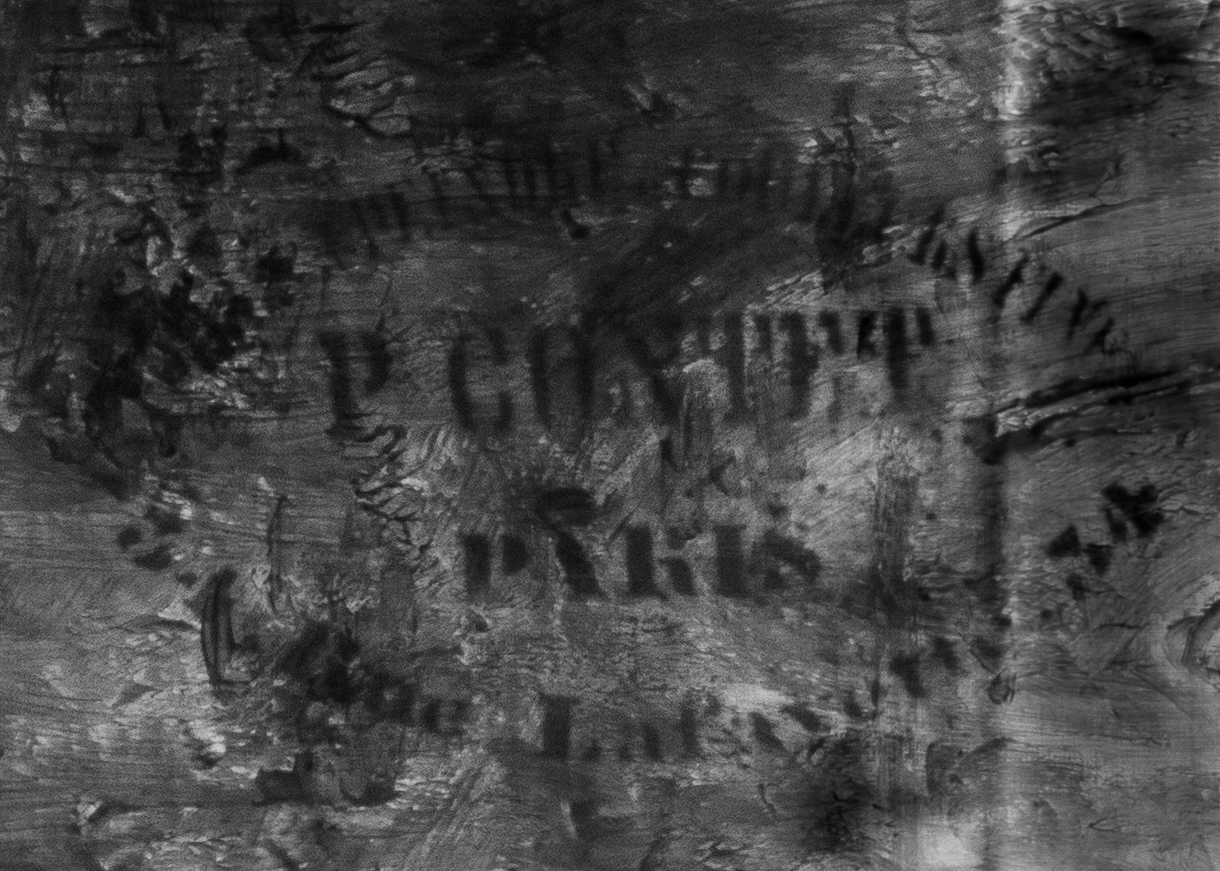
The painting is executed on extremely fine, plain weave: A basic textile weave in which one weft thread alternates over and under the warp threads. Often this structure consists of one thread in each direction, but threads can be doubled (basket weave) or tripled to create more complex plain weave. Plain weave is sometimes called tabby weave. canvas that has been lining: A procedure used to reinforce a weakened canvas that involves adhering a second fabric support using adhesive, most often a glue-paste mixture, wax, or synthetic adhesive. to a slightly coarser fabric. At an unknown date, the original stretcher: A wooden structure to which the painting’s canvas is attached. Unlike strainers, stretchers can be expanded slightly at the joints to improve canvas tension and avoid sagging due to humidity changes or aging. or strainer: A wooden structure to which the painting’s canvas is attached. Unlike stretchers, strainers cannot be expanded. was replaced with a six-membered stretcher that has one vertical and one horizontal crossbar.1In 1983, most of the early labels were removed from the replacement stretcher and attached to the backing board. The labels that were too fragile to remove were left in place. See Forrest Bailey, December 30, 1982 to January 4, 1983, treatment summary, NAMA conservation file, 2015.13.18. While the original secondary support has been lost, the tacking margins: The outer edges of canvas that wrap around and are attached to the stretcher or strainer with tacks or staples. See also tacking edge. remain intact. cusping: A scalloped pattern along the canvas edges that relates to how the canvas was stretched. Primary cusping reveals where tacks secured the canvas to the support while the ground layer was applied. Secondary cusping can form when a pre-primed canvas is re-stretched by the artist prior to painting. associated with the original, empty tack holes indicates the painting has never been cropped (Fig. 9).2Two sets of tacks are currently present: one associated with the lining fabric and the other with the original canvas. The original tacks, represented by their empty holes, were spaced 5.4 to 6.4 cm apart and had heads measuring 0.6 cm in diameter. Empty staple holes relate to edge stripping that was added in the 1980s and removed at a later date. See Bailey, 1982–83, treatment summary, NAMA conservation file, 2015.13.18. The overall dimensions correspond to a no. 15 figure standard-format supports: Commercially prepared supports available through art suppliers, which gained popularity in the nineteenth century during the industrialization of art materials. Available in three formats figure (portrait), paysage (landscape), and marine (marine), these were numbered 1 through 120 to indicate their size. For each numbered size, marine and paysage had two options available: a larger format (haute) and smaller (basse) format. canvas (65 x 54 cm),3See the list of canvas sizes offered by the Bourgeois Ainé company in 1888, reproduced in Iris Schaefer, Caroline von Saint-George, and Katja Lewerentz, Painting Light: The Hidden Techniques of the Impressionists (Milan: Skira, 2008), 50. and a stenciled supplier mark: A mark (ink stamp, brand, impression, etc.), often present on the reverse of canvas, panel, or other support, signifying the company that sold or prepared the support. As these companies sometimes performed framing and restorations, these marks could also reflect these services. See also canvas stamp. on the reverse identifies the supplier as P. Contet.4The stamp reads, “TOILES à PEINDRE à COULEURS FINE / P. CONTET / PARIS / 34, Rue Lafayette, 34.” Although obscured by the lining, the stamp was revealed using transmitted infrared (IR) photography: An examination technique whereby the light source is placed on one side of the artwork while an electronic infrared imager or IR-modified digital camera placed on the opposite side captures the IR that is transmitted. This form of IR photography can be used to detect characteristics of the artist’s paint application, underlying compositions, artist changes, or inscriptions now covered by a lining canvas. (Fig. 10). The presence of the stamp, along with the fact that the ground layer: An opaque preparatory layer applied to the support, either commercially or by the artist, to prevent absorption of the paint into the canvas or panel. See also priming layer. extends over the tacking margins and under the original tack heads, suggests the canvas was commercially primed prior to stretching.
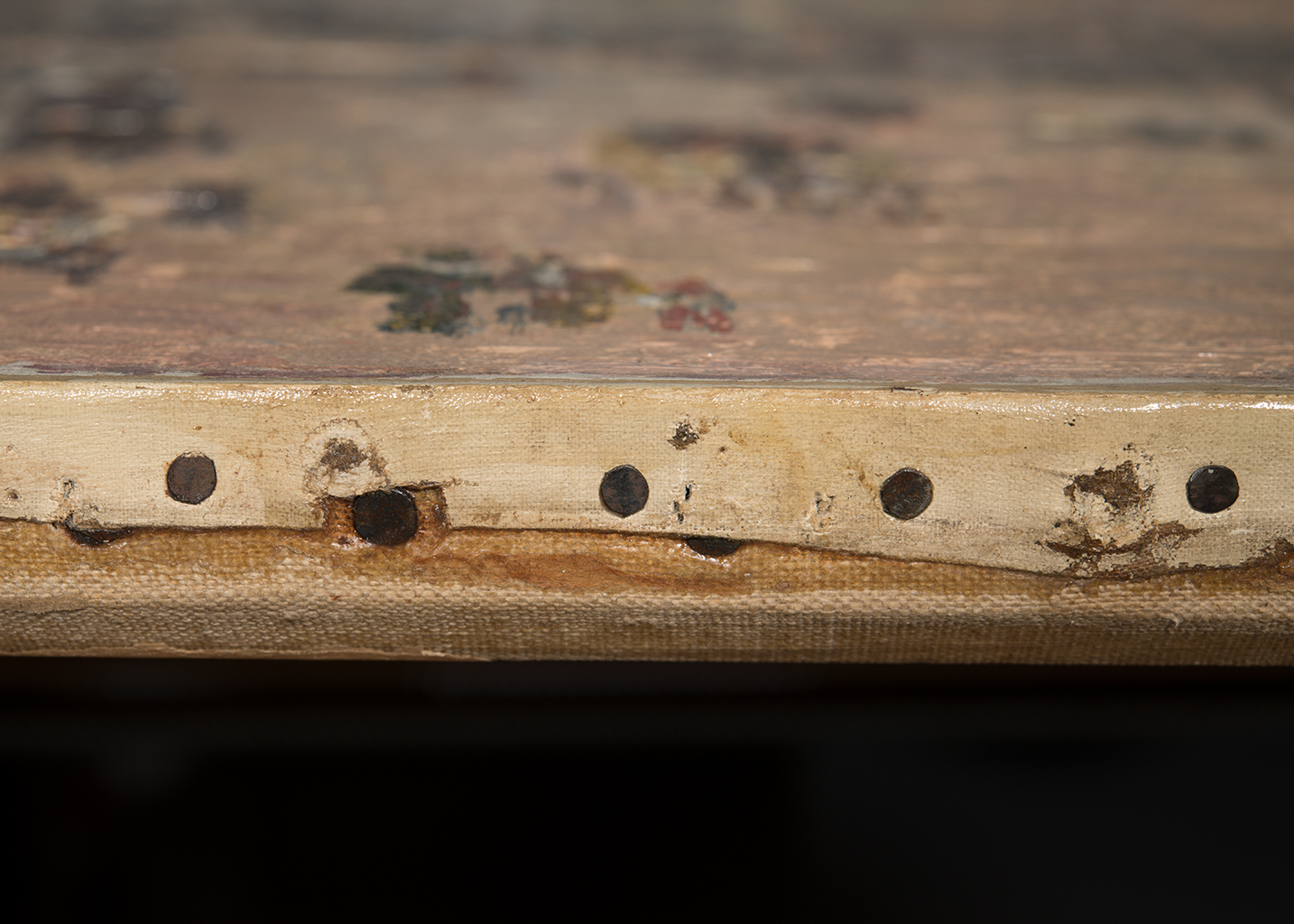
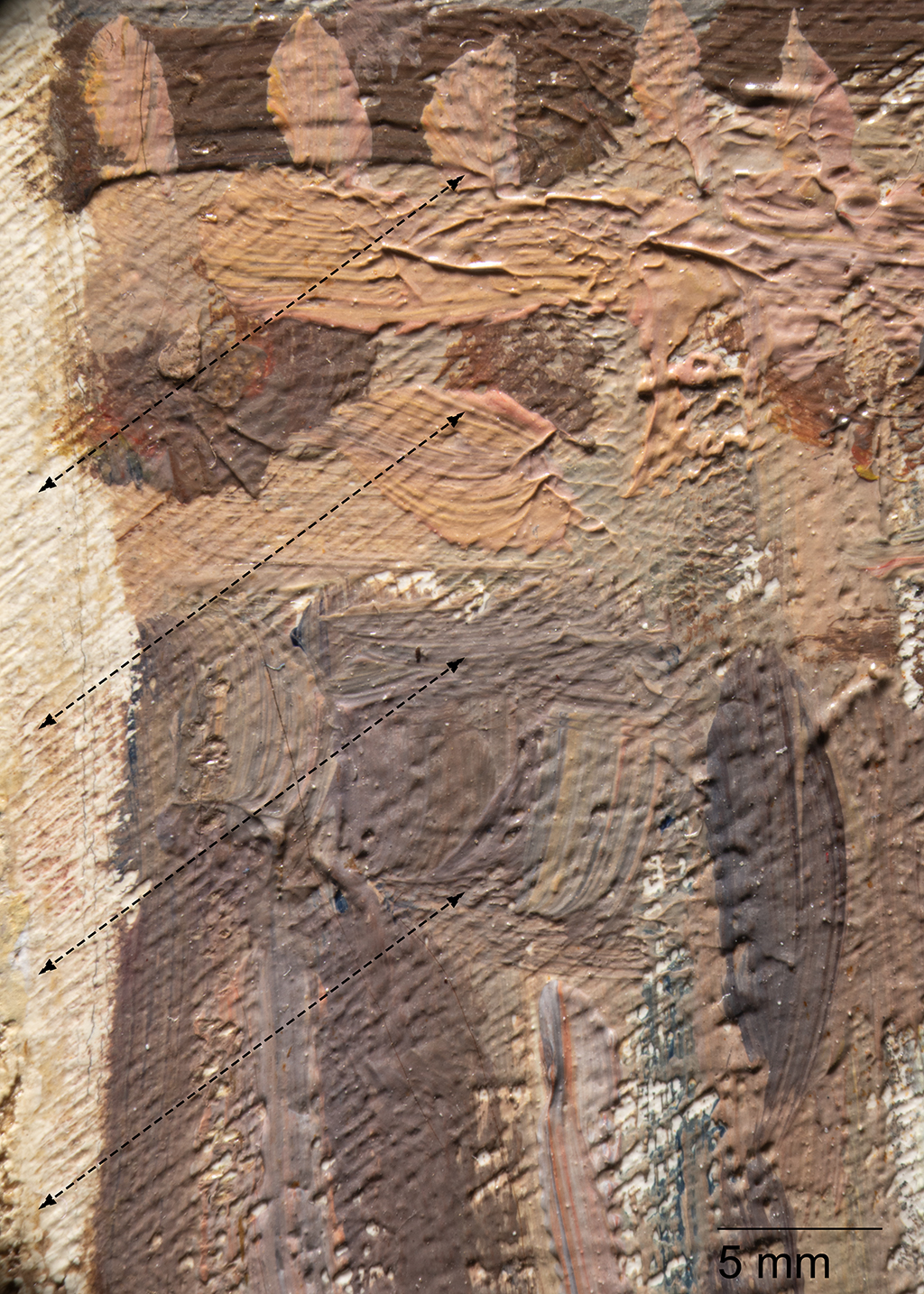
The bright white ground was brush-applied, and streaky
brushstrokes are visible through the paint layers
(Fig. 11). The stamp’s precise placement at the lower
center (oriented upside-down relative to the painting
at recto) suggests that Contet stretched the primed
canvas and stenciled it afterward.5Pissarro’s use of a similar brush-applied ground
that was likely prepared by Contet is noted in
Kelly Keegan, “Cat. 12,
Haymaking at Éragny, 1892: Technical
Report,” in
Pissarro Paintings and Works on Paper at the
Art Institute of Chicago (Chicago: Art Institute of Chicago, 2015), para
23, figs. 12.20–12.22,
https://publications.artic.edu
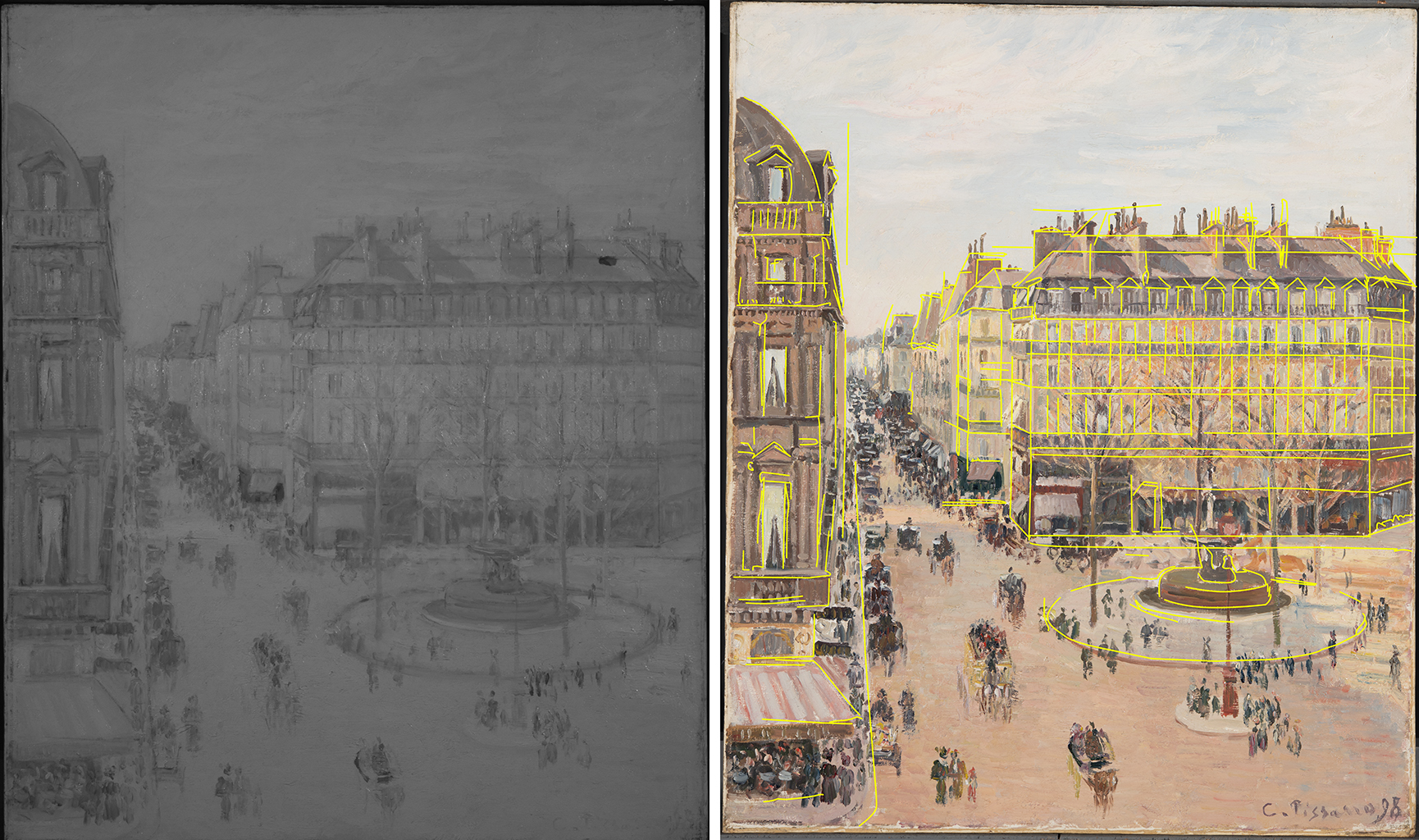
The artist executed an unusually extensive underdrawing: A drawn or painted sketch beneath the paint layer. The underdrawing can be made from dry materials, such as graphite or charcoal, or wet materials, such as ink or paint., likely necessitated by the complexity and rigidity of the urban architecture.7Regarding a similar series of urban views on the Boulevard Montmarte, Pissarro wrote, “I have a stunning motif that will require every conceivable effort to interpret. On my left, I have another motif, but it’s terribly difficult, almost a bird’s-eye view of carriages, omnibuses, people between big trees, big houses that have to be set straight, it’s hard!” Joachim Pissarro and Claire Durand-Ruel Snollaerts, Pissarro: Catalogue critique des peintures / Critical Catalogue of Paintings, trans. Mark Hutchinson and Michael Taylor (Paris: Wildenstein Institute, 2005), 3:728. Using a dry, black medium (Fig. 12), Pissarro mapped the perspective of the street, spacing between windows, and contours of the buildings and fountain (Fig. 13). The long gridlines in the building at right were likely achieved with a straight edge or another drafting tool. He adhered closely to his sketch when painting, only deviating from the plan by introducing elements that were not included in the underdrawing at all.
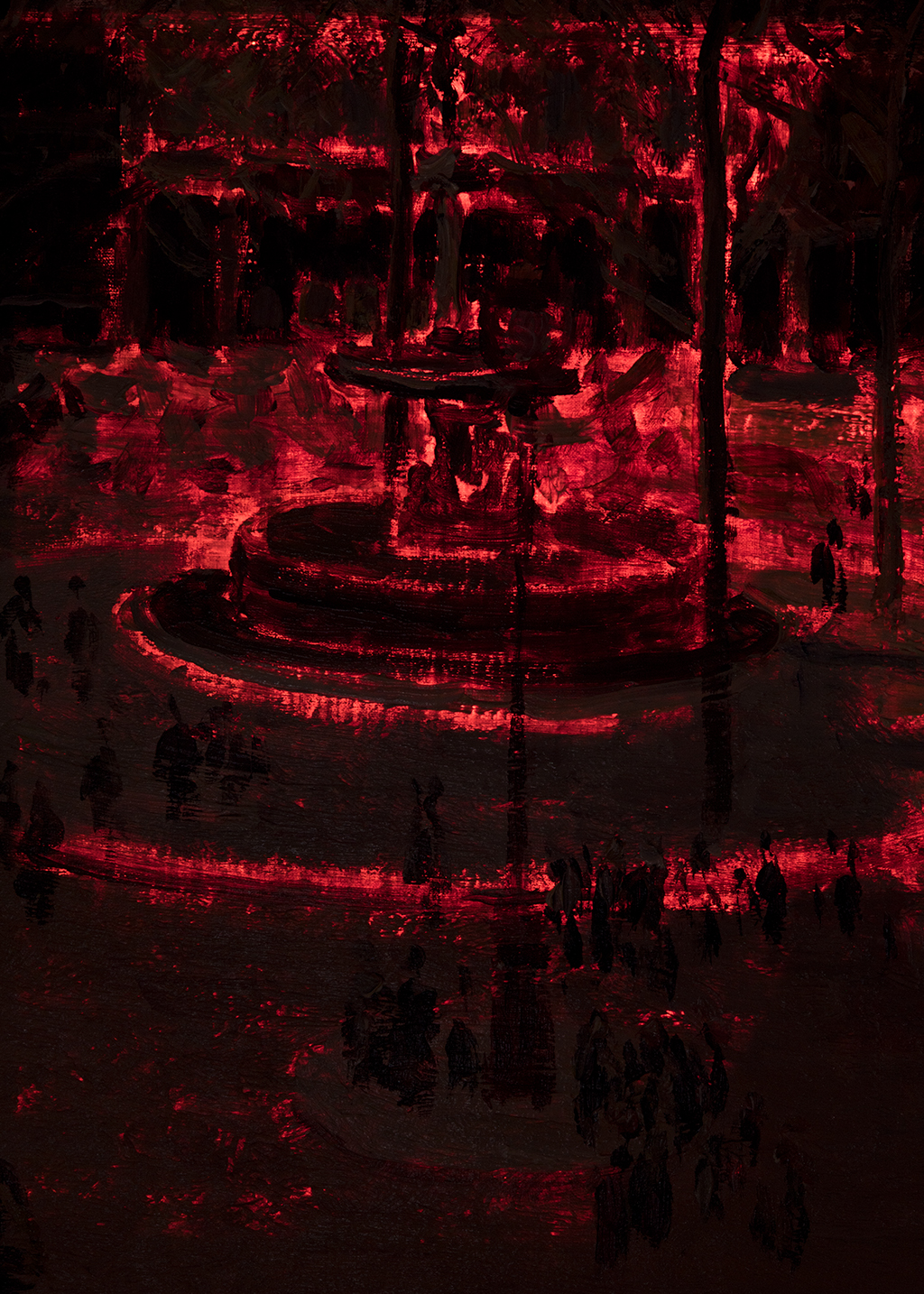
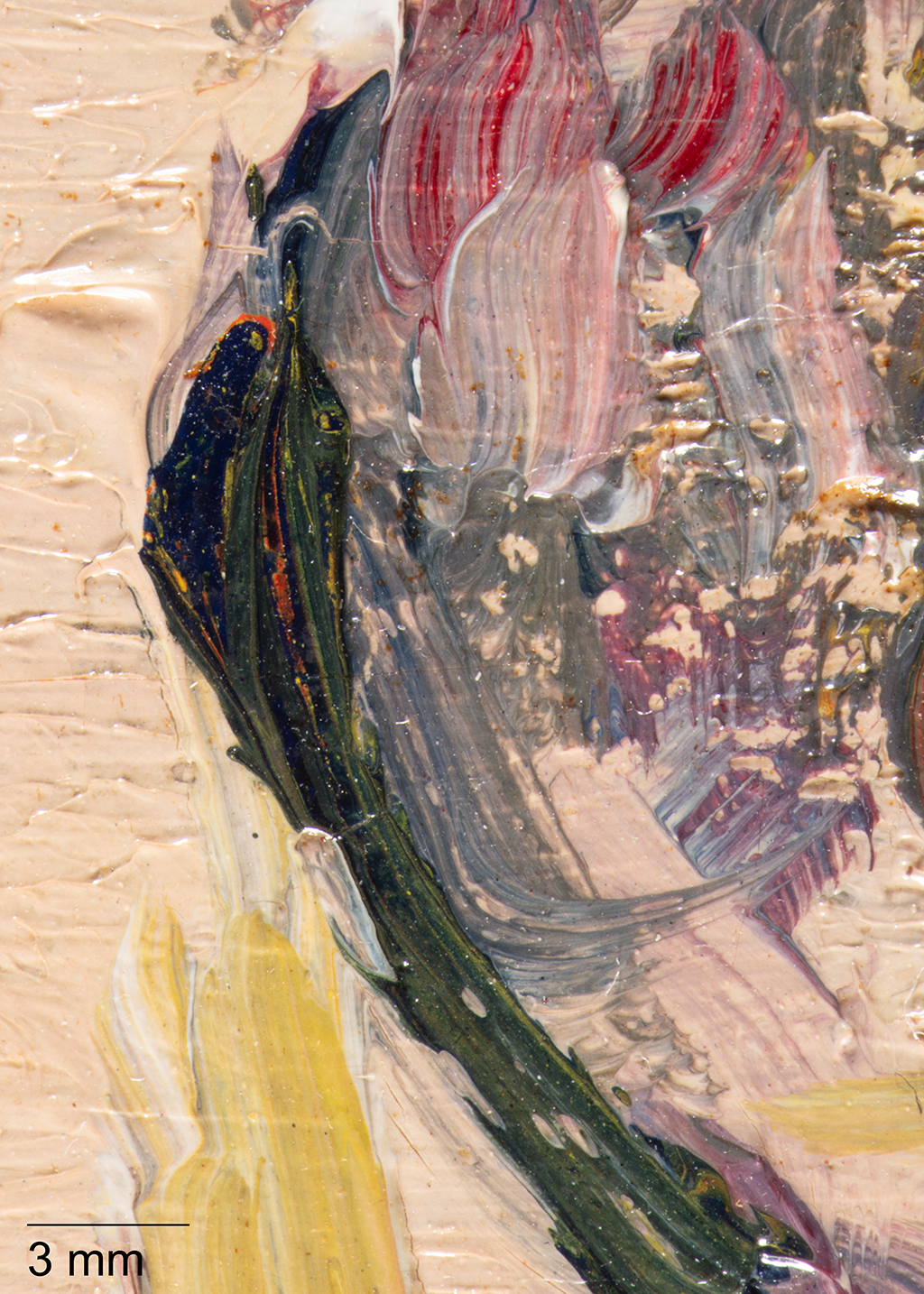
As was his typical practice, Pissarro blocked in the major forms, leaving reserve: An area of the composition left unpainted with the intention of inserting a feature at a later stage in the painting process. of exposed ground between them (Fig. 14).8See Becca Goodman “Camille Pissarro, Chestnut Grove at Louveciennes, 1872,” technical entry in this catalogue, 2025; Gutierrez and Burnstock, “Technical Examination of Works,” 20; and Alex Chipkin and Laura Mosteller, “Woman Washing Her Feet in a Brook, 1894: Technical Examination,” Paintings by the Pissarro Family, https://pissarro.discovernewfields.org/technical-reports/48.17/. Then, he rapidly and confidently built up the layers with saturated, jewel-like hues (Fig. 15). Regarding the series as a whole, he wrote, “I am having great fun, the light is so splendid—it’s a feast for the eyes,”9Camille to Lucien Pissarro, March 7, 1898, cited and translated in Richard R. Brettell and Joachim Pissarro, The Impressionist and the City: Pissarro’s Series Paintings, exh. cat. (New Haven, CT: Yale University Press, 1992), 82. and his joyfulness shows. Broad, gestural strokes of vibrant colors swirl together wet-into-wet: An oil painting technique which involves blending of colors on the picture surface., but the result is controlled, legible, and masterful. Once the paint had started to dry, he introduced additional paint layers, thin paint strokes, and drybrushing to refine the color and texture within the crowds and sunlit facades (Fig. 16).
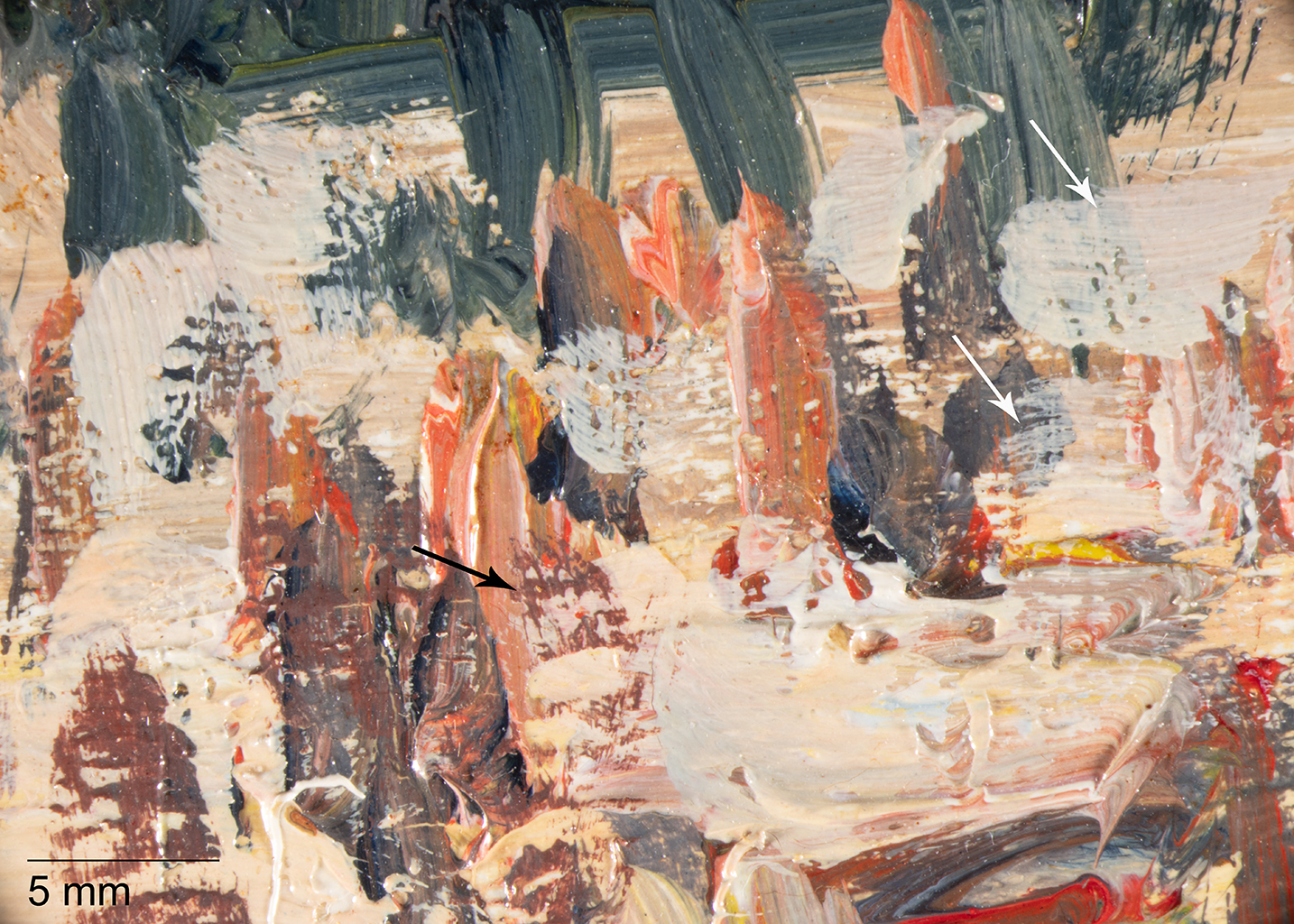
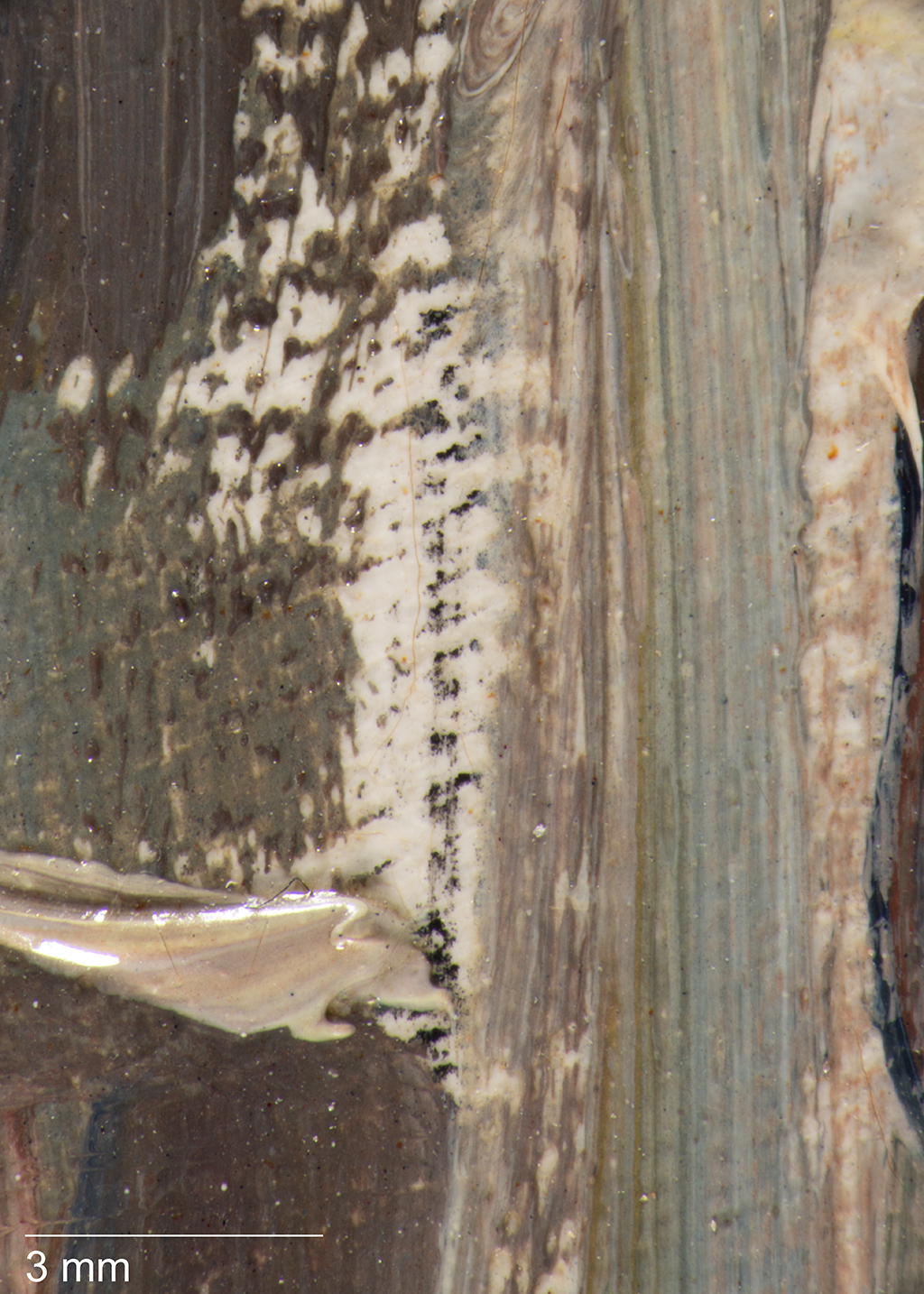
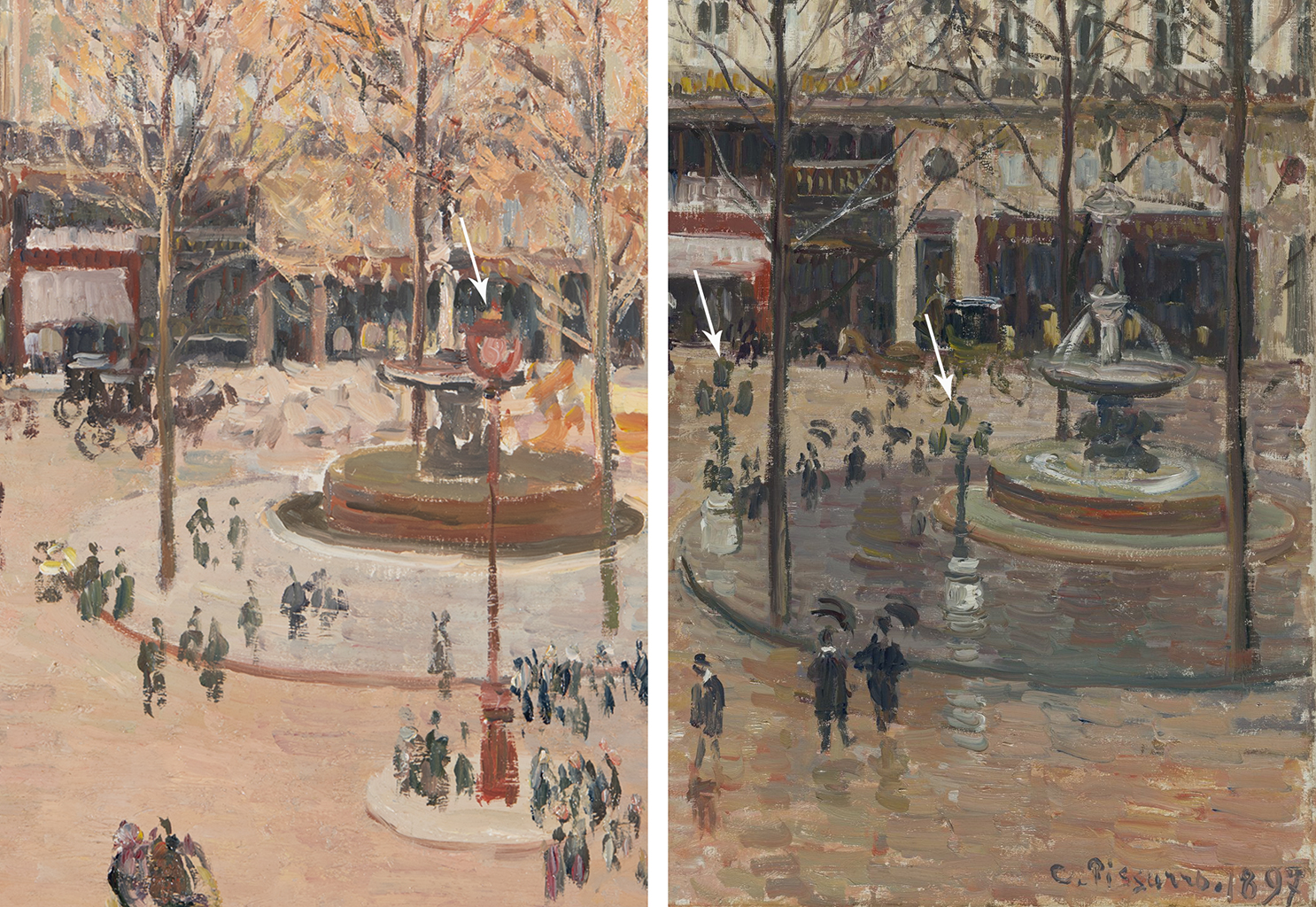
In a subsequent session, he reworked parts of the sky and street, possibly to adjust the atmospheric effects and shadows (Fig. 17). He seems to have added the pedestrian refuge island at this stage, as it was neither underdrawn nor left in reserve (see Figs. 13 and 14). The island (and the lamppost on it) does not appear in the closely related paintings, Rue Saint-Honoré, Morning, Effect of Sunlight (1898; Ordrupgaard, Charlottenlund) and Rue Saint-Honoré, Afternoon, Effect of Rain (1897; Museo Thyssen-Bornemisza, Madrid), but it is visible in broader views of the place du Théâtre-Français and at the far left of Figure 7.10See, for example, Avenue de l’Opéra: Morning Sunshine (1898; Philadelphia Museum of Art) and Avenue de l’Opera, Effect of Snow (1898; Pushkin Museum of Fine Arts, Moscow). The island was integrated into the composition by repainting a large section of the street wet-into-wet over earlier, dried paint (Fig. 18). Although he exerted such effort to include the large lamppost, Pissarro omitted the smaller candelabra lamps around the fountain, which appear in the Madrid painting (Fig. 19) and postcard in Figure 7.11If the candelabra lampposts were painted and then later omitted, they must have been fully scraped off, as there is no evidence of them under magnification or with any imaging technique.
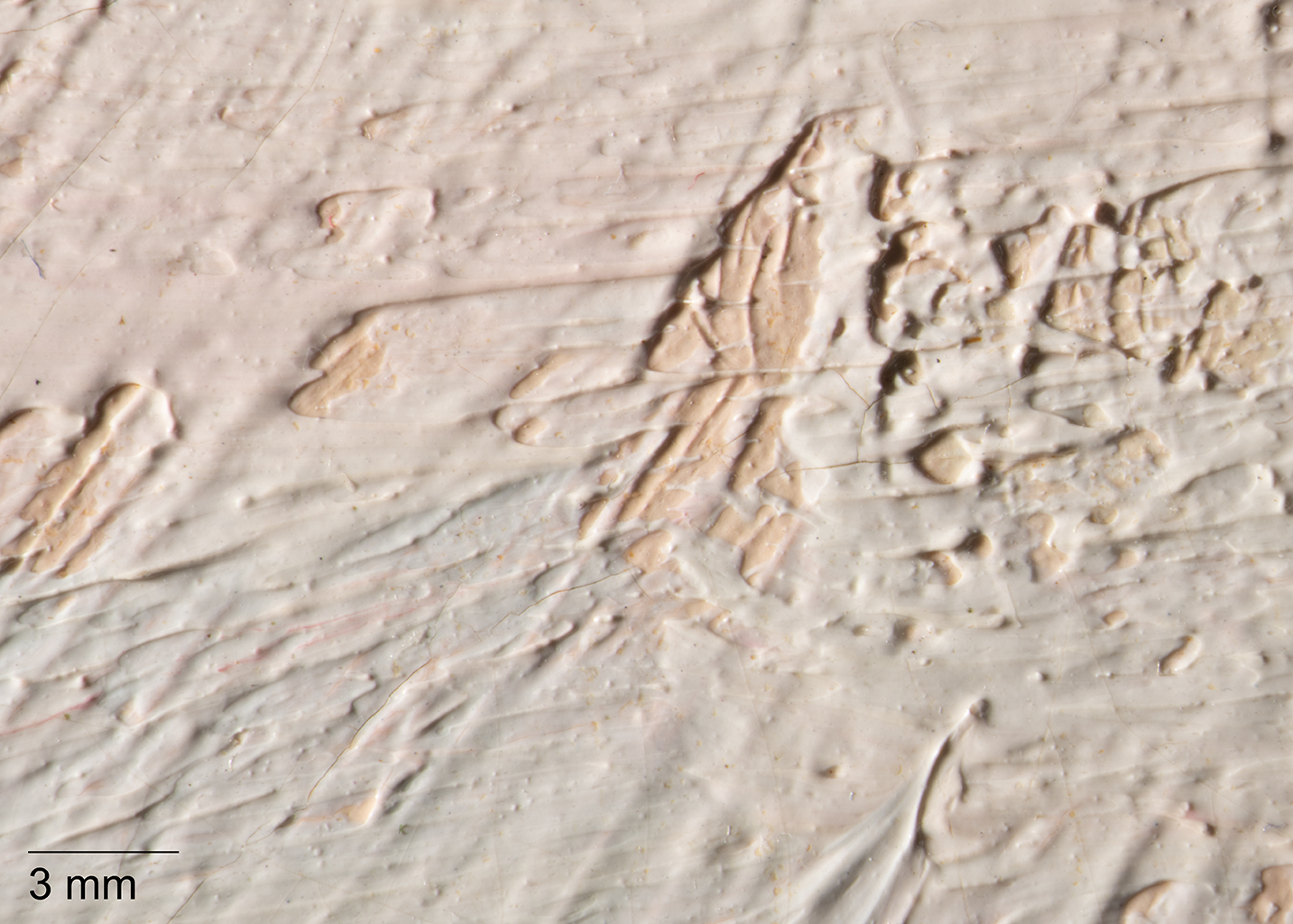
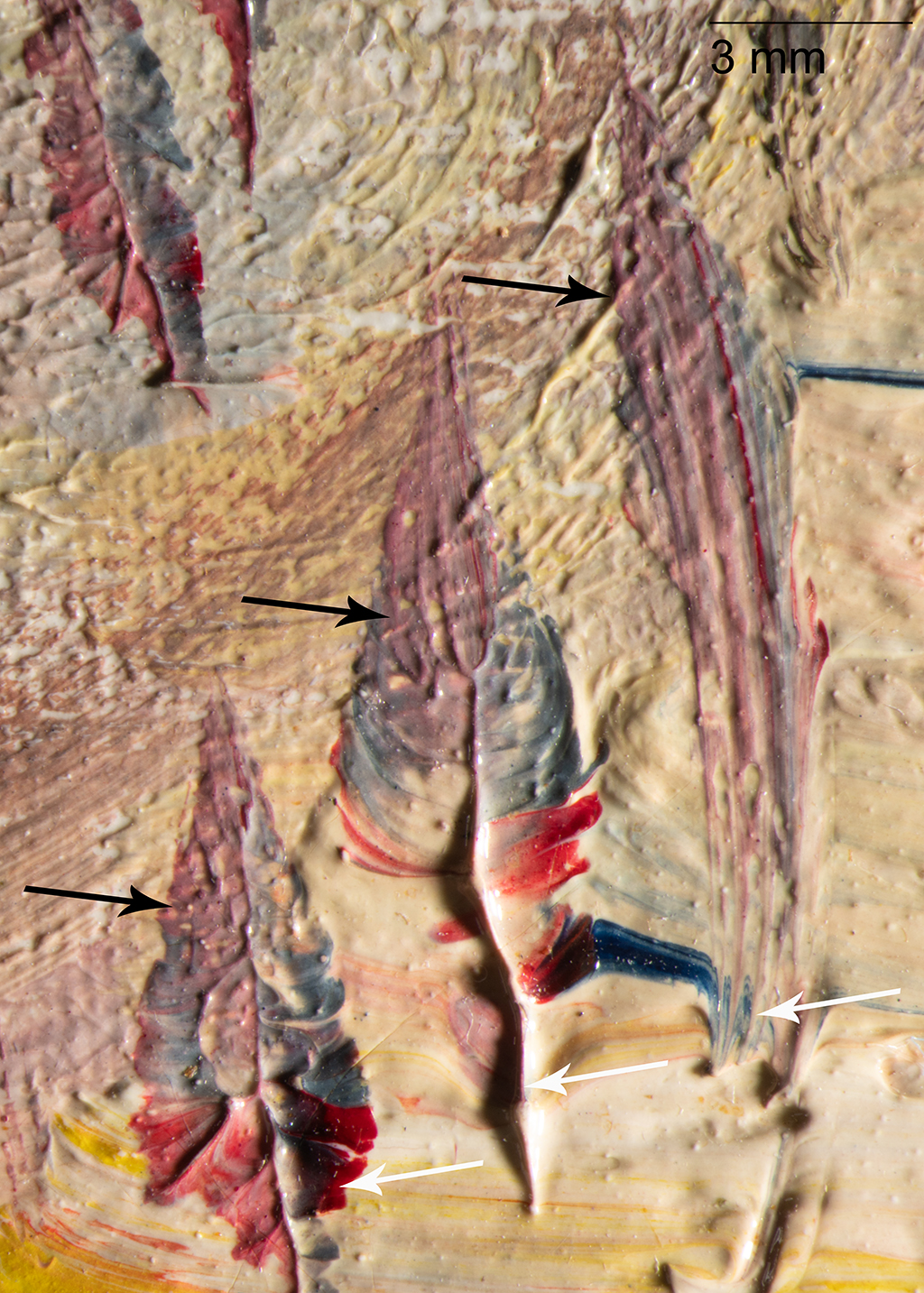
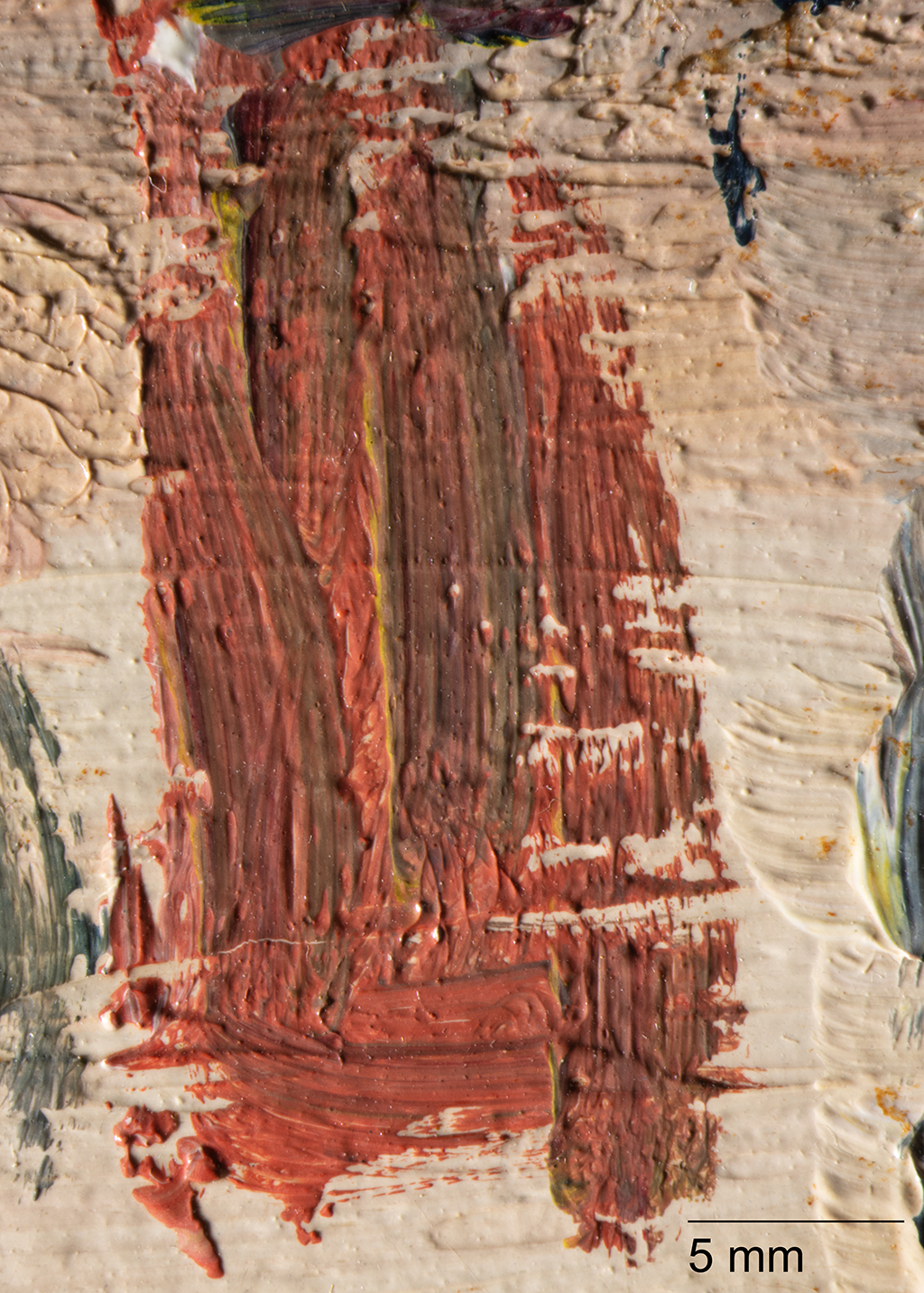
After the reworkings dried, Pissarro painted the lamppost on the island and over the fountain (Fig. 20). The vehicles, groups of people in the foreground, and trees were also painted wet-over-dry: An oil painting technique that involves layering paint over an already dried layer, resulting in no intermixing of paint or disruption to the lower paint strokes., but they were not afterthoughts. Unlike the lamppost, these elements were never omitted and appear in all fifteen paintings in the series. The bustling carts and people were integral to the animated spirit of his cityscapes, and he likely painted them last to capture the spontaneity and immediacy of the scene. Minor later adjustments include the removal of the last row of passengers in the omnibus, now visible as a pentimento (pl: pentimenti): A change to the composition made by the artist that is visible on the paint surface. Often with time, pentimenti become more visible as the upper layers of paint become more transparent with age. Italian for "repentance" or "a change of mind." (see Fig. 5).
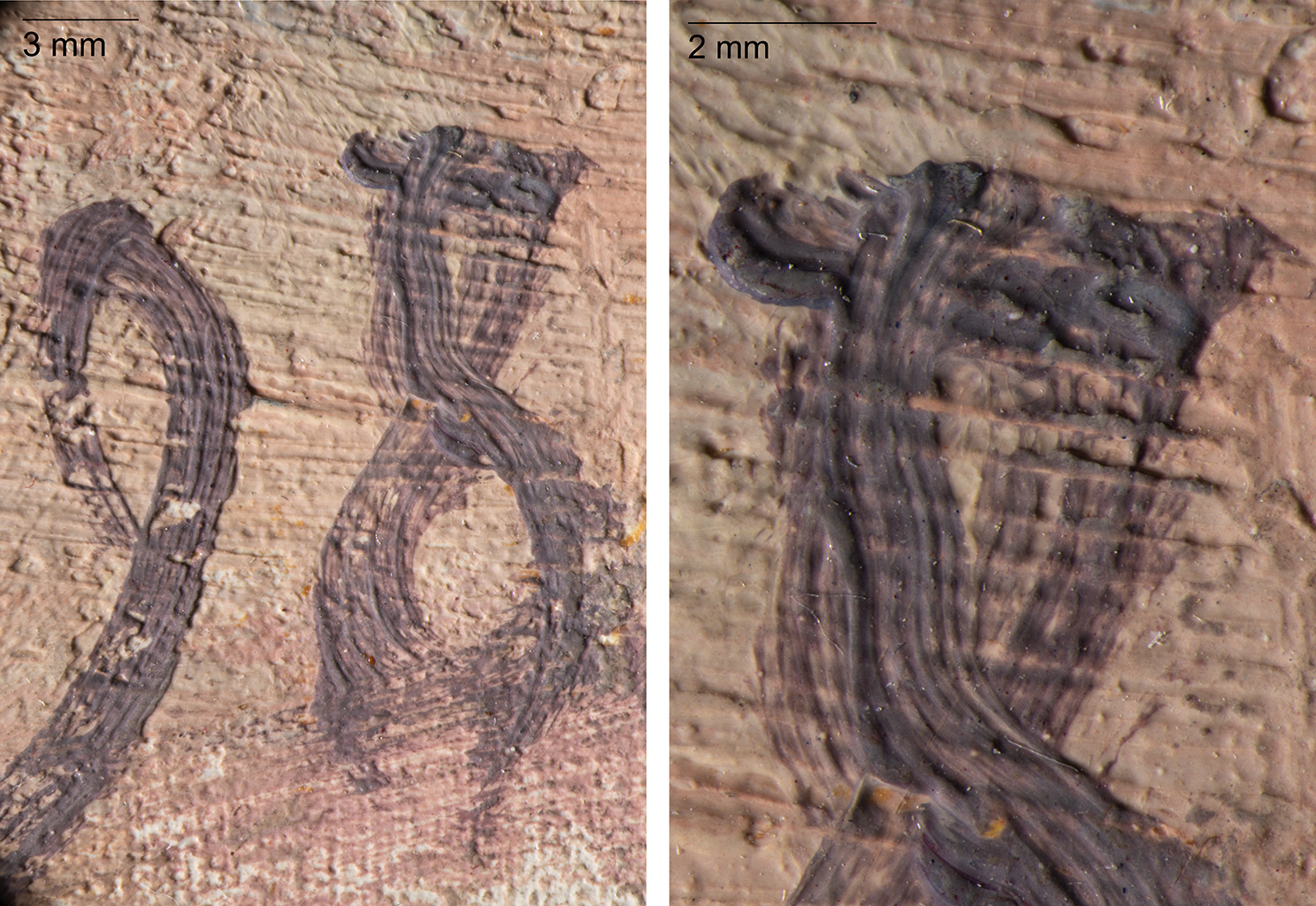
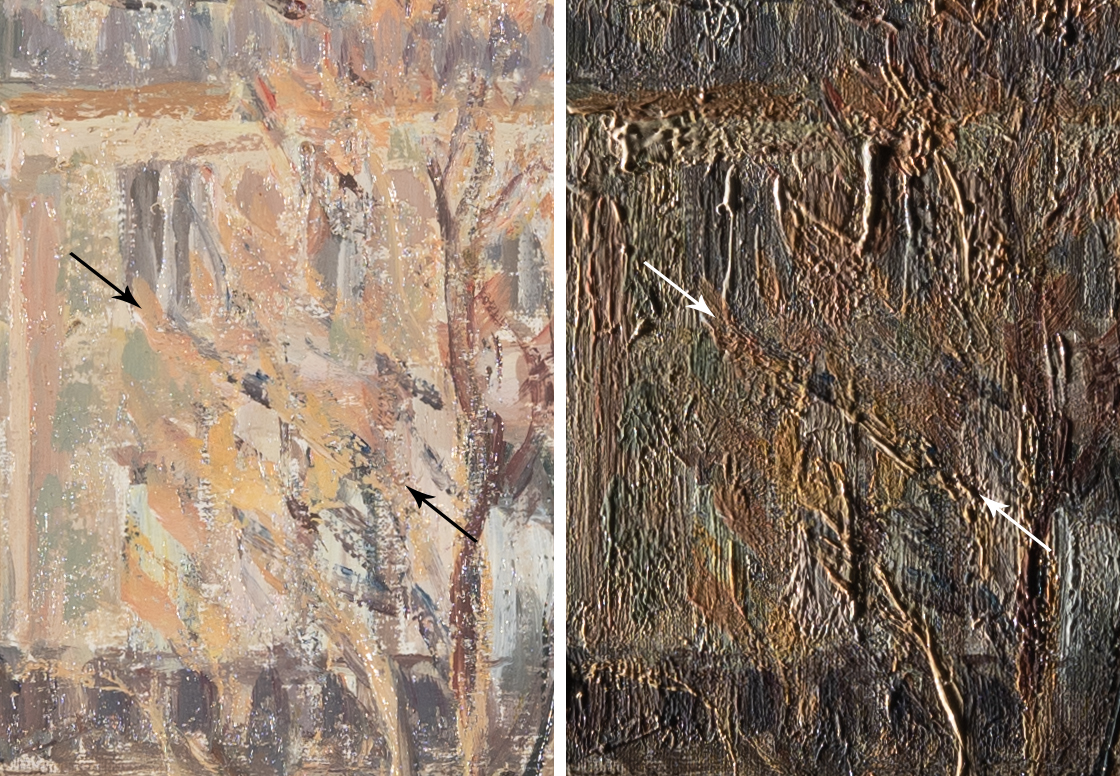
Pissarro signed and dated the painting at the lower right corner. The “8” in “98” seems to have been changed from a 7 (Fig. 21). The construction of his dates and numbers is not consistent across his works, so the discrepancy might have no significance. However, Pissarro had rented his hotel room in December of 1897 and produced at least two works before the new year. The Madrid painting and Place du Théâtre-Français and the Avenue de l’Opéra, Fog (Dallas Museum of Art) are both dated 97. Perhaps the Nelson-Atkins painting was painted on the cusp of the new year, leading to momentary confusion when writing the date, and then reworked closer to springtime when the leaves were beginning to emerge.12Pissarro is suspected to have added leaves to the trees of another painting in the series, Place du Théâtre-Français, the Omnibuses, Spring, Sunlight (1898; State Hermitage Museum, St. Petersburg) in a later reworking. Pissarro and Durand-Ruel Snollaerts, Pissarro: Critical Catalogue of Paintings, 3:756. The heavily worked treetops make it difficult to determine whether foliage was added wet-over-dry at a later stage (Fig. 22).
The provenance of the painting is well documented, but its conservation history is sparse. Residue of a natural resin varnish—likely not original as Pissarro disapproved of varnishing—is still present in the interstices of the paint and at the tacking margins.13By the 1880s, it was clear that Pissarro opposed varnish. On the verso of Landscape at Chaponval (1880; Musée d’Orsay), he wrote on a label: “Veuillez ne pas vernir ce tableau. C. Pissarro” (Please do not varnish this picture. C. Pissarro). See David Bomford, Jo Kirby, John Leighton, and Ashok Roy, Art in the Making: Impressionism (London: Yale University Press, 1991), 101; Michael Swicklick, “French Painting and the Use of Varnish, 1750–1900,” Conservation Research: Studies in the History of Art 41, no. 2 (1993): 168–69; Anthea Callen, “The Unvarnished Truth: Mattness, ‘Primitivism,’ and Modernity in French Painting, c. 1870–1907,” Burlington Magazine 136, no. 1100 (November 1994): 738. The absence of varnish beneath the original tack heads indicates that the coating predates tack removal and lining (see Fig. 9), which occurred sometime before 1982.14The painting was already lined when Forrest Bailey examined it. See Bailey, 1982–1983, treatment summary, NAMA conservation file, 2015.13.18. A 1982 report records a “recent” cleaning, probably removal of the natural resin, and the subsequent application of a synthetic varnish. By 1986, this coating already appeared “milky” and was removed.15Forrest Bailey, January 14, 1986, treatment report, NAMA conservation file, 2015.13.18. The painting was revarnished with different synthetic resins that are still on the surface today. retouching: Paint application by a conservator or restorer to cover losses and unify the original composition. Retouching is an aspect of conservation treatment that is aesthetic in nature and that differs from more limited procedures undertaken solely to stabilize original material. Sometimes referred to as inpainting or retouch. is minimal and confined to the perimeter and a small area of roof near the right edge.
Notes
-
In 1983, most of the early labels were removed from the replacement stretcher and attached to the backing board. The labels that were too fragile to remove were left in place. See Forrest Bailey, December 30, 1982 to January 4, 1983, treatment summary, NAMA conservation file, 2015.13.18.
-
Two sets of tacks are currently present: one associated with the lining fabric and the other with the original canvas. The original tacks, represented by their empty holes, were spaced 5.4 to 6.4 cm apart and had heads measuring 0.6 cm in diameter. Empty staple holes relate to edge stripping that was added in the 1980s and removed at a later date. See Bailey, 1982–83, treatment summary, NAMA conservation file, 2015.13.18.
-
See the list of canvas sizes offered by the Bourgeois Ainé company in 1888, reproduced in Iris Schaefer, Caroline von Saint-George, and Katja Lewerentz, Painting Light: The Hidden Techniques of the Impressionists (Milan: Skira, 2008), 50.
-
The stamp reads, “TOILES à PEINDRE à COULEURS FINE / P. CONTET / PARIS / 34, Rue Lafayette, 34.”
-
Pissarro’s use of a similar brush-applied ground that was likely prepared by Contet is noted in Kelly Keegan, “Cat. 12, Haymaking at Éragny, 1892: Technical Report,” in Pissarro Paintings and Works on Paper at the Art Institute of Chicago (Chicago: Art Institute of Chicago, 2015), para 23, figs. 12.20–12.22, https://publications.artic.edu
/pissarro ./reader /paintingsandpaper /section/24 -
Pissarro occasionally stretched both bare and pre-primed canvas on standard-format stretchers that he already had. See Alex Chipkin, “Inspiration, Collaboration, and Evolution: The Painting Techniques of Camille Pissarro and his Sons,” Paintings by the Pissarro Family: A Technical Catalogue (Indianapolis: Indianapolis Museum of Art at Newfields, 2024), para 31, https://pissarro.discovernewfields.org
/inspiration ; Lydia Gutierrez and Aviva Burnstock, “Technical Examination of Works by Camille and Lucien Pissarro from the Courtauld Gallery,” Art Matters 5 (2013): 16, https://www.amjournal.org-collaboration -and -evolution -the -painting -techniques -of -camille -pissarro -and -his -sons /_files ; and letter from Camille to Lucien Pissarro, February 18, 1897, in Camille Pissarro: Letters to his Son Lucien, ed. and trans. John Rewald (New York: Pantheon Books, 1943), 307./ugd /14a82d _1 cd5 fda55 c9d4 cdbb5 cf6168377 f1fd2 .pdf -
Regarding a similar series of urban views on the Boulevard Montmarte, Pissarro wrote, “I have a stunning motif that will require every conceivable effort to interpret. On my left, I have another motif, but it’s terribly difficult, almost a bird’s-eye view of carriages, omnibuses, people between big trees, big houses that have to be set straight, it’s hard!” Joachim Pissarro and Claire Durand-Ruel Snollaerts, Pissarro: Catalogue critique des peintures / Critical Catalogue of Paintings, trans. Mark Hutchinson and Michael Taylor (Paris: Wildenstein Institute, 2005), 3:728.
-
See Becca Goodman “Camille Pissarro, Chestnut Grove at Louveciennes, 1872,” technical entry in this catalogue, 2025; Gutierrez and Burnstock, “Technical Examination of Works,” 20; and Alex Chipkin and Laura Mosteller, “Woman Washing Her Feet in a Brook, 1894: Technical Examination,” Paintings by the Pissarro Family, https://pissarro.discovernewfields.org
/technical .-reports /48 .17/ -
Camille to Lucien Pissarro, March 7, 1898, cited and translated in Richard R. Brettell and Joachim Pissarro, The Impressionist and the City: Pissarro’s Series Paintings, exh. cat. (New Haven, CT: Yale University Press, 1992), 82.
-
See, for example, Avenue de l’Opéra: Morning Sunshine (1898; Philadelphia Museum of Art) and Avenue de l’Opera, Effect of Snow (1898; Pushkin Museum of Fine Arts, Moscow).
-
If the candelabra lampposts were painted and then later omitted, they must have been fully scraped off, as there is no evidence of them under magnification or with any imaging technique.
-
Pissarro is suspected to have added leaves to the trees of another painting in the series, Place du Théâtre-Français, the Omnibuses, Spring, Sunlight (1898; State Hermitage Museum, St. Petersburg) in a later reworking. Pissarro and Durand-Ruel Snollaerts, Pissarro: Critical Catalogue of Paintings, 3:756.
-
By the 1880s, it was clear that Pissarro opposed varnish. On the verso of Landscape at Chaponval (1880; Musée d’Orsay), he wrote on a label: “Veuillez ne pas vernir ce tableau. C. Pissarro” (Please do not varnish this picture. C. Pissarro). See David Bomford, Jo Kirby, John Leighton, and Ashok Roy, Art in the Making: Impressionism (London: Yale University Press, 1991), 101; Michael Swicklick, “French Painting and the Use of Varnish, 1750–1900,” Conservation Research: Studies in the History of Art 41, no. 2 (1993): 168–69; Anthea Callen, “The Unvarnished Truth: Mattness, ‘Primitivism,’ and Modernity in French Painting, c. 1870–1907,” Burlington Magazine 136, no. 1100 (November 1994): 738.
-
The painting was already lined when Forrest Bailey examined it. See Bailey, 1982–1983, treatment summary, NAMA conservation file, 2015.13.18.
-
Forrest Bailey, January 14, 1986, treatment report, NAMA conservation file, 2015.13.18.
Documentation
Citation
Chicago:
Danielle Hampton Cullen, “Camille Pissarro, Paris, Rue Saint-Honoré, Sun Effect, Afternoon, 1898,” documentation in French Paintings and Pastels, 1600–1945: The Collections of The Nelson-Atkins Museum of Art, ed. Aimee Marcereau DeGalan (Kansas City: The Nelson-Atkins Museum of Art, 2022), https://doi.org/10.37764/78973.5.650.4033.
MLA:
Hampton Cullen, Danielle. “Camille Pissarro, Paris, Rue Saint-Honoré, Sun Effect, Afternoon, 1898,” documentation. French Paintings and Pastels, 1600–1945: The Collections of The Nelson-Atkins Museum of Art, edited by Aimee Marcereau DeGalan, Nelson-Atkins Museum of Art, 2022. doi: 10.37764/78973.5.650.4033.
Provenance
Purchased from the artist by Durand-Ruel, Paris, stock no. L4635, as Paris, rue Saint-Honoré, effet de soleil, matin [sic], May 2, 1898–February 20, 1917 [1];
Purchased from Durand-Ruel, New York, stock no. 3800, by Josef Stransky (1872–1936), New York, February 20–April 20, 1917 [2];
Purchased from Stransky by Durand-Ruel, New York, stock no. 4078, April 20, 1917–September 23, 1920 [3];
Purchased from Durand-Ruel by Henry Douglas Hughes (1869–1928), Philadelphia, September 23, 1920;
With Marie Sterner Gallery, New York, by May 16, 1930–at least June 8, 1934 [4];
Purchased from Marie Sterner Gallery, probably through Sam Salz, by Gladys Lloyd (née Cassell, 1895–1971) and Edward G. (1893–1973) Robinson, Beverly Hills, after July 8, 1934–56 [5];
Edward G. Robinson (1893–1973), Beverly Hills, 1956–January 26, 1973 [6];
Inherited by his wife, Jane Robinson (née Bodenheimer, 1919–91), January 26–April 3, 1973 [7];
Purchased from Jane Robinson by Armand Hammer, through Knoedler and Co., New York, on joint account with Acquavella Galleries, New York, April 3, 1973 [8]
Purchased from Acquavella Galleries by Alex Reid and Lefèvre Ltd., London, stock no. 46/73, by November 1, 1973–December 1976 [9];
Purchased from Reid and Lefèvre by Cynthia Wood (d. 1993), Santa Barbara, CA, December 1976–December 30, 1982;
Purchased from Wood, through John and Paul Herring and Co., New York, by Marion (née Helzberg, 1931–2013) and Henry (1922–2019) Bloch, Shawnee Mission, KS, December 30, 1982–June 15, 2015;
Their gift to the Nelson-Atkins Museum of Art, Kansas City, MO, 2015.
Notes
[1] Durand-Ruel purchased the painting from Pissarro under the title Paris, rue Saint-Honoré, effet de soleil, matin, not “après-midi”; see email from Paul-Louis Durand-Ruel and Flavie Durand-Ruel, Durand-Ruel et Cie., Paris, to Nicole Myers, NAMA, January 11, 2016, NAMA curatorial file. The painting was exhibited at Durand-Ruel, Paris, in April 1904, as belonging to “M. Lebeau,” a name sometimes used by Paul Durand-Ruel when he lent paintings from his personal collection. However, the painting was entered as stock into Durand-Ruel, Paris, from May 2, 1898 to February 20, 1917. The painting was transferred from Durand-Ruel, Paris, to Durand-Ruel, New York, in 1914. Durand-Ruel, New York, stock no. 3800. See email from Paul-Louis Durand-Ruel and Flavie Durand-Ruel, Durand-Ruel et Cie, Paris, to Nicole Myers, NAMA, January 11, 2016, NAMA curatorial files.
[2] See email from Paul-Louis Durand-Ruel and Flavie Durand-Ruel, Durand-Ruel et Cie, Paris, to Nicole Myers, NAMA, January 11, 2016, NAMA curatorial files.
[3] See email from Paul-Louis Durand-Ruel and Flavie Durand-Ruel, Durand-Ruel et Cie, Paris, to Nicole Myers, NAMA, January 11, 2016, NAMA curatorial files.
[4] See letter from Marie Sterner to Louis Earle
Rowe, Rhode Island School of Design, May 16, 1930,
proposing the purchase of the painting by the
museum. According to the letter, Sterner was
acting as an agent for another owner. This may
have been Hannah Curnuck Hughes (b. ca. 1885),
widow of Henry D. Hughes, who often consigned
paintings to Sterner. Archives of American Art,
Smithsonian Institution, Washington, D. C.,
Clayton-Liberatore Gallery records and papers,
1899-1977, Marie Sterner Gallery subset, folder
“Sterner, M. Rhode Is. School of Design.” See also
https://www.nga.gov
[5] See the publicity photo of Edward G. Robinson taken in 1934 featuring the painting. Along the bottom of the photo it reads: copyright 1934 Vitagraph Inc. Property of Vintagraph Inc. Photograph, gift of Harold Sterner, 41919, Frick Art Reference Library, New York (FARL) negative. Robinson purchased the painting shortly after Marie Sterner lent it to the California Palace of the Legion of Honor, San Francisco, from June 8 to July 8, 1934.
[6] Gladys and Edward G. Robinson divorced in 1956. In the divorce proceedings, the couple sold most of their art collection, with the exception of fourteen paintings (including the Nelson-Atkins canvas) which were retained by Edward. See letter from Knoedler and Co., New York, to Edward G. Robinson, January 18, 1957, copy in NAMA curatorial files. See also M. Knoedler and Co. records, approximately 1848–1971. Series VI. Correspondence, box 985, Folder 5, Getty Research Institute, Los Angeles. In 1958, Robinson married his second wife, Jane Bodenheimer.
[7] A publicity photo of Robinson taken in 1973 for his upcoming film Soylent Green features the Nelson-Atkins painting. This was Robinson’s final film appearance as he died on January 26, twelve days after the completion of filming; see photograph in Edward G. Robinson and Leonard Spigelgass, All My Yesterdays: An Autobiography (New York: Hawthorn Books, 1973), unpaginated, (repro.), as La Rue St. Honoré.
[8] In his will, Robinson left his wife Jane his entire art collection, including the Pissarro, The Dead Tree. The entire collection was purchased by oil tycoon Armand Hammer, through his firm Knoedler and Co., New York, on April 3, 1973; see “Knoedler Pays 5-Million For Robinson Collection,” New York Times (April 4, 1973): 36, and Alan L. Gansberg, Little Caesar: A Biography of Edward G. Robinson (Lanham, MD: Scarecrow Press, 2004), 257. Acquavella Gallery, New York, also purchased the collection in conjunction with Armand Hammer; see Peter Aspden, “Lunch with the FT: William Acquavella,” Financial Times (September 30, 2011).
[9] See the Alex Reid and Lefèvre Ltd label on the
painting’s backing board, lower middle,
encapsulated white rectangular with blue border,
handwritten in black marker: 64/73. This
information was confirmed via a similar label
found on the verso of a painting at the Art
Institute of Chicago; see Gloria Groom et al., Pissarro: Paintings and Works on Paper at the
Art Institute of Chicago
(Chicago: Art Institute of Chicago, 2015), no. 2,
https://publications.artic.edu
Exhibitions
Œuvres récentes de Camille Pissarro, Galerie Durand-Ruel, Paris, June 1–18, 1898, no. 22, as Rue Saint-Honoré. Après-midi, effet de soleil.
Exposition de l’Œuvre de Camille Pissarro, Galeries Durand-Ruel, Paris, April 7–30, 1904, no. 110, as La Rue Saint-Honoré.
Pissarro, Galerie Durand-Ruel, Paris, March 1908, no. 7, no cat.
Paintings by French Impressionists, Detroit Museum of Art, Detroit, November 1915, no. 38, as Rue St. Honore [sic], Paris.
Exhibition of paintings lent by Durand-Ruel, Brooks Reed Gallery, Boston, December 1916–January 1917, no cat.
Paintings by Pissarro, Durand-Ruel Galleries, New York, February 3–17, 1917, no. 5, no cat.
Exhibition of paintings lent by Durand-Ruel, Mattatuck Historical Society, Waterbury, CT, October–November, 1919, no cat.
A Group of French Paintings from Courbet down to and including the Contemporary Moderns, Albright Art Gallery, Buffalo, NY, November 16–December 14, 1930, no. 56, as Rue St. Honore [sic].
Exhibition of French Painting from the Fifteenth Century to the Present Day, California Palace of the Legion of Honor, San Francisco, June 8–July 8, 1934, no. 132, as Rue Saint Honoré.
The Gladys Lloyd Robinson and Edward G. Robinson Collection, Los Angeles County Museum, September 11–November 11, 1956; California Palace of the Legion of Honor, San Francisco, November 30, 1956–January 13, 1957, no. 42, as Rue St. Honoré.
Important XIX and XX Century Paintings, Lefevre Gallery, London, November 1–December 22, 1973, no. 13, as La Rue Saint-Honoré, Effet de Soleil, Après-Midi.
Le Centenaire de l’Impressionnisme, Ginza Matsuzakaya, Tokyo, July 25–August 11, 1974; Sapporo Matsuzakaya, Sapporo, Japan, August 17–28, 1974; Osaka Matsuzakaya, Osaka, Japan, September 5–17, 1974; Le Musée Préfectoral de Yamaguchi, Yamaguchi, Japan, September 20–30, 1974; Nagoya Matsuzakaya, Nagoya, Japan, October 3–15, 1974; Shizuoka Matsuzakaya, Shizuoka, Japan, October 17–29, 1974; Ueno Matsuzakaya, Ueno, Japan, October 31–November 12, 1974, no. 43, as La rue Saint-Honoré, Effet de Soleil, Après-midi.
The Bloch Collection, The Nelson-Atkins Museum of Art, Kansas City, MO, June–August 1982, no cat.
Paris Cafés: Their Role in the Birth of Modern Art, Wildenstein, New York, November 13–December 20, 1985, unnumbered, as The Rue Saint-Honoré in Afternoon Sunlight.
Manet to Matisse: Impressionist Masters from the Marion and Henry Bloch Collection, The Nelson-Atkins Museum of Art, Kansas City, MO, June 9–September 9, 2007, no. 8, as Rue Saint-Honoré, Sun Effect, Afternoon (La rue Saint-Honoré, effet de soleil, après-midi).
References
Exposition d’œuvres récentes de Camille Pissarro, exh. cat. (Paris: A. Marty et H. Floury, 1898), unpaginated, as Rue Saint-Honoré.–Matin, effet de soleil.
Arsène Alexandre, “Vues de Paris de M. Pissarro,” Le Figaro, no. 154 (June 3, 1898): 4.
Possibly Georges Lecomte, “Camille Pissarro,” Les Droits de l’homme (June 4, 1898).
Eugene Hoffman, “Les Petits salons, Camille Pissarro,” Le Journal des Artistes (June 5, 1898): 2311.
Possibly “Ausstellungen,” Frankfurter Zeitung (June 14, 1898).
Possibly F. Jourdain, “Les Hommes du Jour, Camille Pissarro,” L’éclair (June 18, 1898).
Georges Lecomte, “Camille Pissarro,” Revue Populaire des Beaux-Arts 22, no. 35 (June 18, 1898): 43.
Gustave Geffroy, “Camille Pissarro,” Le Journal Quotidien, Littéraire, Artistique et Politique 7, no. 2007 (June 25, 1898): 2 [repr., in Gustave Geffroy, La Vie Artistique, vol. 6, Eau-forte de Camille Pissarro (Paris: H. Floury, 1900), 183–85].
Possibly Ch. Snabilie, “De Impressionisten, III, Camille Pissarro,” De Amsterdammer Week-blad voor Nederland (August 21, 1898).
“Art Moderne,” Mercure de France 27, no. 103 (July 1898): 280.
Possibly F.-A. Bridgmann, “L’Anarchie dans l’art impressionnisme-symbolisme,” L’anarchie dans l’art (1898).
Catalogue de l’Exposition de l’Œuvre de Camille Pissarro, exh. cat. (Paris: Trève, 1904), 19, as La Rue Saint-Honoré.
Pissarro (Paris: Galerie Durand-Ruel, 1908).
Catalogue of an Exhibition of Paintings by French Impressionists, exh. cat. (Detroit: Detroit Museum of Art, 1915), unpaginated, as Rue St. Honore [sic], Paris.
Paintings by Pissarro (New York: Durand-Ruel Galleries, 1917).
Catalog of Exhibitions Commemorating the Twenty-Fifth Anniversary of the Opening of Albright Art Gallery (New York: The Buffalo Fine Arts Academy, 1930), 15, as Rue St. Honore [sic].
Exhibition of French Painting from the Fifteenth Century to the Present Day, exh. cat. (San Francisco: California Palace of the Legion of Honor, 1934), 57, (repro.), as Rue Saint Honoré.
Ludovic Rodo Pissarro and Lionello Venturi, Camille Pissarro, Son Art—Son Œuvre (Paris: Paul Rosenberg, 1939), no. 1021, pp. 1:223, 2:204, (repro.), as La Rue Saint-Honoré, Effet de Soleil, Après-Midi.
John Rewald, “Pissarro’s Paris and His France,” Art News 42, no. 2 (March 1–14, 1943): 16, (repro.), as Rue St. Honore [sic].
John Rewald and Lucien Pissarro, ed., Camille Pissarro, Letters to His Son Lucien (1943; repr., Boston: MFA Publications, 2002), 9, 317, (repro.), as La rue Saint-Honoré, Paris.
The Gladys Lloyd Robinson and Edward G. Robinson Collection, exh. cat. (Los Angeles: Los Angeles County Museum, 1956), unpaginated, (repro.), and Rue St. Honoré.
John Rewald, Camille Pissarro, 1st ed. (New York: Harry N. Abrams, 1963), 150.
Jane Robinson, Edward G. Robinson’s World of Art (New York: Harper and Row, 1971), 20–21, 99, (repro.), as La Rue Saint-Honore [sic], Effet de Soleil, Apres-Midi [sic] (The Rue Saint-Honore [sic] in the Afternoon Sunlight).
“Knoedler Pays 5-Million For Robinson Collection,” New York Times 122, no. 42,074 (April 4, 1973): 36.
Edward G. Robinson, All My Yesterdays: An Autobiography (New York: New American Library, 1973), unpaginated, (repro.), as La Rue St. Honoré.
Important XIX and XX Century Paintings, exh. cat. (London: Lefevre Gallery, 1973), 28–29, (repro.), as La Rue Saint-Honoré, effet de Soleil, après-midi.
Diana Hildreth, “XIX and XX Century Paintings,” Arts Review 25, no. 23 (November 3, 1973): 786, (repro.), as La Rue Saint-Honoré, effet de Soleil, après-midi.
William Allan, “Art and Antiques in London: The Summer Scene,” Connoisseur, no. 748 (June 1974): 135, (repro.), as La Rue Saint-Honoré, effet de Soleil Après-midi.
François Daulte, Le Centenaire de l’Impressionnisme, exh. cat. (Tokyo: Ginza Matsuzakaya, 1974), unpaginated, (repro.), as La rue Saint-Honoré. Effet de Soleil, Après-midi.
Alex Reid and Lefevre, 1926–1976 (London: Lefevre Gallery, 1976), 31, 106–07, (repro), as La Rue Saint-Honoré, effet de soleil, après-midi.
Janine Bailly-Herzberg ed., Correspondence de Camille Pissarro (Paris: Editions du Valhermeil, 1980), 1:49.
“The Bloch Collection,” Gallery Events (The William Rockhill Nelson Gallery of Art and Mary Atkins Museum of Fine Arts) (June–August 1982): unpaginated.
Georges Bernier, Paris Cafés: Their role in the birth of Modern Art, exh. cat. (New York: Wildenstein, 1985), 74, 96, 120, (repro.), as La Rue Saint-Honoré – Effet de Soleil and The Rue Saint-Honoré in Afternoon Sunlight.
Christopher Lloyd, ed., Studies on Camille Pissarro (London: Routledge and Kegan Paul, 1986), 113n1.
Janine Bailly-Herzberg, ed., Correspondence de Camille Pissarro (Paris: Editions du Valhermeil, 1989), 4:476, Rue Saint-Honoré, effet de soleil après-midi.
Ludovico Rodo Pissarro and Lionello Venturi, Camille Pissarro, Son Art—Son Œuvre, 2nd rev. ed (San Francisco: Alan Wofsy Fine Arts, 1989), no. 1021, pp. 1:223, 2:unpaginated, (repro.), as La Rue Saint-Honoré, Effet de Soleil, Après-Midi.
Richard Brettell and Joachim Pissarro, The Impressionist and the City: Pissarro’s Series Paintings, ed. MaryAnne Stevens, exh. cat. (New Haven, CT: Yale University Press, 1992), 81–82, 87, (repro.), as Rue Saint-Honoré: Sun Effect, Afternoon and Rue Saint-Honoré, effet de soleil, après-midi.
Mikael Wivel, Ordrupgaard Selected Works (Copenhagen: Ordrupgaard, 1993), unpaginated.
Christofer Conrad, Renoir, Gauguin, Degas: Schätze der Sammlung Ordrupgaard, Kopenhagen, exh. cat. (Stuttgart: Staatsgalerie Stuttgart, 2003), 80–81, 103n51.
Alan L. Gansberg, Little Caesar: A Biography of Edward G. Robinson (Lanham, MD: Scarecrow Press, 2004), 357.
Eva-Maria Preiswerk-Lösel, ed., A House for the Impressionists: The Langmatt Museum (Ostfildern-Ruit: Hatje Cantz, 2005), 144.
Joachim Pissarro and Claire Durand-Ruel Snollaerts, Pissarro: Catalogue critique des peintures; Critical Catalogue of Paintings (New York: Wildenstein Institute Publications, 2005), no. 1199, pp. 1:364, 366–67, 370–71, 379, 391, 401–02, 409, 3:749, 751, (repro.), as La Rue Saint-Honoré, après-midi, effet de soleil.
Rebecca Dimling Cochran and Bobbie Leigh, “100 Top Collectors who have made a difference,” Art and Antiques (March 2006): 90.
Bobbie Leigh, “Magnificent Obsession,” Art and Antiques 29, no. 6 (June 2006): 61, (repro.), as Rue Saint-Honoré: Sun Effect, Afternoon.
Alice Thorson, “A final countdown—A rare showing of Impressionist paintings from the private collection of Henry and Marion Bloch is one of the inaugural exhibitions at the 165,000-square-foot glass-and-steel structure,” Kansas City Star (June 29, 2006): B1.
“Inaugural Exhibitions Celebrate Kansas City,” Member Magazine (The Nelson-Atkins Museum of Art) (Fall 2006): 3.
Richard R. Brettell and Joachim Pissarro, Manet to Matisse: Impressionist Masters from the Marion and Henry Bloch Collection, exh. cat. (Kansas City, MO: Nelson-Atkins Museum of Art, 2007), 10, 13, 56-59, 156–57, (repro), as Rue Saint-Honoré, Sun Effect, Afternoon (La rue Saint-Honoré, effet de soleil, après-midi).
Alice Thorson, “A Tiny Renoir Began an Impressive Obsession,” Kansas City Star (June 3, 2007): E4, (repro,), as Rue Saint-Honoré, Sun Effect, Afternoon.
“Lasting Impressions: A Tribute to Marion and Henry Bloch,” Member Magazine (The Nelson-Atkins Museum of Art) (Fall 2007): 11-12.
Steve Paul, “Pretty Pictures: Marion and Henry Bloch’s Collection of Superb Impressionist Masters,” Panache 4, no. 3 (Fall 2007): 20, as Rue Saint-Honoré.
Alice Thorson, “Museum to Get 29 Impressionist Works from the Bloch Collection,” Kansas City Star (February 5, 2010): A1.
Carol Vogel, “Inside Art: Kansas City Riches,” New York Times 159, no. 54, 942 (February 5, 2010): C26.
Melissa Muller, Lost Lives, Lost Art: Jewish Collectors, Nazi Art Theft, and the Quest for Justice (New York: Vendome Press, 2010), 11.
Thomas M. Bloch, Many Happy Returns: The Story of Henry Bloch, America’s Tax Man (Hoboken, NJ: John Wiley and Sons, 2011), 175.
Markus Müller, Camille Pissarro: Mit den Augen eines Impressionisten (München: Hirmer, 2013), 47.
Diane Stafford, “Bloch Gift to Go for Nelson Upgrade,” Kansas City Star 135, no. 203 (April 8, 2015): A8.
“Nelson-Atkins Museum of Art Officially Accessions
Bloch Impressionist
Masterpieces,” Artdaily.org (July 25,
2015): http://artdaily.com
Julie Paulais, “Le Nelson-Atkins Museum of Art
reçoit des tableaux impressionnistes en échange de
leurs répliques,” Le Journal des arts (July 30, 2015): http://www.lejournaldesarts.fr
Josh Niland, “The Nelson-Atkins Museum of Art
Acquires a Renowned Collection of Impressionist
and Postimpressionist Art,” architecturaldigest.com
(August 6, 2015): https://www.architecturaldigest.com
Nina Siegal, “Upon Closer Review, Credit Goes to Bosch,” New York Times 165, no. 57130 (February 2, 2016): C5.
“Nelson-Atkins to unveil renovated Bloch Galleries
of European Art in winter
2017,” Artdaily.org (July 20, 2016): http://artdaily.com
“Nelson-Atkins Museum of Art celebrates generosity
of Henry Bloch with new
acquisition,” Artdaily.org (October 18,
2016): http://artdaily.com
Catherine Futter et al., Bloch Galleries: Highlights from the Collection of the Nelson-Atkins Museum of Art (Kansas City, MO: Nelson-Atkins Museum of Art, 2016), 74-75, (repro.), as Rue Saint-Honoré, Sun Effect, Afternoon.
Kelly Crow, “Museum Rewards Donor with Fake Art to
Hang at Home,” Wall Street Journal (January 25, 2017): https://www.wsj.com
David Frese, “Bloch savors paintings in redone galleries,” Kansas City Star (February 25, 2017): 1A.
Albert Hect, “Henry Bloch’s Masterpieces
Collection to Go on Display at Nelson-Atkins
Museum,” Jewish Business News (February
26, 2017): http://jewishbusinessnews.com
David Frese, “Inside the Bloch Galleries: An interactive experience,” Kansas City Star 137, no. 169 (March 5, 2017): 1D, 4D.
“Editorial: Thank you, Henry and Marion
Bloch,” Kansas City Star (March 7,
2017): http://www.kansascity.com
Hampton Stevens, “(Not Actually) 12 Things To Do
During The Big 12 Tournament,” Flatland: KCPT’s Digital Magazine (March 9, 2017): http://www.flatlandkc.org
Laura Spencer, “The Nelson-Atkins’ Bloch Galleries
feature Old Masterworks and New
Technology,” KCUR (March 10, 2017): http://kcur.org
Victoria Stapley-Brown, “Nelson-Atkins Museum’s
new European art galleries come with a ‘love
story,’” Art Newspaper (March 10,
2017): http://theartnewspaper.com
Harry Bellet, “Don du ciel pour le Musée
Nelson-Atkins,” Le Monde (March 13,
2017): http://www.lemonde.fr
Menachem Wecker, “Jewish Philanthropist
Establishes Kansas City as Cultural Mecca,” Forward
(March 14, 2017): http://forward.com
Juliet Helmke, “The Bloch Collection Takes up
Residence in Kansas City’s Nelson Atkins
Museum,” BoulinArtInfo International
(March 15, 2017): http://www.blouinartinfo.com
Erich Hatala Matthes, “Digital replicas are not
soulless—they help us engage with art,” Apollo
(March 23, 2017): https://www.apollo-magazine.com
Louise Nicholson, “How Kansas City got its
magnificent museum,” Apollo (April 7,
2017): https://www.apollo-magazine.com
Lilly Wei, “Julián Zugazagoitia: ‘Museums should
generate interest and open a door that leads to
further learning,’” Studio International (August 21, 2017): http://studiointernational.com
Anne-Birgitte Fonsmark and et al., Gauguin e gli impressionisti: capolavori dalla Collezione Ordrupgaard (Venezia: Marsilio, 2018), 148n4, as La Rue Saint-Honoré, Effet de Soleil, Après-Midi.
Robert D. Hershey Jr., “Henry Bloch, H&R Block’s cofounder, dies at 96,” Boston Globe (April 23, 2019): https://www3.bostonglobe.com/metro/ obituaries/2019/04/23/henry-bloch-block-cofounder/?arc404=true.
Robert D. Hershey, Jr., “Henry W. Bloch, Tax-Preparation Pioneer (and Pitchman), Is Dead at 96,” New York Times (April 23, 2019): https://www.nytimes.com/2019/04/23/ obituaries/henry-w-bloch-dead.html.
Claire Selvin, “Henry Wollman Bloch, Collector and Prominent Benefactor of Nelson-Atkins Museum of Art, Is Dead at 96,” ArtNews (April 23, 2019): http://www.artnews.com/2019/04/23/henry-bloch-dead-96/.
Eric Adler and Joyce Smith, “Henry Bloch, co-founder of H&R Block, dies at 96,” Kansas City Star 139, no. 219 (April 24, 2019): 1A.
“Henry Wollman Bloch (1922-2019),” Art Forum (April 24, 2019): https://www.artforum.com/news/henry-wollman-bloch-1922-2019-79547.
Frank Morris, “Henry Bloch, Co-Founder Of H&R
Block, Dies At 96,” npr.org (April 24,
2019): https://www.npr.org
Ignacio Villarreal, “Nelson-Atkins mourns loss of
Henry Bloch,” ArtDaily.org (April 24,
2019): http://artdaily.com
Eric Adler and Joyce Smith, “H&R Bloch co-founder, philanthropist Bloch dies,” Cass County Democrat Missourian 140, no. 29 (April 26, 2019): 1A.
Eric Adler and Joyce Smith, “KC businessman and philanthropist Henry Bloch dies,” Lee’s Summit Journal 132, no. 79 (April 26, 2019): 3A, (repro.).
Luke Nozicka, “Family and friends remember Henry Bloch of H&R Block,” Kansas City Star 139, no. 225 (April 30, 2019): 4A [repr., Luke Nozicka, “Family and friends remember Henry Bloch of H&R Block,” Kansas City Star 139, no. 228 (May 3, 2019): 3A].
Eric Adler, “Sold for $3.25 million, Bloch’s home in Mission Hills may be torn down,” Kansas City Star 141, no. 90 ( December 16, 2020): 2A.