Catalogue Entry
Read more about this painting at the associated catalogue entry.
Technical Entry
Citation
Chicago:
Susan Pavlik Enterline, “Claude Joseph Vernet, Coastal Harbor with a Pyramid: Evening, 1751,” technical entry in French Paintings and Pastels, 1600–1945: The Collections of the Nelson-Atkins Museum of Art, ed. Aimee Marcereau DeGalan (Kansas City: The Nelson-Atkins Museum of Art, 2026), https://doi.org/10.37764/78973.5.333.2088.
MLA:
Enterline, Susan Pavlik. “Claude Joseph Vernet, Coastal Harbor with a Pyramid: Evening, 1751,” technical entry. French Paintings and Pastels, 1600–1945: The Collections of The Nelson-Atkins Museum of Art, edited by Aimee Marcereau DeGalan, Nelson-Atkins Museum of Art, 2026. doi: 10.37764/78973.5.333.2088.
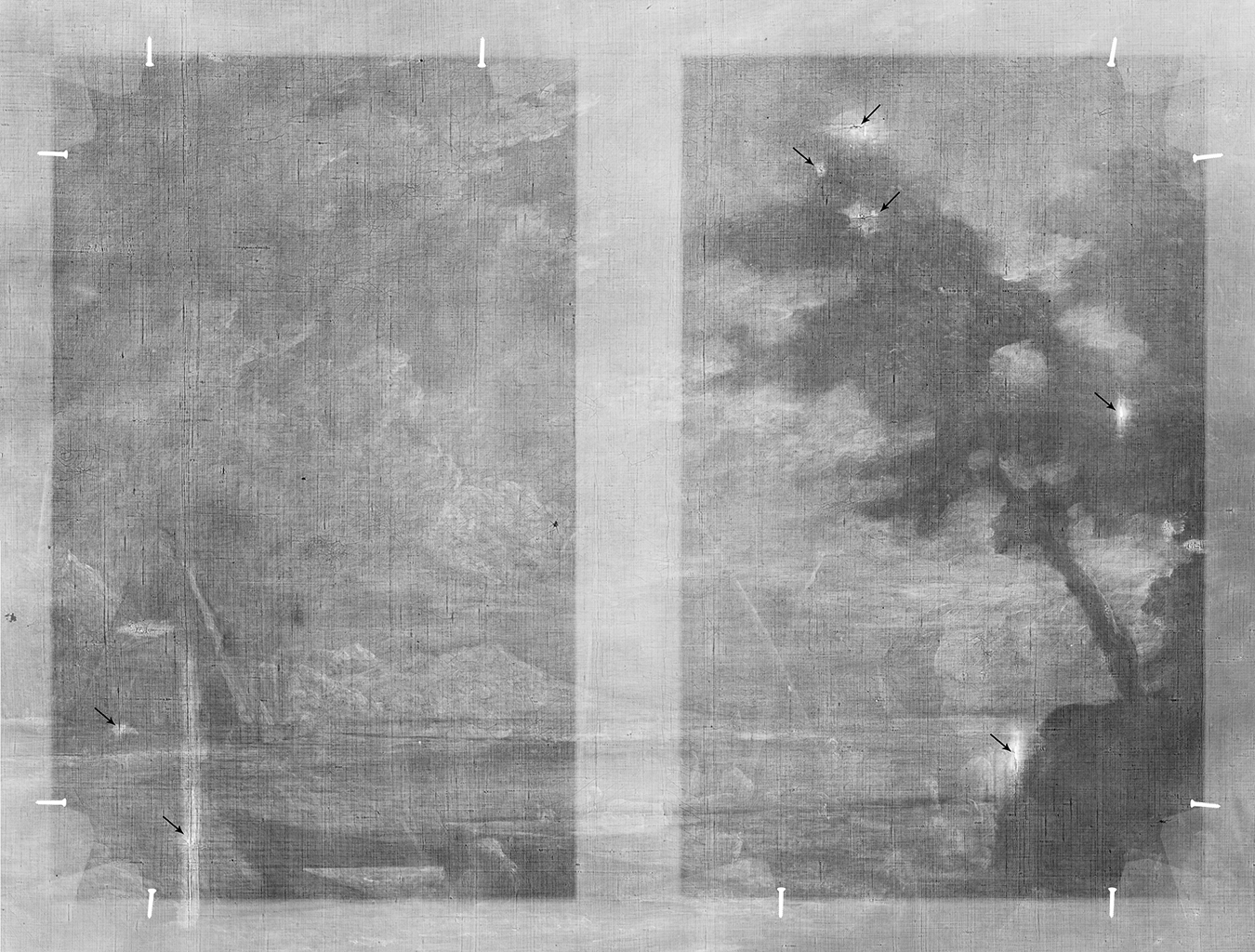
Coastal Harbor with a Pyramid: Evening and its pendant: One of two paintings conceived as a pair and intended to be displayed togther., Seaport with Antique Ruins: Morning, share similar characteristics and have experienced similar issues over their centuries-long lives. Vernet painted Coastal Harbor on a plain weave: A basic textile weave in which one weft thread alternates over and under the warp threads. Often this structure consists of one thread in each direction, but threads can be doubled (basket weave) or tripled to create more complex plain weave. Plain weave is sometimes called tabby weave. canvas, with slubs and irregularities throughout, visible in X-ray radiography (also referred to as x-radiography or radiography): Radiography is an examination tool analogous to the use of X-rays in medicine whereby denser components of a painted composition can be recorded as an inverted shadow image cast on film or a digital X-ray imaging plate from a source such as an X-ray tube. The method has been used for more than a century and is most effective with dense pigments incorporating metallic elements such as lead or zinc. It can reveal artist changes, underlying compositions, and information concerning the artwork’s construction and condition. The resulting image is called an x-radiograph or radiograph. It differs from the uses of X-ray spectrometry in being dependent on the density of the paint to absorb X-rays before they reach the film or image plate and being non-specific as to which elements are responsible for the resulting shadow image. (Fig. 1).1Digital radiograph composite, nos. 616.1-616.4, May 14, 2026, NAMA conservation file, F84-66/2. The digital radiograph was captured under the following conditions: 40 kV, 1 mA, and 10 seconds. The painting has been lining: A procedure used to reinforce a weakened canvas that involves adhering a second fabric support using adhesive, most often a glue-paste mixture, wax, or synthetic adhesive., and its tacking margins: The outer edges of canvas that wrap around and are attached to the stretcher or strainer with tacks or staples. See also tacking edge. have been removed, limiting close examination of the original canvas. The painting has notable cusping: A scalloped pattern along the canvas edges that relates to how the canvas was stretched. Primary cusping reveals where tacks secured the canvas to the support while the ground layer was applied. Secondary cusping can form when a pre-primed canvas is re-stretched by the artist prior to painting., especially along the lower and side edges, also visible in the radiograph. The current size of the original canvas is close to the measurements from Vernet’s studio account book:2See the accompanying catalogue entry by Richard Rand. Rand shares the painting’s measurements (“two feet eight inches wide, by two feet one inch high”) from a note in Vernet’s Livre de raison. The canvas now measures 86 by 66 centimeters. In 1750, a French pouce was equivalent to 1.066 current modern imperial inches, thus indicating the original measurements were approximately 86.6 by 67.7 centimeters. less than two centimeters have been lost in the vertical direction and under one centimeter horizontally.
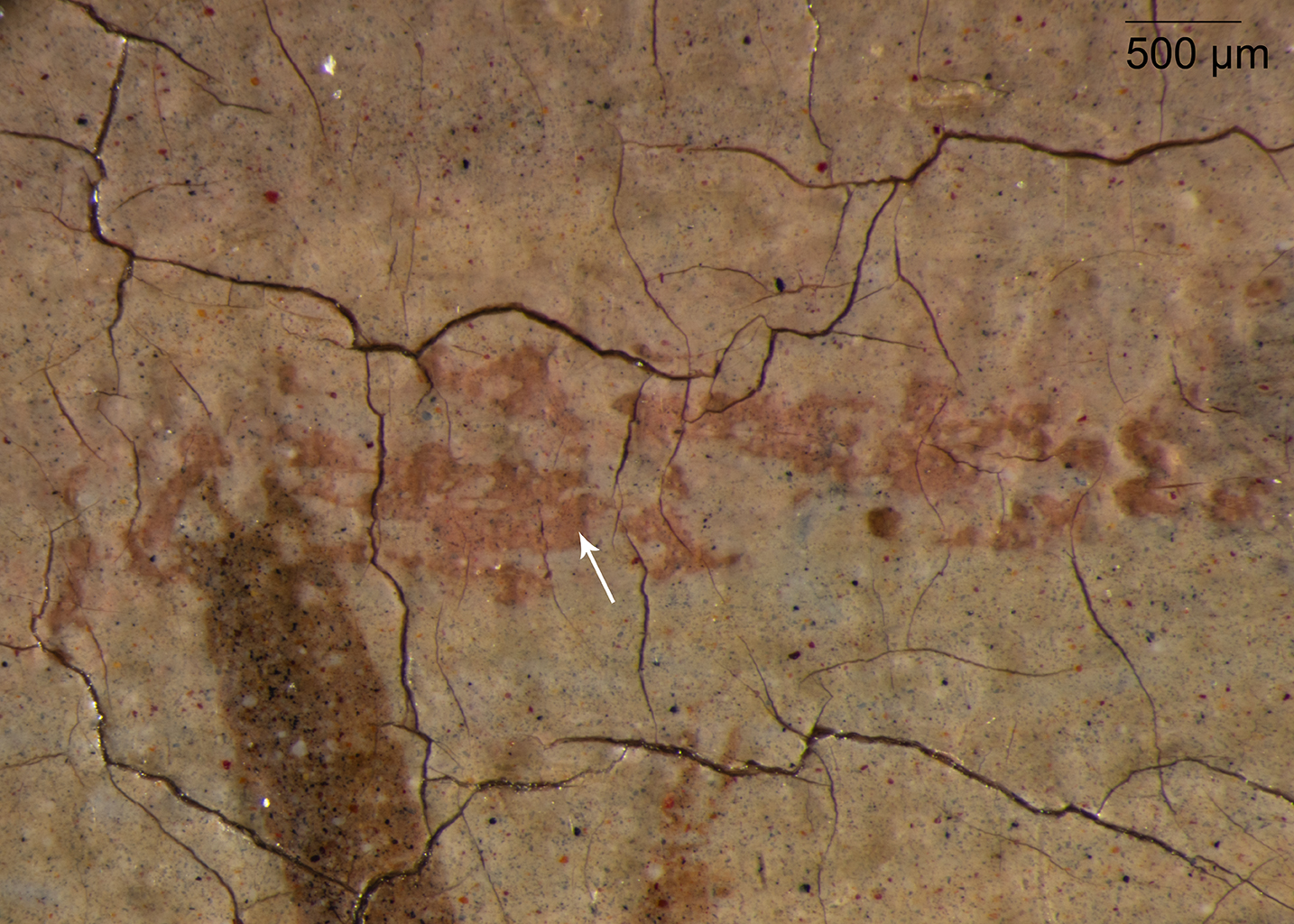
There is weave interference: A distortion that can occur when excess heat or pressure is applied to a painting, usually during the lining process. As a result, the original canvas weave texture becomes more pronounced or the weave texture of the lining material becomes visible on the painting surface. Also called weave emphasis or weave accentuation. from the lining treatment, most noticeable in raking light: An examination technique in which light is placed at a shallow angle from one direction to reveal the surface topography.. The brushy texture of the ground layer: An opaque preparatory layer applied to the support, either commercially or by the artist, to prevent absorption of the paint into the canvas or panel. See also priming layer. is also visible in some areas, though it is unclear whether this too was accentuated by the lining process or if it was intentional. The pinkish color of the ground is visible in cracks and losses, as well as in places along the edge of the cut canvas (Fig. 2). The canvas edges are mostly obscured by thick, discolored adhesive or varnish residue and remnants of lining tape.
No
underdrawing: A drawn or painted sketch
beneath the paint layer. The underdrawing can be
made from dry materials, such as graphite or
charcoal, or wet materials, such as ink or
paint.
was detected using any of the multimodal imaging
techniques deployed during the technical
examination.3Vernet wrote a letter in response to a request
for sketches: “Je ne suis pas habitué à faire des
esquisses pour mes tableaux, et je n’en ai jamais
fait. Ma coutume est de composer sur la toile du
tableau que je dois d’aire et de le peindre tout
de suite pour profiter de la chaleur de mon
imagination” (I am not in the habit of making
sketches for my paintings, and I have never done
so. My practice is to compose directly on the
canvas of the painting I am to create and to paint
it immediately, so as to capitalize on the heat of
my imagination). Léon Lagrange,
Joseph Vernet et la peinture au XVIIIe siècle.
Avec le texte des Livres de raison, et un grand
nombre de documents inédits
(Paris: Didier, 1864), 179, https://
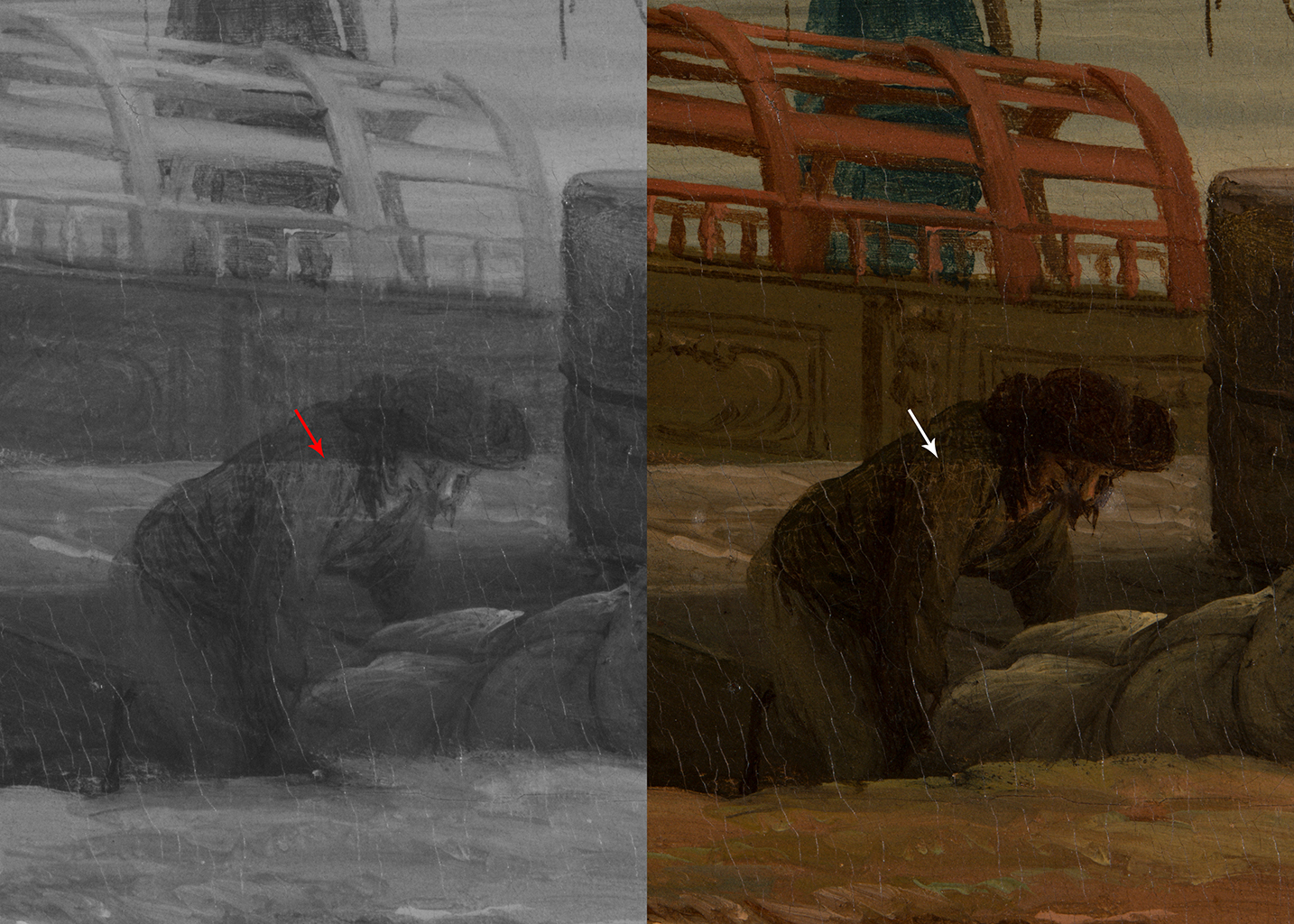
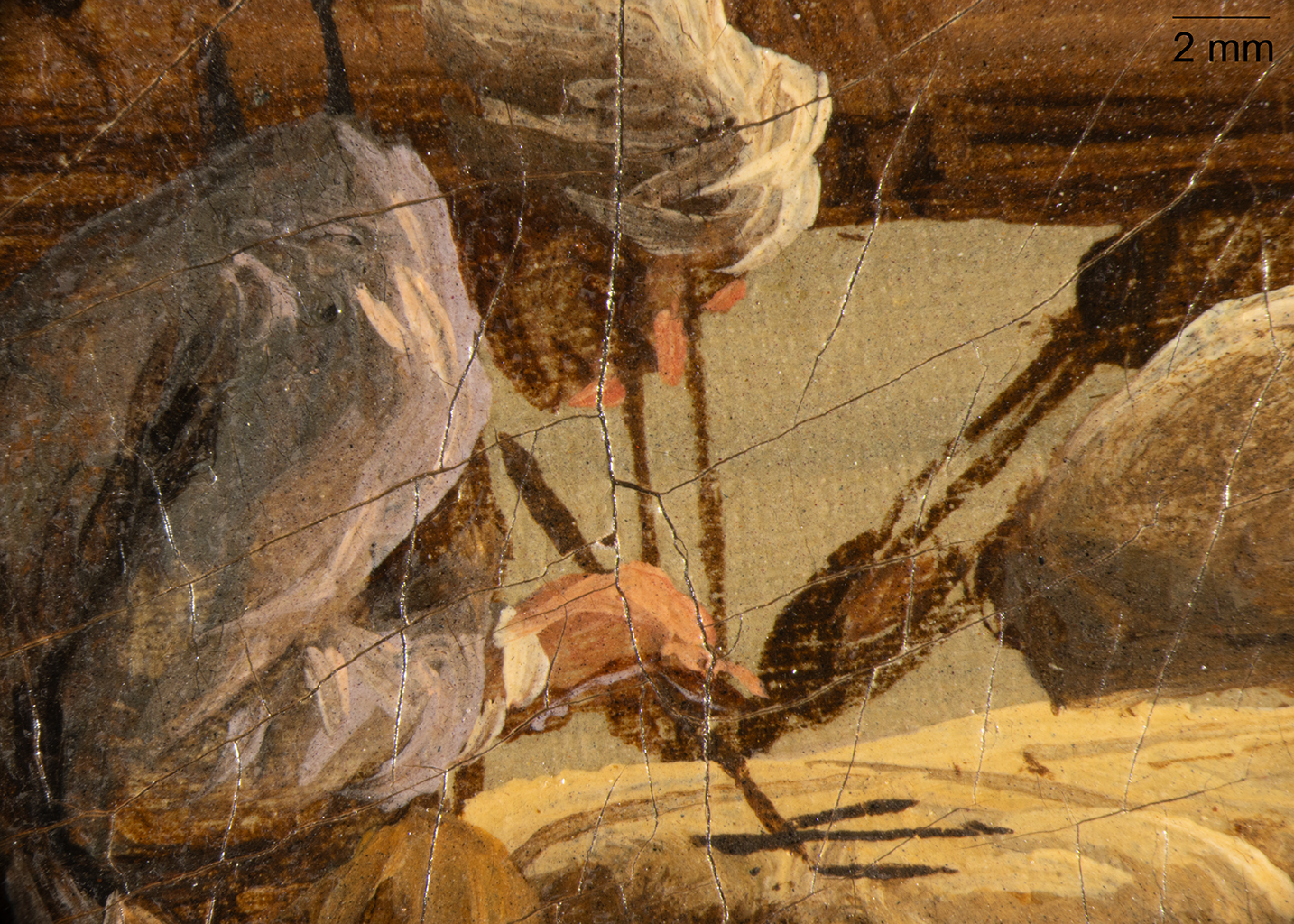
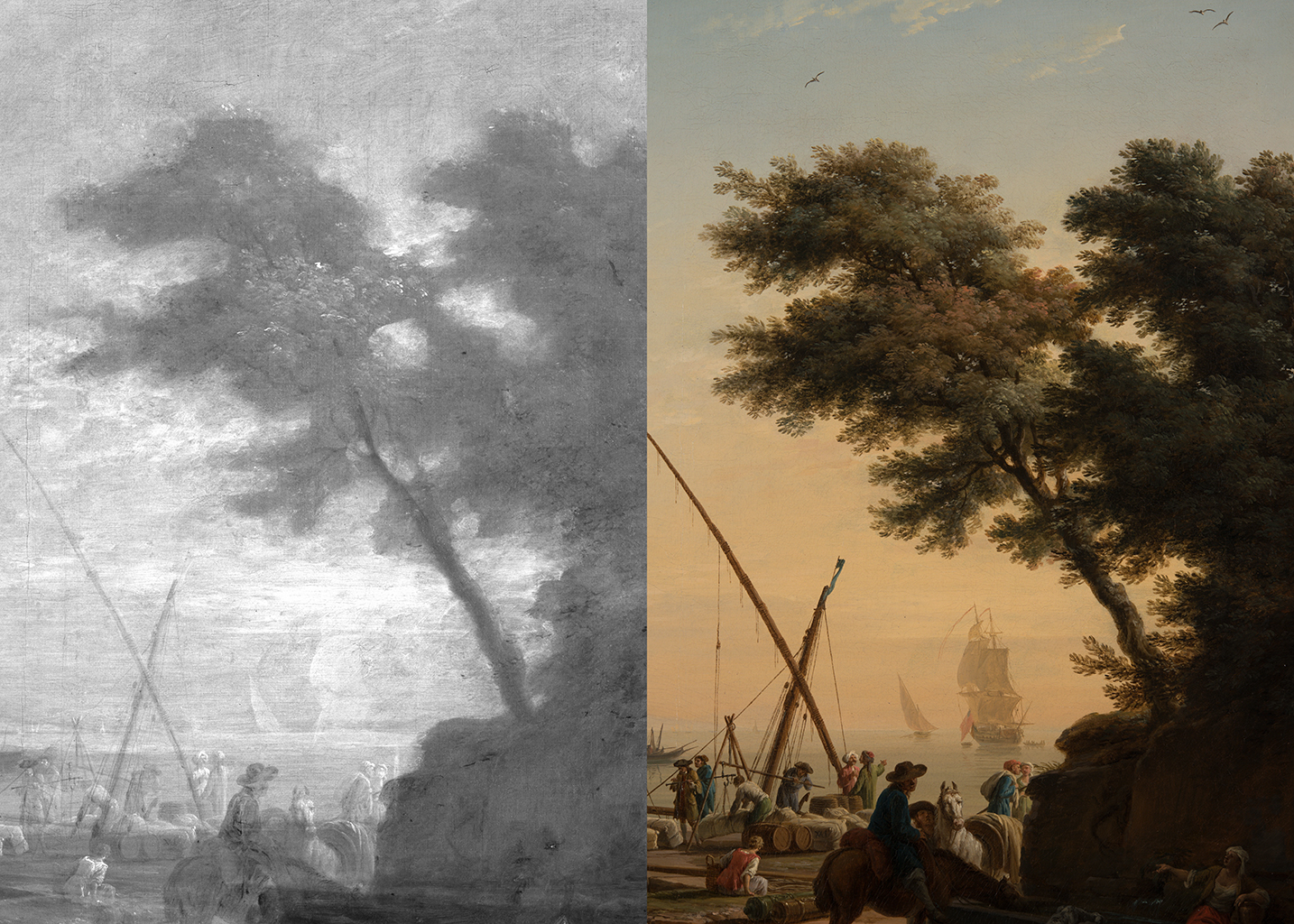
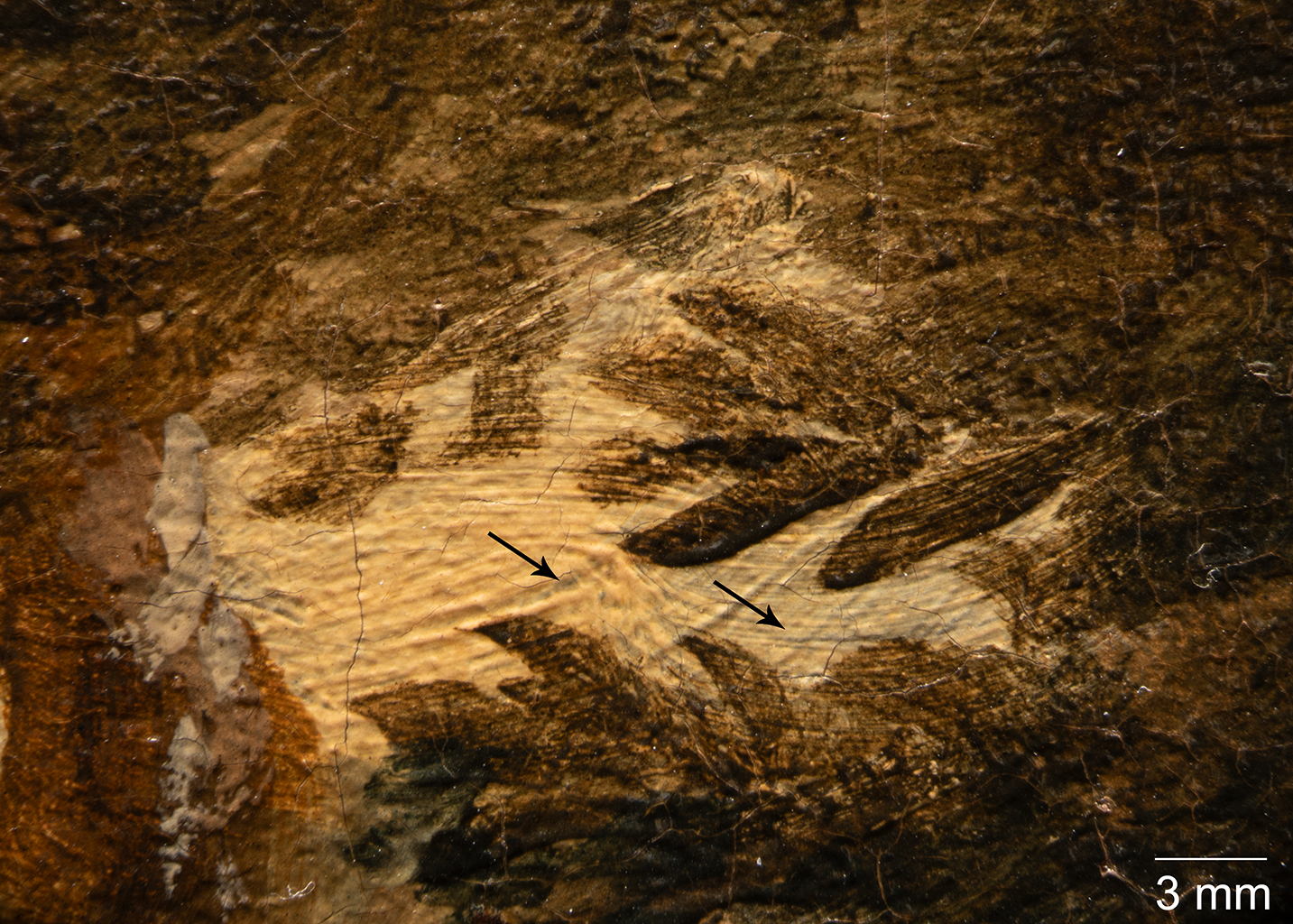
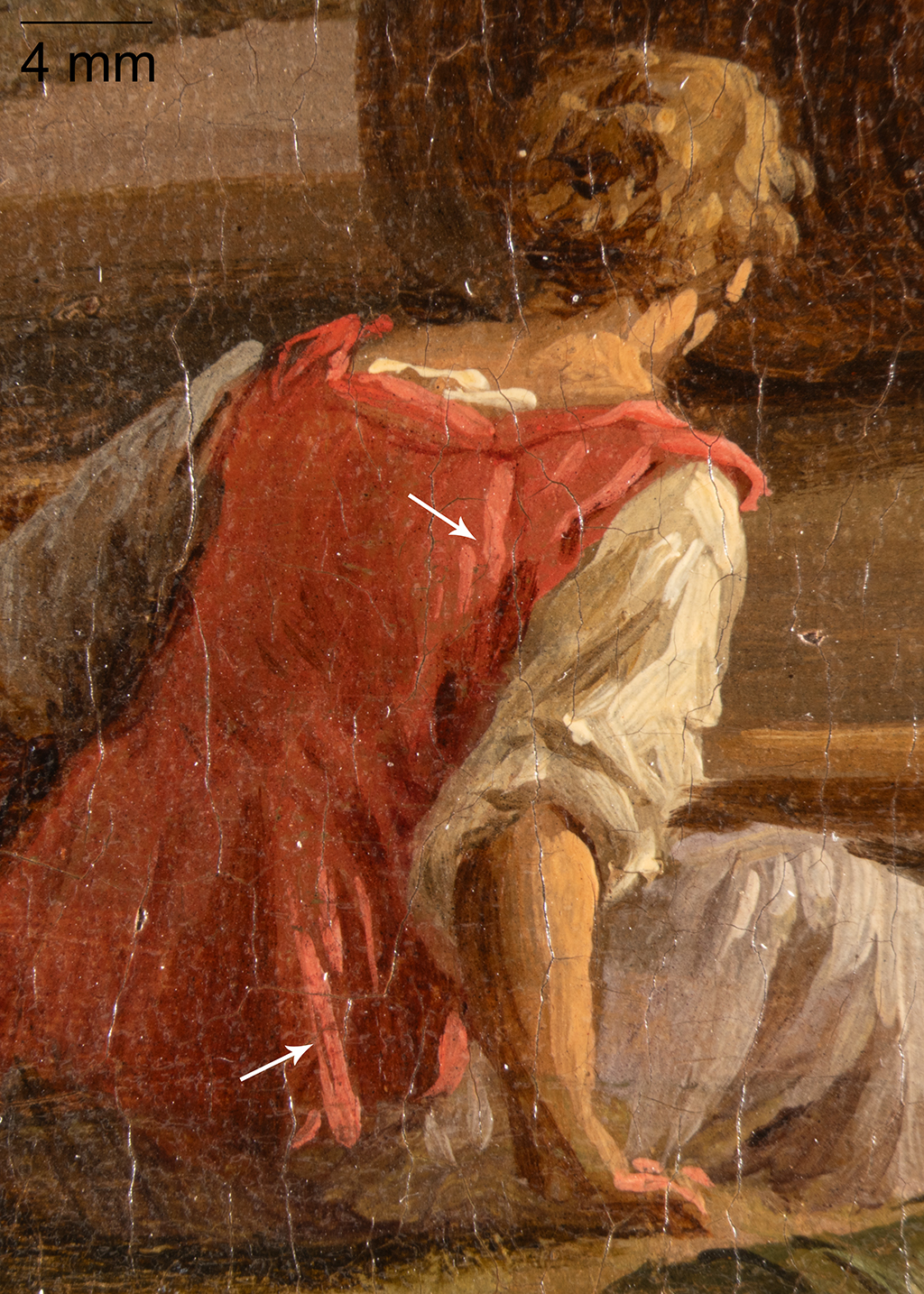
Vernet painted the landscape elements in a loose manner, capturing with painterly brushstrokes the fleeting effects of evening light on the mountains, clouds, and structures.4Based on contemporary writing, Vernet “devised some tablets, which he carried perpetually about him, and on which he painted, not merely the different tints of heavenly azure, but the different tones and accidents of light which the different heavenly colours reflected on the same objects.” Friedrich Melchior Grimm and Denis Diderot, Historical and Literary Memoirs and Anecdotes, Selected from the Correspondence of Baron de Grimm and Diderot with the Duke of Saxe-Gotha, between the Years 1753 and 1790 (London: Printed for H. Colburn, 1814), 2:455. He coded these painted tablets and “. . . inventa un alphabet de tons qu’il portait toujours sur lui dans un livre garni de plusieurs feuilles blanches; Les caractères divers de son alphabet étaient accolés à autant de teintes différentes. . . . Aussi promptement que l’on jette dix ou douze lettres sur le papier, il indiquait toute la gradation des tons du ciel qu’il admirait. Revenu chez lui . . . l’ayant fixé aussi rapidement que l’éclair sur ses tablettes, le rendait sur la toile d’après ses chiffres” (devised an alphabet of tones, which he always carried with him in a book containing several blank pages.The various characters of his alphabet corresponded to an equal number of distinct hues. . . . As quickly as one might jot down ten or twelve letters on paper, he would record the entire gradation of tones in the sky he was admiring. Upon returning home . . . having jotted it down on his tablets as quick as a flash, he would render it onto the canvas using those notations). Amédée Durande, Joseph, Carle et Horace Vernet: Correspondance et Biographies (Paris: J. Hetzel, 1863), 17–18. The natural and built elements of the landscape were completed without leaving reserve: An area of the composition left unpainted with the intention of inserting a feature at a later stage in the painting process. for the figures. For example, stone blocks are clearly visible beneath the increasingly transparent paint5For a discussion of increasing transparency of oil paint as it ages, see Andrea Kirsh and Rustin S. Levinson, Seeing Through Paintings: Physical Examination in Art Historical Studies (New Haven: Yale University Press, 2000), 161. of the torso of the figure loading goods in the lower left (Fig. 5a-b). Figures were underpainting: The first applications of paint that begin to block in color and loosely define the compositional elements. Also called ébauche. in thin brown paint, with fine dark lines describing the contours and washes used to develop shadows. Vernet used a similar technique in study sketches in pencil or pen and ink.6Figure 8 in the technical entry for the pendant painting, Seaport with Antique Ruins: Morning compares the red-brown underpainting in a figure from the painting to one of Vernet’s pen and ink study sketches. See Susan Pavlik Enterline, “Claude-Joseph Vernet, Seaport with Antique Ruins: Morning, 1751,” technical entry, in this catalogue, https://doi.org/10.37764/78973.5.332.2088. This method of underpainting is visible in the face of the figure holding the paintbrush where the artist only added a few dabs of peach paint along the figure’s profile (Fig. 6). Vernet painted the figures wet-over-wet: An oil painting technique which involves drawing a stroke of one color across the wet paint of another color. and lighter over darker, adding thicker dabs of bright tones for final highlights (Fig. 7).
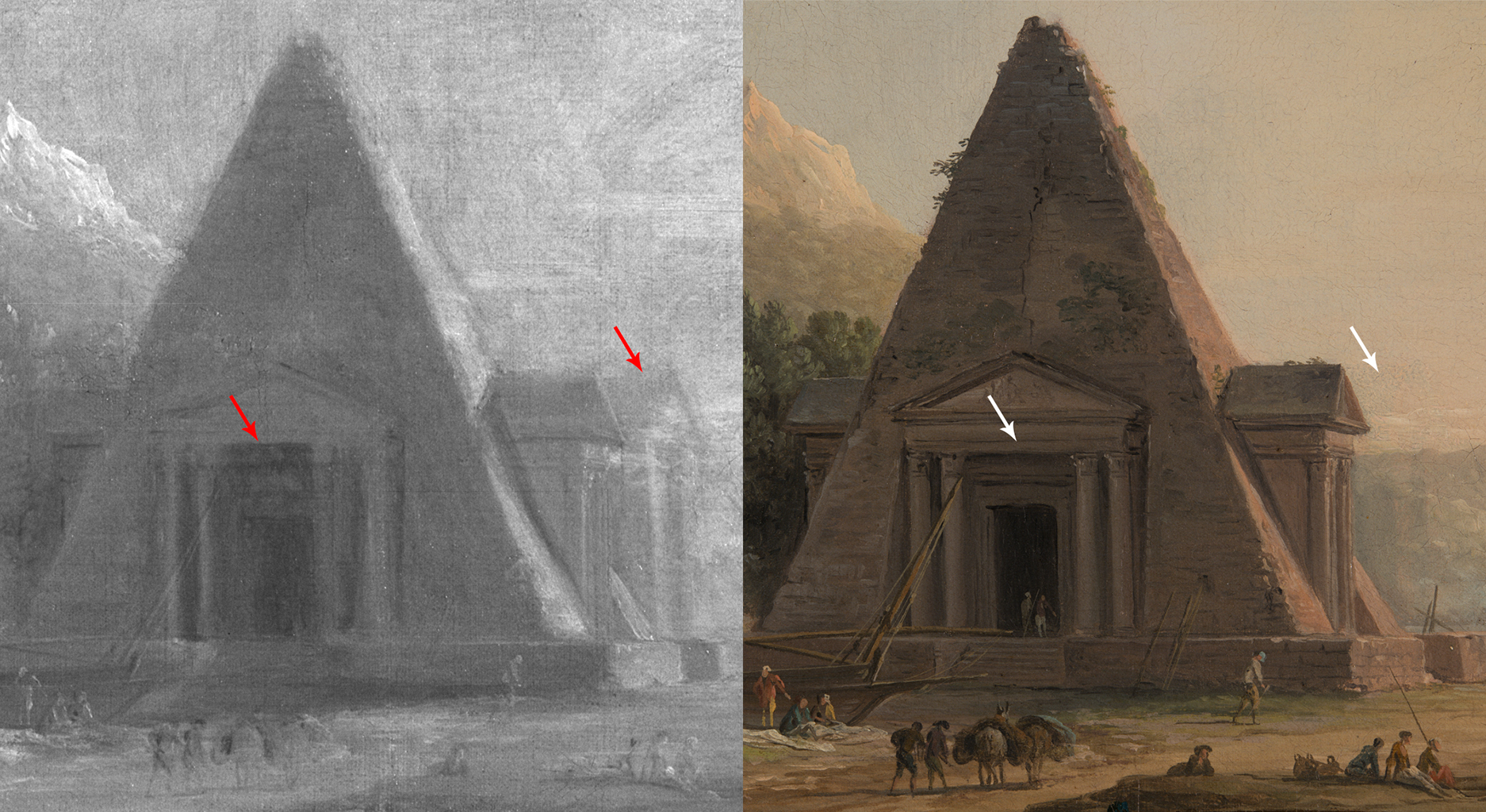
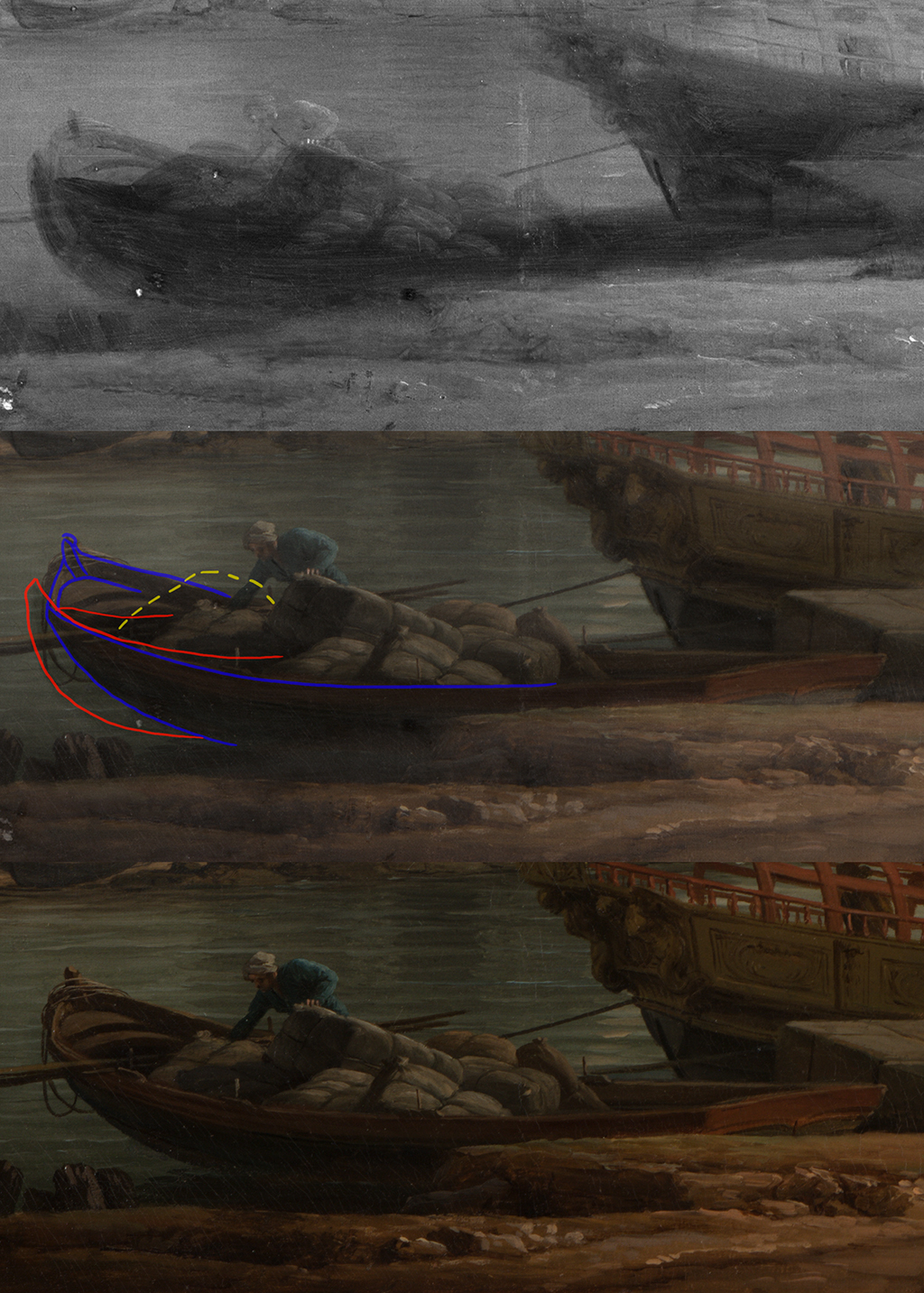
Coastal Harbor has several significant artist changes, some of which are visible as pentimento (pl: pentimenti): A change to the composition made by the artist that is visible on the paint surface. Often with time, pentimenti become more visible as the upper layers of paint become more transparent with age. Italian for "repentance" or "a change of mind." under normal viewing conditions. Two of the entrances to the pyramid, facing the viewer and facing right, have been shifted (Fig. 8a-b). On the forward-facing entrance, the entablature was lowered and the dark entrance doorway was shrunk to add pilasters and a lintel within the portico. The entrance facing right was originally further to the right, indicating that either the portico extended further from the pyramid, or the proportions of the pyramid were narrowed. Vernet also shifted the boat in the lower left (Fig. 9a-c). Originally painted in profile, the final composition shows a three-quarters view, drawing the eye into the bow.
The painting was glue-paste lined prior to its acquisition, likely due in part to the several tears or severe cracks apparent across the surface, most easily noted in the radiograph (Fig. 1). Small remnants of lining tape and thick, discolored adhesive or natural resin varnish cover most of the perimeter of the original canvas. The painting has typical craquelure: The network or pattern of cracks that develop on a paint surface as it ages. for its age that is not particularly distracting, though there are dark, somewhat disfiguring stretcher cracks: Linear cracks or deformations in the painting’s surface that correspond to the inner edges of the underlying stretcher or strainer members. running vertically near the center of the painting as well as in the upper right corner. Cracking associated with keying-out the painting is present in the lower corners, and impact cracks are scattered throughout. Some cracking has been addressed by retouching, as have areas of loss, abrasion, and visible pentimenti. There is widespread abrasion, most noticeable in the leaves of the tree on the right and in many of the figures. Treatment in 1984 focused on filling losses, retouching, and localized varnishing.7Forrest R. Bailey, November 7, 1984, treatment report, NAMA conservation file F84-66/2. The synthetic surface coating was applied before the painting entered the collection, and numerous campaigns of earlier filling and retouching are apparent.8The longwave ultraviolet (UVA)-induced visible fluorescence response of the varnish layer appears similar to the known fluorescence response of synthetic varnishes. The areas of overpaint and retouching have varied fluorescence responses, and the handling of the paint is mostly distinguishable between different campaigns. Along the upper edge, and in the right corner especially, there is fill material which appears to have been added to straighten the edge and square the corner. Much of the perimeter has been retouched.
Along the bottom edge and extending partway up the right edge, there is a band of yellow paint measuring approximately one centimeter in width. It is unclear whether it was added by the artist or by a later restorer; in some areas it is directly on top of the pink ground and elsewhere it continues over original paint. Especially along the bottom, it is completely covered by retouching. It is possible the yellow band was related to framing, but its purpose remains unclear. The painting is signed “Joseph Vernet / f. Roma 1751” in the lower right corner in a manner that makes the signature appear to be carved into the stone basin from which the dog is drinking.
Notes
-
Digital radiograph composite, nos. 616.1-616.4, May 14, 2026, NAMA conservation file, F84-66/2. The digital radiograph was captured under the following conditions: 40 kV, 1 mA, and 10 seconds.
-
See the accompanying catalogue entry by Richard Rand. Rand shares the painting’s measurements (“two feet eight inches wide, by two feet one inch high”) from a note in Vernet’s Livre de raison. The canvas now measures 86 by 66 centimeters. In 1750, a French pouce was equivalent to 1.066 current modern imperial inches, thus indicating the original measurements were approximately 86.6 by 67.7 centimeters.
-
Vernet wrote a letter in response to a request for sketches: “Je ne suis pas habitué à faire des esquisses pour mes tableaux, et je n’en ai jamais fait. Ma coutume est de composer sur la toile du tableau que je dois d’aire et de le peindre tout de suite pour profiter de la chaleur de mon imagination” (I am not in the habit of making sketches for my paintings, and I have never done so. My practice is to compose directly on the canvas of the painting I am to create and to paint it immediately, so as to capitalize on the heat of my imagination). Léon Lagrange, Joseph Vernet et la peinture au XVIIIe siècle. Avec le texte des Livres de raison, et un grand nombre de documents inédits (Paris: Didier, 1864), 179, https://
archive.org . All translations are by Susan Pavlik Enterline unless otherwise noted./details /josephvernetetla00lagr /page /178 /mode /2up -
Based on contemporary writing, Vernet “devised some tablets, which he carried perpetually about him, and on which he painted, not merely the different tints of heavenly azure, but the different tones and accidents of light which the different heavenly colours reflected on the same objects.” Friedrich Melchior Grimm and Denis Diderot, Historical and Literary Memoirs and Anecdotes, Selected from the Correspondence of Baron de Grimm and Diderot with the Duke of Saxe-Gotha, between the Years 1753 and 1790 (London: Printed for H. Colburn, 1814), 2:455. He coded these painted tablets and “. . . inventa un alphabet de tons qu’il portait toujours sur lui dans un livre garni de plusieurs feuilles blanches; Les caractères divers de son alphabet étaient accolés à autant de teintes différentes. . . . Aussi promptement que l’on jette dix ou douze lettres sur le papier, il indiquait toute la gradation des tons du ciel qu’il admirait. Revenu chez lui . . . l’ayant fixé aussi rapidement que l’éclair sur ses tablettes, le rendait sur la toile d’après ses chiffres” (devised an alphabet of tones, which he always carried with him in a book containing several blank pages.The various characters of his alphabet corresponded to an equal number of distinct hues. . . . As quickly as one might jot down ten or twelve letters on paper, he would record the entire gradation of tones in the sky he was admiring. Upon returning home . . . having jotted it down on his tablets as quick as a flash, he would render it onto the canvas using those notations). Amédée Durande, Joseph, Carle et Horace Vernet: Correspondance et Biographies (Paris: J. Hetzel, 1863), 17–18.
-
For a discussion of increasing transparency of oil paint as it ages, see Andrea Kirsh and Rustin S. Levinson, Seeing Through Paintings: Physical Examination in Art Historical Studies (New Haven: Yale University Press, 2000), 161.
-
Figure 8 in the technical entry for the pendant painting, Seaport with Antique Ruins: Morning compares the red-brown underpainting in a figure from the painting to one of Vernet’s pen and ink study sketches. See Susan Pavlik Enterline, “Claude-Joseph Vernet, Seaport with Antique Ruins: Morning, 1751,” technical entry, in this catalogue, https://doi.org/10.37764/78973.5.332.2088.
-
Forrest R. Bailey, November 7, 1984, treatment report, NAMA conservation file F84-66/2.
-
The longwave ultraviolet (UVA)-induced visible fluorescence response of the varnish layer appears similar to the known fluorescence response of synthetic varnishes. The areas of overpaint and retouching have varied fluorescence responses, and the handling of the paint is mostly distinguishable between different campaigns.
Documentation
Citation
Chicago:
Glynnis Napier Stevenson, “Claude Joseph Vernet, Coastal Harbor with a Pyramid: Evening, 1751,” documentation in French Paintings and Pastels, 1600–1945: The Collections of the Nelson-Atkins Museum of Art, ed. Aimee Marcereau DeGalan (Kansas City: The Nelson-Atkins Museum of Art, 2023), https://doi.org/10.37764/78973.5.333.4033.
MLA:
Stevenson, Glynnis Napier. “Claude Joseph Vernet, Coastal Harbor with a Pyramid: Evening, 1751,” documentation. French Paintings and Pastels, 1600–1945: The Collections of The Nelson-Atkins Museum of Art, edited by Aimee Marcereau DeGalan, Nelson-Atkins Museum of Art, 2023. doi: 10.37764/78973.5.333.4033.
Provenance
Commissioned from the artist, along with its pendant, Seaport with Antique Ruins: Morning, by Louis Gabriel Peilhon (1700–1762), Paris, November 1750–1762 [1];
Purchased at his posthumous sale, Tableaux du Cabinet de feu M. Peilhon, Secrétaire du Roi et Fermier Général, Chez Peilhon, Paris, May 16, 1763, no. 71, as Vues de Mer, des Ruines, des Fabriques et du Paysage avec beaucoup de Figures, by Jean Henri Eberts (1726–1793), Paris, 1763 [2];
Pieter de Smeth (1753–1809), heer van Alphen en Rietveld, Amsterdam, by September 7, 1809 [3];
Purchased from his posthumous sale, Eene fraaije Verzameling van Uitmuntende Schilderijen, door de Meest Beroemde Nederlandsche Meesters, In vele Jaren met kunde bijeen verzameld door Een Voornaam Liefhebber, Philippus van der Schley, Amsterdam, August 6, 1810, lot 108, as Een Zeehaven, rijk gestosseerd met Kooplieden en Arbeiders, bezig Koopmanschappen als Balen, Vaten en andere Goederen in Vaartuigen te laden, op den voorgrond Reizigers bij eenen Put, die hunnen Paarden laten drinken; warm van koloriet; uitvoerig en fraai gepenceeled, through Texier Gerbet en Comp [Teissier], Amsterdam, by Jean-Baptiste-Pierre Lebrun, Paris, 1810–April 16, 1811;
Purchased from his sale, Vente d’une Collection de Tableaux Capitaux et du Plus Beau Choix, des Trois Écoles; Statues de Marbre, Bronzes, Tables Antiques, de Florence, Piscines, et Autres Objets, Provenant de Voyages faits tant en Italie, qu’en Flandres, en Hollande, en Suisse, et à Genève, rue du Gros-Chenet, Paris, April 16, 1811, lot 228, as Deux Marines: l’autre offre sur la droite un monticule sur lequel est une masse d’arbres et une fontaine au bas, où l’on voit un homme qui fait boire son cheval, tandis que boit son chien; il semble parler à une femme assise; de l’autre côté de la jetée, l’on voit un bâtiment dont les voiles sont carguées; une petite barque chargée de ballots; plus loin, au-delà de la rivière, s’offre une pyramide avec portique et fronton; nombre de figures; une grande étendue d’eau, nombre de figures; une grande étendue d’eau, nombre de petits vaisseaux et de montagnes terminent cette riche composition, éclairée par un soleil couchant. Ces deux précieux Tableaux sont du plus beau temps et des plus parfaits de ce maître, by Jean-Louis Titon La Neuville, called Laneuville (1748–1826), Paris, 1811–January 1813 at the latest;
With Irlande l’aîné and Bordier, Paris, by January 27, 1813;
Purchased at their sale, Une Collection de Tableaux des Écoles flamande, hollandaise, allemande et française; D’une suite variée de Bronzes de grande et moyenne proportions, dont l’exécution ne laisse rien à désirer, galerie de la rue de l’Échiquier, Paris, January 27, 1813, no. 95, as Deux Marines: l’autre offre, sur la droite, un monticule sur lequel est une masse d’arbres et une fontaine au bas, où l’on voit un homme qui fait boire son cheval, tandis que son chien boit; il semble parler à une femme assise; de l’autre côté de la jetée, on voit un bâtiment dont les voiles sont carguées; une petite barque chargée de balots; plus loin, au-delà de la rivière, s’offre une pyramide, avec portique et fronton, nombre de fig[ures], by Jacques Nicolas Brunot (1763–1826), Paris, 1813 [4];
With Bordier, Bareira, and Rioult, Paris, by January 27, 1817 [5];
Baron Melchior Roger Portalis (1841–1912), Paris, by May 12, 1873;
His sale, Tableaux anciens formant les collections de M. le Marquis de B[iancourt] et M. le Baron P[ortalis], Hôtel Drouot, Paris, May 12–13, 1873, no. 93, as Port de mer;
Fould family, Paris, by May 26, 1980 [6];
Purchased from the Fould family descendants, Importants Tableaux Anciens, Sotheby’s, Monte Carlo, May 26, 1980, lot 541, as Soleil couchant, vue d’un port méditerranéen, by Richard Green and Edward Speelman, London, May–September 1980;
Purchased from Richard Green, London, by Charles Agee (b. 1954) and Frances Martin “Marti” (née Bellingrath, b. 1954) Atkins, New York, September 1980 [7];
With Newhouse Galleries, New York, by October 8, 1984 [8];
Purchased from Newhouse by The Nelson-Atkins Museum of Art, Kansas City, MO, 1984.
Notes
[1] Citation of the month of commission can be found in Léon Lagrange, Joseph Vernet: sa vie, sa famille, son siècle, d’après des documents inédits (Brussels: Imprimerie de A. Labroue et Cie, 1858), 48.
[2] For buyer’s name, see annotated sale catalogue at the Philadelphia Museum of Art Library.
[3] The “Mr. Smeth” annotation on the RKD Netherlands Institute for Art History copy of the 1811 catalogue drawn up by the dealer Lebrun almost certainly refers to Pieter de Smeth van Alphen, who died in 1809 and amassed a significant collection offered up in August 1810 after his banking firm went bankrupt. Further support for his presence in the provenance comes from Smeth expert Laurens Meerman, “The French dealer Lebrun bought no fewer than 27 paintings at Pieter’s sale through the Amsterdam art dealers Texier, Gerbet en Co. . . . He sold most of them between 16 and 20 April [1811] in his Paris auction rooms.” See Laurens Meerman, “An Unwritten Chapter of Dutch Collecting History: The Painting Collection of Pieter de Smeth van Alphen (1753–1809),” Simiolus: Netherlands Quarterly or the History of Art 40, no. 1 (2018): 50–51.
[4] The Getty Provenance Index lists “Irlande aîné et Bordier” as the sellers at the January 27, 1813 sale. These are both dealers. “Lot 0095 from Sale Catalog F–421,” The Getty Provenance Index Databases, Los Angeles.
The previous owner of the pendants, the dealer Laneuville, could have still been involved in this sale. See Valérie Lavergne-Durey, Jean-Louis Titon La Neuville, dit Laneuville (1756–1826): Portraitiste et Marchand-Expert, exh. cat. (Vizille, France: Musée de la Révolution française, 2014), 43.
[5] As per the Getty Provenance Index Databases, the pendants were in the dealer Bordier’s stock by 1817. A “M. B***” is noted on the cover of the 1817 catalogue and this could be Jacques Nicolas Brunot, who bought the painting in 1813. It could also be a reference to Bordier. Lot 0077 from Sale Catalog F–717, The Getty Provenance Index Databases, Los Angeles. The two paintings were in the following sale, organized by Laneuville, but were withdrawn after failing to sell: Une Collection de Tableaux de Différens [sic] Maitres des Écoles Italienne, Flamande et Française; Estampes encadrées et Estampes en feuilles, Provenant du Cabinet de M. B[ordier], Hôtel de Bullion, Paris, January 27, 1817, lot 77. The Getty lists “Bordier, Bareira, Rioult” as the seller.
[6] See ongoing email correspondence between Clémence Enriquez, cataloguer of old master and nineteenth-century paintings and Russian art liaison expert, Sotheby’s, Paris, and Glynnis Napier Stevenson, NAMA, begun January 26, 2023, NAMA curatorial file. This exchange is regarding the identities of the Fould family members who owned the Vernet pendants.
[7] See email from Laura Bergues, personal assistant to Jonathan Green, Richard Green Fine Paintings, London, to Glynnis Napier Stevenson, NAMA, January 24, 2023, NAMA curatorial file.
[8] See ongoing email correspondence from Glynnis Napier Stevenson and MacKenzie Mallon, NAMA, to Meg Newhouse Kirkpatrick, former CEO of Newhouse Galleries, begun October 28, 2019, NAMA curatorial file.
Exhibitions
Salon of 1753, Paris, August 25–September 25, 1753, no. 129, as Deux Païsages et Marines.
A Bountiful Decade: Selected Acquisitions 1977–1987, The Nelson-Atkins Museum of Art, Kansas City, MO, October 14–December 6, 1987, no. 62, as Coastal Harbor with a Pyramid: Evening.
References
Explication des Peintures, Sculptures, et Autres Ouvrages de Messieurs de L’Academie Royale dont l’exposition a été ordonnée suivant l’intention de Sa Majesté, par M. De Vandieres, Conseiller du Roy en ses Conseils, Directeur et Ordonnateur Général des Bâtimen[t]s, Jardins, Arts et Manufactures de S.M. dans le grand Salon du Louvre; et l’arrangement conduit par les soins du Sieur Portail, de l’Académie Royale de Peinture et de Sculpture, Garde des Plans et Tableaux du Roy (Paris: Imprimerie de J. J. E. Collombat, 1753), 27, as Deux Païsages et Marines sous le même Numero.
“Beaux-Arts: Exposition des ouvrages de l’Académie Royale de Peinture et de Sculpture, faite dans une Sal[l]e du Louvre le 25 Août 1753,” Mercure de France (October 1753): 163.
[Charles-Nicolas] Cochin, Lettre à un amateur En réponse aux Critiques qui ont paru sur l’exposition des Tableaux ([Paris: Charles-Antoine Jombert], 1753), Bibliothèque nationale de France, Collection Deloynes, vol. 5, no. 61, pp. 24–25, as le Tableau du Soleil couchant n’est qu’une ébauche.
[Anne Claude Phillipe de Pestels de Lévis de Tubiéres-Grimoard, comte de] Caylus, Exposition Des ouvrages de l’Academie Royale de Peinture et Sculpture, faite dans un sal[l]e du Louvre, le 25 Août 1753, [1753–1754], Bibliothèque nationale de France, Collection Deloynes, vol. 5, no. 54, p. 6.
[Pierre] Estéve, Lettre à un Ami, Sur l’Exposition des Tableaux faite dans le grand Sallon [sic] du Louvre, le 25. Août 1753 [1753–1754], Bibliothèque nationale de France, Collection Deloynes, vol. 5, no. 56, p. 12, as un coucher de Soleil, qui ne paroît qu’ébauché.
P[ierre] Rémy, Catalogue Raisonné des Tableaux du Cabinet de feu M. Peilhon, Secrétaire du Roi et Fermier Général (Paris: Didot, May 16, 1763), 39, as Deux Tableaux du même Maître peints en 1751, sur toile de deux pieds de haut, sur deux pieds sept pouces et demi de large. Ils représentent[nt] des Vues de Mer, des Ruines, des Fabriques et du Paysage avec beaucoup de Figures.
Catalogus van eene fraaije Verzameling van Uitmuntende Schilderijen, door de Meest Beroemde Nederlandsche Meesters, In vele Jaren met kunde bijeen verzameld door Een Voornaam Liefhebber (Amsterdam: Schleij, Ijver, roos, Vries, and Spaan, August 6, 1810), 26, as en Zeehaven, rijk gestoffeerd met Koplieden en Arbeiders, bezig Koppmanschappen als Balen, Vaten en andere Goederen in Vaartuigen te laden, op den voorgrond Reizigers bij eenen Put, die hunnen Paarden laten drinken; warm van koloriet; uitvoerig en sraai gepenceeld.
Vente d’une collection de tableaux capitaux et du plus beau choix, des trois écoles: statues de marbre, bronzes, tables antiques, de Florence, piscines, et autres objets, provenant de voyages faits tant en Italie, qu’en Flandres, en Hollande, en Suisse, et à Genève (Paris: Jean-Baptiste-Pierre Lebrun, April 16, 1811), 77–78, as Deux Marines; l’autre offre sur la droite un monticule sur lequel est une masse d’arbres et une fontaine au bas, où l’on voit un homme qui fait boire son cheval, tandis que boit son chien; il semble parler à une femme assise; de l’autre côté de la jetée, l’on voit un bâtiment dont les voiles sont carguées; une petite barque chargée de ballots; plus loin, au-délà de la rivière, s’offre une pyramide avec portique et fronton; nombre de figures; une grande étendue d’eau, nombre de petits vaisseaux et de montagnes terminent cette riche composition, éclairée par un soleil couchant. Ces deux précieux Tableaux sont du plus beau temps et des plus parfaits de ce maître.
Jean-Baptiste-Pierre Lebrun, Catalogue d’une Collection de Tableaux des Écoles flamande, hollandaise, allemande et française; D’une suite variée de Bronzes de grande et moyenne proportions, dont l’exécution ne laisse rien à désirer (Paris: Olivier and Jean-Baptiste-Pierre Lebrun, 1813), 27–28, as Deux Marines: l’autre offre, sur la droite, un monticule sur lequel est une masse d’arbres et une fontaine au bas, où l’on voit un homme qui fait boire son cheval, tandis que son chien boit; il semble parler à une femme assise; de l’autre côté de la jetée, on voit un bâtiment dont les voiles sont carguées; une petite barque chargée de balots; plus loin, au-delà de la rivière, s’offre une pyramide, avec portique et fronton, nombre de fig[ures].
Catalogue d’Une Collection de Tableaux de Différens [sic] Maitres des Écoles Italienne, Flamande et Française; Estampes encadrées et Estampes en feuilles, Provenant du Cabinet de M. B*** (Paris: Laneuville et Revenaz, January 27, 1817), 12, as Deux marines . . . L’autre offre, sur la droite, un monticule sur lequel sont une masse d’arbres et une Fontaine au bas, o l’on voit un homme qui fait boire son cheval, tandis que son chien boit; il semble parler à une femme assise; de l’autre côté de la jetée, on voit un bâtiment dont les voiles sont carguées; une petite barque chargée de ballots; plus loin, au-delà de la rivière, s’offre une pyramide avec portique et fronton; nombre de figures; une grande étendue d’eau; quantité de petits vaisseaux et de montagnes terminent cette riche composition éclairée par un soleil couchant.
Charles Blanc, Le trésor de la curiosité, tiré des catalogues de vente de tableaux, dessins, estampes, livres, marbres, bronzes, ivoires, terres cuites, vitraux, médailles, armes, porcelaines, meubles, émaux, laques et autres objets d’art; avec diverses notes et notices historiques et biographiques (Paris: Veuve Jules Renouard, 1857), 1:115, as Deux Marines peintes en 1751, dont l’une est gravée par Daullé sous le titre du Pèlerinage.
Léon Lagrange, Joseph Vernet: sa vie, sa famille, son siècle, d’après des documents inédits (Brussels: Imprimerie de A. Labroue et Cie, 1858), 48, as un soleil couchant, bien chaud et bien doré.
Léon Lagrange, Les Vernets: Joseph Vernet et La Peinture au XVIIIe Siècle, 2nd ed. (Paris: Didier, 1864), 187, 333, as un soleil couchant, bien chaud et bien doré . . . qu’il y aye [sic] du païsage [sic] et de la marine, avec des cascades ou des rivières, des figures et des animeaux [sic].
Jules Guiffrey, Collection des livrets des anciennes expositions depuis 1673 jusqu’en 1800: Salon de 1753 (Paris: Liepmannssohn et Dufour, 1869), 28, as Deux Païsages et Marines sous le même Numero [sic].
Tableaux anciens formant les collections de M. le Marquis de B[iancourt] et M. le Baron P[ortalis] (Paris: Hôtel Drouot, May 12–13, 1873), 43, as Port de mer.
Félix de Bona [Blanche Besserve], Une famille de peintres: Horace Vernet et ses ancêtres (Lille: Desclée, de Brouwer et Cie, 1891), 13.
Emilia Francis Strong Dilke, French Painters of the XVIIIth Century (London: G. Bell and Sons, 1899), 212, as Deux Païsages et Marines sous le même Numéro.
Hippolyte Mireur, Dictionnaire des ventes d’art faites en France et à l’Étranger pendant les XVIIIe et XIXe siècles (Paris: Maison d’Editions d’Œuvres artistiques, Ch. de Vincenti, 1912), 7:342, as Deux marines peintes en 1751.
Florence Ingersoll-Smouse, Joseph Vernet, peintre de marine, 1714–1789: étude critique suivie d’un catalogue raisonné de son œuvre peint (Paris: Étienne Bignou, 1926), no. 321, p. 1:60, as Soleil couchant.
Emile Dacier, “L’Athénienne et son inventeur,” Gazette des beaux-arts 8, no. 835 (July 1932): 115.
Pierre Arlaud, Catalogue raisonné des estampes gravées d’aprês Joseph Vernet (Avignon: Impriméries Rullière-Libeccio, 1976), 38, as Soleil Couchant.
Philip Conisbee, Claude-Joseph Vernet, 1714–1789, exh. cat. (London: Greater London Council, 1976), unpaginated.
Importants Tableaux Anciens Principalement de l’Ecole Française du XVIIIe Siècle (Monte Carlo: Sotheby Parke Bernet Monaco S.A., May 26, 1980), 38–39, as Soleil couchant, vue d’un port méditerranéen.
Art at Auction: The Year at Sotheby Parke Bernet 1979–80 (London: Sotheby Parke Bernet, 1980), 26, (repro.), as A Mediterranean port at sunset.
Enrique Mayer, International Auction Records: 1981 ( n.p.: Éditions Mayer, 1981), 15:1243, as Soleil couchant, vue d’un port méditerranéen and A harbour scene at sunset.
“Behind the Scenes: Curatorial Travel is No Vacation,” Calendar of Events (The Nelson-Atkins Museum of Art) (November 1984): unpaginated, as Evening.
“New at the Nelson: Pair of Paintings by Vernet Given to the Nelson,” Calendar of Events (The Nelson-Atkins Museum of Art) (January 1985): unpaginated, as Coastal harbor with a pyramid: evening.
“Calendar,” Burlington Magazine 127, no. 984 (March 1985): 195–96.
Sotheby’s à Monaco 10 Ans: 1975–1985 (Paris: Sotheby’s Paris, 1986), unpaginated, (repro.), as Soleil couchant, vue d’un port méditerranéen.
Roger Ward, ed., A Bountiful Decade: Selected Acquisitions, 1977–1987, exh. cat. (Kansas City, MO: Nelson-Atkins Museum of Art, 1987), 144–45, (repro.), as Coastal Harbor with a Pyramid: Evening.
Michael Churchman and Scott Erbes, High Ideals and Aspirations: The Nelson-Atkins Museum of Art, 1933–1993 (Kansas City, MO: Nelson-Atkins Museum of Art, 1993), 108, as Coastal Harbor with a Pyramid: Evening.
Roger Ward and Patricia J. Fidler, eds., The Nelson-Atkins Museum of Art: A Handbook of the Collection (New York: Hudson Hills Press, in association with Nelson-Atkins Museum of Art, 1993), 188, (repro.), as Coastal Harbor with a Pyramid: Evening.
Helge Siefert, Claude-Joseph Vernet, 1714–1789, exh. cat. (Munich: Bayerische Staatsgemäldesammlungen, 1997), 10, as die römischen und neapolitanischen Veduten mit Szenen des täglichen Lebens.
Jan Schall, ed., Tempus Fugit: Time Flies, exh. cat. (Kansas City, MO: Nelson-Atkins Museum of Art, 2000), 241, 349, 356, (repro.), as Coastal Harbor with a Pyramid: Evening.
Pierre Sanchez, Dictionnaire des Artistes Exposant dans les Salons des XVII et XVIIIème Siècles À Paris et en Province 1673–1800 (Dijon: L’Échelle de Jacob, 2004), 3:1679, as Deux Païsages et Marines sous le même Numéro.
Stephen D. Borys, The Splendor of Ruins in French Landscape Painting, 1630–1800, exh. cat. (Oberlin, OH: Allen Memorial Art Museum, 2005), 163, 165–66, (repro.), as Coastal Harbor with a Pyramid: Evening.
Deborah Emont Scott, ed., The Nelson-Atkins Museum of Art: A Handbook of the Collection, 7th ed. (Kansas City, MO: Nelson-Atkins Museum of Art, 2008), 99, (repro.), as Coastal Harbor with a Pyramid: Evening.
Valérie Lavergne-Durey, Jean-Louis Titon La Neuville, dit Laneuville (1756–1826): Portraitiste et Marchand-Expert, exh. cat. (Vizille, France: Musée de la Révolution française, 2014), 50, 71n426, as Marines.