Catalogue Entry
Read more about this painting at the associated catalogue entry.
Technical Entry
Citation
Chicago:
Sophia Boosalis, “After Jean François de Troy, A Lady Showing a Bracelet Miniature to Her Suitor, 1764 (?),” technical entry in French Paintings and Pastels, 1600–1945: The Collections of the Nelson-Atkins Museum of Art, ed. Aimee Marcereau DeGalan (Kansas City: The Nelson-Atkins Museum of Art, 2026), https://doi.org/10.37764/78973.5.313.2088.
MLA:
Boosalis, Sophia. “After Jean François de Troy, A Lady Showing a Bracelet Miniature to Her Suitor, 1764 (?),” technical entry. French Paintings and Pastels, 1600–1945: The Collections of The Nelson-Atkins Museum of Art, edited by Aimee Marcereau DeGalan, Nelson-Atkins Museum of Art, 2026. doi: 10.37764/78973.5.313.2088.
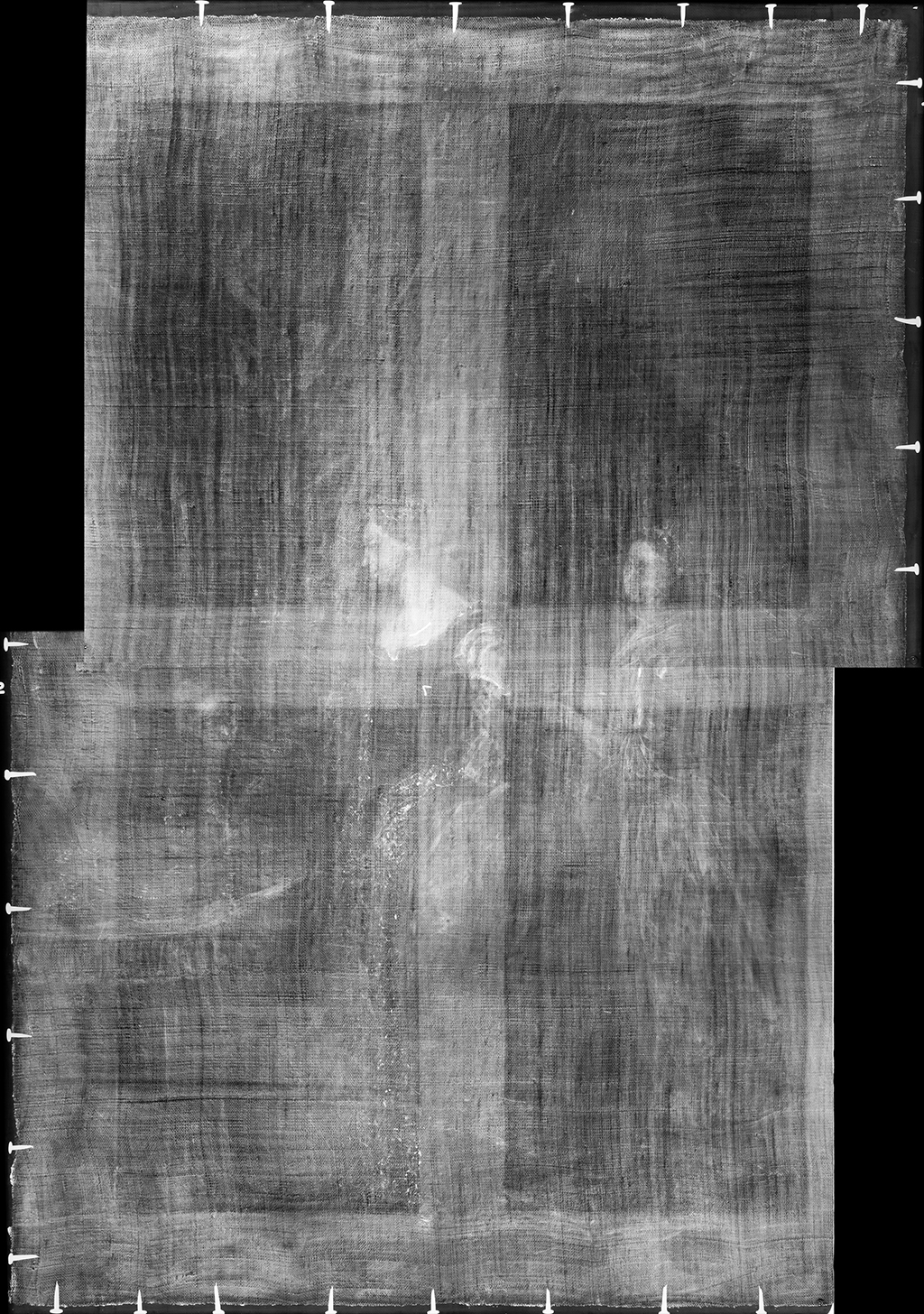
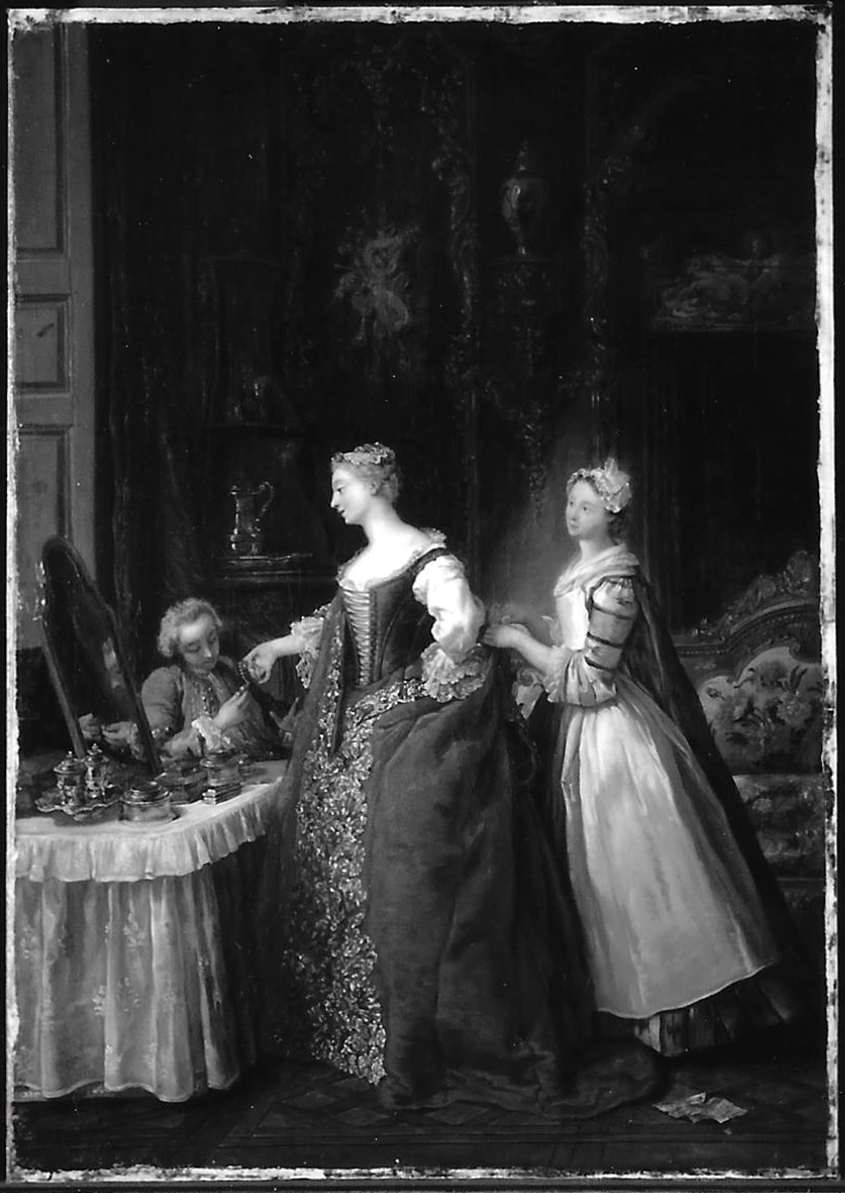
A Lady Showing a Bracelet Miniature to Her Suitor was executed on a fine, plain weave: A basic textile weave in which one weft thread alternates over and under the warp threads. Often this structure consists of one thread in each direction, but threads can be doubled (basket weave) or tripled to create more complex plain weave. Plain weave is sometimes called tabby weave. canvas with numerous slubs.1Forrest Bailey, examination report, December 17, 1982, NAMA conservation file, 82-36/2. Little information is known about the original canvas as its tacking margins: The outer edges of canvas that wrap around and are attached to the stretcher or strainer with tacks or staples. See also tacking edge. were removed during a previous lining: A procedure used to reinforce a weakened canvas that involves adhering a second fabric support using adhesive, most often a glue-paste mixture, wax, or synthetic adhesive., and the outer edges are now covered by fill material: A material added to a loss of paint and/or ground to create an area level with the surrounding original paint. and retouching: Paint application by a conservator or restorer to cover losses and unify the original composition. Retouching is an aspect of conservation treatment that is aesthetic in nature and that differs from more limited procedures undertaken solely to stabilize original material. Sometimes referred to as inpainting or retouch.. X-ray radiography (also referred to as x-radiography or radiography): Radiography is an examination tool analogous to the use of X-rays in medicine whereby denser components of a painted composition can be recorded as an inverted shadow image cast on film or a digital X-ray imaging plate from a source such as an X-ray tube. The method has been used for more than a century and is most effective with dense pigments incorporating metallic elements such as lead or zinc. It can reveal artist changes, underlying compositions, and information concerning the artwork’s construction and condition. The resulting image is called an x-radiograph or radiograph. It differs from the uses of X-ray spectrometry in being dependent on the density of the paint to absorb X-rays before they reach the film or image plate and being non-specific as to which elements are responsible for the resulting shadow image. confirms that the original canvas does not extend to the painting’s current outer edges (Fig. 1);2The radiograph is a composite of two film-based radiographs, with black areas representing regions that were not captured. See film-based radiographs, no. 173, 1982, NAMA conservation file, 82-36/2. a similar treatment was performed on A Lady Attaching a Bow to a Gentleman’s Sword (F82-36/1). However, strong cusping: A scalloped pattern along the canvas edges that relates to how the canvas was stretched. Primary cusping reveals where tacks secured the canvas to the support while the ground layer was applied. Secondary cusping can form when a pre-primed canvas is re-stretched by the artist prior to painting. visible along all four edges indicates that the composition is close to its original dimensions. The canvas was prepared with a thickly applied, light-gray ground layer: An opaque preparatory layer applied to the support, either commercially or by the artist, to prevent absorption of the paint into the canvas or panel. See also priming layer..
No underdrawing: A drawn or painted sketch beneath the paint layer. The underdrawing can be made from dry materials, such as graphite or charcoal, or wet materials, such as ink or paint. was detected using infrared reflectography (IRR): A form of infrared imaging that exploits the behavior of painting materials at wavelengths beyond those accessible to infrared photography. These advantages sometimes include a continuing increase in the transparency of pigments beyond wavelengths accessible to infrared photography (i.e, beyond 1,000 nanometers), rendering underdrawing more clearly. The resulting image is called an infrared reflectogram. Devices that came into common use in the 1980s such as the infrared vidicon effectively revealed these features but suffered from lack of sharpness and uneven response. Vidicons continue to be used out to 2,200 nanometers but several newer pixelated detectors including indium gallium arsenide and indium antimonide array detectors offer improvements. All of these devices are optimally used with filters constraining their response to those parts of the infrared spectrum that reveal the most within the constraints of the palette used for a given painting. They can be used for transmitted light imaging as well as in reflection. or stereomicroscopic examination. The artist executed the composition over a short period of time as evident by the extensive wet-over-wet: An oil painting technique which involves drawing a stroke of one color across the wet paint of another color. brushwork. Compositional elements appear to have been laid in with initial wash: An application of thin paint that has been diluted with solvent., such as the red wash beneath the vanity and the brown wash in the curtains. The artist established the salon interior first and left reserve: An area of the composition left unpainted with the intention of inserting a feature at a later stage in the painting process. for the central figures.
The back wall was constructed with a modulating brownish-gray tone over which the gilded boiseries (paneling) were blocked in with ocher, yellow, and brown paint. Dark washes were subsequently applied to define shadows and spatial depth. Although abrasion: A loss of surface material due to rubbing, scraping, frequent touching, or inexpert solvent cleaning. limits a more detailed analysis, the gilded surfaces throughout the composition appear to follow a similar approach. The green curtain was painted over a brown wash that remains visible as a warm midtone within the folds. Above the green washes, loose zigzagging strokes of lighter green paint create highlights and a satin-like reflectance.
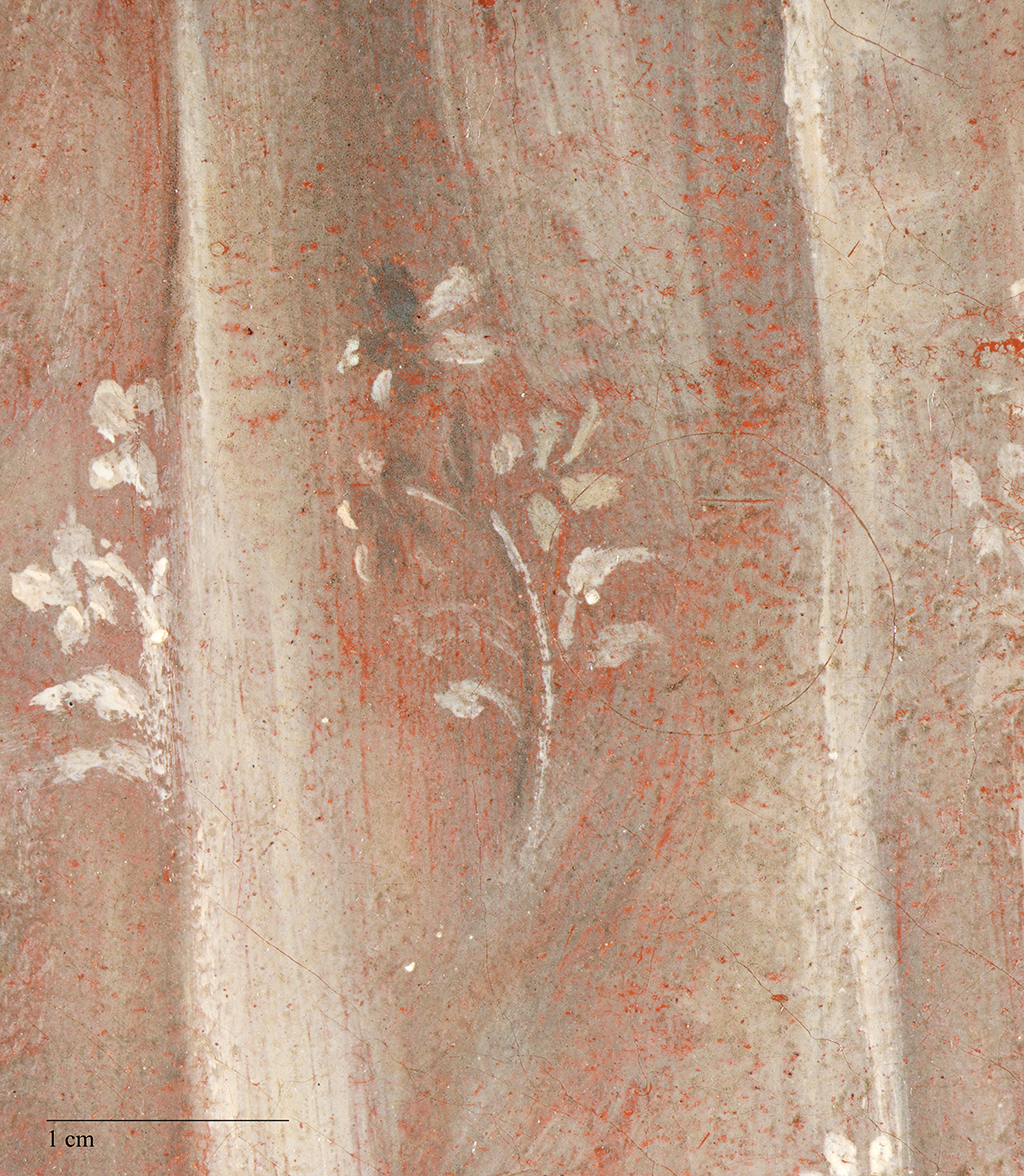
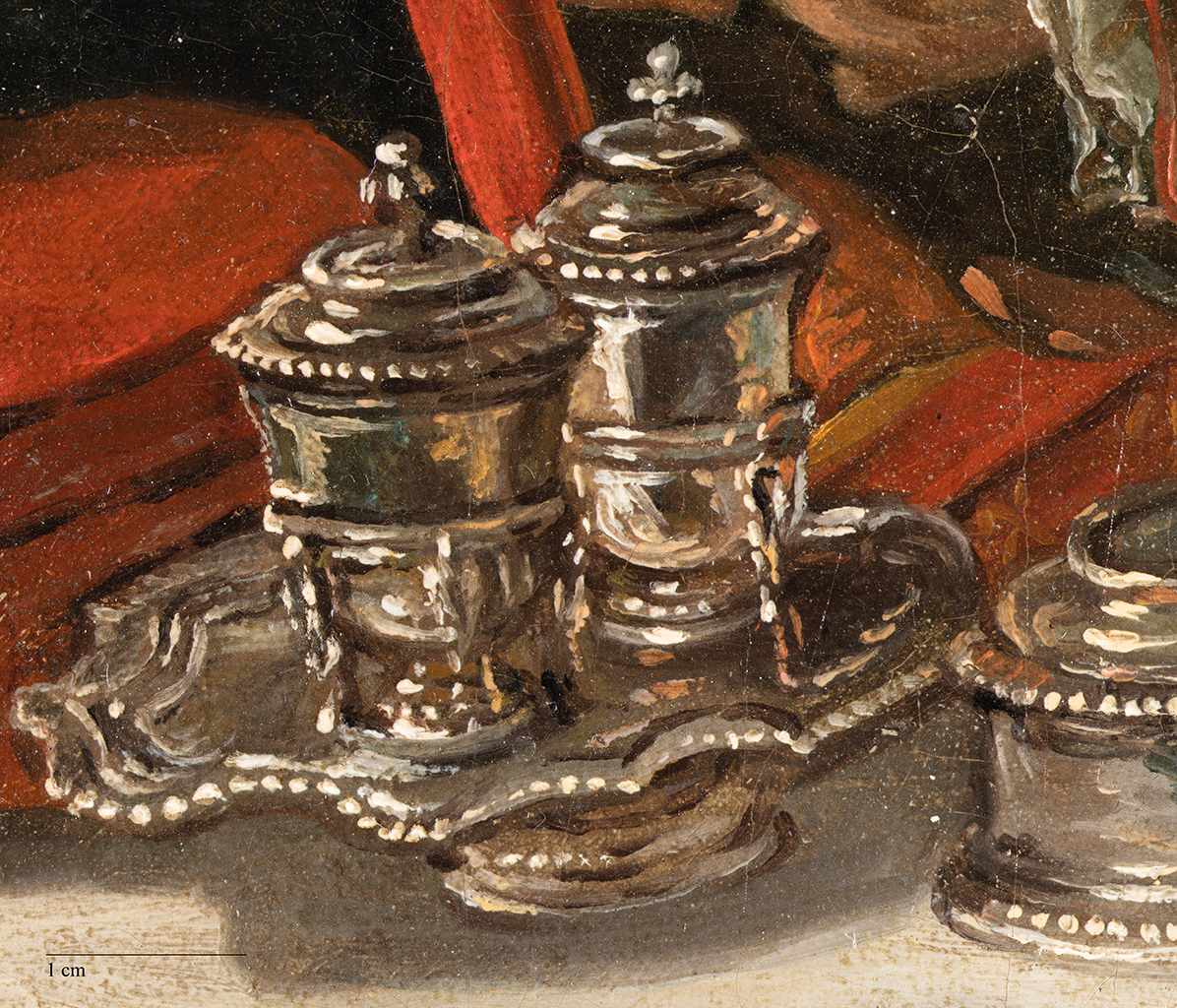
In the execution of the vanity table, the artist underpainting: The first applications of paint that begin to block in color and loosely define the compositional elements. Also called ébauche. the area with a red wash. Thin, scumble: A thin layer of opaque or semi-opaque paint that partially covers and modifies the underlying paint.-like applications of gray and white establish the vertical folds of the tablecloth followed by fine strokes to produce the floral motifs. Paint abrasion has made this red underlayer visibly prominent, disrupting the sense of transparency that the artist had generated in the thin white fabric (Fig. 2). The objects arranged on the vanity were executed rapidly with wet-over-wet handling, while dabs of white paint were applied to suggest reflected light across the metallic surfaces (Fig. 3).
The sequence of execution suggests that the man and maid were painted before the central female figure, whose dress overlaps adjacent forms. Costumes were generally established with a flat base tone, followed by wet-over-wet brushwork to define folds and decorative details. For instance, the aristocratic woman’s red dress consists of a pinkish-orange tone with sketchy horizonal strokes of dark-brown wash to suggest shadows and folds and brighter reddish-orange strokes for highlights. The decorative motif running down the center of the dress was executed with fine dabs of paint. Similarly, the man’s coat consists of a gray wash, lighter highlights, and brown shadows, with the gold embellishments formed through strokes and dabs of ocher, yellow, and white paint. The maid’s apron was rendered with vertical and zigzagging brushstrokes, while her sleeves and dress display a floral pattern with more delicate, finely painted details.
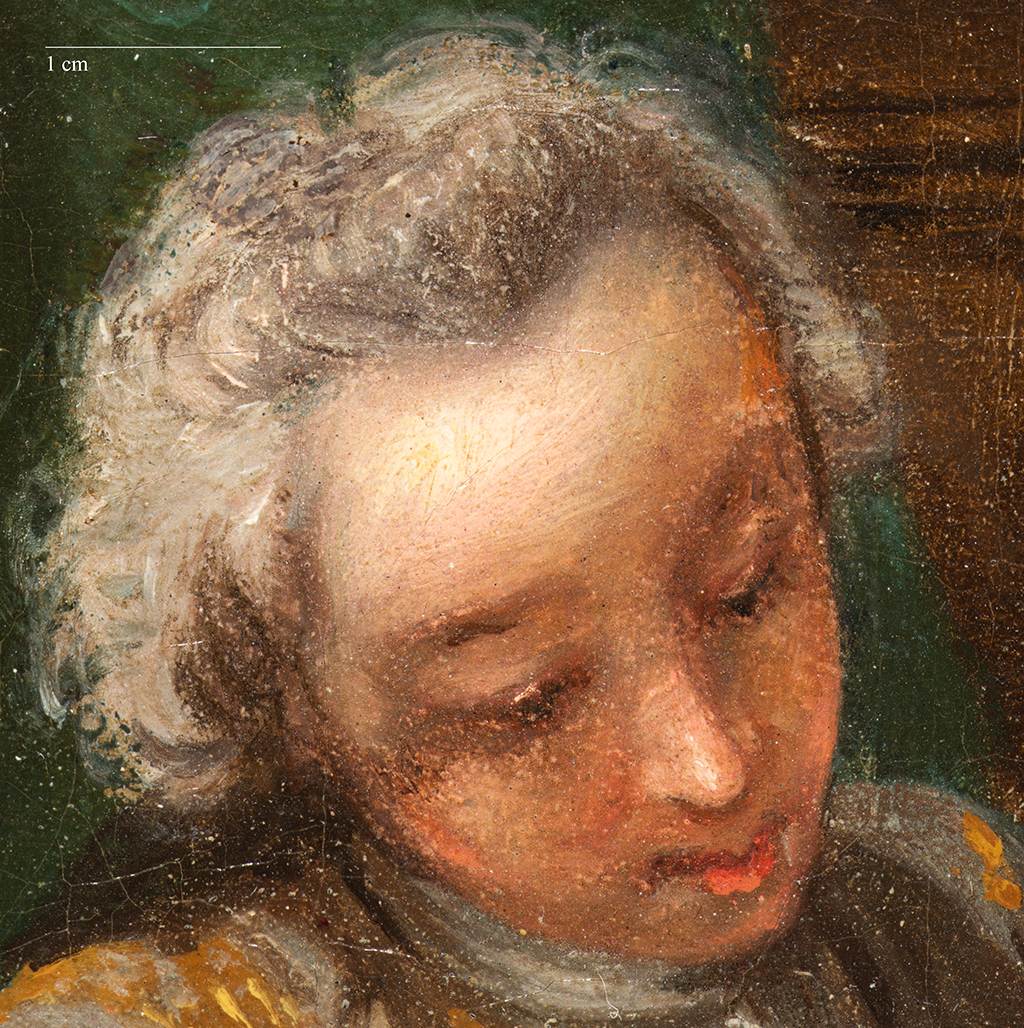
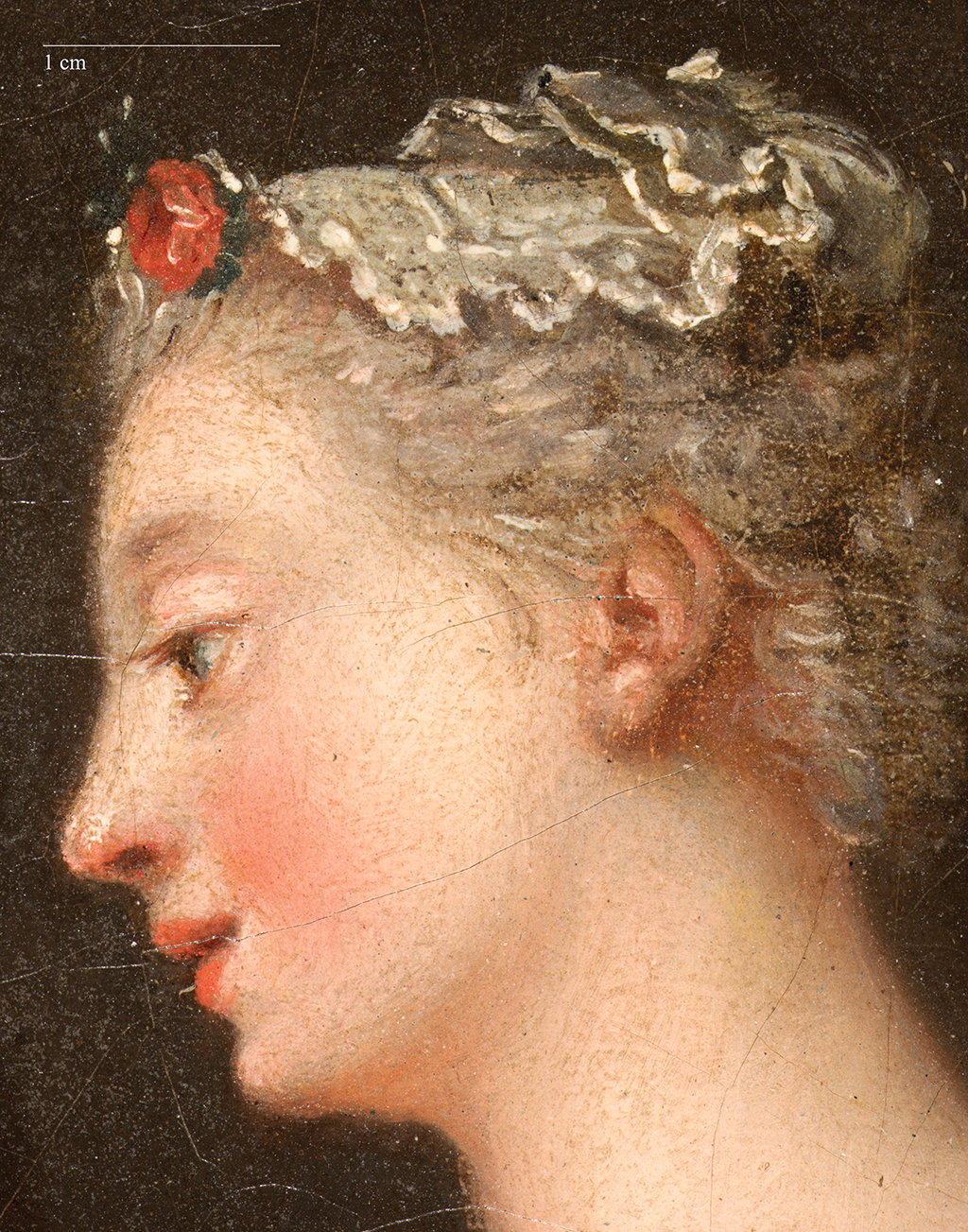
The figures’ faces were constructed with a light pinkish-beige tone, traces of which remain visible beneath abraded brown shadows in the man’s partially shaded face (Fig. 4). Pink tones model rosy complexions, while reddish-brown paint defines warm shadows along the contours of the faces. Pink accents and dark brown linear strokes outline the nose, eyes, lips, and eyebrows (Fig. 5), followed by touches of white, pink, and sometimes yellow for highlights. By comparison, the hands were executed more rapidly, often leaving the ground exposed beneath the streaky applications of pink, beige, and brown.
No pentimento (pl: pentimenti): A change to the composition made by the artist that is visible on the paint surface. Often with time, pentimenti become more visible as the upper layers of paint become more transparent with age. Italian for "repentance" or "a change of mind." or compositional changes are apparent beyond minor adjustments along the contours of individual forms. Christophe Leribault identified that the Nelson-Atkins version differs slightly from the original, including a lack of finish in the parquet floor and the expanded composition along the painting’s edges.3Christophe Leribault, Jean-François de Troy (1679–1752) (Paris: Arthena, 2002), 334. These differences remain evident despite the painting’s dimensions having been slightly enlarged during a previous lining, with approximately 3/5 centimeters of fill and retouching added along the outer edges (Fig. 6).4Bailey, examination report, December 17, 1982, NAMA conservation file, 82-36/2. Leribault further notes a drier paint handling, although this observation may result from the extensive abrasion caused by past cleaning campaigns.5Leribault, Jean-François de Troy (1679–1752), 334.
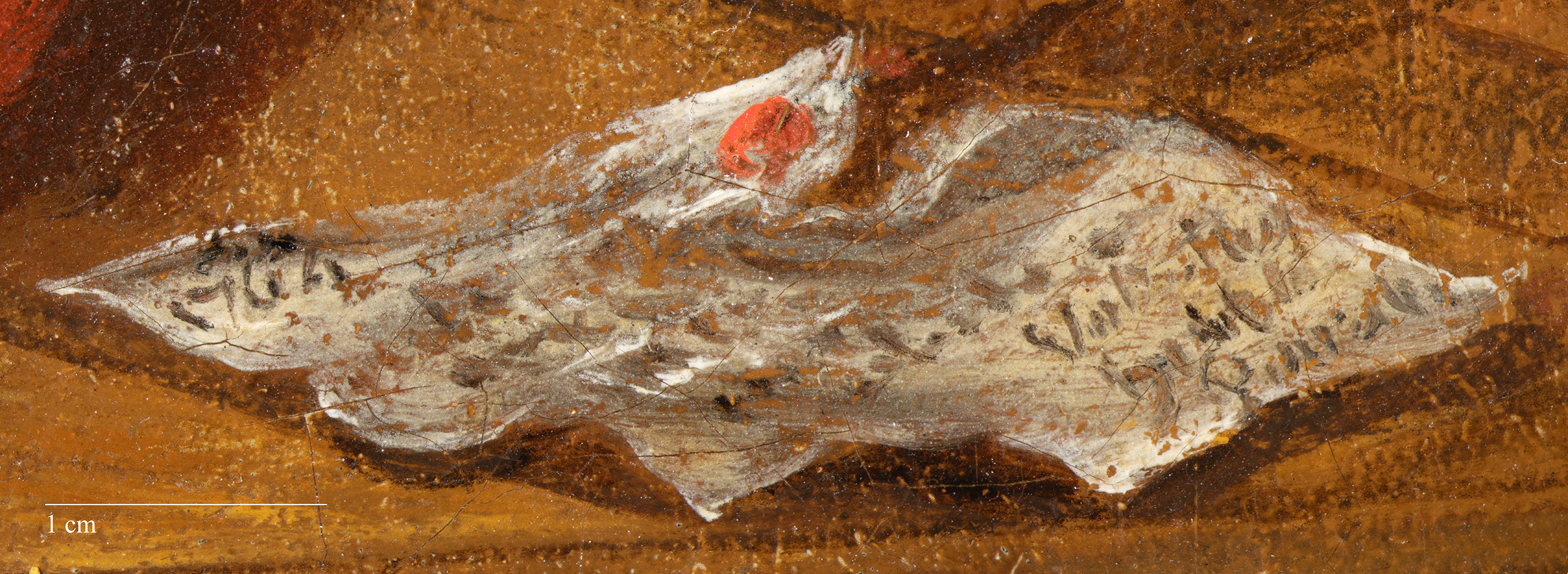
The likely execution date, located on the left side of the crumpled letter on the parquet floor, appears to be “1764” (Fig. 7), which is later than the year of De Troy’s death. The date was painted wet-over-wet into the white paint and appears to be contemporary to the composition. Additional paint strokes on the letter may represent a decorative text or a signature, though the letter is heavily abraded.6In the original pair, A Lady at Her Toilette bears the signature “De Troy” on the letter in the lower right; see the accompanying curatorial entry by Nicole R. Myers. The artist of the Nelson-Atkins paintings may similarly have inscribed their own name in this location. The dated inscription supports the conclusion that the work is a posthumous copy after De Troy, together with the absence of an underdrawing, minimal pentimenti, and smaller dimensions.7See the accompanying curatorial entry by Myers.
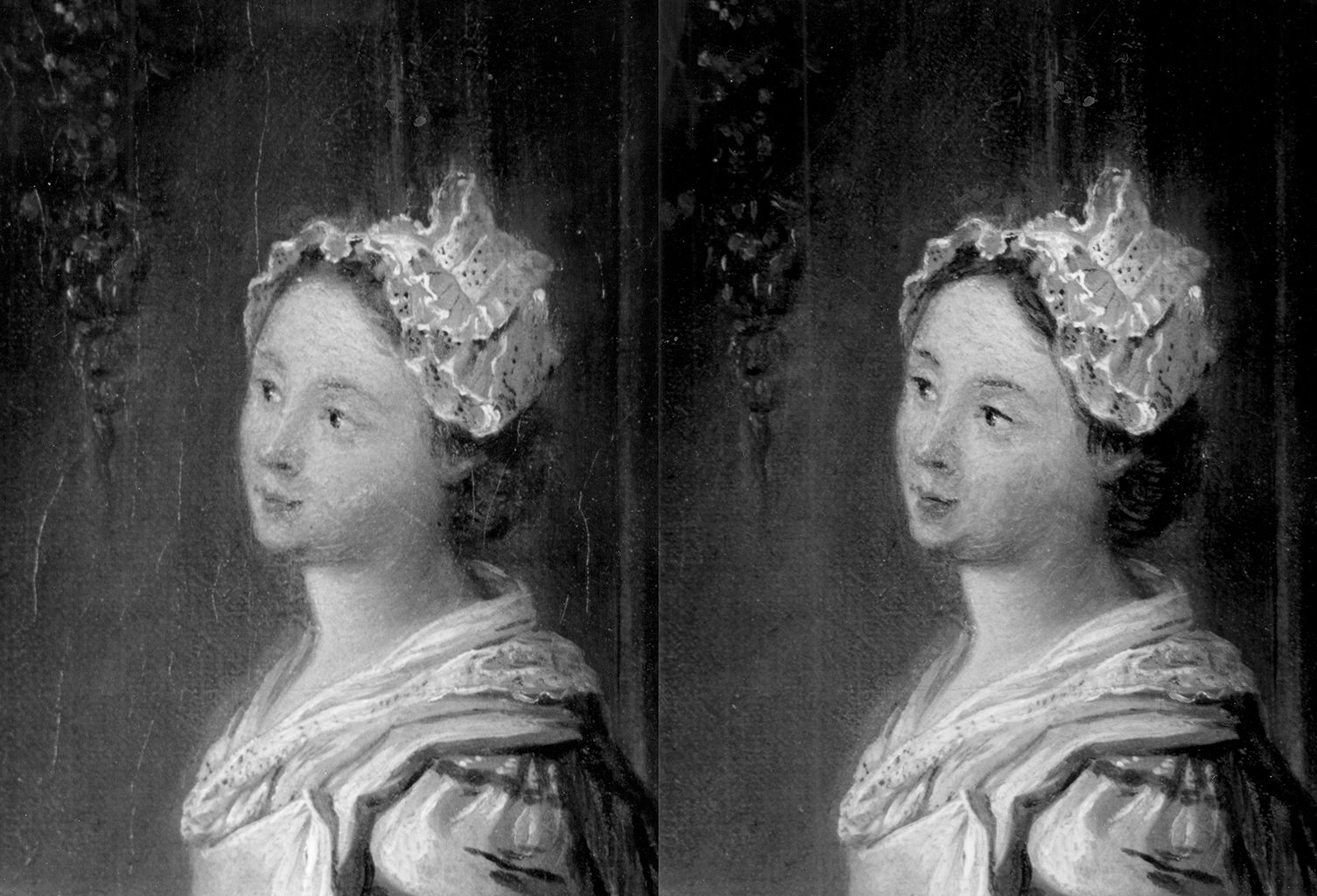
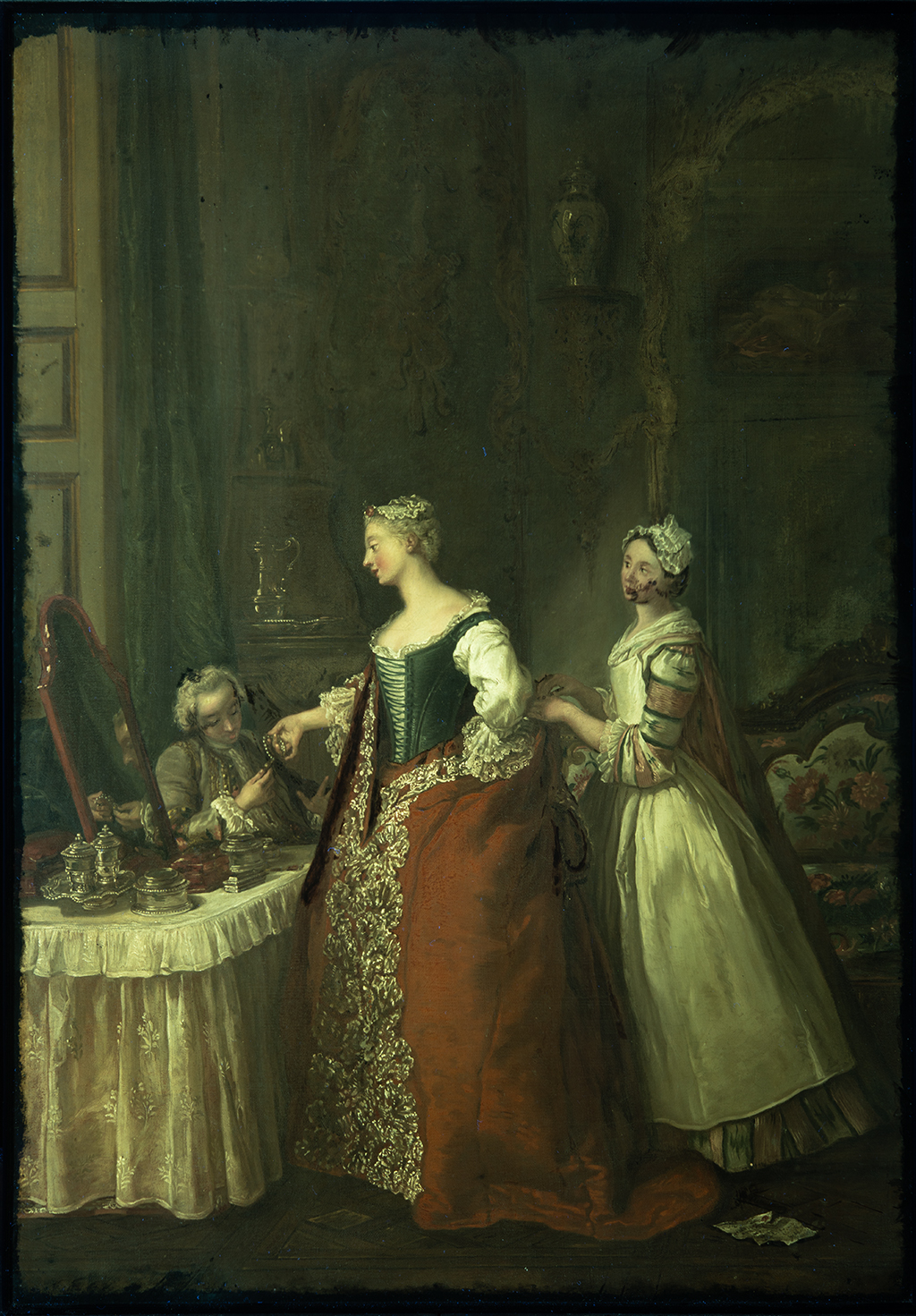
The painting has a similar condition and treatment history as A Lady Attaching a Bow to a Gentleman’s Sword. Prior to its acquisition by the Nelson-Atkins in 1982, the painting was glue-lined and attached to a six-membered stretcher: A wooden structure to which the painting’s canvas is attached. Unlike strainers, stretchers can be expanded slightly at the joints to improve canvas tension and avoid sagging due to humidity changes or aging.. The painting has a network of age cracks: The formation of cracks that occur due to a loss of elasticity in the paint film and priming as these materials age, combined with responses to environmental changes (i.e. expansion and contraction of the support). distributed across its surface, along with horizontal stretcher cracks: Linear cracks or deformations in the painting’s surface that correspond to the inner edges of the underlying stretcher or strainer members. from a previous auxiliary support. In 1983, the painting was cleaned, retouched, and coated with a blend of synthetic varnishes.8Forrest Bailey, treatment report, January 27, 1983, NAMA conservation file, 82-36/2. Conservator Forrest Bailey noted that the delicate, translucent passages had been abraded from previous cleaning campaigns, along with the letter and all three heads (Fig. 8).9Bailey, examination report, December 17, 1982, NAMA conservation file, 82-36/2. The extent of the retouching campaign can be clearly distinguished when the painting is examined with ultraviolet (UV) radiation: A segment of the electromagnetic spectrum, just beyond the sensitivity of the human eye, with wavelengths ranging from 100–400 nanometers. For a description of its use in the study of art objects, see ultraviolet (UV) fluorescence or UV-induced visible fluorescence. (Fig. 9). There remain residues of an old natural-resin varnish trapped in the shallow impasto: A thick application of paint, often creating texture such as peaks and ridges., providing a brownish tint to the white passages, such as in the aristocratic woman’s dress.
Notes
-
Forrest Bailey, examination report, December 17, 1982, NAMA conservation file, 82-36/2.
-
The radiograph is a composite of two film-based radiographs, with black areas representing regions that were not captured. See film-based radiographs, no. 173, 1982, NAMA conservation file, 82-36/2.
-
Christophe Leribault, Jean-François de Troy (1679–1752) (Paris: Arthena, 2002), 334.
-
Bailey, examination report, December 17, 1982, NAMA conservation file, 82-36/2.
-
Leribault, Jean-François de Troy (1679–1752), 334.
-
In the original pair, A Lady at Her Toilette bears the signature “De Troy” on the letter in the lower right; see the accompanying curatorial entry by Nicole R. Myers. The artist of the Nelson-Atkins paintings may similarly have inscribed their own name in this location.
-
See the accompanying curatorial entry by Myers.
-
Forrest Bailey, treatment report, January 27, 1983, NAMA conservation file, 82-36/2.
-
Bailey, examination report, December 17, 1982, NAMA conservation file, 82-36/2.
Documentation
Citation
Chicago:
Glynnis Napier Stevenson, “After Jean François de Troy, A Lady Showing a Bracelet Miniature to Her Suitor, 1764 (?),” documentation in French Paintings and Pastels, 1600–1945: The Collections of the Nelson-Atkins Museum of Art, ed. Aimee Marcereau DeGalan (Kansas City: The Nelson-Atkins Museum of Art, 2024), https://doi.org/10.37764/78973.5.313.4033.
MLA:
Stevenson, Glynnis Napier. “After Jean François de Troy, A Lady Showing a Bracelet Miniature to Her Suitor, 1764 (?),” documentation. French Paintings and Pastels, 1600–1945: The Collections of The Nelson-Atkins Museum of Art, edited by Aimee Marcereau DeGalan, Nelson-Atkins Museum of Art, 2024. doi: 10.37764/78973.5.313.4033.
Provenance
Possible sale, Versailles, ca. 1980 [1];
With Etablissement pour la diffusion et la connaissance des œuvres d’art (“D.C.”), Vaduz, Liechenstein, by August 18–September 14, 1982;
Purchased from Etablissement “D.C.”, through David Carritt Limited, London, by The Nelson-Atkins Museum of Art, Kansas City, MO, 1982.
Notes
[1] Former Nelson-Atkins curator Roger Ward noted in a letter to Jessica Falvo, student at the Institute of Fine Arts, New York University, November 27, 1995, that the painting might have been auctioned at a Versailles sale in 1980. See letter in NAMA curatorial file. Extensive research has not produced any record of the paintings before 1982.
Exhibitions
Genre, The Nelson-Atkins Museum of Art, Kansas City, MO, April 5–May 15, 1983, no. 16B, as by Jean François De Troy, Scenes Gallantes: A Lady Showing a Bracelet Miniature to her Suitor.
A Bountiful Decade: Selected Acquisitions 1977–1987, The Nelson-Atkins Museum of Art, Kansas City, MO, October 14–December 6, 1987, no. 52, as by Jean François de Troy, A Lady Showing a Bracelet Miniature to her Suitor.
References
Roger Ward, “New at the Nelson: Two Detroy [sic] Paintings Added to Collection,” Calendar of Events (The Nelson-Atkins Museum of Art) (April 1983): 2, (repro.), as by Jean François Detroy [sic], A Lady Showing a Bracelet Miniature to her Suitor.
Donald Hoffmann, “Art journal: This preservation exhibit is better late,” Kansas City Star 103, no. 292 (August 28, 1983): 8E.
Ross E. Taggart and Laurence Sickman, Genre, exh. cat. (Kansas City, MO: Nelson-Atkins Museum of Art, 1983), 12, as by Jean François Detroy [sic], Scenes Gallantes: A Lady Showing a Bracelet Miniature to her Suitor.
New Criterion 3 (1984): 86, as by Jean François De Troy, A Lady Showing a Bracelet Miniature to her Suitor.
“Principales acquisitions des musées en 1983,” La Chronique des Arts: supplément à la Gazette des Beaux-Arts 103, no. 1382 (March 1984): S27, as by J. F. de Troy, Jeune femme montrant un bracelet miniature à son suivant.
Peter Thornton, Authentic Decor: The Domestic Interior 1620–1920 (London: Weidenfeld and Nicolson, 1984), 108–09, (repro.), as by Jean François de Troy, At the dressing-table, France.
Elise Goodman-Soellner, “Boucher’s Madame de Pompadour at Her Toilette,” Simiolus 17, no. 1 (1987): 55–57, (repro.), as by Jean François de Troy, A young woman showing a bracelet miniature to her suitor.
Roger Ward, ed., A Bountiful Decade: Selected Acquisitions, 1977–1987, exh. cat. (Kansas City, MO: Nelson-Atkins Museum of Art, 1987), 124–25, (repro.), as by Jean François de Troy, A Lady Showing a Bracelet Miniature to her Suitor.
Jean-Luc Bordeaux, “Jean François de Troy, Still an Enigma: Some Observations on His Early Works,” Artibus et Historiae 10, no. 20 (1989): 169n28, as by Jean François de Troy, The Bracelet.
Alison J. Carter, Underwear: The Fashion History (London: B. T. Batsford, 1992), 27, (repro.), as by Jean François de Troy, At the Dressing Table.
Henrietta Spencer-Churchill, Classic Fabrics (London: Collins and Brown, 1996), 21, (repro.), as by Jean François de Troy.
Patricia Wardle and I. C. Grunnill, “Een toilet kleed met kant: Kanttekeningen bij de textilia voor de toilettafel in de late zeventiende en achttiende eeuw,” Bulletin van het Rijksmuseum 44, no. 1 (1996): 28, 35n10, as by Jean François de Troy.
Klaus G. Beuckers and Annemarie Jaeggi, eds., Festschrift für Johannes Langner zum 65. Geburtstag am 1. Februar 1997 (Munich: Lit, 1997), 146–48, 156n41, 160–61, (repro.), as by Jean François de Troy, Une dame qui donne don portrait à un jeune homme.
Richard Rand, Intimate Encounters: Love and Domesticity in Eighteenth-Century France, exh. cat. (Hanover, NH: Hood Museum of Art, Dartmouth College, 1997), 108n2, as by Jean François de Troy.
Jan Walgrave, Het Labo van de Verleiding: Geschiedenis van de Make-up / The Laboratory of Seduction: History of Make-Up, exh. cat. (Antwerp: Koningin Fabiolazaal, 1998), 158, 179, (repro.), as by Jean François de Troy, Dame en haar bezoeker.
Important mobilier, important orfèvrerie (Monte-Carlo, Monaco: Sotheby’s, December 11, 1999), 28–29, (repro.), as by Jean François de Troy, Femme à sa toilette.
Melissa Hyde, “The ‘Makeup’ of the Marquise: Boucher’s Portrait of Pompadour at Her Toilette,” Art Bulletin 82, no. 3 (September 2000): 466, 470, (repro.), as by François de Troy, A Lady Showing a Miniature Bracelet to Her Suitor.
Valerie Steele, The Corset: A Cultural History (New Haven: Yale University, 2001), 18–19, (repro.), as by Jean François Detroy [sic], A Lady Showing a Bracelet Miniature to Her Suitor.
Monique Crick, “Regard sur la céramique chinoise dans quelques peintures françaises des XVIIème et XVIIIème siècles,” Cahiers de la Compagnie des Indes, no. 7/8 (2002–2003): 40, 42, (repro.), as A la table de toilette.
Christophe Léribault, Jean-François de Troy (1679–1752) (Paris: Arthena, 2002), no. P. 221 b, p. 334, (repro.), as Dame à sa toilette recevant un cavalier.
Colin B. Bailey, Philip Conisbee, and Thomas W. Gaehtgens, The Age of Watteau, Chardin, and Fragonard: Masterpieces of French Genre Painting, exh. cat. (New Haven: Yale University, 2003), 39n243.
Denise Amy Baxter, “Fashions of Sociability in Jean François de Troy’s Tableaux de Mode, 1725–1738” (PhD diss., University of California, Santa Barbara, 2003), 267–68, as by Jean François de Troy, Dame à sa toilette recevant un cavalier.
Watteau et la fête galante, exh. cat. (Paris: Éditions de la Réunion des Musées Nationaux, 2004), 35, (repro.), as by Jean François de Troy, Dame à sa toilette recevant un cavalier.
Yves Carlier, “Details of the Toilet Service of the Duchesse de Cadaval,” Bulletin of the Detroit Institute of Arts 78, no. 1/2 (2004): 5, 7, (repro.), as by Jean François de Troy, A Lady Showing a Bracelet Miniature to Her Suitor.
Melissa Hyde, Making Up the Rococo: François Boucher and His Critics (Los Angeles: Getty Research Institute, 2006), 120–21, (repro.), as by Jean François de Troy, A Lady Showing a Bracelet Miniature to Her Suitor.
Alden Cavanaugh, ed., Performing the “Everyday”: The Culture of Genre in The Eighteenth Century (Newark: University of Delaware, 2007), 28, 31, 34, 40, 43n16, (repro.), as by Jean François de Troy, Lady at Her Toilette Receiving a Gentleman.
Kristel Smentek, Rococo Exotic: French Mounted Porcelains and the Allure of the East, exh. cat. (New York: Frick Collection, 2007), 33n21, as by Jean François de Troy, At the Toilette.
Denise Amy Baxter, “Parvenu or honnête homme: The Collecting Practices of Germain-Louis de Chauvelin,” Journal of the History of Collections 20, no. 2 (2008): 280, (repro.), as by Jean François de Troy, Lady at Her Toilette Receiving a Gentleman.
Monika Kopplin, European Lacquer: Selected Works from the Museum Für Lackkunst Münster (Munich: Hirmer, 2010), 110, 113, (repro.), as by Jean François de Troy, Dame à sa toilette reçevant un cavalier.
Charissa Bremer-David, ed., Paris: Life and Luxury in the Eighteenth Century, exh. cat. (Los Angeles: J. Paul Getty Museum, 2011), 56–59, 68, (repro.), as by Jean François de Troy, A Lady Showing a Bracelet to her Suitor.
Paula Phipps, Mirrors Reflections of Style (New York: W. W. Norton, 2012), 20, (repro.), as by Jean François de Troy, A Lady Showing a Bracelet Miniature to Her Suitor.
Paula Radisich, Pastiche, Fashion, and Galanterie in Chardin’s Genre Subjects: Looking Smart (Newark: University of Delaware Press, 2013), 92, (repro.), as attributed to Jean François de Troy, A Lady Showing a Bracelet Miniature to Her Suitor.
Paul Micio, Les Collections de Monsieur frère de Louis XIV: Orfèvrerie et objets d’art des Orléans sous l’Ancien Régime (Paris: Somogy éditions d’art, 2014), 252–53, (repro.), as Dame à sa toilette recevant un cavalier.
Être et paraître: La vie aristocratique au XVIIIe siècle; Trésors caches du musée national de la Renaissance, exh. cat. (Paris: ArtLys, 2015), 22, 25, (repro.), as La Table de toilette.
Martine Gauvard, Gérard Picaud, and Jean Foisselon, Fils de lin, lumière de l’autre: modes et dentelles à la Visitation (Paris: Somogy Editions d’Art, 2017), 146, (repro.), as by Follower of Jean François de Troy, Une femme montrant son bracelet à son prétendant.
The Exceptional Sale: Le regard d’Elie Top (Paris: Christie’s, November 27, 2019), 59, as attributed to Jean François de Troy, Dame à sa toilette recevant un cavalier.
Margherita Rosina and Enrica Morini, Moda del Settecento a Palazzo Morando: La donazione di Amichæ, exh. cat. (Milan: Cinisello Balsamo, 2020), 74–75, (repro.), as a copy by (?) Jean François de Troy, Dama che mostra una miniatura del braccialetto al suo corteggiatore.
Janet Arnold et al., Patterns of Fashion 6: The Content, Cut, Construction, and Context of European Women’s Dress ca. 1695–1795, ed. Jenny Tiramani (London: School of Historical Dress, 2021), 26, (repro.), as after J.-F. de Troy, A Lady and Her Suitor.
Maroma Camilleri and Maverick Spiteri, eds., Power, Costume, and Scenography: Making Fashion a Statement in 18th and 19th Century Malta; Proceedings of the Public Lectures Series 2019–2020 held at the National Library of Malta, Valletta (Valletta: Malta Libraries, 2022), 17–18, 20, (repro.), as by Unknown artist, after Jean François de Troy, A Lady Showing a Bracelet Miniature to Her Suitor.
Christophe Huchet de Quénetain, Nicolas Besnier (1685/86–1754): architecte, orfèvre du roi, et échevin de la ville de Paris (Rennes: Presses Universitaires de Rennes, 2023).
Sarah Kilby and Clare Murphy, eds., Crown to Couture: The Magazine; Fashion, Style, and Celebrity from the Georgian Court and the Red Carpet (London: Historic Royal Palaces, 2023), 72, (repro.).
Thierry Franz, Paraître. Beauté(s) en Representation XVIIIème–XXIème siècles, exh. cat. (Lunéville, France: Château de Lunéville, forthcoming 2024), 7, (repro.).